
GemTrove
Understand diamond anatomy, including table, crown, girdle, pavilion, culet, facets, depth, spread and how these terms affect beauty.
DIAMOND EDUCATION GUIDE
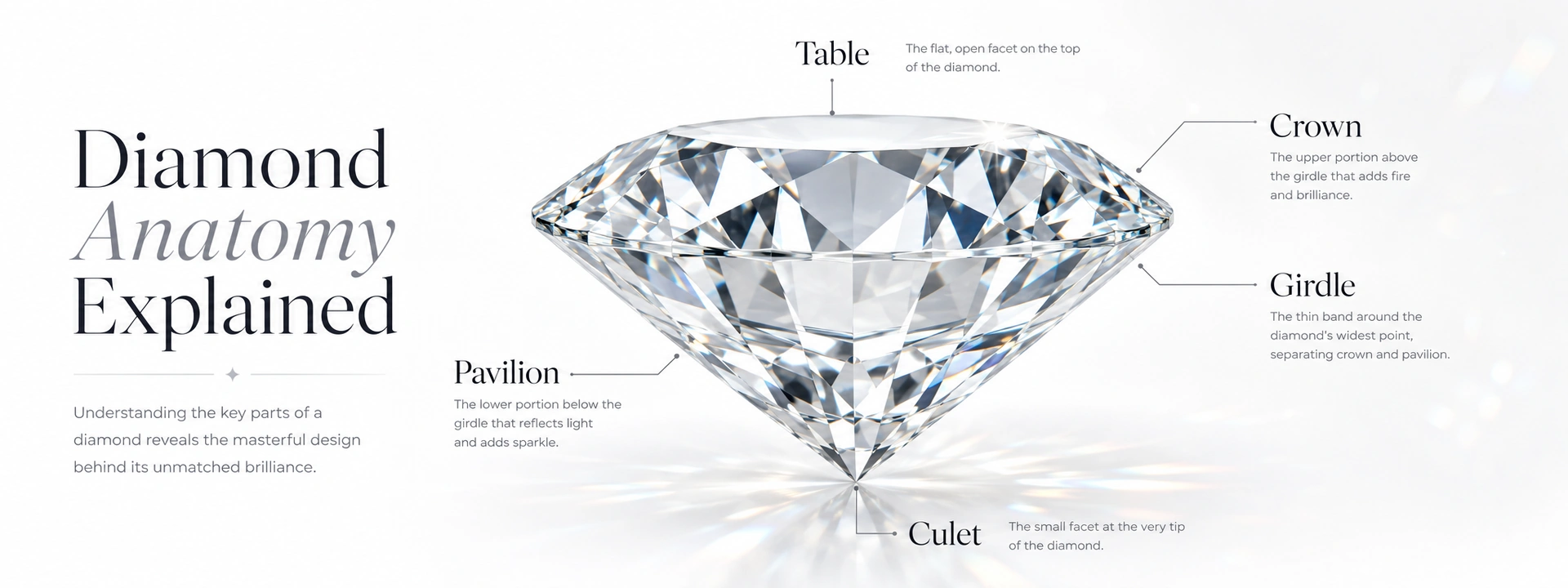
Anatomy of a diamond: table, crown, girdle, pavilion and culet explained
Diamond anatomy describes the visible parts, proportions and facet structure that shape how a diamond looks and performs. Understanding these terms makes it easier to compare cut quality, reports, measurements and overall beauty with confidence.

QUICK ANSWER
What are the main parts of a diamond?
The main parts of a diamond are the table, crown, girdle, pavilion and culet. These elements sit together within the diamond’s full structure and affect how the stone handles light, how it appears from the top and how it is set into jewellery.
Diamond anatomy is closely connected to cut quality. A diamond is not judged by one part in isolation; the relationship between proportions, facet arrangement, symmetry and polish influences the overall visual result.
Table
The large top facet through which light commonly enters and returns.
Crown
The upper section between the girdle and table.
Girdle
The diamond’s perimeter where crown and pavilion meet.
Pavilion
The lower section extending from the girdle to the culet.
Culet
The point or very small facet at the bottom of the diamond.
DIAMOND PARTS EXPLAINED
How each part of a diamond affects its appearance
| Diamond part | Where it sits | Why it matters |
|---|---|---|
| Table | The broad, flat facet at the top of the diamond. | It plays a major role in how light enters and returns through the diamond, and forms part of the proportion assessment. |
| Crown | The upper portion from the girdle to the table. | Crown height and crown angle can influence fire, brightness and the way light returns to the eye. |
| Girdle | The narrow outer edge where crown and pavilion meet. | It forms the setting edge of the diamond and can affect durability, visual spread and apparent size. |
| Pavilion | The lower section from the girdle down toward the culet. | Pavilion depth and angle are critical to light return. If proportions are poorly balanced, light may escape through the side or bottom. |
| Culet | The bottom tip or tiny facet at the end of the pavilion. | It forms the lowest part of the diamond and may be described on a grading report. |
| Facets | The polished surfaces arranged across the crown and pavilion. | Facet layout, polish and symmetry influence contrast patterns, scintillation and overall appearance. |
| Total depth | The diamond’s height from table to culet. | Depth affects how weight is distributed and how large or small a diamond may look face-up. |
| Diameter or width | The across-stone measurement used in proportions and size comparison. | It helps compare visual spread between stones of similar carat weight. |
PROPORTIONS AND LIGHT PERFORMANCE
Why diamond anatomy matters when judging cut quality
Diamond anatomy is not only vocabulary. It helps explain why some diamonds appear lively and bright while others look less energetic. The table, crown, pavilion and girdle must work together with facet precision, symmetry and polish to create attractive light performance.
A diamond that is too shallow may lose light through the pavilion. A diamond that is too deep may carry unnecessary weight and appear smaller from the top. The strongest appearance usually comes from a balanced combination of structural features rather than a single measurement viewed alone.
Light entry and return
The table and crown help manage how light enters and returns, affecting brightness and fire.
Reflection through the pavilion
Pavilion angle and depth strongly influence whether light returns upward or leaks away.
Durability and setting
Girdle thickness and overall structure matter when securing the diamond into jewellery.
TERMS SEEN ON REPORTS
Diamond anatomy words commonly found on grading reports
A diamond report may record several proportion details that relate directly to anatomy. Understanding these terms helps buyers read reports more carefully and compare diamonds beyond carat weight alone.
| Report term | What it refers to | Why buyers should notice it |
|---|---|---|
| Table percentage | The table size in relation to the diamond’s average width or diameter. | It contributes to the diamond’s overall proportion profile. |
| Total depth percentage | The full depth from table to culet relative to width. | It helps explain whether weight is distributed efficiently or hidden in excessive depth. |
| Crown angle / height | The upper portion’s slope and vertical proportion. | These measurements influence light behaviour, fire and face-up appearance. |
| Pavilion angle / depth | The lower section’s slope and depth. | These measurements are important for understanding light return and leakage risk. |
| Girdle thickness | The thickness range of the outer setting edge. | Very thin or overly thick girdles may affect durability or apparent spread. |
| Culet | The bottom point or facet description. | It records whether the culet is pointed or visible to some degree. |
To understand how these details interact with the broader quality framework, read GemTrove’s Diamond 4Cs guide and Diamond Polish and Symmetry guide.
VISUAL SIZE AND PROPORTIONS
How anatomy connects with face-up size and carat weight
Carat weight tells you how much a diamond weighs, but anatomy helps explain how that weight is distributed. Two diamonds of the same carat weight may look different from the top because of differences in total depth, girdle thickness, pavilion build and overall spread.
This is especially useful when comparing round diamonds and fancy shapes. Reviewing measurements, length-to-width ratio, visible spread and proportion balance gives a more complete picture than carat alone.
Carat is weight
A higher carat number does not always mean a larger face-up appearance.
Depth affects spread
Excessive depth may add weight without improving the stone’s visible top size.
Shape changes perception
Oval, pear, marquise and radiant diamonds can appear visually longer or larger depending on their proportions.
Read more in GemTrove’s Diamond Carat Weight guide and Diamond Length-to-Width Ratio guide.
GEMTROVE GUIDANCE
How GemTrove uses diamond anatomy in practical selection
GemTrove helps clients understand diamonds beyond a simple grade line. Established in 2008, the business combines third-generation jewellery experience, professional gemological knowledge and practical custom design advice for natural diamonds, lab-grown diamonds and coloured gemstones.
When reviewing a diamond, GemTrove may consider anatomy, proportions, polish, symmetry, measurements, visual spread, shape behaviour, certification details and how the stone may suit the final jewellery design.
Gemologist-led explanation
Clear guidance on table, crown, girdle, pavilion, culet and proportion terms.
Design suitability
Better understanding of how diamond structure works with settings and custom jewellery designs.
Report interpretation
Support reading diamond reports in a practical, buyer-friendly way rather than focusing on one number alone.
HELPFUL RELATED GEMTROVE GUIDES
Explore connected diamond education pages
These pages help build a stronger understanding of diamond proportions, grading, shapes and buying decisions.
Diamond 4Cs
Understand cut, colour, clarity and carat weight in one clear guide.
Diamond Cut Grade
Learn how proportions, light return and facet precision influence sparkle.
Polish and Symmetry
See how finish and facet alignment affect diamond appearance.
Diamond Carat Weight
Compare weight, visual size, spread and millimetre measurements.
Length-to-Width Ratio
Understand outline balance for fancy shapes and elongated diamonds.
Diamond Shapes
Explore round, oval, emerald, cushion, radiant, pear and more.
Engagement Rings
Browse ring styles that can be custom-made with selected diamonds.
Design Your Own Ring
Begin planning a custom ring around your preferred diamond and setting style.
Contact GemTrove
Speak with GemTrove about diamonds, gemstones or custom jewellery guidance.
FREQUENTLY ASKED QUESTIONS
Diamond anatomy FAQs
What is the anatomy of a diamond?
Diamond anatomy refers to the structure and parts of a polished diamond, including the table, crown, girdle, pavilion, culet, facets and measurable proportions. These features help explain how a diamond looks, how it reflects light and how it is assessed.
What is the table of a diamond?
The table is the broad flat facet at the top of the diamond. It is one of the main windows through which light enters and returns, and it forms an important part of the diamond’s proportion profile.
What is the crown of a diamond?
The crown is the upper portion of the diamond between the girdle and the table. Crown angle and crown height can influence fire, brightness and the diamond’s overall face-up appearance.
What is the girdle of a diamond?
The girdle is the narrow outer edge where the crown and pavilion meet. It forms the widest perimeter of many diamonds and is important for setting security, durability and visual spread.
What is the pavilion of a diamond?
The pavilion is the lower part of a diamond extending from the girdle to the culet. Pavilion depth and angle are important for light return. If proportions are poorly balanced, light may escape instead of returning upward.
What is a culet on a diamond?
The culet is the point or tiny facet at the bottom of the diamond. It may be described on a grading report and forms the lowest part of the pavilion.
Why does diamond anatomy matter when buying a diamond?
It helps buyers understand how proportions, shape, light performance and visual spread connect. Anatomy terms also make diamond reports easier to read and can explain why two diamonds with similar carat weights or grades may look different.
Is diamond anatomy the same as diamond shape?
No. Shape refers to the outline, such as round, oval, emerald or pear. Anatomy refers to structural parts such as table, crown, girdle, pavilion and culet. Cut quality then considers how these elements work together.
How does diamond anatomy affect sparkle?
Sparkle is influenced by how the diamond’s anatomy and facet arrangement manage light. The table, crown and pavilion all play roles, while polish, symmetry and overall proportion balance affect how crisp and lively the diamond appears.
Can GemTrove explain diamond anatomy during a diamond appointment?
Yes. GemTrove can explain diamond anatomy, proportions, grading report terms and how these factors connect with natural or lab-grown diamond selection, custom ring design and overall value.
Understand the diamond before choosing the jewellery
GemTrove helps clients compare diamonds with practical, gemologist-led guidance. Discuss anatomy, proportions, certification, natural or lab-grown options, and the right diamond for your custom jewellery design.
Phone: 0488 878 000
Email: diamonds@gemtrove.com.au
Showroom: Suite 903/125 Swanston St, Melbourne VIC 3000