
- Education
- Diamond Anatomy & Light
- Diamond Light Leakage: What It Is, What Causes It and How to Spot It
Diamond Anatomy & Light
Diamond Light Leakage: What It Is, What Causes It and How to Spot It
Diamond light leakage is the reason two stones with identical colour and clarity grades can look completely different on the hand. Once you know where leaked light shows up and how to read the scope images, you can tell a lively diamond from a dull one before it is set.
 Reviewed by Raj Sood, Graduate Gemologist (GIA), AJP (GIA)Master jeweller and Graduate Gemologist (GIA) · reviewed 4 November 2026
Quick answer
Diamond light leakage is light that enters a diamond and escapes through the pavilion (the lower half) instead of bouncing back up to your eye. It is caused by pavilion angles that are too shallow or too deep, and shows as dull, glassy or dark areas. ASET and Idealscope images reveal it before you buy.
What is diamond light leakage?
Light leakage is light that enters a diamond through the top and escapes out of the bottom or sides instead of returning to your eye. Every diamond leaks some light; what matters is how much and where. A well-cut stone sends most of the light back up through the crown (the upper part, above the girdle) as brightness and sparkle. A poorly proportioned stone lets a share of it fall out through the pavilion (the cone-shaped lower half), and those areas look dull, grey, glassy or see-through. If the names of the parts are new to you, our guide to the parts of a diamond, from table to culet lays them out with a diagram.
Leakage is purely a cut issue. It has nothing to do with the colour or clarity grade, and natural and lab-grown diamonds behave in exactly the same way, because both are the same material with the same optics. It is one of several things that decide how bright a stone looks, alongside contrast, fire and sparkle; our page on how a diamond handles light overall puts leakage in that bigger picture.
In practice, light leakage in diamonds shows up in a handful of recognisable ways:
- Windows: a glassy, see-through patch under the table (the large flat top facet) where you can almost read through the stone.
- Fisheye: a grey or whitish ring just inside the table edge, a reflection of the girdle in a stone that is too shallow.
- Nailhead: a dark centre, like the head of a nail, in a stone that is too deep.
- A fixed bow-tie: a dark band across the middle of an oval, pear or marquise that does not change as the stone moves.
Any of these terms, and the others used below, are also defined in our plain-English jewellery glossary.
Why does light leak out of a diamond?
Diamond has a refractive index (a measure of how much it bends light) of about 2.42, one of the highest of any natural transparent material. That high index gives diamond a small critical angle of about 24.4°. The critical angle is the cut-off point: if light inside the stone meets a facet at more than 24.4° from the perpendicular, it cannot get out and bounces back inside. This is called total internal reflection, and it is the mirror effect a cutter relies on.
The pavilion facets are the mirrors. When the pavilion angle is right, light coming in through the top strikes one side of the pavilion, reflects across to the other side, reflects again and travels back up through the crown. When the angle is wrong, one of those reflections arrives at less than the critical angle, and the light passes straight out of the bottom. That escaped light is the leak, and the part of the stone it came from looks dark or watery from above.
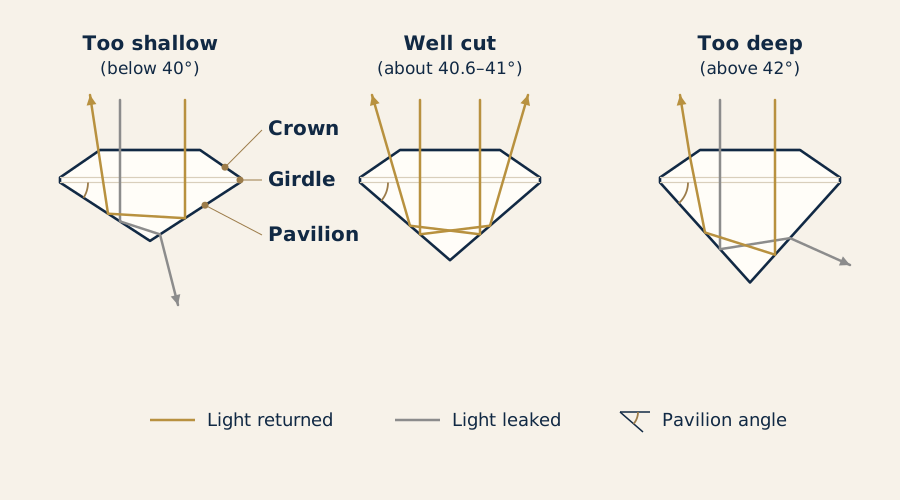
Light that does make it back is what you see as brilliance (white light), fire (flashes of spectral colour) and scintillation (the on-off sparkle as you move). Leakage robs all three. Our explainer on brilliance, fire and scintillation covers how each one works and why a stone can be strong in one and weaker in another.
The crown matters too. The crown angle and the table size decide how light is spread as it leaves the stone, and a steep crown can partly rescue a slightly shallow pavilion. But the pavilion angle is the main lever: get it badly wrong and no crown can make up for it.
What proportions cause light leakage in a round diamond?
For a round brilliant, the pavilion angle (measured from the girdle plane) with the least leakage sits in a narrow band, about 40.6° to 41.0°, paired with a crown angle of about 34° to 35°. Small departures are fine; bigger ones show. The depth percentage on a report (total depth divided by average width) is a rough stand-in for the pavilion angle, but it also includes the crown height and girdle thickness, so always look at the angles if they are listed.
| Pavilion angle | Typical total depth | What you see |
|---|---|---|
| Below 40.0° | Often below about 58% | Fisheye risk: grey ring under the table edge, glassy windows |
| 40.0–40.5° | About 58–59.5% | Bright but some edge leakage, a little less contrast |
| 40.6–41.0° | About 59.5–62% | Least leakage, strong, even light return |
| 41.2–41.8° | About 62–63% | Darker areas under the table edge; still acceptable with a matching crown |
| Above 42.0° | Often above about 63.5% | Nailhead risk: dark centre, light escaping through the opposite pavilion |
These depth figures assume a medium girdle and a crown of about 34–35°, so treat them as a guide, not a rule. A stone with a thick girdle can read deep on the report while its pavilion is fine, and a thin crown can make a slightly deep pavilion look shallow on paper. Our guide to how table and depth percentages work explains how to read the two together.
Why do shallow stones exist at all? A shallower cut spreads the weight across the top, so a 1.00 carat stone can measure 6.6 mm or more across instead of about 6.4–6.5 mm. That extra width looks appealing on paper, but past a point it is bought at the cost of leakage. Our page on spread and face-up size shows where that trade-off starts to hurt.
What do fisheye and nailhead look like in a diamond?
A fisheye is the classic sign of a pavilion that is too shallow. Light entering near the edge of the table travels down, reflects off the girdle region and comes back up as a faint grey or white ring just inside the table, like the pale outline of a fish's eye. It is easiest to see against a plain light background and looking straight down. Mild fisheyes can be hard to spot in a photo but obvious in daylight. We go into the causes and the warning numbers in the fisheye effect in detail.
A nailhead is the opposite fault. In a pavilion that is too steep, light hits the pavilion at angles that let it escape through the far side, so the centre of the stone goes dark, sometimes almost black, while the outer edge stays bright. Deep stones also face up smaller for their weight, so you pay twice: less sparkle and less size. Our guide on why deep diamonds develop a nailhead shows examples at different depths.
| Fisheye | Nailhead | |
|---|---|---|
| Cause | Pavilion too shallow | Pavilion too deep |
| Where it shows | Grey or white ring inside the table edge | Dark centre under the table |
| Face-up size | Looks larger for its weight | Looks smaller for its weight |
| Easiest to see | Light background, looking straight down | Normal room light, any background |
| Typical round depth | Below about 57–58% | Above about 64% |
Not sure which one is right?
Send us the stones you are looking at and our gemologist will tell you which to choose and why.
Is light leakage the same as extinction or a bow-tie?
Not quite, and this is where most guides go wrong. Extinction means any area of a diamond that looks dark face-up. Some extinction is good: your own head and body block light from above, and a well-cut stone turns that shadow into a crisp pattern of dark and bright facets. That pattern is contrast, and without it a diamond looks flat and milky. Other extinction is bad: it comes from leakage, where the stone shows you whatever is behind or below it, usually a dark surface, so the area looks dead.
The way to tell them apart is to watch the dark areas as the stone moves. Contrast from obstruction shifts, flickers and stays in a balanced pattern. Leakage tends to sit in the same place, looks grey or see-through rather than black, and changes with the background more than with the angle. A dark patch that turns pale when you hold a white card under the stone is leakage.
The bow-tie in ovals, pears, marquises and elongated hearts is a mix of both. Across the narrow width of these shapes the pavilion angles change, and in that band light is either blocked by your head or escapes through the pavilion. A faint bow-tie that comes and goes is normal. A wide one that stays dark is usually leakage. Whether facets line up evenly also affects how patchy leakage looks, which is the difference covered in optical symmetry versus the symmetry grade.
One more look-alike: a diamond can look grey or soft because of the material itself, from tiny clouds or strain, rather than the cut. That is a transparency problem, not leakage, and no change of angle will fix it. See haziness and transparency problems for how to tell the difference.
Does diamond light leakage differ by shape?
Yes. The round brilliant was refined over a century for maximum light return, so it leaks the least when cut well; our page on how the modern round brilliant grew out of the Old European cut traces that history. Fancy shapes have changing angles around their outline, and some leakage at the ends or corners is part of their character. The question is whether it is minor and moving or large and fixed. For a side-by-side look at the outlines themselves, start with our overview of every diamond shape.
| Shape | Typical total depth | Where leakage usually shows |
|---|---|---|
| Round brilliant | About 59–62.5% | Under the table edge if shallow, centre if deep |
| Oval | About 58–63% | Bow-tie across the centre, sometimes the ends |
| Pear | About 58–64% | Bow-tie, and near the point |
| Marquise | About 58–63% | Bow-tie and both points |
| Heart | About 56–62% | Bow-tie across the belly, the lobes |
| Princess | About 68–75% | Corners, and windows under the table if shallow |
| Cushion | About 61–68% | Windows in the centre if shallow |
| Radiant | About 61–67% | Corners; bow-tie in elongated versions |
| Emerald and Asscher | About 61–68% | Windows through the step facets, dark ends |
Step cuts such as the emerald have long, flat facets and fewer of them, so leakage looks like a clear window rather than a grey patch. Some window is expected and is part of the 'hall of mirrors' look; a centre you can read print through is too much. Princess and radiant cuts are deep by design, so their depth percentages look alarming next to a round's but are normal for the shape. Our guide to light performance across shapes compares how much brightness each shape typically returns.
Shallow fancy shapes are popular because they look large for their weight. A shallow oval can face up noticeably bigger than a deeper one of the same carat, but if that comes with a wide, fixed bow-tie the extra size rarely feels worth it on the hand. Our page on why shallow stones look bigger gives typical millimetre figures by shape, and our guides to choosing an oval diamond and the heart shaped diamond, lobes to point show how the bow-tie plays out in each.
How do ASET and Idealscope images show light leakage?
Two simple viewers make leakage visible. The Idealscope is a tube with a red reflector: areas that return light glow red, areas where light leaks through show white or pale pink, and black areas show where your head blocks light (contrast). The ASET (Angular Spectrum Evaluation Tool, developed by the American Gem Society) adds more detail by colour-coding the angle the light comes from.
| Colour | Idealscope | ASET |
|---|---|---|
| Red | Light return | Brightest light, from high angles overhead |
| Green | Not used | Light from lower angles, less intense |
| Blue | Not used | Contrast: light blocked by the viewer's head |
| Black | Contrast from obstruction | Can also appear in leaked or obstructed areas |
| White or very pale | Light leakage | Light leakage |
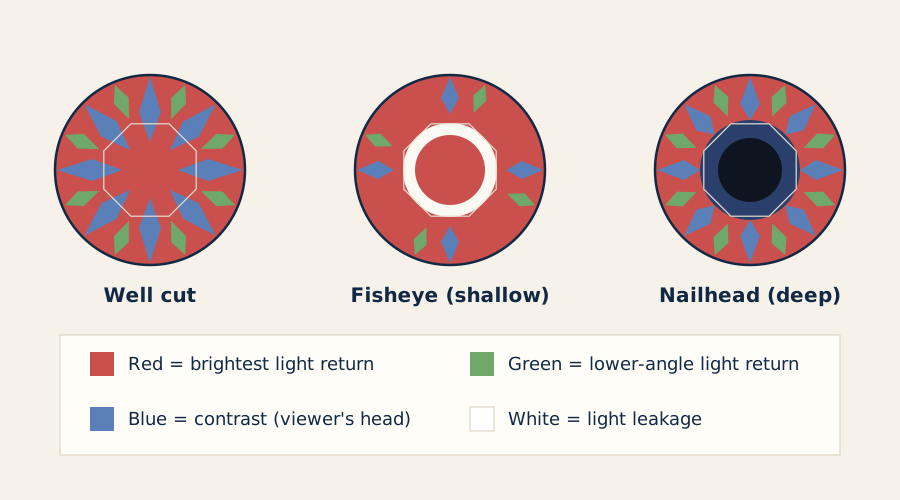
What you want in a round is mostly red, with an even pattern of blue and green and almost no white. A fisheye shows up as a pale ring inside the table edge; a heavily leaky fancy shape shows white across the bow-tie or the ends. Patterns that are lopsided, with more red on one side than the other, point to uneven facets, which is also what a hearts and arrows viewer checks; see hearts and arrows optical symmetry for that test.
Scope images do not replace your eyes. They are taken under controlled conditions and exaggerate small differences, so a little white at the edge of a fancy shape is not a reason to walk away. Use them to compare stones side by side and to rule out the clearly leaky ones. We can photograph stones through an ASET or Idealscope on request, so you can compare them before deciding.
Do grading reports tell you about light leakage?
Only indirectly. GIA gives an overall cut grade (Excellent to Poor) for standard round brilliants, and that grade is built from proportions, so a round graded Excellent should not have a serious fisheye or nailhead. It does not show you where light leaks. For fancy shapes, GIA gives no overall cut grade at all, only polish and symmetry, which say nothing about leakage. That leaves the numbers on the report, which you can check against the tables above using our guide to the table and depth figures on the report.
Some laboratories go further. GCAL, for example, issues reports with light performance data such as brightness measurements and scope-style images, plus an optical symmetry check. Our page on reports that include ASET and light return scans explains what those measurements mean and how far to rely on them.
Natural and laboratory-grown diamonds leak light in exactly the same way, because a lab-grown diamond is real diamond with the same refractive index and critical angle. What differs is how each stone was cut. Cutters sometimes favour weight retention or spread over light return in either type, so check the angles and a scope image whichever you are considering. Lab-grown diamonds cost much less than natural ones of similar grades, which can leave room to choose a better-cut stone within the same budget.
Browse natural and lab-grown diamonds
How do you check a diamond for light leakage? Step by step
- Read the report first. Note the depth, table, crown angle and pavilion angle if listed, and whether the stone is natural or lab-grown.
- Check the pavilion angle. For a round, aim for about 40.6–41.0°; be cautious below 40° (fisheye) or above 42° (nailhead).
- Compare depth with the shape's normal range. Use the shape table above, not round figures, for fancy cuts.
- Look at an ASET or Idealscope image. Mostly red with even blue and green is the goal; note any white areas and where they sit.
- Watch a 360° video or the stone itself. Dark areas that move are contrast; grey or glassy areas that stay put are leakage.
- Do the white card test. Hold a white card under the stone; patches that brighten are showing you the background, which means leakage.
- Judge it on the hand. A small, moving bow-tie or a slightly pale corner in a fancy shape is normal; a fixed dark centre or a grey ring is not.
If you want to understand why those angles matter, our guide to crown and pavilion angles and how they are measured is a good companion to this checklist.
Free consultation
Talk to a gemologist
Compare stones in person or online with Raj Sood, Graduate Gemologist (GIA), AJP (GIA).
Book a consultationShop this shape
FAQ
Common questions
What is light leakage in a diamond?
It is light that enters the diamond and escapes through the pavilion instead of reflecting back up to your eye. The leaking areas look dull, grey, glassy or dark, and the cause is almost always a pavilion angle that is too shallow or too deep.
Can you see light leakage with the naked eye?
Serious leakage, such as a fisheye ring or a nailhead, is visible to the naked eye, especially side by side with a well-cut stone. Milder leakage is easier to spot with an ASET or Idealscope image.
Do lab-grown diamonds leak more light than natural diamonds?
No. Lab-grown and natural diamonds have the same refractive index, so they handle light the same way. Leakage depends only on how each individual stone is cut.
Is a bow-tie the same as light leakage?
Partly. A bow-tie is a mix of shadow from your head and light escaping through the pavilion. A faint bow-tie that moves is normal in ovals, pears and marquises; a wide one that stays dark usually means leakage.
Does an Excellent cut grade mean no light leakage?
For a round brilliant graded by GIA, an Excellent cut grade means the proportions should not cause serious leakage, though some Excellent stones still perform better than others. Fancy shapes have no overall GIA cut grade, so you need to check the proportions and a scope image.
Can light leakage be fixed?
Sometimes, by recutting the pavilion to a better angle, but this loses weight and is rarely worthwhile on smaller stones. It is usually simpler to choose a stone without significant leakage in the first place.

Ask a gemologist
Not sure which diamond to choose?
Raj Sood is a Graduate Gemologist (GIA) and master jeweller. Bring the stones you are considering, or send the reports, and he will tell you honestly which one is better and why.
Keep learning
Related guides
 Diamond Anatomy & LightDiamond Light Performance Guide
 Diamond Anatomy & LightFisheye Effect in Diamonds
 Diamond Anatomy & LightNailhead Effect in Diamonds
 Certificates & ValuationsGCAL and Light Performance ReportsDiamond Anatomy & LightAnatomy of a diamond: table, crown, girdle, pavilion and culet explainedDiamond Anatomy & LightDiamond Fire, Brilliance & Scintillation ExplainedDiamond Anatomy & LightDiamond Spread and Face Up Size GuideDiamond Anatomy & LightDiamond Table and Depth Explained
Explore more
More guides on this topic
Education