
- Education
- Diamond Anatomy & Light
- Diamond Light Performance Explained: Brilliance, Leakage, ASET and Angles
Diamond Anatomy & Light
Diamond Light Performance Explained: Brilliance, Leakage, ASET and Angles
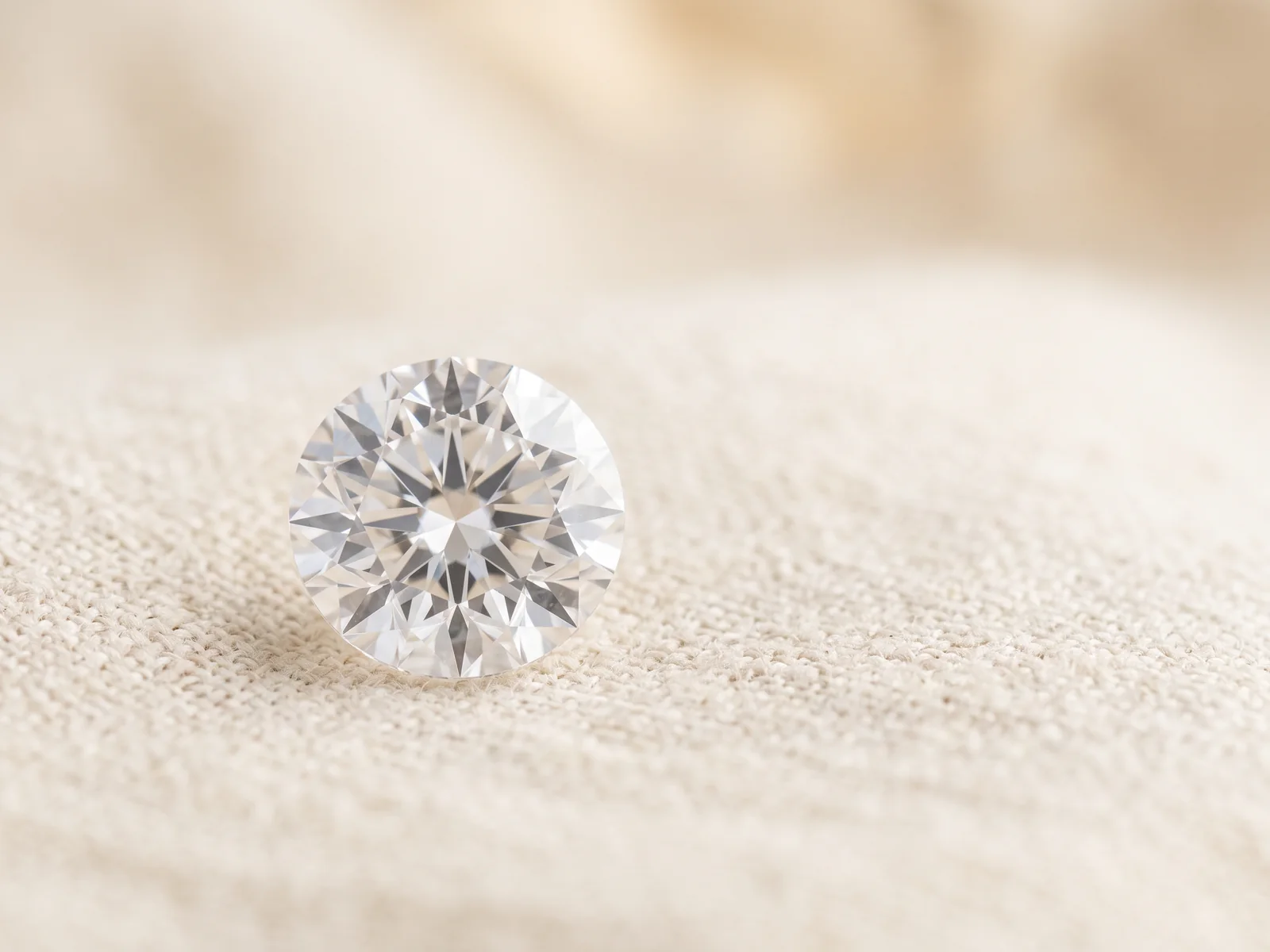
Two diamonds with identical grades can look completely different on the hand, and light performance is usually why. Here is how light moves through a cut diamond, what goes wrong, and how to check it yourself.
 Reviewed by Raj Sood, Graduate Gemologist (GIA), AJP (GIA)Master jeweller and Graduate Gemologist (GIA) · reviewed 4 November 2026
Quick answer
Diamond light performance explained simply: it is how well a cut diamond gathers light and sends it back to your eye as brightness (brilliance), coloured flashes (fire), sparkle (scintillation) and crisp contrast. It depends mainly on the crown and pavilion angles. Poor angles cause leakage, nailhead and fisheye effects, which ASET and Idealscope images reveal.
Diamond light performance explained: what is it?
Light performance describes what a cut diamond does with the light that reaches it. Light enters through the top, bounces off the angled facets underneath and, in a well-cut stone, comes back out through the top towards your eye. In a poorly cut stone, some of that light escapes out the back or sides instead. That escaping light is called leakage, and it is the main reason a diamond can look glassy, grey or dull even when its colour and clarity grades are excellent.
Light performance is not a single grade on most reports. It is the combined result of the diamond's proportions (the angles and percentages of each part), how precisely the facets are aligned and how the stone is polished. If the parts of a diamond are new to you, our guide to the table, crown, girdle, pavilion and culet is a good starting point, and any unfamiliar word is in the GemTrove jewellery glossary.
The same physics applies to every diamond, natural or laboratory-grown, round or fancy shaped. What changes from shape to shape is how forgiving the outline is and which faults show up most.
How does light travel through a diamond?
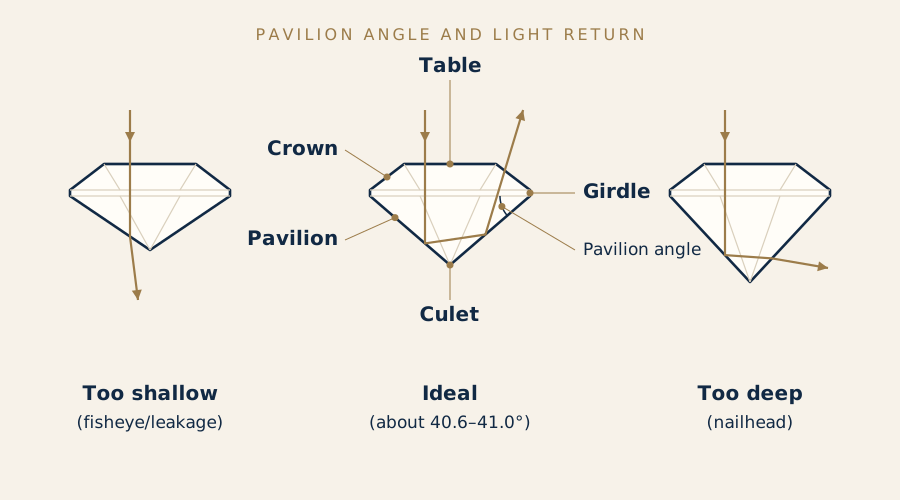
Diamond has a refractive index (a measure of how strongly a material bends light) of about 2.42, one of the highest of any natural transparent material. Glass is about 1.5. That high figure gives diamond a small critical angle of about 24.4°. Any light striking an inside surface at more than 24.4° from straight on is reflected back inside rather than passing out. This is called total internal reflection, and it is what a cutter uses to turn the pavilion (the lower cone) into a set of mirrors.
For this to work, the pavilion facets have to sit at the right angle. In a round brilliant, light should hit one side of the pavilion, reflect across to the other side, and then rise up through the crown. If the pavilion is too shallow, light meets the first facet at too steep an angle and passes straight out the bottom. If it is too deep, light reflects once but then hits the second facet at too steep an angle and escapes out the side. Our guide to how crown and pavilion angles work together shows the geometry in more detail.
The crown (the upper part) matters too. Its angled facets bend light as it leaves the stone and split white light into spectral colours. Diamond's dispersion (how much it spreads light into colours) is about 0.044, well above most gems, which is why a good crown produces strong fire. At the very bottom, a large or open culet, the tiny facet at the pavilion tip can show as a small dark or see-through dot when you look down through the table.
What are brilliance, fire, scintillation and contrast?
Gemmologists break light performance into four visible effects. A diamond needs all four in balance; maximising one usually costs another.
- Brilliance: the total white light returned to your eye. It makes the stone look bright rather than grey.
- Fire: flashes of spectral colour, mostly from the crown. Most visible under spotlights and in candlelight.
- Scintillation: the on-off sparkle as the diamond, the light or your eye moves. It depends on the size and number of facets.
- Contrast: the pattern of dark areas, mostly reflections of your own head and body. Some contrast is essential; without it, sparkle has nothing to flash against.
A useful way to think about it: brilliance is the volume, fire is the colour, scintillation is the movement and contrast is the shadow that makes the rest visible. Our page on the difference between fire, brilliance and scintillation goes deeper into each one and how cutters trade them off.
What are nailhead, fisheye, windowing and extinction in a diamond?
Most light performance problems have names. Each one points to a specific proportion fault, which makes them easy to look for once you know them.
| Fault | What you see | Usual cause | Where it shows most |
|---|---|---|---|
| Nailhead | Dark centre under the table, like the head of a nail | Pavilion too deep (round pavilion above about 42°, depth above about 64%) | Rounds, princess and deep fancy shapes |
| Fisheye | Grey-white ring just inside the table edge (the girdle's reflection) | Pavilion too shallow (round pavilion below about 40°, depth below about 57%) | Shallow rounds and ovals |
| Windowing | See-through patch in the centre; you can read print through it | Shallow pavilion, light passing straight out the back | Ovals, pears, emerald cuts |
| Extinction | Dark areas that stay dark as the stone moves | Poor angles or unbalanced facets | Fancy shapes, especially elongated ones |
| Bow-tie | Dark band across the middle of an elongated stone | Light lost across the narrow width | Ovals, pears, marquise |
Nailhead and fisheye are the two extremes of pavilion depth, which is why the pavilion angle is the single most important number for light return. Windowing and fisheye are both forms of light leakage, where light exits the wrong way. Extinction is different: some darkness is normal and creates contrast, but a dark area that never lights up, whatever angle you view from, is lost brightness.
The bow-tie is a specific type of extinction in elongated shapes, explained in our guide to the bow-tie effect in ovals and pears. In rounds, cutters can also adjust the small facets near the edge, a practice called painting or digging out. It can change how the stone grades and how dark the outer ring looks; see how painting and digging out affect a round.
Not sure which one is right?
Send us the stones you are looking at and our gemologist will tell you which to choose and why.
What are the best angles for diamond light performance in a round?
The round brilliant is the only shape where light performance is well mapped by research. In 1919 Marcel Tolkowsky published a design with a crown angle of about 34.5°, a pavilion angle of about 40.75° and a table of about 53%. Modern top-grade rounds sit very close to his angles, though tables are usually a little larger.
| Measurement | Range many gemmologists look for | What happens outside it |
|---|---|---|
| Pavilion angle | 40.6–41.0° | Below: fisheye and leakage; above: nailhead |
| Crown angle | 34.0–35.0° | Too low: less fire; too high: can look smaller and darker |
| Table | 53–58% | Larger tables often reduce fire |
| Total depth | 59–62.5% | Deep stones look smaller face-up; shallow ones leak |
| Girdle | Thin to slightly thick | Very thick hides weight; very thin chips easily |
| Culet | None to very small | Large culet shows as a dark dot |
The crown and pavilion angles work as a pair. A slightly steeper crown can balance a slightly shallower pavilion, which is why two stones with different numbers can both perform well. GIA's cut grade for rounds (Excellent to Poor) takes these combinations into account, and a GIA Excellent round is a reasonable starting point, though the range inside Excellent is wide.
Girdle thickness affects how much weight sits in the edge rather than the face, covered in our guide to what girdle thickness means for size and safety. Precise facet alignment also matters: a stone can have good angles but misaligned facets that scatter light unevenly. That is the difference explained in symmetry grades versus optical symmetry, and the reason some buyers pay extra for hearts and arrows cut precision.
How are ASET and Idealscope images used to explain diamond light performance?
Numbers tell you what should happen. Reflector images show you what actually does happen. Both tools place the diamond under a coloured reflector and photograph it face-up, so each part of the stone is coloured by the direction its light comes from.
ASET (Angular Spectrum Evaluation Tool) was developed by the American Gem Society (AGS). It uses three colours:
- Red: light from high above the stone, between about 45° and 90°. This is the brightest light in most rooms, so you want plenty of red.
- Green: light from lower angles, between the horizon and about 45°. Still useful, but less intense.
- Blue: areas reflecting the viewer's head and body. This is contrast; it should be present and evenly spread.
- White or black: leakage, depending on the background. These areas are returning no useful light.
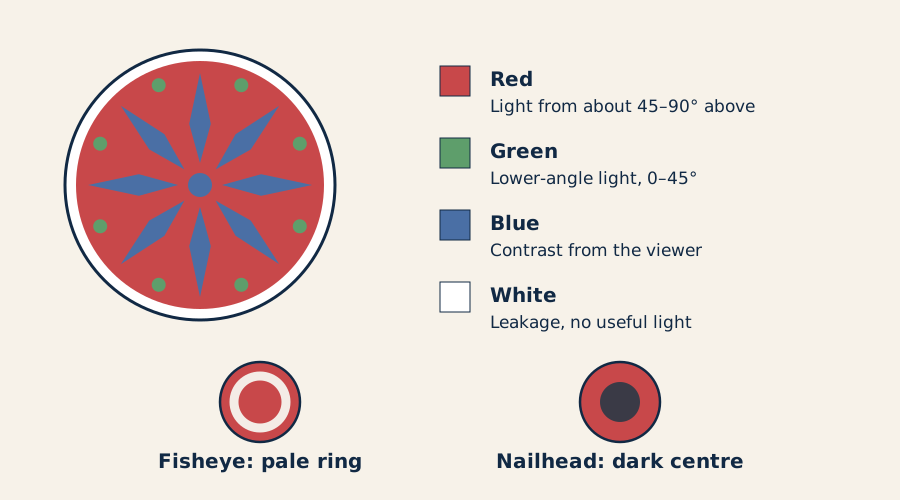
Idealscope is a simpler two-colour version. Red shows light return, black shows contrast, and pale or white areas show leakage. A good round looks evenly red with a crisp, symmetrical black pattern; a fisheye shows a pale ring and a nailhead shows a dark or washed-out centre.
Some laboratories go further and grade light performance directly. AGS Laboratories gave a Light Performance grade from 0 (Ideal) to 10 (the lab has since stopped issuing new reports, but older AGS reports still show it), and GCAL issues reports with measured brightness, fire and optical symmetry. Our page on light performance reports from GCAL and others compares what each one measures.
Does diamond light performance differ by shape?
Yes. A round brilliant has the same pavilion angle all the way around, so it can be cut close to optical perfection. Fancy shapes change width as you go around the outline, so the pavilion angle changes too, and some part of the stone will always be less than ideal. That is why fancy shapes show bow-ties, extinction and windowing more often, and why GIA gives no overall cut grade to them.
| Shape | Depth % often preferred | Table % often preferred | Watch for |
|---|---|---|---|
| Round brilliant | 59–62.5 | 53–58 | Nailhead, fisheye, painted girdle |
| Oval | 58–63 | 53–63 | Bow-tie, windowing |
| Pear | 58–64 | 53–63 | Bow-tie, dark point |
| Cushion | 61–68 | 58–66 | Crushed-ice look, dark corners |
| Radiant | 61–67 | 61–69 | Deep stones looking small |
| Emerald cut | 60–68 | 60–68 | Windowing in the centre steps |
These are typical ranges, not rules. For each shape, see our detailed charts: oval diamond proportions, proportions that suit a pear, cushion cut depth and table ranges, radiant cut proportion targets and emerald cut proportions and windowing.
Step cuts such as the emerald work differently from brilliants. Their long parallel facets produce broad flashes of light and dark rather than pinpoint sparkle, so you judge them on clarity of the steps and an absence of windowing, not on fire. In elongated shapes, the outline also matters: our length-to-width ratio guide explains how a narrow or wide stone changes where light is lost.
Do lab-grown and natural diamonds perform the same in light?
Yes, when they are cut to the same proportions. Lab-grown diamonds are real diamond, with the same refractive index of about 2.42, the same dispersion and the same critical angle as natural diamonds. Light behaves identically in both. A well-cut lab-grown round and a well-cut natural round with matching angles will produce matching ASET images.
Where they can differ is in cutting priorities. Natural rough is costly, so some natural stones are cut deeper or with thicker girdles to keep weight, which can cost light return. Lab-grown rough is less costly, so cutters can more easily favour proportions, though plenty of lab-grown stones are still cut poorly for speed. Either way, check the angles and images rather than assuming.
Light performance also changes how big a stone looks. A diamond that leaks light or carries extra depth can look smaller and duller than a lighter, better cut one, which is the subject of why diamonds of the same carat look different and our guide to spread and face-up size.
Related guideGCAL and Light Performance ReportsCompare natural and lab-grown diamonds
How do you check a diamond's light performance before you buy?
- Read the report. Note the cut grade (rounds), polish, symmetry, depth %, table %, crown and pavilion angles, girdle and culet, and whether the stone is natural or lab-grown.
- Check the pavilion angle. For a round, about 40.6–41.0° is the target; below about 40° risks fisheye, above about 42° risks nailhead.
- Check the crown angle against it. About 34–35° for a round; a steep pavilion with a steep crown is the most common route to a dark stone.
- Ask for an ASET or Idealscope image. Look for even red, a symmetrical contrast pattern and no pale ring at the edges.
- Watch a 360° video or view in person. Look for dark areas that stay dark, a fixed bow-tie or a see-through window in the centre.
- Compare face-up size. Use the millimetre measurements, not only the carat weight, so a deep stone does not hide behind its weight.
- View in different lighting. Daylight shows brilliance; spotlights or halogen show fire and scintillation.
Free consultation
Talk to a gemologist
Compare stones in person or online with Raj Sood, Graduate Gemologist (GIA), AJP (GIA).
Book a consultationShop this shape
FAQ
Common questions
What is light performance in a diamond?
It is how well a cut diamond returns light to your eye as brightness, fire, sparkle and contrast. It depends mostly on the crown and pavilion angles and how precisely the facets are cut.
What is a fisheye diamond?
A fisheye diamond has a pavilion cut too shallow, so the girdle reflects as a grey-white ring just inside the table. It usually shows in rounds with a pavilion angle below about 40° or depth below about 57%.
What causes a nailhead in a diamond?
A pavilion cut too deep sends light out the sides instead of back through the top, leaving a dark centre. It is most common in rounds with pavilion angles above about 42°.
What do the colours on an ASET image mean?
Red is bright light from high above, green is lower-angle light, blue is contrast from the viewer, and white or black shows leakage. A well-cut round shows mostly red with even blue contrast.
Do lab-grown diamonds sparkle as much as natural diamonds?
Yes, if they are cut to the same proportions. Lab-grown and natural diamonds share the same refractive index and dispersion, so light behaves identically in both.
Is a GIA Excellent cut enough for good light performance?
It is a sound starting point for rounds, but the Excellent band is wide. Checking the angles and an ASET or Idealscope image tells you where in that band the stone sits.

Ask a gemologist
Not sure which diamond to choose?
Raj Sood is a Graduate Gemologist (GIA) and master jeweller. Bring the stones you are considering, or send the reports, and he will tell you honestly which one is better and why.
Keep learning
Related guides
 Diamond Anatomy & LightWhat Is Light Leakage in a Diamond?
 Diamond Anatomy & LightDiamond Crown & Pavilion Angles Explained
 Diamond Anatomy & LightDiamond Fire, Brilliance & Scintillation Explained
 Certificates & ValuationsGCAL and Light Performance ReportsDiamond Anatomy & LightAnatomy of a diamond: table, crown, girdle, pavilion and culet explainedDiamond Anatomy & LightPainting and Digging Out in Round Diamonds
 Diamond Anatomy & LightIdeal Proportions Chart: Oval Diamonds
 Diamond Anatomy & LightIdeal Proportions Chart: Pear Diamonds
Explore more
More guides on this topic
Education