
- Education
- Diamond Anatomy & Light
- Diamond Girdle Thickness Explained: Grades, Chips, Spread and Light
Diamond Anatomy & Light
Diamond Girdle Thickness Explained: Grades, Chips, Spread and Light
Diamond girdle thickness is the one line on a grading report most people skip, yet it decides how easily a stone chips, how big it looks for its weight and whether a grey ring shows through the top. Here is how to read it, shape by shape.
 Reviewed by Raj Sood, Graduate Gemologist (GIA), AJP (GIA)Master jeweller and Graduate Gemologist (GIA) · reviewed 4 November 2026
Quick answer
Diamond girdle thickness describes how thick the narrow band around a diamond's widest edge is. For most diamonds, aim for a GIA grade between Thin and Slightly Thick, roughly 2–5% of the diameter on a round. Extremely or very thin girdles chip more easily; thick to extremely thick girdles hide weight, so the diamond faces up smaller.
What is a diamond girdle?
The girdle is the narrow band that runs around the widest part of a diamond, where the top half (the crown) meets the bottom half (the pavilion). It is the edge a setter's claws grip, and it sets the stone's outline: round, oval, pear and so on. If you want the full picture of how the parts fit together, our guide to the five parts of a diamond, from table to culet lays them out in one diagram.
Seen side-on under magnification, the girdle is not a flat strip of even width. On a round brilliant it rises and falls in a gentle wave. Where the crown's bezel facets touch the pavilion's main facets, the girdle is at its thinnest; these narrow points are called valleys. Between them, where the small upper and lower girdle facets meet, the girdle is thicker; these are the peaks. A round has 16 of each, which is why a report gives a range rather than one number.
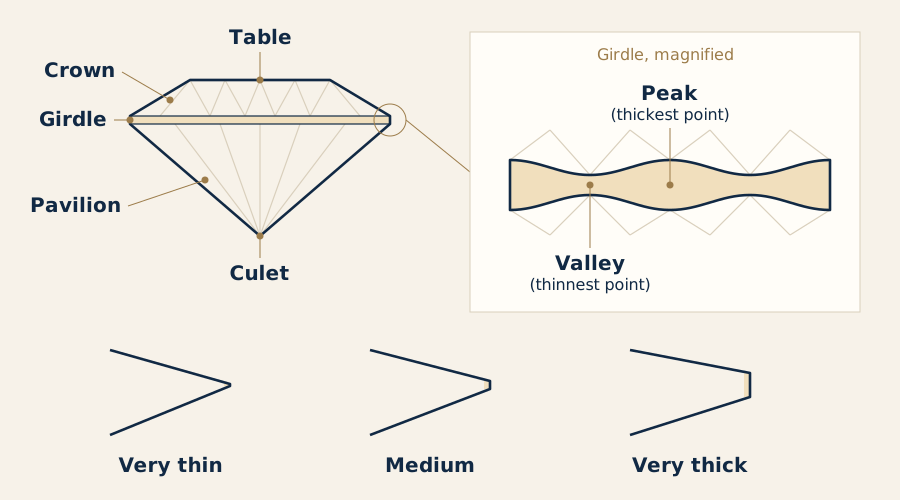
The girdle also contributes to total depth, the height of the stone as a percentage of its width. A heavier girdle adds height without adding any sparkle, which is one reason it matters alongside how table and total depth percentages work. Any term here you have not met before is defined in our jewellery glossary of cutting and grading words.
What is a good diamond girdle thickness?
GIA describes girdle thickness with eight terms, judged against the size of the stone. A 0.2 mm girdle is Medium on a 1 carat round but would look thick on a 0.10 carat melee stone, so the grade is relative, not a fixed millimetre figure. Many reports also print a diamond girdle percentage, the average thickness as a share of the diameter.
| GIA grade | Approx. % of diameter (round) | Approx. thickness on a 6.5 mm round | What it means for you |
|---|---|---|---|
| Extremely Thin | under about 1% | under about 0.06 mm | Knife-edge; chips easily, avoid for rings |
| Very Thin | about 1–2% | about 0.06–0.13 mm | Fragile, especially under claws |
| Thin | about 2–3% | about 0.13–0.20 mm | Fine if no part dips to Very Thin |
| Medium | about 3–4% | about 0.20–0.26 mm | The comfortable middle |
| Slightly Thick | about 4–5% | about 0.26–0.33 mm | Fine; a little extra protection |
| Thick | about 5–7% | about 0.33–0.45 mm | Some hidden weight; check the spread |
| Very Thick | about 7–9% | about 0.45–0.6 mm | Noticeable hidden weight on a round |
| Extremely Thick | over about 9% | over about 0.6 mm | Looks small for its weight; may show a grey ring |
So a good diamond girdle thickness for a round is usually Thin to Slightly Thick, with Medium to Slightly Thick a popular choice for everyday rings because it balances protection and spread. GIA's top cut grade for round brilliants generally sits within this window, and a girdle outside it can pull a round's overall cut grade down even when the angles are good.
The girdle never works alone. It sits between the crown and pavilion, so a stone cut with a thick girdle often also has a steeper pavilion or a lower crown. Read it together with the crown and pavilion angles on the report rather than in isolation.
How is girdle thickness shown on a grading report?
On a GIA or IGI report you will usually see three pieces of girdle information:
- The thickness range: for example "Thin to Medium". The first word is the thinnest point (normally a valley), the second the thickest (normally a peak).
- A percentage: for example 3.0%. This is an average, so a stone at 3.0% can still have a localised thin spot.
- The finish: Faceted, Polished or Bruted, which describes the surface of the girdle itself.
A narrow range such as "Medium to Slightly Thick" tells you the cutter kept the girdle even. A wide range such as "Very Thin to Thick" on a round suggests an uneven, wavy girdle; the thin parts are a chipping risk and the thick parts hide weight, so you get the downsides of both. Fancy shapes are different: a wide range is normal and often deliberate, as we explain further down.
Faceted girdle vs polished girdle: a faceted girdle is cut into many tiny flat facets, which is the most common finish on modern brilliants. A polished girdle is smooth and glassy. A bruted girdle is left frosted from the grinding that rounds the rough; it looks slightly grainy, can collect skin oil and dirt, and may show as a faint grey line around the edge. Bruted girdles are more common on older stones, as our comparison of the modern round and the Old European cut shows. None of the three finishes is a fault on its own, but a faceted or polished girdle stays cleaner and reflects less grey into the stone.
Is a thin girdle diamond more likely to chip?
Yes, when it is very thin. Diamond is 10 on the Mohs hardness scale, so it resists scratching better than anything else you wear. Hardness is not toughness, though. Diamond has cleavage planes, directions along which its crystal structure can split, and a sharp knock on a thin edge can flake off a small piece. The girdle is the edge that meets doorframes, benchtops and other rings first.
A thin girdle diamond graded Thin is usually fine, provided the thinnest point is still Thin and not lower. Very Thin and Extremely Thin girdles are where the risk climbs. The setter also has to bend claws over that edge; with a knife-edge girdle the pressure of setting alone can nick it. Small chips at the girdle, recorded on reports as chips or nicks, are among the most common forms of wear we see on older engagement rings.
Not sure which one is right?
Send us the stones you are looking at and our gemologist will tell you which to choose and why.
What happens if a diamond's girdle is too thick?
A thick girdle diamond is tough at the edge, but you pay for weight you cannot see. Carat is weight, and a heavy band around the middle adds weight without adding width. A well-cut 1.00 carat round typically measures about 6.4–6.5 mm across. Cut with a Very Thick girdle, a stone of the same weight may measure closer to 6.2–6.3 mm and look more like a 0.90 carat from above.
That difference is what our guide to spread and face-up size is all about: comparing millimetres, not just carats. A thick girdle also pushes total depth up; on a round, a total depth above about 63% often signals either a thick girdle, a steep pavilion or both, and the stone will look smaller than its weight suggests. Our explainer on why a deep diamond faces up small covers the depth side of this, and shape plays its part too: see which shapes look largest for their carat weight.
Why would a cutter leave a girdle thick? Rough diamond is priced by weight, and leaving extra material at the girdle keeps the finished stone over a popular weight such as 1.00 carat, which sells for noticeably more than 0.97 carat. That is a choice in the cutter's favour, not yours. In fancy shapes, though, a thicker girdle at the points is often there to protect them, which is a fair trade.
Related guideNaturals on a Diamond's GirdleHow does diamond girdle thickness affect sparkle and light?
The girdle itself returns almost no light; it is a thin band seen edge-on. Its effect on sparkle is indirect, through the proportions around it and through reflections. Two well-known cut faults are closely tied to the girdle and the pavilion below it.
- Fisheye: when the pavilion is too shallow (on a round, roughly below about 39°), the girdle is reflected back up through the table as a whitish or grey ring just inside the table edge. A thick or bruted girdle makes that ring more obvious. A fisheye diamond looks washed out in the middle.
- Nailhead: when the pavilion is too steep (roughly above about 43°), light escapes through the pavilion instead of bouncing back, leaving a dark area under the table, like the head of a nail seen from above. Deep stones with thick girdles often have this problem, because the same weight-saving instinct drives both.
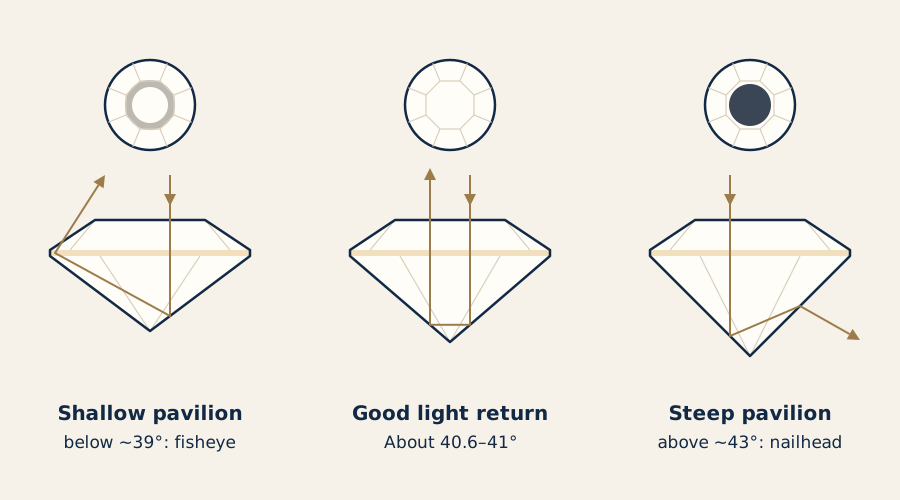
Reflector tools make these effects easy to see. An ASET (Angular Spectrum Evaluation Tool) image shows red where the stone gathers light from high angles, green for lower-angle light, blue for the contrast created by your own head, and white or clear where light leaks out. An aset diamond image of a fisheye stone shows a pale ring under the table; a nailhead shows a washed-out or dark centre. An Idealscope is simpler: red means light return, white or clear means leakage.
Extinction is the word for areas of a diamond that stay dark in normal lighting. Some dark contrast is healthy, because it is what makes sparkle visible, but large fixed dark zones are not. For a fuller walk through these tools, see our guide to reading ASET and Idealscope images, and for how sparkle is split into its three parts, fire, brilliance and scintillation in plain English.
Diamond girdle thickness by shape: what should you accept?
Fancy shapes have points, corners and long sides, so their girdles are rarely even. A wide range on the report is normal. What matters is where the thin and thick parts are. If you are still deciding on an outline, start with our overview of the main diamond shapes.
| Shape | Common report range | What to look for |
|---|---|---|
| Round | Thin to Medium or Slightly Thick | An even, narrow range; no point dipping to Very Thin |
| Oval | Thin to Slightly Thick, sometimes Thick at the ends | Thicker ends are fine; check the bow-tie and the spread |
| Pear, heart, marquise | Thin to Thick; Very Thick at the point is common | A thicker point protects it; avoid Extremely Thin at any point |
| Princess | Thin to Slightly Thick | Corners should not be Very Thin; they are the weak spots |
| Emerald, Asscher | Thin to Slightly Thick | Cut corners help; check the long sides are not knife-edged |
| Cushion | Medium to Thick | Older or chunkier cushions can hide weight in a Very Thick girdle |
In pears, hearts and marquises, a girdle reading "Thin to Very Thick" usually means the cutter left the tip deliberately heavy. That is good for durability, as long as the thick zone is confined to the point and does not run all the way round. Our guides to choosing a pear cut diamond, heart shaped diamond ratios and settings and the two-pointed marquise cover how each shape's points are protected.
Elongated shapes also show the bow-tie, a dark band across the middle; it is caused by the pavilion angles rather than the girdle, but the two often get checked together. Our page on the bow-tie in ovals, pears and marquises explains what is normal, and our oval diamond guide covers why thicker ends are common in that shape.
Princess cuts deserve extra care. Their four sharp corners are the thinnest, most exposed part of the stone, so a report girdle of Very Thin on a princess usually means the corners. Claws or V-shaped prongs over each corner are standard for this reason.
Does girdle thickness matter for the ring setting?
It does, in both directions. A setter cuts a small seat into each claw for the girdle to sit in. A thin girdle needs gentle, precise pressure so the claw does not crush the edge. A very thick girdle needs a deeper seat, otherwise the claw tip sits high and catches on clothing. In a bezel setting the girdle is enclosed in a rim of metal, which protects a thin edge well but hides a thick one, so you lose a little face-up size either way.
- Claw settings: work with Thin to Thick girdles; claws should sit on thicker sections where possible.
- Bezel and half-bezel: good protection for Thin girdles and sharp points.
- Tension settings: the stone is held by pressure at two points on the girdle, so Very Thin girdles are generally avoided.
- Channel settings: used for small side stones; even girdles help them sit level.
The girdle also carries other information. Some diamonds keep a tiny patch of original crystal skin on the girdle, left to save weight; our guide to naturals, small patches of untouched crystal on the edge explains when that is harmless. Many girdles also carry a microscopic laser inscription, usually the report number, and you can add your own words: see engraving a name or date on the girdle.
Do natural and lab-grown diamonds differ in girdle thickness?
No. Girdle thickness comes from how a diamond is cut, not where it came from. Natural and laboratory-grown diamonds are the same material, with the same hardness (10 on the Mohs scale) and refractive index (about 2.42), and they are cut on the same equipment to the same proportions. Both can have thin, medium or thick girdles, and both are graded on the same eight-term scale.
One practical difference shows up on the girdle itself. Lab-grown diamonds graded by major laboratories are normally laser-inscribed on the girdle with the report number and a lab-grown statement, so the origin can be confirmed under magnification. Natural diamonds often carry the report number too. If you are comparing the two, judge girdle thickness, depth and angles exactly the same way; our guide to where the crown meets the pavilion shows which measurements to line up side by side.
Browse natural and lab-grown diamonds with full grading reports
How do you check girdle thickness before you buy?
- Find the girdle line on the report. Note the range (for example Thin to Medium), the percentage and the finish.
- Check the range against the shape. For a round, aim for Thin to Slightly Thick with no Very Thin points. For pears, hearts and marquises, a thicker point is fine.
- Compare millimetres with carats. A 1.00 ct round under about 6.3 mm, or a total depth above about 63%, suggests weight hidden in the girdle or pavilion.
- Look at the pavilion angle. On a round, roughly 40.6–41.0° avoids both fisheye and nailhead in most stones.
- Ask for an ASET or Idealscope image. Look for a pale ring under the table (fisheye) or a dark centre (nailhead).
- Inspect the edge under a 10x loupe. Check the thinnest valleys or corners for chips, nicks or a bearded (hairline-feathered) girdle.
- Plan the claws with the setter. Agree where the claws will sit so the thinnest sections are protected.
Free consultation
Talk to a gemologist
Compare stones in person or online with Raj Sood, Graduate Gemologist (GIA), AJP (GIA).
Book a consultationShop this shape
FAQ
Common questions
What is the ideal girdle thickness for a round diamond?
Thin to Slightly Thick is the usual target, with Medium to Slightly Thick a popular choice for everyday rings. That is roughly 2–5% of the diameter, or about 0.13–0.33 mm on a 1 carat round.
Is a very thin girdle bad?
It is a chipping risk, especially in a ring that takes knocks or under the pressure of setting claws. A Very Thin or Extremely Thin girdle is better suited to a protected setting such as a bezel, or to earrings and pendants.
Does a thick girdle make a diamond look smaller?
Yes. The extra weight sits at the edge, where it adds carats but not width, so a 1 carat stone with a Very Thick girdle can face up closer to the size of a 0.90 carat.
What does 'Medium to Slightly Thick, Faceted' mean on a report?
The girdle's thinnest point is Medium and its thickest is Slightly Thick, and the edge has been cut into small facets rather than left frosted. It is a sound, even girdle for most shapes.
Why does my pear shaped diamond have a Very Thick girdle?
Cutters often leave the point of a pear, heart or marquise thicker to protect it from chipping. As long as the thick section is at the point and not all the way round, it is a sensible feature.
What is a fisheye diamond?
A diamond with a pavilion cut too shallow, so the girdle reflects up through the table as a whitish or grey ring. It makes the centre look washed out, and a thick or bruted girdle makes the ring more visible.

Ask a gemologist
Not sure which diamond to choose?
Raj Sood is a Graduate Gemologist (GIA) and master jeweller. Bring the stones you are considering, or send the reports, and he will tell you honestly which one is better and why.
Keep learning
Related guides
 Diamond Anatomy & LightDiamond Crown & Pavilion Angles Explained
 Diamond Anatomy & LightDiamond Light Performance GuideDiamond Anatomy & LightDiamond Spread and Face Up Size Guide
 Diamond 4Cs & GradingNaturals on a Diamond's GirdleCare, Repairs & RemodellingDiamond Girdle Engraving: Names, Dates and Custom Messages
 Diamond Anatomy & LightDiamond Bow Tie Effect
 Diamond Anatomy & LightDiamond Fire, Brilliance & Scintillation Explained
Explore more
More guides on this topic
Education