
- Education
- Diamond Anatomy & Light
- Diamond Extinction and Dark Zones: Causes, Shapes and How to Avoid Them
Diamond Anatomy & Light
Diamond Extinction and Dark Zones: Causes, Shapes and How to Avoid Them
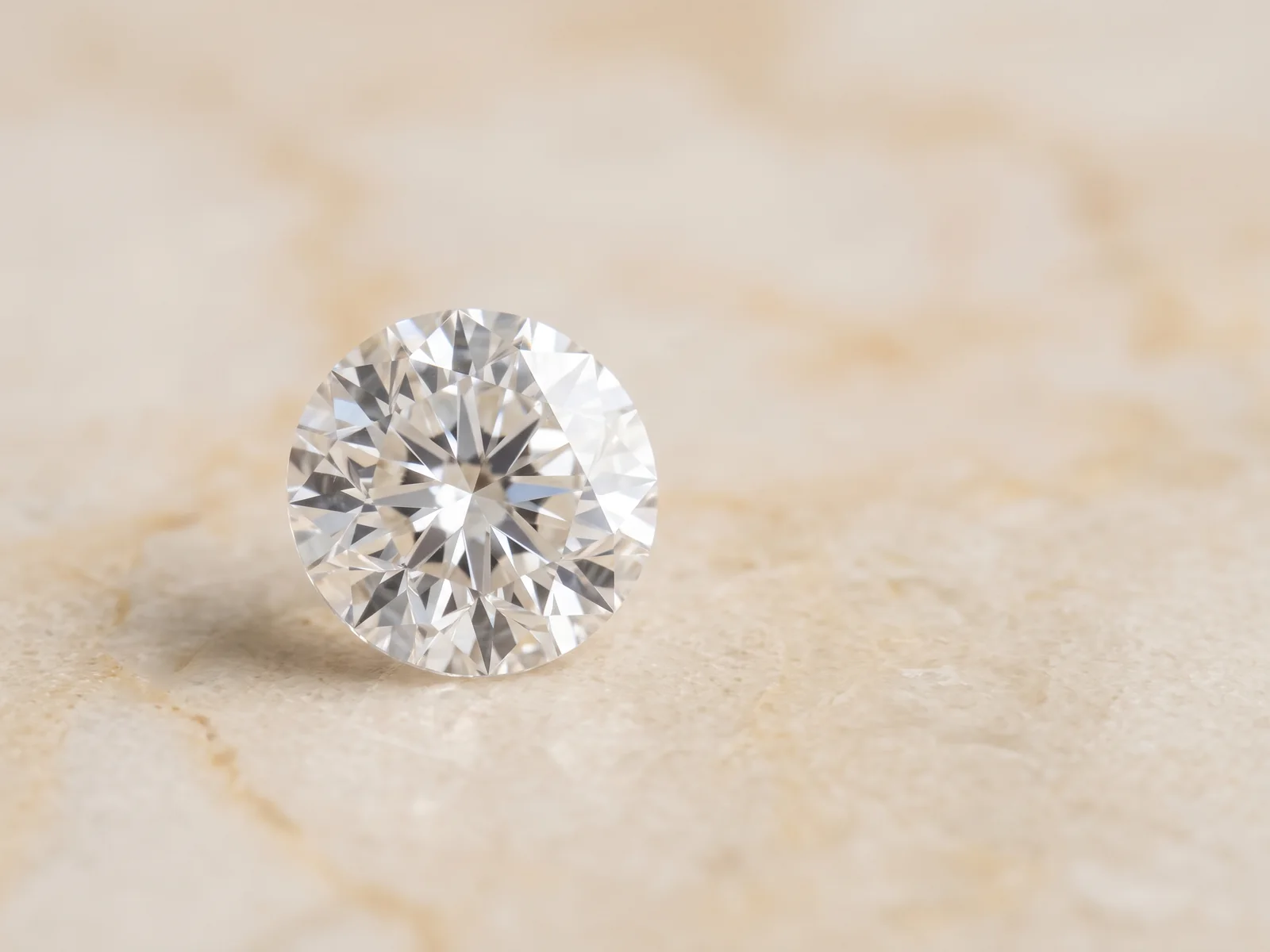
Diamond extinction is the reason two stones with identical grades can look completely different on the hand. Knowing what causes dark zones, and how to spot them before you choose, protects you from a diamond that looks grey instead of bright.
 Reviewed by Raj Sood, Graduate Gemologist (GIA), AJP (GIA)Master jeweller and Graduate Gemologist (GIA) · reviewed 4 November 2026
Quick answer
Diamond extinction is the dark areas you see in a diamond's face-up view where light leaks out or is blocked instead of returning to your eye. Some contrast is normal and makes sparkle visible. Too much comes from poor angles, usually a steep or deep pavilion, and shows most in fancy shapes such as ovals, pears, marquise and radiants.
What is diamond extinction?
Extinction is the gemmologist's word for areas of a diamond that look dark when you view it face-up (from above, the way it sits in a ring). Light enters through the top, and in a well-cut stone most of it bounces off the lower facets and comes back out the top towards your eye. Where it does not, because it escapes through the bottom of the stone or because your own head is blocking the light source, you see grey or black. If you need a refresher on the parts of a stone, our guide to the table, crown, girdle and pavilion labels each one.
Not all darkness is a fault. A diamond needs some dark areas to sparkle at all, because bright flashes only read as sparkle when dark facets sit beside them. Gemmologists separate two things. Contrast is small, sharp dark facets that shift and swap places as the stone moves; they are mostly reflections of your head and body. Extinction, or dark zones, means larger dark patches that stay dark however you tilt the stone. The second is the one to watch for.
Extinction is only one piece of how a diamond handles light. Brightness, colour flashes and sparkle are separated out in how fire, brilliance and scintillation differ, and the bigger picture of how cut quality shows up is in our overview of diamond light performance. Any unfamiliar term on this page is defined in the A to Z jewellery glossary.
What causes extinction in a diamond?
It comes down to one number. Diamond has a refractive index (how strongly it bends light) of about 2.42, which gives it a critical angle of about 24.4°. When light inside the stone hits a facet at more than 24.4° from the perpendicular, it reflects back inside, which is called total internal reflection. When it hits closer to straight on, it passes out through that facet and is lost. The job of the cutter is to set the pavilion (lower) facets at angles that keep light reflecting until it exits through the top.
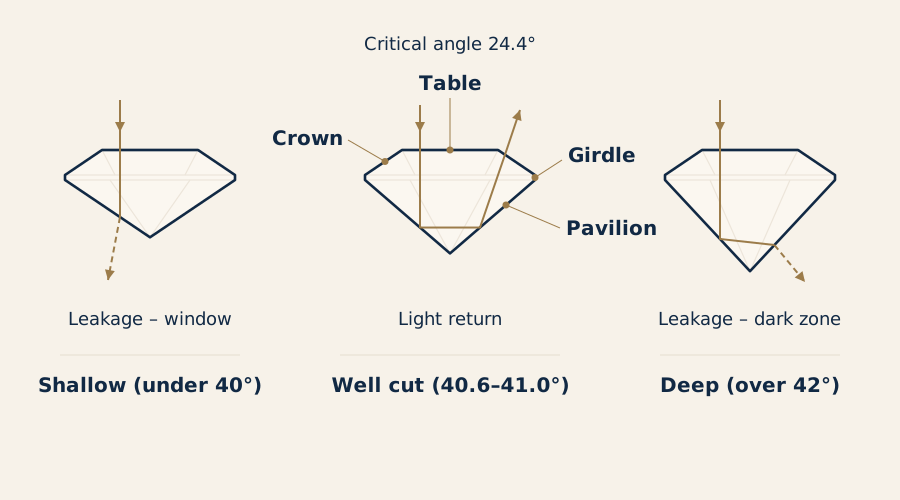
In a round brilliant the pavilion angle does most of the work. This is roughly how it plays out:
| Pavilion angle (round) | What happens to light | What you see face-up |
|---|---|---|
| Below about 40° | Light strikes the pavilion too directly and passes out the bottom | Washed-out, see-through centre (window) or a grey fisheye ring |
| About 40.6–41.0° | Light reflects off both sides of the pavilion and exits through the crown | Bright, even pattern with crisp, moving contrast |
| About 41.2–41.8° | Light still returns, but more of it is angled back towards your head | Slightly darker under the table, more obstruction |
| Above about 42° | Light reflects to the opposite pavilion facet at an angle where it escapes | Dark centre (nailhead) and dark zones that do not move |
The crown matters too. A crown angle of about 34–35° works with a 40.6–41.0° pavilion to spread light into fire and keep it bright; an unusual pairing, such as a very flat crown on a steep pavilion, can leave dark rings under the crown. Total depth (the height of the stone as a percentage of its width) is the result of these angles, so a round over about 63% deep is a warning sign. See crown and pavilion angles measured in degrees and how table and depth percentages affect brightness for the numbers in detail.
Two other causes are worth knowing. Obstruction is your own head blocking light from directly above the stone; some of it is unavoidable, and it increases as you lean closer. And in fancy shapes, the facets curve around an elongated or cornered outline, so the pavilion angle changes from one part of the stone to another. Where the angle drifts too steep, that part goes dark. This is why extinction is mostly a fancy-shape problem.
How is extinction different from a bow-tie, nailhead or windowing?
These terms overlap, and people often use them loosely. Here is how a gemmologist separates them:
| Effect | Main cause | Where it shows | Shapes most affected |
|---|---|---|---|
| Extinction (dark zones) | Steep or uneven pavilion angles, light leakage, obstruction | Dark patches that stay put, often at the ends or under the crown | Fancy shapes, deep rounds |
| Bow-tie | Pavilion angle changes across the width of an elongated stone | Dark band across the centre, shaped like a bow-tie | Oval, pear, marquise, heart |
| Nailhead | Pavilion too deep (steep) | Dark centre under the table, like the head of a nail | Deep rounds, princess cuts |
| Windowing | Pavilion too shallow | See-through, washed-out centre | Oval, emerald, cushion |
| Fisheye | Very shallow pavilion reflecting the girdle | Grey or white ring inside the table | Shallow rounds |
| Haziness | Clouds of tiny inclusions, not cut | Milky, low-contrast look across the whole stone | Any shape |
A bow-tie is really a specific pattern of extinction, and a nailhead is extinction concentrated in the centre. Windowing and fisheye are the opposite problem: too little reflection, so light leaks straight through. Here is the twist: leakage can look dark or pale depending on what is behind the stone. Over a white background, leaked light shows as a pale window; set in a ring on your hand, the same area can look grey or black. That is why a stone that looked fine on a white tray can look dull once it is set.
Each effect has its own guide: why elongated diamonds show a bow-tie, the dark centre known as a nailhead, windowing in each diamond shape and the fisheye ring caused by a shallow pavilion. If a stone looks dull all over rather than patchy, the cause may be inclusions instead of cut; see what makes a diamond look hazy or cloudy.
Which diamond shapes are most prone to dark zones?
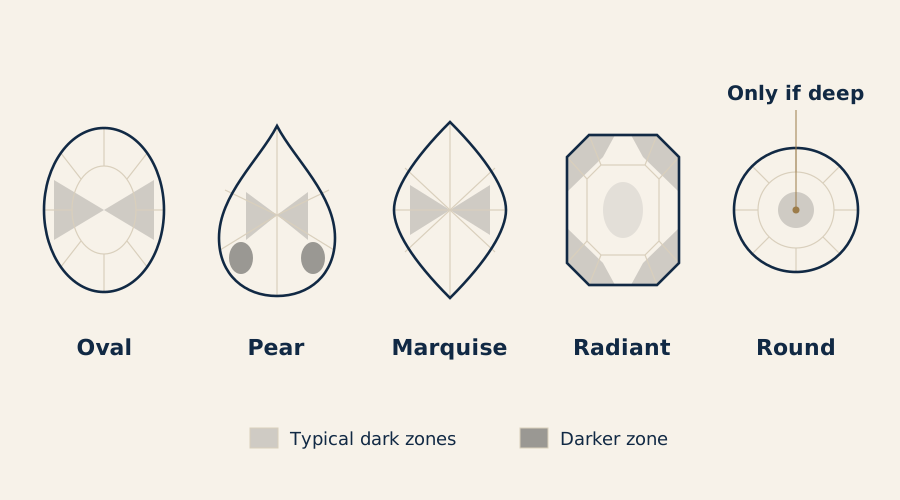
Rounds are the least prone, because every facet sits at the same angle all the way around and the shape has been refined for light return over a century. Fancy shapes are harder to cut evenly, and GIA does not give them an overall cut grade, so dark zones are not flagged on the report. These are typical patterns:
| Shape | Risk of dark zones | Where they usually appear | What tends to help |
|---|---|---|---|
| Round brilliant | Low | Centre, if the pavilion is deep | Pavilion 40.6–41.0°, depth about 59–62.5% |
| Princess | Moderate | Corners, or a dark cross through the centre | Avoid very deep stones (over about 75%) |
| Cushion | Moderate to high | Under the crown and in the centre | Moderate depth, even facet pattern on video |
| Oval | High | Bow-tie across the width | Ratio about 1.30–1.50, depth about 58–63% |
| Pear | High | Bow-tie and dark shoulders near the round end | Depth about 58–64%, rounded shoulders |
| Marquise | High | Bow-tie across the middle, dark tips | Depth about 58–63% |
| Heart | Moderate to high | Bow-tie across the belly | Ratio about 0.90–1.10, even lobes |
| Radiant | Moderate | Corners, dark centre if deep | Depth about 61–67% |
| Emerald and Asscher | Moderate | Large dark blocks in the step facets if deep | Depth about 61–68%, crisp step pattern |
Cutters are paid by weight, so many fancy shapes are cut deeper than ideal to keep more of the rough crystal. Extra depth carries weight below the girdle, where it adds nothing to the face-up look, and it often pushes the pavilion angle into the range that causes extinction. You lose twice: the stone looks smaller for its carat and darker. Our guide to how depth trades against face-up size shows the effect in millimetres, and the radiant proportion ranges chart gives table and depth targets for one of the shapes most often cut heavy.
Not sure which one is right?
Send us the stones you are looking at and our gemologist will tell you which to choose and why.
How do you spot diamond extinction in photos and video?
Grading reports do not mention extinction, so you have to judge it with your eyes or with reflector images. When you look at a stone online or across the counter, run through these checks:
- Do not trust a single still photo. Studio lighting can hide dark zones, and a lucky angle can make a dull stone look bright. One frame also cannot tell contrast from extinction.
- Watch a 360° video. Contrast flickers on and off as the stone turns; extinction sits in the same place in every frame.
- Look at the ends and corners. In ovals, pears and marquise, check the centre for a bow-tie and the tips for darkness. In radiants and princess cuts, check the four corners.
- Compare with similar stones. Two ovals of the same size side by side make a heavy bow-tie obvious.
- Check the depth and measurements. A fancy shape that is deep for its type, or small in millimetres for its carat, is more likely to show dark zones.
- Ask for softer light. Spotlights hide extinction; diffuse light, like an office or overcast day, shows it more honestly.
Tilt extinction is worth testing too. A stone that looks bright face-up can darken quickly when tilted 10–20°, which is how you see it on your hand most of the time. Rock the stone gently, or watch for darkening in the video as it rotates.
What do ASET and Idealscope images show about dark zones?
Reflector tools take the guesswork out. The ASET (Angular Spectrum Evaluation Tool), developed by the American Gem Society, uses a coloured reflector so the image shows where each part of the stone is gathering its light. The older Idealscope uses a red reflector to show light return against leakage. Both make dark zones visible that a photo can hide.
| Colour in the image | ASET meaning | Idealscope meaning |
|---|---|---|
| Red | Light from high angles, the brightest return | Strong light return |
| Green | Light from lower angles, less intense | Not used |
| Blue | Obstruction by the viewer's head (normal contrast) | Not used; obstruction shows as dark |
| Black or white | Light leakage, where extinction and windows come from | Pale or white areas show leakage |
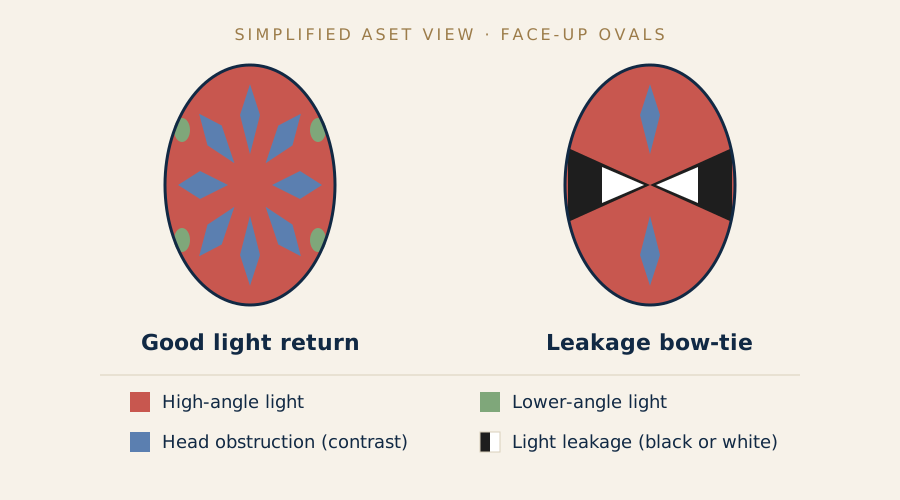
In a well-cut stone you want mostly red, an even and symmetrical scatter of blue, and very little black or white. A bow-tie of black or white across an oval, or white patches in the centre of a round, shows exactly where light is leaking. Our step-by-step guide to reading ASET and Idealscope colours works through real examples, and for rounds, the patterns a hearts and arrows viewer reveals show how precisely the facets line up.
Related guideASET and Idealscope Images ExplainedDoes extinction differ between natural and lab-grown diamonds?
No. Lab-grown diamonds are real diamond grown in a laboratory rather than mined, with the same refractive index of about 2.42 and the same 24.4° critical angle. Light behaves identically in both, so extinction depends only on how the stone was cut. A deep lab-grown oval will show the same bow-tie as a deep natural oval. Lab-grown diamonds cost much less than natural, which makes it easier to choose on cut quality without stretching the budget, but the same checks apply to both.
Coloured gemstones show extinction even more readily. Their refractive index is lower, so their critical angle is wider (about 34–35° for sapphire and most garnets) and more light escapes through the pavilion. Many are also cut deep to save weight or darken the colour. In darker stones, extinction and dark tone blend together, which is why some garnets look almost black in places; see why garnets can look darker than you expect.
Browse natural and lab-grown diamonds
Does lighting or the ring setting make a diamond look darker?
Yes, though neither turns a well-cut stone into a dull one. Lighting changes how much contrast and extinction you notice:
- Spot lighting (jewellery store downlights, direct sun) creates strong sparkle and hides mild dark zones.
- Diffuse lighting (offices, overcast days) shows extinction most clearly, because there is no single bright source to fill dark areas.
- Dim or warm evening light makes every diamond darker; a well-cut stone keeps its pattern, a poorly cut one goes flat.
Dirt matters more than most people realise. Total internal reflection depends on air sitting against the pavilion. A film of skin oil or hand cream (refractive index about 1.4–1.5) widens the effective critical angle, so light escapes through the bottom and the stone looks darker and duller. Cleaning the back of the stone with warm water, mild detergent and a soft brush usually brings it straight back.
Settings play a smaller part. An open setting lets you clean the pavilion easily, while a closed back traps grime. A halo of small diamonds can visually mask slight darkness at the edge of a fancy shape, and white metals keep the surroundings neutral, but no setting fixes a heavy bow-tie or nailhead. That has to be chosen out at the stone stage.
How do you avoid a diamond with too much extinction? Step by step
- Start with the report. Note the shape, measurements, depth and table, and whether the diamond is natural or lab-grown.
- Check depth for the shape. Compare it with the typical ranges above; treat a stone well outside them with caution.
- Check face-up size. Compare the millimetre measurements with other stones of the same carat; a small stone for its weight is often deep.
- Watch a 360° video. Pause at several positions and look for dark areas that stay put, especially across the centre and at the ends.
- Ask for an ASET or Idealscope image. Look for mostly red, even blue contrast and little black or white leakage.
- View it in diffuse light. If you can see the stone in person, look at it away from spotlights and tilt it slightly.
- Compare at least two stones. Dark zones that seem acceptable alone are often obvious beside a better-cut stone.
Free consultation
Talk to a gemologist
Compare stones in person or online with Raj Sood, Graduate Gemologist (GIA), AJP (GIA).
Book a consultationShop this shape
FAQ
Common questions
Is some darkness in a diamond normal?
Yes. Every diamond needs dark contrast facets for its sparkle to be visible. The problem is large dark patches that stay in the same place as the stone moves, which is extinction.
What causes dark spots in a diamond?
Usually a pavilion cut too steep or uneven, so light leaks out of the bottom instead of returning through the top. Dark spots can also be inclusions, such as dark crystals, which the report's plotting diagram will show.
Which diamond shapes have the most extinction?
Elongated shapes such as ovals, pears and marquise are most prone, mainly as a bow-tie across the centre. Rounds with pavilion angles around 40.6–41.0° show the least.
Do lab-grown diamonds have more extinction than natural diamonds?
No. Lab-grown and natural diamonds have the same optical properties, so extinction depends only on the cut. Check the proportions, video and ASET image the same way for both.
Can a jeweller fix extinction in a diamond?
Only by recutting, which changes the angles and loses weight, so it is rarely worthwhile. It is far easier to choose a stone without heavy dark zones in the first place.
Why does my diamond look darker than when I bought it?
Most often it is dirt or skin oil on the back of the stone, which lets light escape. A clean with warm water, mild detergent and a soft brush usually restores it.

Ask a gemologist
Not sure which diamond to choose?
Raj Sood is a Graduate Gemologist (GIA) and master jeweller. Bring the stones you are considering, or send the reports, and he will tell you honestly which one is better and why.
Keep learning
Related guides
 Diamond Anatomy & LightASET and Idealscope Images Explained
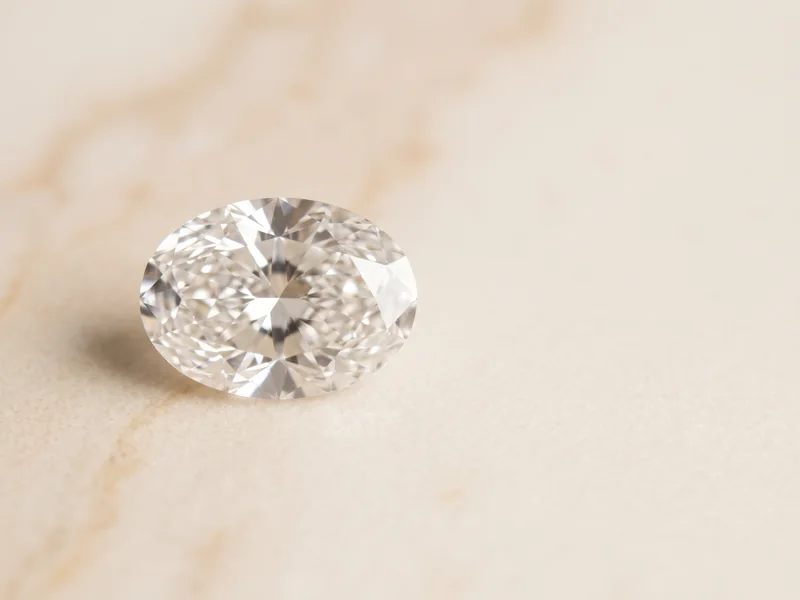 Diamond Anatomy & LightDiamond Bow Tie Effect
 Diamond Anatomy & LightNailhead Effect in DiamondsDiamond Anatomy & LightDiamond Light Performance GuideDiamond Anatomy & LightAnatomy of a diamond: table, crown, girdle, pavilion and culet explained
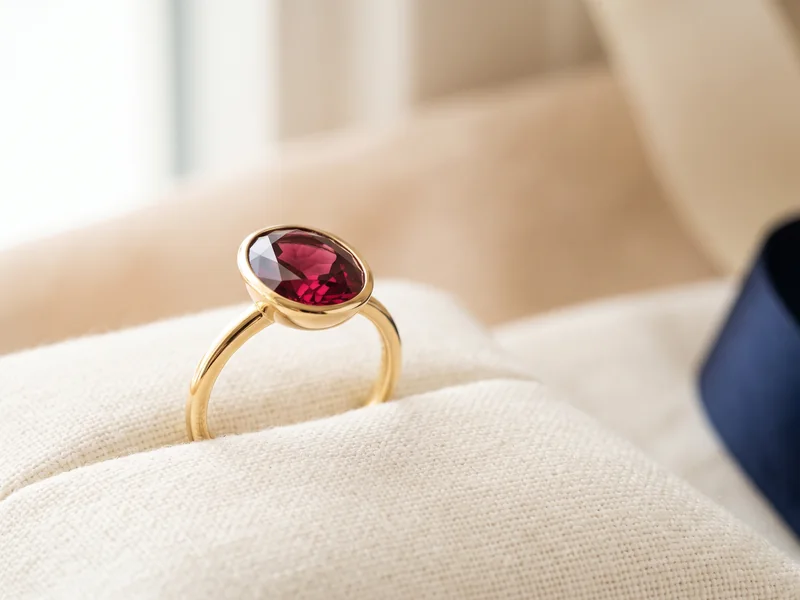 GemstonesGarnet Engagement Rings: More Than Dark Red
 Diamond Anatomy & LightFisheye Effect in DiamondsDiamond Anatomy & LightHearts and Arrows Viewer Explained
Explore more
More guides on this topic
Education