
- Education
- Diamond Anatomy & Light
- Diamond Windowing Across Every Shape: Why It Happens and How to Avoid It
Diamond Anatomy & Light
Diamond Windowing Across Every Shape: Why It Happens and How to Avoid It
Diamond windowing is a cut problem that no clarity or colour grade will warn you about, and it shows up most in the fancy shapes people love. Here is what causes it, how to spot it before you buy, and the numbers that keep it away.
 Reviewed by Raj Sood, Graduate Gemologist (GIA), AJP (GIA)Master jeweller and Graduate Gemologist (GIA) · reviewed 4 November 2026
Quick answer
Diamond windowing is a washed-out, see-through patch in the centre of a diamond where light passes straight through the pavilion instead of reflecting back to your eye. It is mainly caused by a shallow pavilion. Emerald, Asscher, oval, pear and marquise cuts window most; well-proportioned rounds rarely do. Check video, ASET images and depth figures.
What is diamond windowing?
Diamond windowing is a pale, see-through area, usually in the centre of the stone, where you look straight through the diamond instead of seeing sparkle. It happens when light entering through the top is not reflected back up to your eye but passes out through the bottom. The name describes what you see: a small pane of glass in the middle of an otherwise lively stone. If the parts named below are new to you, our guide to the table, crown, girdle and pavilion sets each one out with a diagram.
A well-cut diamond works like a set of angled mirrors. Light enters the table (the large flat facet on top) and the crown (the sloping upper section), strikes the facets of the pavilion (the cone-shaped lower half) and bounces back up towards you. When the pavilion facets sit at the wrong angle, some of that light leaks away underneath. What is left is a dull, glassy patch that looks flat next to the bright facets around it. Windowing is one of several ways a diamond loses light, and our overview of how diamonds return light puts it in the wider picture.
Windowing has nothing to do with clarity or colour. A D flawless diamond can window badly, and an H SI1 can be bright from edge to edge. It is purely a matter of cut, which is why it rarely appears on a grading report and why it catches so many buyers out. Every technical term in this article is also defined in our plain-English jewellery glossary.
What causes windowing in a diamond?
The cause is physics. Diamond has a refractive index of about 2.42, a measure of how strongly it bends and slows light. A high refractive index gives diamond a small critical angle of about 24.4°. Light that strikes a pavilion facet at more than 24.4° from the perpendicular is bounced back inside the stone, which is called total internal reflection. Light that strikes the facet more directly than that passes straight out through the bottom.
In a round brilliant, the pavilion angle (the slope of the lower facets measured from the girdle plane) that keeps light inside is a fairly narrow band, roughly 40.6–41.0°. Make the pavilion shallower and more light meets the facets head-on, below the critical angle, and escapes. That escaping light is the window. Our explainer on how crown and pavilion angles steer light goes deeper into the geometry, including how the crown angle shifts the ideal pavilion angle slightly.
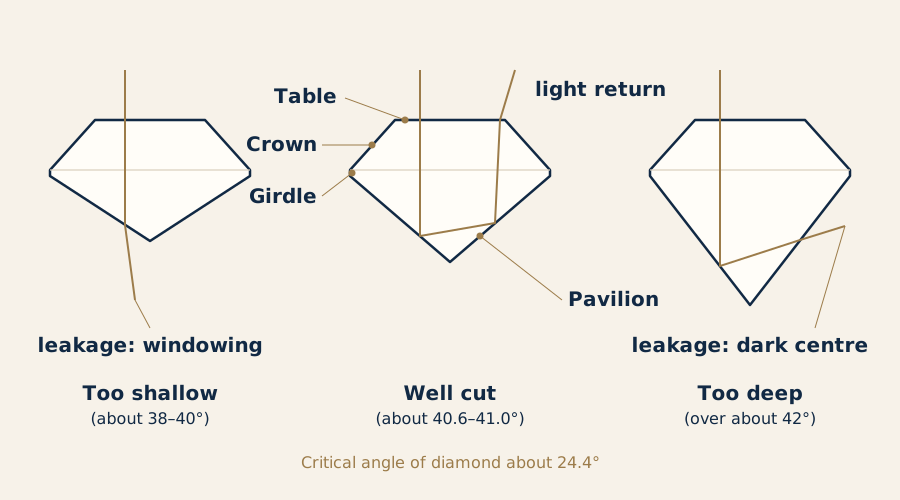
| Round pavilion angle | What usually happens | Typical look |
|---|---|---|
| Below about 38° | Severe leakage; the girdle reflects under the table | Fisheye: a grey ring inside the table |
| About 38–40° | Light leaks through the centre | Windowing: a pale, glassy middle |
| About 40.6–41.0° | Most light returns to the eye | Bright, even and lively |
| About 41.2–42° | Mostly bright; depends on the crown angle | Some darkness under the table with a steep crown |
| Above about 42° | Light leaks out the sides of the pavilion | Nailhead: a dark centre |
Why would a cutter make a shallow stone? Rough diamond is expensive, and carat weight and face-up size are what most buyers compare. A flat piece of rough often yields a wider, shallower stone, and a shallow stone faces up larger for its weight. Our guide to spread and how big a diamond looks from above shows how much extra width a shallow cut gains, and our page on reading table and depth percentages explains where to find those numbers on a report.
Depth alone does not tell the full story. Two stones with the same total depth can have very different pavilion depths if one has a thick girdle (the narrow band around the widest edge) or a tall crown. A stone with a thick girdle and a shallow pavilion can look normal on paper at 60% total depth and still window. Where the report gives a pavilion depth or angle, it is the more useful figure.
Which diamond shapes are most prone to windowing?
Rounds window least. They are the most studied shape, their facets are all cut at close to the same angle, and GIA gives them a full cut grade that penalises leakage. Fancy shapes have no GIA overall cut grade, and their facet angles change as you move around the outline. That means some part of a fancy stone, usually the belly or the ends, is almost always shallower than ideal. The table below gives typical well-cut depth ranges and where windowing tends to appear.
| Shape | Typical well-cut total depth | Windowing risk | Where it usually shows |
|---|---|---|---|
| Round brilliant | about 59–62.5% | Low | Centre, in stones under about 58% |
| Princess | about 64–75% | Low to moderate | Centre, in shallow stones under about 63% |
| Oval | about 58–63% | High | Centre and belly |
| Pear | about 58–64% | High | Belly and the rounded end |
| Marquise | about 58–63% | High | Centre, along the long axis |
| Heart | about 56–62% | Moderate | Belly, below the cleft |
| Cushion | about 61–68% | Moderate | Centre, varies by facet pattern |
| Radiant | about 61–67% | Moderate | Centre |
| Emerald | about 61–69% | High (partly by design) | Centre of the table |
| Asscher | about 60–70% | Moderate to high | Centre of the table |
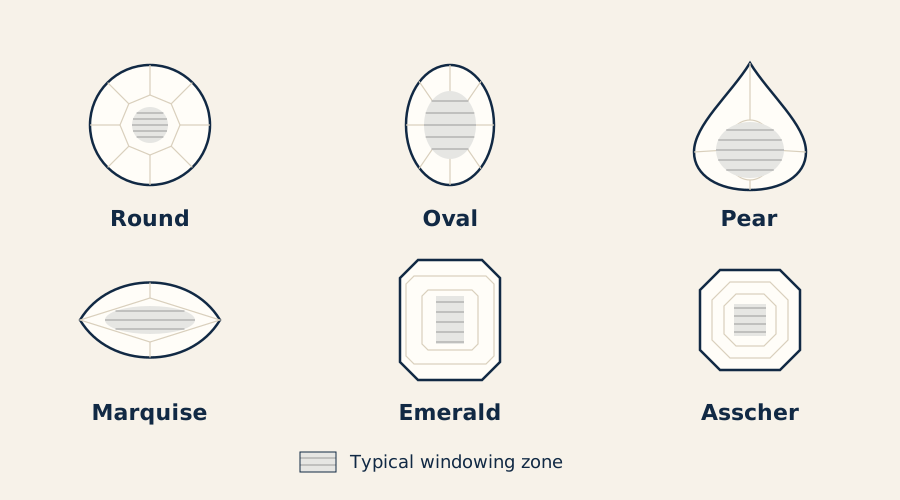
Elongated brilliants such as ovals, pears and marquises are the most common windowing problem we see in fancy shapes. They are often cut shallow to maximise length and spread, and their long, curved pavilions make it hard to keep every facet at a light-returning angle. The same shapes can also show a dark band across the middle, the bow-tie effect seen in ovals, pears and marquises. A stone can have both at once: a window is too much light passing through, a bow-tie is too little light coming back.
Step cuts such as emerald and Asscher have long, flat, parallel facets rather than the many small triangles of a brilliant. That gives them fewer chances to bounce light around, so an open, glassy look is part of their character. Whether that open look has tipped into a real window is a judgement call, covered below and in its own dedicated guide.
Related guideWhat Is Windowing in an Emerald-Cut Diamond?Shapes that carry more windowing risk also tend to cost less per carat than rounds, partly because more of the rough can be kept and partly because demand is lower. Our price-per-carat comparison across shapes shows the pattern, which is worth knowing because a low price on a fancy shape is sometimes a shallow cut in disguise.
How do you spot diamond windowing in photos and video?
Windowing is easy to see in person and surprisingly easy to miss online. When you look at photos or a 360° video, check for these signs:
- A paler centre: the middle looks lighter, greyer or more watery than the edges, with fewer crisp facet reflections.
- The background shows through: you can see the surface the stone sits on, or the skin of a finger, through the centre of the stone.
- It stays put: a window stays in the same place as the stone rocks. Normal contrast flickers and moves; leakage does not.
- Facets go blurry: in a windowed area the facet junctions look soft and washed out rather than sharp.
- Unusual spread: the millimetre measurements are larger than you would expect for the carat weight, which often points to a shallow pavilion.
Lighting and background matter. Many retail videos are filmed on a white background in a light box. A window shows that white background through the stone, so it can blend in and look like brightness. Ask for a video against a darker or patterned background, or a photo of the stone on a hand, and the window becomes much more obvious.
Do not confuse windowing with haziness. A window is clear and glassy: you see through it. Haze is milky or cloudy and comes from tiny inclusions or growth features inside the diamond, not from the cut. Our guide to milky, hazy and low-transparency diamonds explains the difference. Likewise, dark patches that never brighten point to a different cut problem, covered in our page on extinction and dark zones.
Not sure which one is right?
Send us the stones you are looking at and our gemologist will tell you which to choose and why.
How do ASET and Idealscope images show windowing?
Photos and video depend on the camera and lighting, so gemmologists use reflector tools that make light leakage obvious. An ASET (Angular Spectrum Evaluation Tool, developed by the American Gem Society) shows which angles the returning light comes from, using colours. An Idealscope uses a red reflector to show where light returns and where it leaks. Both images take the guesswork out of windowing, because leakage shows as an area with no colour at all.
| What you see | ASET | Idealscope | What it means |
|---|---|---|---|
| Strong colour | Red: bright light from high angles | Red: light returning to the eye | Good light return |
| Secondary colour | Green: light from lower angles | Lighter pink areas | Some return, softer brightness |
| Contrast colour | Blue: reflection of the viewer's head | Black: contrast from the viewer | Normal, healthy contrast pattern |
| No colour | White or clear patches | White or clear patches | Light leakage: windowing or fisheye |
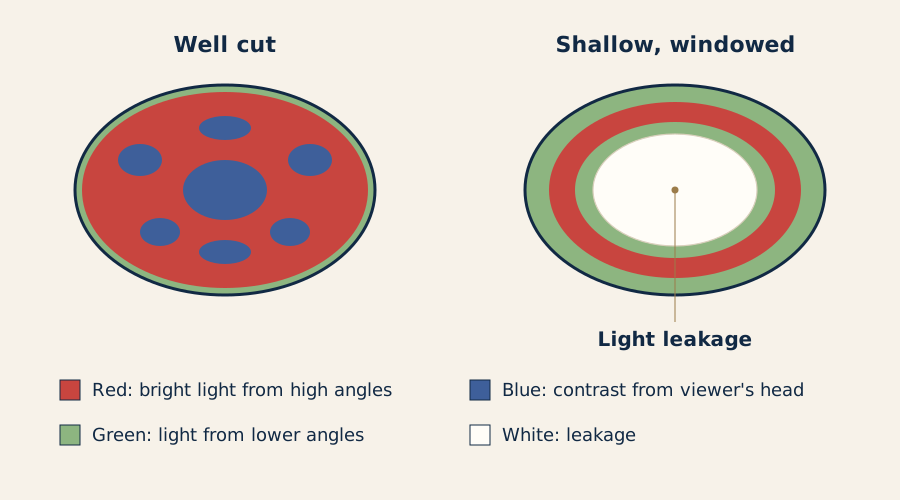
A small amount of leakage near the girdle of a fancy shape is common and usually invisible in wear. A clear patch in the centre or across the belly is the one to worry about. Our guide to reading ASET and Idealscope images walks through real examples. For rounds, the hearts and arrows viewer is a related tool, though it mainly shows optical symmetry (how precisely the facets line up) rather than leakage.
How is windowing different from nailhead, fisheye, bow-tie and extinction?
These five effects are often lumped together as 'dead spots', but they have different causes and look different. Telling them apart helps you work out what is wrong with a stone and whether it matters.
| Effect | What you see | Main cause | Shapes most affected |
|---|---|---|---|
| Windowing | Pale, see-through patch, usually central | Pavilion too shallow | Ovals, pears, marquises, emeralds, Asschers |
| Fisheye | Grey or white ring inside the table | Pavilion very shallow, so the girdle reflects | Rounds and some fancy shapes |
| Nailhead | Dark centre, like the head of a nail | Pavilion too deep | Rounds, princess cuts |
| Bow-tie | Dark band across the middle | Head obstruction and uneven angles in long shapes | Ovals, pears, marquises, hearts |
| Extinction | Dark areas that stay dark as the stone moves | Deep pavilions, steep crowns or poor facet angles | Any shape |
Windowing and fisheye sit at the shallow end of the scale; fisheye is essentially an extreme window where you can see the reflection of the girdle. Nailhead sits at the deep end. Our guides to the dark nailhead centre in deep stones and the grey fisheye ring in very shallow stones show each one with examples.
All of these effects reduce the three things people mean by sparkle: brilliance (white light return), fire (flashes of colour) and scintillation (the sparkle pattern as the stone moves). A window removes all three from the area it covers. Our page on brilliance, fire and scintillation explains how each is produced.
Is windowing always a problem in emerald and Asscher cuts?
Not always. Step cuts are meant to show broad flashes of light and dark across long facets, often called a 'hall of mirrors' look, rather than the busy sparkle of a brilliant. Some clarity through the table is normal and part of the appeal. The question is whether the centre still flashes as the stone moves, or stays flat and glassy in every position.
In practice, an emerald cut between about 61% and 69% total depth, with a table of roughly 60–70% of the width, usually shows a lively step pattern. Below about 60% the centre often goes flat. Asscher cuts, being deeper and squarer, tend to window less, but shallow ones exist. Because step cuts hide very little, a window also makes inclusions and body colour easier to see, so it is worth checking closely with an ASET image or a video against a dark background.
One tell-tale sign is that a windowed emerald cut looks good in photos taken straight on but dull on the hand, where the stone is seen at an angle and against skin. If you can, ask to see it tilted.
Does diamond windowing affect natural and lab-grown diamonds equally?
Yes. Windowing depends on how a stone is cut, not where it formed. Natural diamonds and laboratory-grown diamonds have the same refractive index of about 2.42 and the same critical angle of about 24.4°, so a shallow pavilion leaks light in exactly the same way in both. A lab-grown diamond is real diamond, grown in a laboratory rather than mined; it is graded on the same colour and clarity scales and judged on the same cut principles.
The economics of cutting can differ, though. With natural rough, cutters sometimes accept a shallower stone to keep more carat weight from an expensive crystal. With lab-grown rough, the crystal shape and price per carat are different, so the trade-offs change. Neither type is automatically better cut. The only reliable approach is to judge each stone on its proportions, video and reflector images.
Price also plays a part. Because lab-grown diamonds cost much less than natural diamonds of the same size and grades, it is often easier to choose a well-proportioned lab-grown stone without stretching the budget, rather than accepting a shallow one to reach a target size. With natural stones, a slightly smaller diamond that returns light well will usually look better than a larger one with a window.
Browse natural and lab-grown diamonds
How do you avoid a windowed diamond? Step by step
- Check the depth for the shape. Compare the total depth and table on the report with the typical ranges in the shape table above. Be cautious with ovals, pears and marquises under about 58%.
- For rounds, check the angles. GIA reports for round brilliants list crown and pavilion angles. Aim for a pavilion of about 40.6–41.0° with a crown of about 34–35°.
- Look at girdle thickness. A thick girdle can hide a shallow pavilion inside a normal-looking total depth. Thin to slightly thick is typical for well-cut stones.
- Compare spread to weight. If the millimetre measurements are noticeably larger than similar stones of the same carat weight, suspect a shallow cut.
- Watch a video on a dark background. Look for a centre that stays pale and glassy as the stone rocks, and ask for a view on a hand.
- Ask for an ASET or Idealscope image. White or clear patches in the centre or belly show leakage. Small clear areas near the girdle are common and usually fine.
- Try the read-through test on loose stones. Lay the diamond table-down on printed text. If you can clearly read the text through a brilliant cut, light is leaking through the pavilion (step cuts often allow some read-through even when well cut).
- Judge it by eye last. Look at the stone in daylight, office light and spot lighting. A good cut stays bright across the face in all three.
Free consultation
Talk to a gemologist
Compare stones in person or online with Raj Sood, Graduate Gemologist (GIA), AJP (GIA).
Book a consultationShop this shape
FAQ
Common questions
What does windowing look like in a diamond?
It looks like a pale, glassy patch, usually in the centre, where you can see through the diamond to whatever is behind it. The area has little sparkle and stays in the same place as the stone moves.
Is windowing in a diamond bad?
A strong window makes part of the diamond look dull and lifeless, and it can make inclusions and colour easier to see. A slight open look in an emerald or Asscher cut is normal, but a clear central window in a brilliant cut is a sign of a shallow pavilion worth avoiding.
Which diamond shapes window the most?
Ovals, pears, marquises and step cuts such as emerald and Asscher window most often. Well-proportioned round brilliants rarely window, because their angles are cut to tight standards.
Can you fix a windowed diamond?
Only by recutting the pavilion to a steeper angle, which loses weight and is not always possible from a shallow stone. In most cases it is more sensible to choose a better-proportioned diamond from the start.
Does a grading report show windowing?
Not directly. For round brilliants, a GIA cut grade and the listed angles flag likely leakage; for fancy shapes, you need to check depth, table and girdle figures, then confirm with video or an ASET image.
Do lab-grown diamonds window more than natural diamonds?
No. Lab-grown and natural diamonds have the same optical properties, so windowing depends only on how each stone is cut. Judge every diamond on its proportions and light performance, whatever its origin.

Ask a gemologist
Not sure which diamond to choose?
Raj Sood is a Graduate Gemologist (GIA) and master jeweller. Bring the stones you are considering, or send the reports, and he will tell you honestly which one is better and why.
Keep learning
Related guides
 Diamond Anatomy & LightASET and Idealscope Images Explained
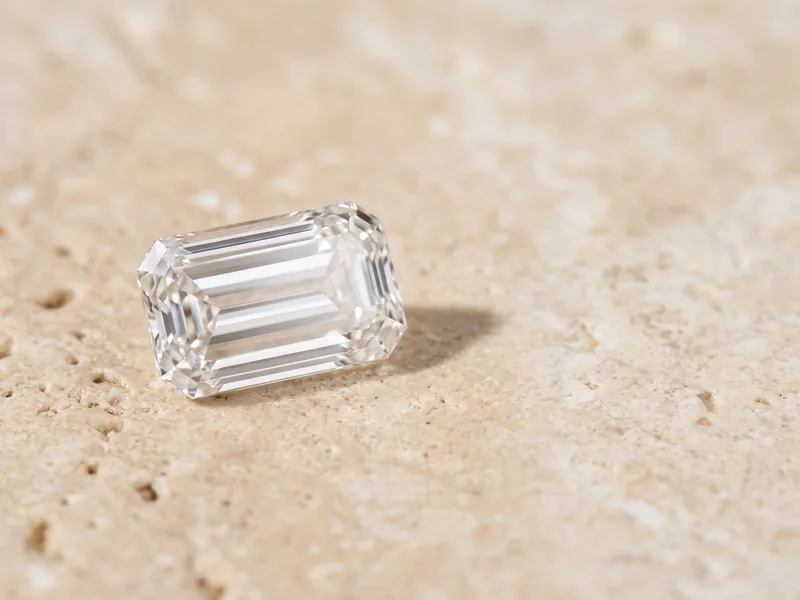 Diamond ShapesWhat Is Windowing in an Emerald-Cut Diamond?
 Diamond Anatomy & LightNailhead Effect in Diamonds
 Diamond Anatomy & LightFisheye Effect in DiamondsDiamond Anatomy & LightAnatomy of a diamond: table, crown, girdle, pavilion and culet explained
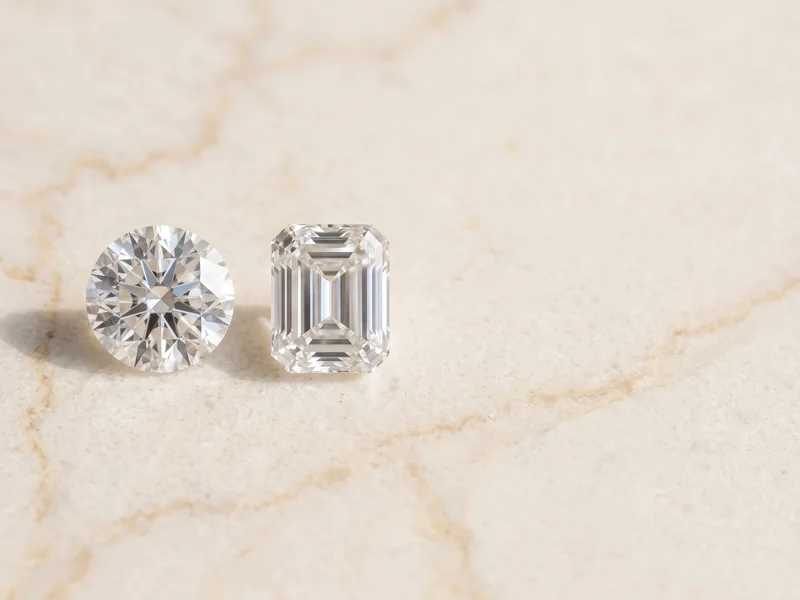 Diamond ShapesDiamond Shape Price ComparisonDiamond Anatomy & LightHearts and Arrows Viewer ExplainedDiamond Anatomy & LightDiamond Light Performance Guide
Explore more
More guides on this topic
Education