
- Education
- Natural Diamonds
- Conflict Free Diamonds: What the Term Means and How to Check It
Natural Diamonds
Conflict Free Diamonds: What the Term Means and How to Check It
The phrase 'conflict free' appears on countless diamond invoices, but it covers far less than most people assume. Here is what conflict free diamonds actually means, where the gaps are, and how Australia's own diamond history fits in.
 Reviewed by Raj Sood, Graduate Gemologist (GIA), AJP (GIA)Master jeweller and Graduate Gemologist (GIA) · reviewed 4 November 2026
Quick answer
Conflict free diamonds are diamonds that have not funded rebel wars, the narrow definition used by the Kimberley Process since 2003. That scheme certifies rough diamond shipments, but it does not cover human rights, labour or environmental harm. For more confidence, ask for the System of Warranties statement, the country of origin and any traceability or origin report.
What are conflict free diamonds?
In everyday use, a conflict-free diamond is one that did not help pay for a war. The formal definition is narrower. Under the Kimberley Process Certification Scheme (KPCS, an international system for trading rough diamonds), conflict diamonds are rough diamonds used by rebel movements or their allies to finance armed conflict aimed at undermining legitimate governments. Any diamond outside that category is, by this definition, conflict-free.
That wording was written in the early 2000s to stop one specific trade: rough diamonds from rebel-held areas of Sierra Leone, Angola and Liberia being swapped for weapons. It says nothing about how miners are paid, whether a government's own forces mistreat people near a mine, or what happens to the land afterwards. That gap is why many in the trade now use terms such as responsibly sourced or traceable instead, and why it helps to know exactly what each label promises.
A diamond's history does not change the stone itself. It is still carbon crystallised under enormous heat and pressure, 10 on the Mohs hardness scale, with a refractive index of about 2.42. Sourcing does not change how a diamond looks, but for many people it changes how it feels to wear. For the material itself, start with our complete guide to natural diamonds and what sets diamond apart from every other gem. Any unfamiliar word here is defined in our plain-English jewellery glossary.
Where did the term 'blood diamonds' come from?
'Blood diamonds' is the popular name for conflict diamonds. It took hold in the late 1990s, after investigations by campaign groups such as Global Witness and Partnership Africa Canada showed rebel armies trading rough diamonds for arms. In Sierra Leone's civil war (1991–2002), the Revolutionary United Front held alluvial diamond fields, meaning deposits in riverbeds and gravels where stones can be dug with shovels and sieves. Because alluvial diamonds need no heavy equipment, whoever controls the ground can mine them.
| Year | What happened |
|---|---|
| 1998 | UN Security Council bans trade in diamonds from rebel-held (UNITA) areas of Angola |
| 2000 | Producing countries meet in Kimberley, South Africa; the UN General Assembly backs a certification scheme |
| 2003 | The Kimberley Process Certification Scheme starts operating |
| 2011 | Global Witness leaves the scheme after exports from Zimbabwe's Marange fields are approved |
| 2013 | Central African Republic suspended after armed groups seize mining areas |
| 2018 | World Diamond Council widens its System of Warranties to cover human rights and labour rights |
| 2022 onward | Kimberley members cannot agree on Russian diamonds; G7 countries and the EU restrict Russian diamond imports from 2024 |
Estimates from the time suggest conflict diamonds made up roughly 4% of world production in the late 1990s, though some campaigners put it higher. The share is far smaller now, but the trade's map has also changed: see the countries that produce most of the world's diamonds for today's picture. Questions about where a diamond came from are also much older than the term itself, as several of the most famous diamonds in history were taken from colonised countries.
How does the Kimberley Process work?
The Kimberley Process is an agreement between governments, with the diamond industry and civil society groups as observers. It has about 60 participants representing around 85 countries, because the European Union counts as one participant. Members agree to trade rough diamonds only with other members, under these rules:
- Sealed shipments: every export of rough diamonds travels in a tamper-resistant container.
- Government certificate: each shipment carries a Kimberley Process certificate stating its value, weight and origin, issued by the exporting government.
- Import checks: the importing country confirms the certificate and refuses shipments from non-members.
- Internal controls: members must track rough diamonds from mine to export within their borders.
- Review visits and statistics: members report production and trade figures and are visited by peer reviewers.
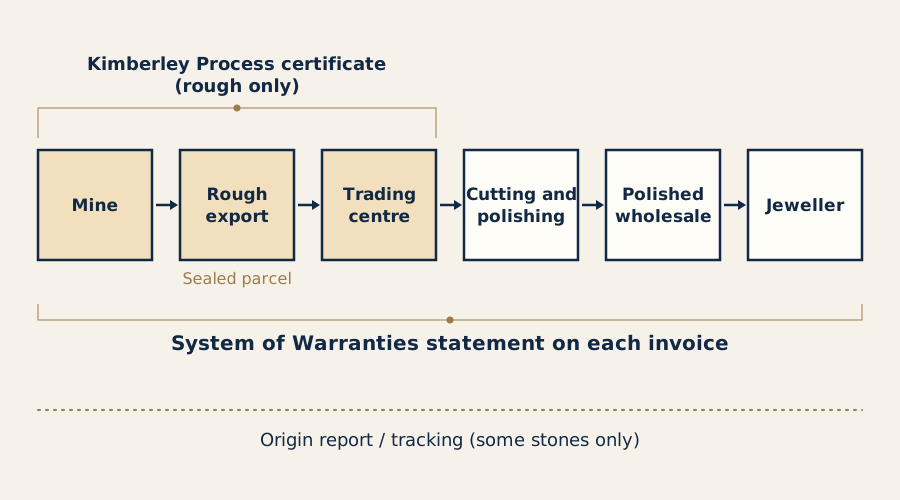
The certificate stays with the parcel only while the diamonds are rough. Once they are cut and polished, often after being mixed with goods from many sources in trading centres such as Antwerp, Dubai or Mumbai, the trade relies on the System of Warranties. This is a statement written on each invoice, from miner to retailer, that the diamonds come from legitimate sources not involved in funding conflict. Since 2018 the World Diamond Council's version also refers to human rights, labour rights, anti-corruption and anti-money-laundering principles. It is a self-declaration passed down the chain, not an independent audit of each stone.
For the rules, the voting system and the scheme's track record in detail, read our full explanation of the Kimberley Process.
Related guideThe Kimberley Process ExplainedAre Kimberley Process diamonds really conflict free?
By the scheme's own definition, the overwhelming majority of diamonds traded today are conflict-free. The scheme did help shrink the rebel diamond trade, and ending wars in Sierra Leone and Angola did the rest. But critics, including some groups that helped create it, point to real gaps:
- Governments are not covered. Violence by state forces does not count. In 2008, Zimbabwe's army killed scores of artisanal miners in the Marange fields, yet Marange exports were approved from 2011.
- Shipments, not stones. Certificates cover a parcel of rough, not each diamond, and parcels are often split and mixed after export.
- Rough only. Polished diamonds and finished jewellery fall outside the scheme.
- Decisions need consensus. Any single member can block a change, which is why members have not agreed a position on Russia, a producer of roughly a third of the world's diamonds by volume.
- Work conditions are outside its scope. Over a million people are estimated to dig diamonds by hand in artisanal mining (small-scale, informal digging), often for very low and irregular pay.
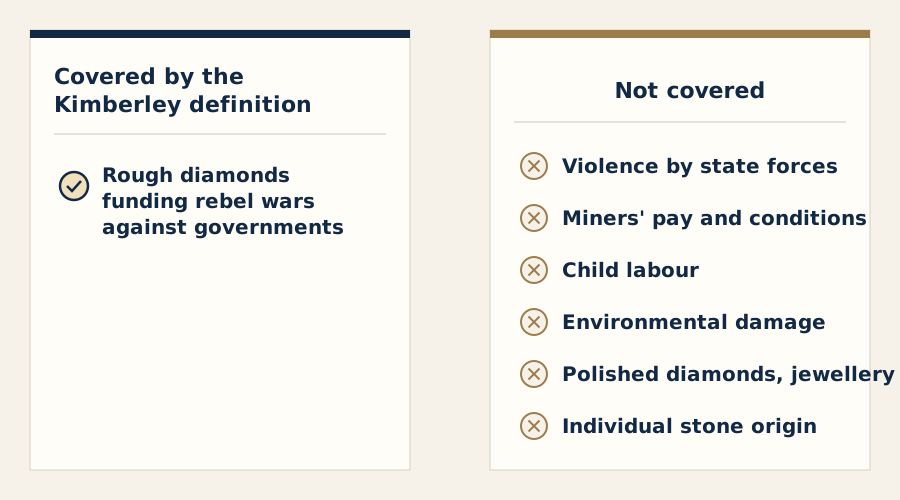
Global Witness left the scheme in 2011, and IMPACT (formerly Partnership Africa Canada) left in 2017, both saying the definition was too narrow. That does not make Kimberley-certified diamonds suspect. It means 'conflict-free' on an invoice is a minimum standard, not the whole story.
Not sure which one is right?
Send us the stones you are looking at and our gemologist will tell you which to choose and why.
Are Australian diamonds conflict free?
Australia is a Kimberley Process member, and its mines worked under Australian labour, safety and environmental law, so Australian-mined diamonds sit at the low-risk end on most measures, not just the conflict one. The best-known source was the Argyle mine in the East Kimberley region of Western Australia. The shared name with Kimberley in South Africa is a coincidence that confuses many people.
Argyle was discovered in 1979, began production in 1985 and closed in November 2020. Over its life it produced more than 865 million carats, mostly small brown diamonds, and it supplied over 90% of the world's pink diamonds. Geologically it was unusual: its diamonds came up in lamproite, a rare volcanic rock, rather than the kimberlite that hosts most diamond deposits. Our page on how natural diamonds form and reach the surface explains both. Argyle also operated under an agreement with the Traditional Owners of the land, signed in 2004, covering employment, benefits and site management.
Smaller Australian mines have come and gone, including Ellendale in Western Australia, known for yellow diamonds, which closed in 2015. With Argyle closed, newly mined Australian diamonds are now rare, and most Argyle stones on the market are already cut and circulating. The full story is in our history of the Argyle mine and Australian diamonds.
Canada is the other origin many Australians ask about. The Ekati (1998), Diavik (2003) and Gahcho Kué (2016) mines in the Northwest Territories operate under Canadian law, and some Canadian diamonds are tracked from mine to polished stone and carry a laser-inscribed serial number. See our guide to Canadian diamonds and how they are tracked. Botswana, the largest producer by value, is another frequently cited origin, where diamond revenue has funded schools, roads and health services.
Can a gemmologist tell where a diamond came from?
Not by looking at it, and not from a standard grading report. A report from GIA or IGI describes the stone (carat, colour, clarity, cut, measurements and whether it is natural or laboratory-grown), not the country it was mined in. Diamonds from different countries can look identical, and polished stones carry no visible stamp of origin.
Gemmology gives clues, not proof. Diamonds are grouped by the nitrogen and boron in their crystal: our guide to diamond types Ia, Ib, IIa and IIb explains each. About 98% of natural diamonds are Type Ia. A Type IIa or IIb stone is rarer, and some mines are known for particular types or colours, such as Argyle's pinks, but no type points to a single country.
Origin is proved by records, not by the stone. The main options are:
- Origin reports: some labs scan rough diamonds before cutting and match them afterwards, then issue a report naming the country of origin.
- Mine-to-market tracking: national or company programs, including Canadian schemes and blockchain-based records, follow individual stones through cutting.
- Laser inscription: a microscopic serial number on the girdle (the thin outer edge) links the stone to its paperwork.
- Supplier documents: invoices with the System of Warranties statement and, where known, the country of origin.
Origin is also a separate question from treatment. A natural diamond can be mined responsibly and then have its colour changed, for example with high-pressure, high-temperature treatment of natural diamonds, which must be disclosed on the report.
How do natural, lab-grown and recycled diamonds compare on sourcing?
There are several ways to reduce sourcing risk, and each answers a slightly different question. This comparison sets them side by side:
| Option | Conflict risk (Kimberley definition) | What you can verify | Questions still worth asking |
|---|---|---|---|
| Natural, with origin report or tracking | Very low | Country of origin, often the mine | Labour and environmental standards at that mine |
| Natural, System of Warranties only | Low | A written warranty on the invoice | Country of origin; how far back the supplier can trace it |
| Lab-grown (laboratory-grown) | Not applicable: not mined | Grower or country, if the supplier discloses it | Energy source and factory conditions; evidence for any environmental claim |
| Antique or old-stock natural | Unknown but no new mining | Age and style of cut, rarely origin | Condition and any repairs or treatments |
| Your own family diamond, reset | Unknown, no new mining | Its history within your family | Condition of the stone and old setting |
Lab-grown diamonds are real diamond, grown in a laboratory rather than mined, so the Kimberley definition does not apply to them. That does not make 'conflict-free' a complete ethical description: growing diamonds uses a lot of electricity, and factory conditions vary. Australian consumer law expects any environmental claim to be backed by evidence. Our guide to whether lab-grown diamonds can fairly be called conflict-free covers the wording in detail.
Antique and old-stock diamonds, such as Old European and old mine cuts, were cut decades or more than a century ago; buying one adds no new mining. Their origin is rarely recorded, and many predate the Kimberley Process. See our guide to buying old-stock and antique diamonds. The simplest option of all is resetting a diamond already in your family into a new design.
The metal deserves the same questions as the stone. If you have sensitive skin, it also matters what the alloy contains: our page on nickel-free metals for sensitive skin explains which golds and platinum alloys suit.
Does a diamond's origin affect its price?
Usually only a little. Most natural diamonds are priced on carat, colour, clarity and cut, and two stones with the same grades sell for similar amounts regardless of origin. Documented origin can add a modest premium, and some named origins add more: Argyle pinks in particular have attracted strong prices since the mine closed, because supply has stopped. Canadian-tracked stones often cost a little more than an equivalent stone without origin records.
Origin should be a reason you choose a diamond, not a forecast of what it will be worth later. Natural diamond resale values are usually well below retail, and prices have fallen as well as risen; our page on how natural diamond prices have moved over the decades sets out the history honestly.
How do you buy conflict free diamonds in Australia? Step by step
- Confirm what the stone is. Check the grading report states natural or lab-grown, and note the report number and any laser inscription.
- Ask for the country of origin. Ask in writing, and ask what document supports the answer.
- Check the invoice. Look for the System of Warranties statement on the paperwork you receive.
- Ask about tracking. If origin matters to you, ask for a stone with an origin report or a mine-to-market tracking record.
- Question vague labels. If a stone is described as 'ethical' or 'responsible', ask exactly what the claim covers and what evidence backs it.
- Consider stones already in circulation. Antique, old-stock or family diamonds add no new mining.
- Ask the same about the metal. Where the gold or platinum comes from is part of the same picture.
Browse natural diamonds
Free consultation
Talk to a gemologist
Compare stones in person or online with Raj Sood, Graduate Gemologist (GIA), AJP (GIA).
Book a consultationShop this shape
FAQ
Common questions
What is the difference between conflict free diamonds and blood diamonds?
Blood diamonds, or conflict diamonds, are rough diamonds sold by rebel groups to fund wars against governments. Conflict-free diamonds are simply diamonds outside that definition, which is narrow and does not cover labour or human rights issues more broadly.
Are all diamonds sold in Australia conflict free?
Australia is a Kimberley Process member, so rough diamonds can only be imported with a Kimberley certificate, and polished diamonds usually come with a System of Warranties statement. These make conflict diamonds very unlikely, but they are paperwork systems, not stone-by-stone audits.
Are Argyle diamonds conflict free?
Yes. Argyle was a large, regulated mine in Western Australia operating under Australian law and the Kimberley Process. The mine closed in 2020, so Argyle stones on the market today were mined before then.
Can I find out which country my diamond came from?
Only through records. A standard grading report does not state origin, but some diamonds come with an origin report, a tracking record or supplier paperwork naming the country.
Are lab-grown diamonds conflict free?
Lab-grown diamonds are not mined, so the Kimberley conflict definition does not apply to them. Questions about energy use and factory conditions still apply, and any environmental claim should be backed by evidence.
Is the Kimberley Process still working?
It still controls the legal trade in rough diamonds between member countries. Critics say its definition is too narrow and its consensus rule makes reform difficult, which is why several campaign groups have left it.

Ask a gemologist
Not sure which diamond to choose?
Raj Sood is a Graduate Gemologist (GIA) and master jeweller. Bring the stones you are considering, or send the reports, and he will tell you honestly which one is better and why.
Keep learning
Related guides
 Natural DiamondsThe Kimberley Process ExplainedNatural DiamondsArgyle Mine and Australian Diamonds
 Lab-Grown DiamondsAre Lab-Grown Diamonds Conflict-Free? How to Use the Term Carefully
 Natural DiamondsWhere Diamonds Are MinedNatural DiamondsNatural Diamonds Guide
 MetalsMetal Allergies and Nickel-Free OptionsNatural DiamondsWhat Makes a Diamond Special?
 Natural DiamondsDiamond Types Ia, Ib, IIa and IIb
Explore more
More guides on this topic
Education