
- Education
- Diamond Anatomy & Light
- Diamond Length to Width Ratio: The Complete Guide by Shape
Diamond Anatomy & Light
Diamond Length to Width Ratio: The Complete Guide by Shape
The ratio decides whether an oval looks slim or chubby, a pear graceful or stubby, and how large the stone looks on the hand. Here are the numbers for every major shape, how to work them out from a report, and what the ratio cannot tell you.
 Reviewed by Raj Sood, Graduate Gemologist (GIA), AJP (GIA)Master jeweller and Graduate Gemologist (GIA) · reviewed 4 November 2026
Quick answer
A diamond length to width ratio is the stone's length divided by its width, taken from the grading report measurements. Rounds should sit at 1.00–1.01. Popular ranges are about 1.35–1.50 for ovals, 1.50–1.75 for pears, 1.85–2.10 for marquise, 1.30–1.50 for emerald cuts and 1.00–1.05 for square shapes. Choose by eye within that range.
What is a diamond length to width ratio?
The length-to-width ratio (often written L/W) compares how long a diamond is with how wide it is, seen face-up from above. A ratio of 1.00 means the outline is exactly as wide as it is long, like a round or a square princess. A ratio of 1.50 means the stone is one and a half times as long as it is wide, like a slim oval.
It is purely a measure of the outline. It says nothing about the depth, the angles or the facets underneath, which live in the crown, girdle and pavilion covered in our guide to the parts of a diamond. That is why two stones with the same diamond length to width ratio can look quite different: one may be bright and lively, the other flat or dark through the middle.
Ratio matters most for fancy shapes, meaning anything that is not round. GIA gives an overall cut grade only to round brilliants, so for ovals, pears, marquise, emeralds, radiants and cushions the ratio is one of the few hard numbers you have to judge the shape, alongside the polish and symmetry grades and the depth and table percentages.
How do you calculate diamond length to width ratio?
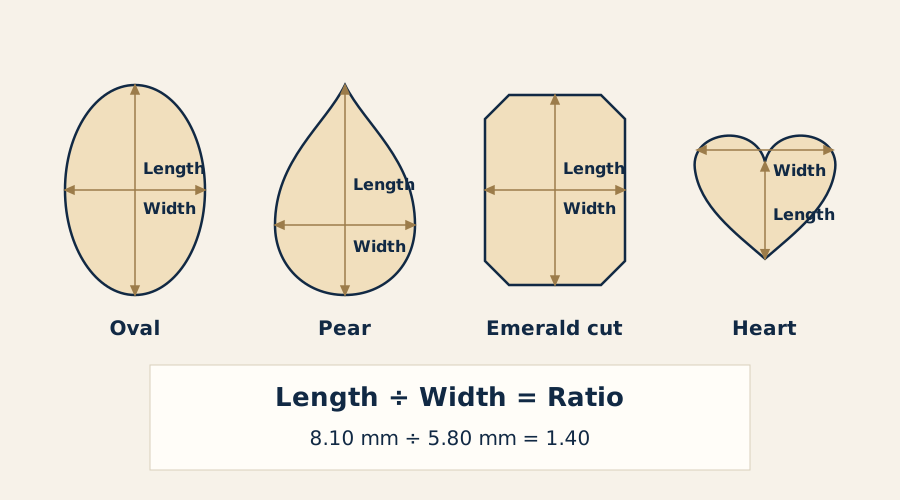
Find the measurements line on the grading report. It is written as length × width × depth in millimetres, for example 8.10 × 5.80 × 3.55 mm. Divide the first number by the second: 8.10 ÷ 5.80 = 1.397, which rounds to 1.40. The third number (depth) is not part of the ratio.
- Rounds: the report gives a minimum and maximum diameter, such as 6.42–6.46 × 3.98 mm. Divide the larger by the smaller: 6.46 ÷ 6.42 = 1.006. This tells you how truly round the stone is.
- Hearts: length runs from the point to the top of the lobes and width across the lobes, so the ratio often sits a little below 1.00. Check which figure the report lists first before you divide.
- Square shapes: princess, Asscher, and square cushions and radiants should measure between 1.00 and 1.05. Above that, one side starts to look visibly longer.
- East-west settings: the ratio does not change when a stone is turned sideways. It is always the long side divided by the short side.
Measurements are taken to a hundredth of a millimetre, so small ratio differences are real but hard to see. Moving from 1.40 to 1.42 on a 1 carat oval is roughly 0.1–0.2 mm of extra length, less than the thickness of a claw. Treat the ratio as a range to aim for, not a target to hit to the second decimal place. If any report terms are new to you, our jewellery glossary defines them in plain English.
What is the ideal length to width ratio for each diamond shape?
There is no official ideal ratio for fancy shapes. The ranges below are what cutters commonly produce and what most buyers choose. Outside them, a stone is not wrong, just less typical, and it is worth looking at closely to see whether you like the outline.
| Shape | Usual range | Most-chosen range | What happens outside it |
|---|---|---|---|
| Round | 1.00–1.02 | 1.00–1.01 | Above about 1.02 it can start to look slightly oval |
| Oval | 1.25–1.60 | 1.35–1.50 | Below 1.30 looks round and chubby; above 1.55 very slim |
| Pear | 1.40–1.80 | 1.50–1.75 | Below 1.45 looks short and wide; above 1.75 a narrow teardrop |
| Marquise | 1.70–2.40 | 1.85–2.10 | Below 1.75 looks stubby; above 2.20 the points look thin and exposed |
| Emerald | 1.25–1.60 | 1.30–1.50 | Near 1.00–1.05 it reads as a square emerald, close to an Asscher; above 1.55 a long, narrow step cut |
| Radiant (rectangular) | 1.15–1.50 | 1.20–1.35 | Lower ratios look almost square; higher ones look long and narrow |
| Cushion (elongated) | 1.10–1.30 | 1.15–1.25 | Below 1.08 it reads as a square cushion |
| Square cushion, radiant, princess, Asscher | 1.00–1.05 | 1.00–1.03 | Above 1.05 one side looks noticeably longer |
| Heart | 0.85–1.15 | 0.90–1.10 | Below 0.90 wide and squat; above 1.10 close to a pear |
Each popular shape has its own habits. Ovals are among the most ratio-sensitive engagement stones, and our guide to the right ratio for an oval compares 1.30, 1.40 and 1.50 side by side. Pears carry a rounded end and a point, so the pear ratio guide looks at how the shoulders change as the stone lengthens.
The marquise has two points and is the longest of the common shapes; see marquise proportions and point safety for why very high ratios need careful setting. Step cuts behave differently because their long, open facets show the outline plainly: our emerald-cut ratio guide covers the classic rectangle, and the radiant ratio guide explains the square-to-rectangle range for that brilliant-faceted cousin.
Does ratio change how big a diamond looks?
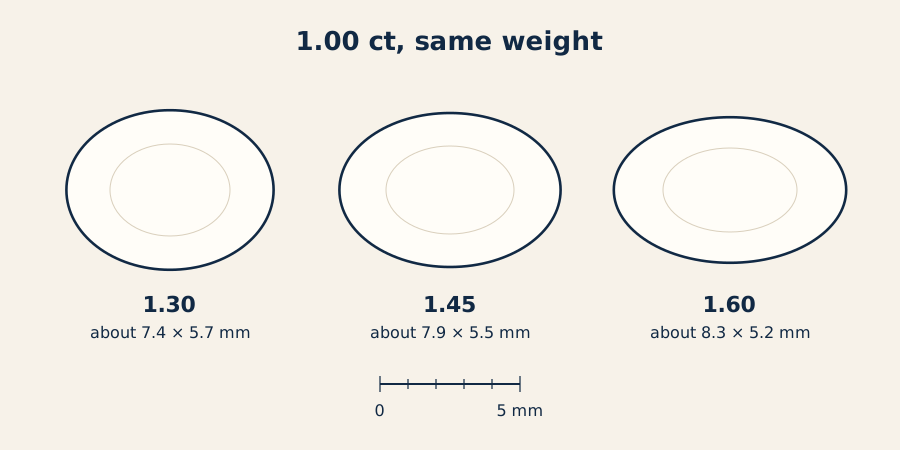
Yes. Carat is a measure of weight, not size, and the ratio decides how that weight is spread across the outline. For the same carat weight, a higher ratio adds length and takes away width. Most people read length as size, so a slimmer stone often looks a little larger on the finger, even though the face-up area is about the same.
| 1.00 ct stone | Ratio | Typical face-up size |
|---|---|---|
| Round | 1.00 | about 6.3–6.5 mm across |
| Oval | 1.30 | about 7.4 × 5.7 mm |
| Oval | 1.45 | about 7.9 × 5.5 mm |
| Oval | 1.60 | about 8.3 × 5.2 mm |
| Pear | 1.55 | about 8.5 × 5.5 mm |
| Marquise | 2.00 | about 10.0 × 5.0 mm |
| Emerald | 1.40 | about 7.0 × 5.0 mm |
| Square cushion | 1.02 | about 5.8 × 5.7 mm |
These are typical figures, not rules. Depth and girdle thickness change them a lot. A stone cut deep, or with a heavy girdle, carries weight where you cannot see it and faces up smaller than its carat suggests. Fancy shapes often have a thicker girdle at the points to protect them, which is sensible, but an extremely thick one is weight you pay for and never see; how girdle thickness affects size and durability explains the grades from very thin to extremely thick.
Elongated shapes also tend to look larger face-up than a round of the same weight, simply because their outline covers more of the finger lengthwise. That is a real reason many people choose an oval, pear or marquise over a round, but it should never be the only reason.
Not sure which one is right?
Send us the stones you are looking at and our gemologist will tell you which to choose and why.
Does the diamond length to width ratio affect sparkle?
Only indirectly. Sparkle comes from how light enters, bounces inside and leaves the stone, and that is decided by the pavilion and crown angles and the depth, not the outline. A perfectly proportioned 1.40 oval and a dull 1.40 oval have the same ratio. What the ratio does change is how hard it is for the cutter to get the angles right along every part of the stone.
- Bow-tie: elongated brilliants such as ovals, pears and marquise often show a dark band across the width. Its strength depends mostly on the pavilion angles, not the ratio, so judge it on video.
- Windows: long, slim stones are sometimes cut shallow to keep the face-up size up. Light then passes straight through the ends, leaving a pale, see-through patch. Our page on windowing in each diamond shape shows where it tends to appear.
- Leakage: windows are one form of light escaping through the pavilion, which makes a stone look less bright than its grades suggest.
- Nailhead: a stone cut too deep can show a dark centre, because light leaks out the sides instead of returning to your eye. The nailhead effect is most often seen in rounds and brilliant-cut fancy shapes.
- Fisheye: a stone cut too shallow reflects its own girdle as a grey ring under the table. The fisheye ring is easy to spot once you know what to look for.
- Dark zones: some areas will always go dark as the stone moves. Extinction and dark zones explains the difference between normal contrast and a stone that looks dead in places.
Two tools show this better than any photo. An ASET or Idealscope image uses colour to map where a diamond gathers light and where it leaks, so a slim pear with windowed ends shows up plainly. Learn to read them in our guide to ASET and Idealscope maps. Remember too that a hazy or cloudy stone looks flat whatever its outline; diamond transparency and haze explains why this is not always shown on the report.
Related guideASET and Idealscope Images ExplainedWhy does ratio matter for round diamonds?
For a round brilliant, the ratio is a check of roundness. A well-cut round measures 1.00 to about 1.01, meaning the widest and narrowest diameters differ by less than about 1%. On a 6.4 mm stone that is under 0.07 mm, invisible to the eye.
Once the difference grows towards 1.02 or more, the stone is described as out-of-round. It may look slightly oval in a tight claw setting, and a cutter may have left it that way to save weight from the rough. GIA's symmetry grade takes roundness into account, but the ratio is a quick way to see it for yourself.
Roundness also matters for optical symmetry. The hearts and arrows pattern only appears when the facets are lined up precisely around a true circle; see how the hearts and arrows viewer reveals this. Whether that level of precision is worth extra money is a fair question, and what you pay for in a hearts and arrows diamond gives a straight answer.
Which ratio suits your hand and your setting?
On the hand, a higher ratio draws the eye along the finger and tends to make fingers look longer and slimmer. A lower ratio sits wider across the finger and looks fuller and softer. Neither is better; it depends on the look you want and the shape of your hand.
- Shorter or wider fingers: many people like an oval around 1.40–1.50, a pear around 1.60–1.70 or a marquise near 2.00, as the extra length balances the hand.
- Long, slim fingers: a fuller ratio, such as a 1.30–1.35 oval, can fill the finger without looking stretched.
- Small hands with a large stone: a very long stone can overhang the finger on either side once you add claws and a halo, so try it on before deciding.
- East-west settings: turning an oval, pear or marquise sideways works best at moderate ratios; a very long stone set sideways can run past the edges of the finger.
The band changes the picture too. A slim stone on a heavy band can look smaller than it is, while a fine band lets the outline lead. Our guide to choosing an engagement ring band width matches widths to stone sizes. For pendants, pears and ovals hang point-down or lengthwise, and the ratio decides how much they draw the eye downwards; pair it with the right chain using our guide to necklace lengths.
What else should you check alongside the ratio?
The ratio tells you the outline. These tell you how well that outline was cut:
- Depth percentage: depth divided by width. For most elongated brilliants, roughly 58–66% is a sensible window; much deeper and the stone faces up small, much shallower and it may window.
- Table percentage: the width of the top facet compared with the stone's width. Very large tables can reduce fire in fancy shapes.
- Girdle: thin to slightly thick is common; watch for very thin edges at the points of pears and marquise.
- Culet: many elongated stones have no culet or a keel line instead of a point; a large culet shows as a dark spot, as covered in what a culet is and when it shows.
- Symmetry of the outline: even shoulders on a pear, matching ends on a marquise, and straight, parallel sides on an emerald cut. The report's symmetry grade reflects this only in part, so look at the outline yourself.
- Video and light images: a 360° video and an ASET or Idealscope image show bow-ties, windows and dark zones that no number reveals.
Do natural and lab-grown diamonds have different ratios?
No. The ratio is a cutting decision, not a property of where the diamond came from. Natural and laboratory-grown diamonds are cut into the same shapes and to the same range of ratios, graded on the same scales, and look identical to the eye. The main difference is price: lab-grown diamonds cost much less than natural diamonds of the same size and grades, which makes it easier to find a lab-grown stone at exactly the ratio you want.
With natural diamonds, the shape of the rough crystal often guides the cutter, so unusual ratios turn up more often and it can take longer to find a specific one in a larger size. Natural stones are rarer and hold that rarity; lab-grown stones are a different product made in a laboratory, not an imitation. Whichever you choose, ask for an independent grading report so the measurements are verified.
Browse natural and lab-grown diamonds in our stock
How to choose the right ratio: step by step
- Choose the shape first. Decide on oval, pear, marquise, emerald or another shape before worrying about numbers.
- Find the usual range. Use the table above to see where most stones of that shape sit.
- Calculate each stone's ratio. Divide the first measurement on the report by the second and round to two decimals.
- Compare face-up size. Check length and width in millimetres, not just carat, and note the depth percentage.
- Look at light, not just outline. Watch a 360° video and, where available, an ASET or Idealscope image for windows, bow-ties and dark zones.
- Try it with the setting. Picture the claws, band width and finger together, or try a similar shape on, before committing.
Free consultation
Talk to a gemologist
Compare stones in person or online with Raj Sood, Graduate Gemologist (GIA), AJP (GIA).
Book a consultationShop this shape
FAQ
Common questions
What is a good length to width ratio for a diamond?
It depends on the shape. Rounds should be 1.00–1.01, ovals about 1.35–1.50, pears 1.50–1.75, marquise 1.85–2.10, emerald cuts 1.30–1.50 and square shapes 1.00–1.05.
How do I calculate a diamond's length to width ratio?
Divide the length by the width, using the first two measurements on the grading report. For example, an 8.10 × 5.80 mm oval has a ratio of about 1.40.
Does a higher ratio make a diamond look bigger?
It usually makes it look longer, which many people read as bigger. The face-up area at the same carat weight stays roughly the same, and depth affects size more than the ratio does.
Does the length to width ratio affect sparkle?
Not directly. Sparkle depends on the angles and depth, but very long stones cut shallow can window at the ends, so check a video or ASET image as well as the ratio.
Is the ratio shown on a GIA report?
The ratio itself is not usually printed, but the measurements are, so you can work it out in a few seconds. Many online listings calculate it for you.
What does out-of-round mean?
It describes a round diamond whose widest and narrowest diameters differ noticeably, usually a ratio above about 1.02. Such stones can look slightly oval in a claw setting.

Ask a gemologist
Not sure which diamond to choose?
Raj Sood is a Graduate Gemologist (GIA) and master jeweller. Bring the stones you are considering, or send the reports, and he will tell you honestly which one is better and why.
Keep learning
Related guides
 Diamond ShapesBest Length-to-Width Ratio for an Oval Diamond?
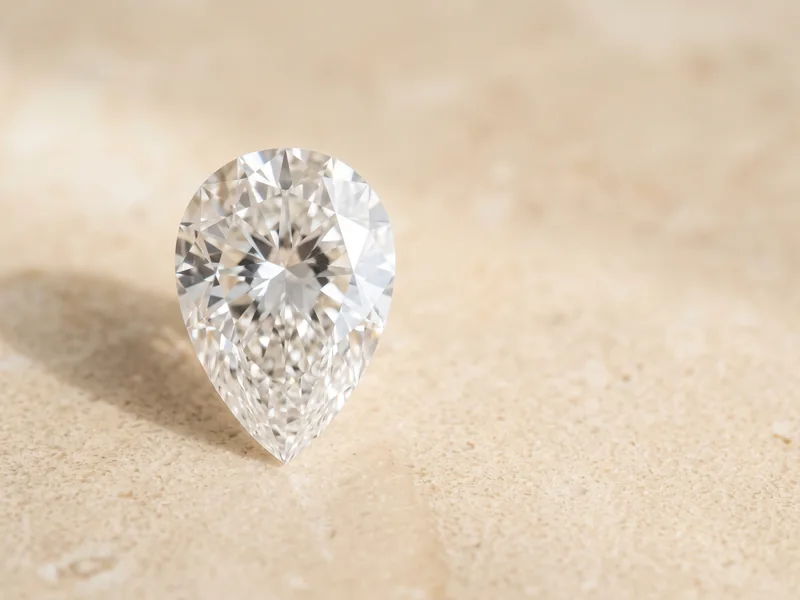 Diamond ShapesPear Diamond Length-to-Width Ratio Guide
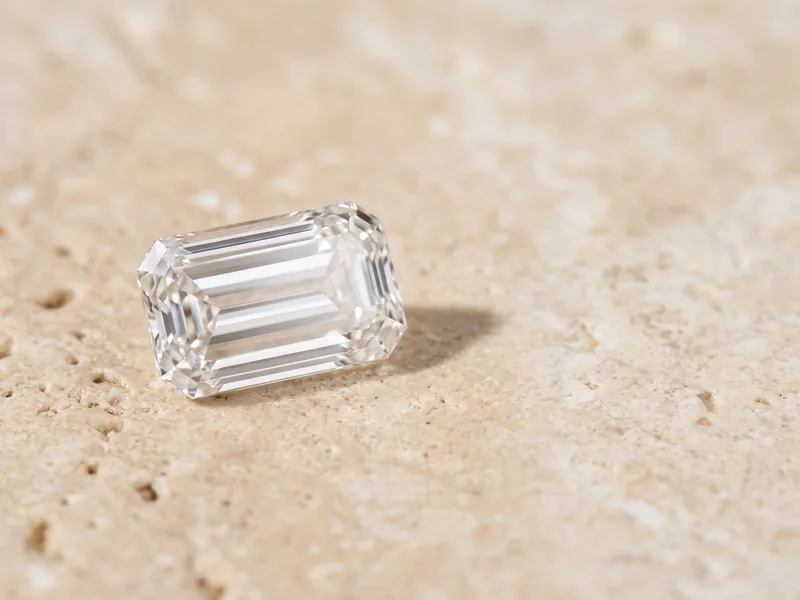 Diamond ShapesEmerald-Cut Diamond Length-to-Width Ratio
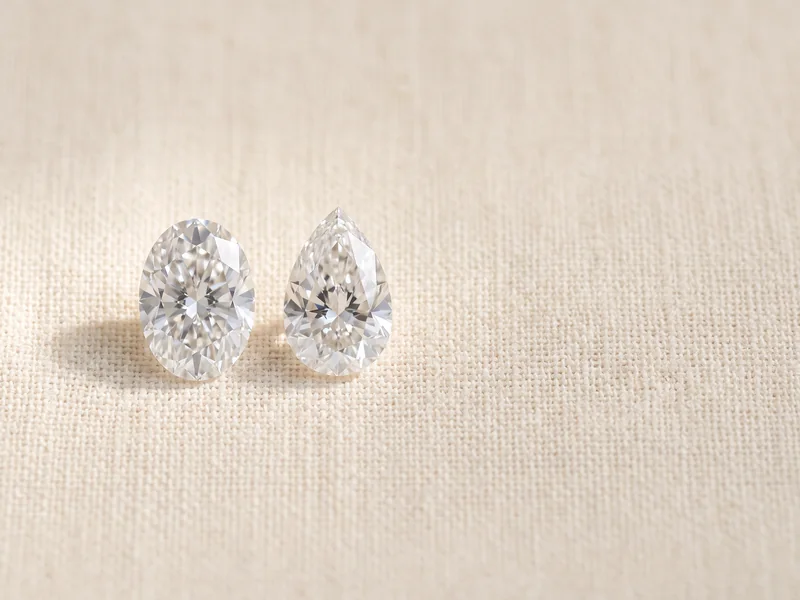 Diamond ShapesMarquise Diamond Length-to-Width RatioDiamond Anatomy & LightAnatomy of a diamond: table, crown, girdle, pavilion and culet explained
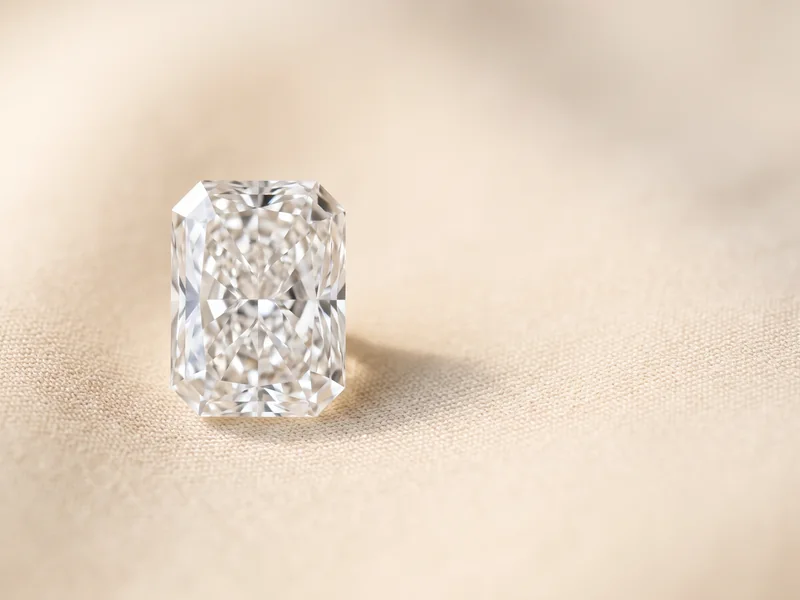 Diamond ShapesRadiant Diamond Length-to-Width Ratio Guide
 Jewellery TypesNecklace Length Guide
 Engagement Rings & SettingsWhat Engagement Ring Band Width Should You Choose?
Explore more
More guides on this topic
Education