
- Education
- Diamond Anatomy & Light
- Nailhead Effect in a Diamond: What Causes the Dark Centre and How to Avoid It
Diamond Anatomy & Light
Nailhead Effect in a Diamond: What Causes the Dark Centre and How to Avoid It
A nailhead effect diamond looks dark in the middle, however well it is graded for colour and clarity. Here is what causes it, how to spot it before you buy, and the proportions that keep it away.
 Reviewed by Raj Sood, Graduate Gemologist (GIA), AJP (GIA)Master jeweller and Graduate Gemologist (GIA) · reviewed 4 November 2026
Quick answer
The nailhead effect is a dark or grey patch in the centre of a diamond, under the table, caused by a pavilion cut too steep and deep. Light entering the middle leaks out or returns away from your eye. In a round, avoid pavilion angles above about 42° and total depth above about 64%. ASET images show it clearly.
What is the nailhead effect in a diamond?
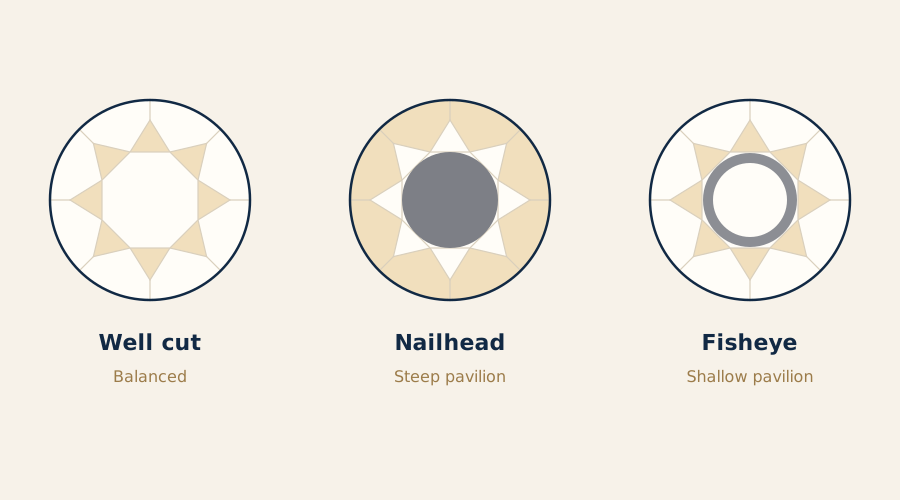
The nailhead effect is a dark, grey or dull area in the centre of a diamond, seen through the table (the large flat facet on top). The name comes from the look: a dark round spot in the middle, like the flat head of a nail sitting under the glass. The edges of the stone may still sparkle, but the middle looks lifeless, almost as if the diamond has a shadow inside it.
It is a cut problem, not a colour or clarity problem. A D-colour, flawless diamond can show a nailhead, and an H-colour SI1 can be bright right across the face. To understand why, it helps to know the basic parts of the stone: the crown (the top section above the widest edge), the girdle (the widest edge itself), the pavilion (the cone-shaped lower half) and the culet (the point or tiny facet at the very bottom). Our guide to the parts of a diamond from table to culet covers each one with diagrams, and any unfamiliar word here is also in our jewellery terms glossary.
A diamond's sparkle depends on light entering through the top, bouncing off the pavilion facets and coming back up to your eye. That returned light is what we call brightness, or brilliance; the flashes of colour are fire; and the on-off sparkle as the stone moves is scintillation. Our explainer on how brilliance, fire and scintillation work goes deeper. A nailhead is simply what you see when the centre of the stone stops returning light.
What causes the nailhead effect in a diamond?
The main cause is a pavilion that is too steep, which also makes the diamond too deep overall. Diamond has a refractive index of about 2.42, which gives it a critical angle of about 24.4°. The critical angle is the cut-off point: light striking an inside surface at more than 24.4° from straight-on is reflected back inside, while light striking closer to straight-on passes out through that surface. Cutters set the pavilion angle so that most light entering the top is reflected twice and sent back up through the crown.
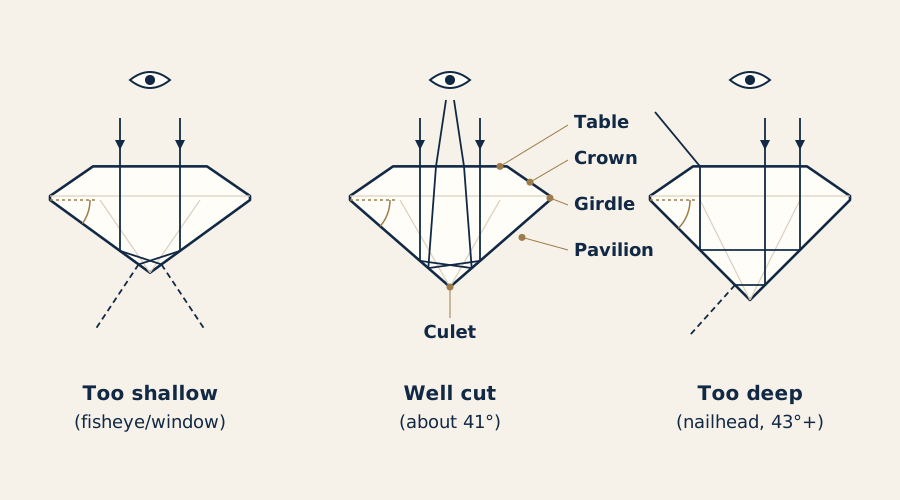
In a round brilliant, a pavilion angle of about 40.6–41° does this efficiently. As the angle climbs past about 42°, more of the light entering the centre of the table strikes the pavilion at angles that let it leak out through the bottom or sides, or returns it steeply towards areas blocked by your own head and shoulders. Either way, little light reaches your eye from the middle, and you see a dark patch. The steeper the pavilion, the larger and darker that patch tends to be.
| Round brilliant measurement | Well-cut range (approx.) | Nailhead risk (approx.) |
|---|---|---|
| Pavilion angle | 40.6–41.0° | Above about 42°, strong above 42.5–43° |
| Pavilion depth | 42.5–43.5% | Above about 45% |
| Total depth | 59–62.5% | Above about 64–65% |
| Crown angle | 34–35° | Steep crowns (36°+) with a steep pavilion make it worse |
| Table | 54–58% | Less important on its own; matters in combination |
Crown and pavilion work together. A slightly steep pavilion paired with a slightly shallow crown can still perform well, while a steep crown on top of a steep pavilion makes the dark centre worse. That is why no single number decides it; our page on crown and pavilion angles in detail shows how the combinations interact, and how table and depth percentages are measured explains where these figures sit on a grading report.
Why would anyone cut a diamond too deep? Weight. A deep pavilion keeps more of the rough crystal, and carat weight is what drives the price. A cutter who can push a stone over 1.00 carat by leaving extra depth underneath will often do so, even though the finished diamond looks smaller and darker face-up than a well-cut 0.95 carat.
Nailhead vs fisheye, bow-tie and windowing: what is the difference?
Several cut-related effects make part of a diamond look dark or washed out, and they are easy to confuse. The key is where the problem sits and what causes it.
| Effect | What you see | Main cause | Shapes most affected |
|---|---|---|---|
| Nailhead | Dark or grey centre under the table | Pavilion too steep and deep | Rounds, princess, cushion, radiant |
| Fisheye | Grey or white ring inside the table | Pavilion too shallow; the girdle reflects in the table | Rounds and most brilliants |
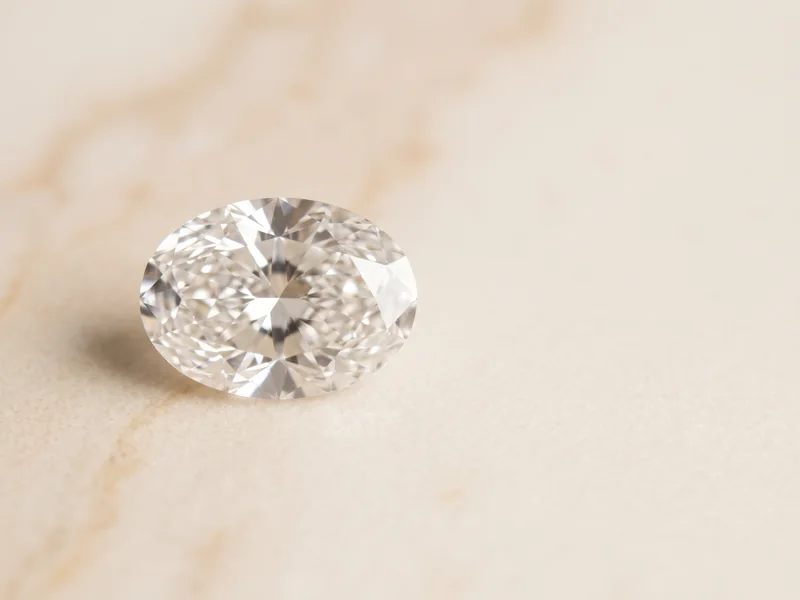
| Bow-tie | Dark band across the middle, shaped like a bow-tie | Elongated outline; light leaks along the short axis | Oval, pear, marquise, heart |
| Windowing | Washed-out, see-through centre | Pavilion too shallow; light passes straight through | Ovals, emeralds, any shallow stone |
| Extinction | Dark zones that shift as the stone moves | Light blocked or leaking at certain angles | Any shape; worst in deep or poorly cut stones |
The nailhead and the fisheye are opposites. A nailhead comes from a pavilion that is too steep; the fisheye effect, the shallow-pavilion opposite comes from one that is too flat, so the stone shows a reflection of its own girdle as a grey ring. Windowing is the shallow-stone cousin of the fisheye: the centre turns glassy and you can read print through it. You can see how it varies from round to oval to emerald in our guide to windowing in different shapes.
The bow-tie is specific to elongated shapes, and a soft one is normal; our page on the bow-tie shadow in elongated shapes explains when it becomes a fault. A deep oval or pear can show both a heavy bow-tie and a dark centre at once. Some darkness is also normal in every diamond: small dark areas that flicker as the stone moves add contrast. The line between healthy contrast and a problem is covered under extinction and other dark zones.
In rounds you may also hear about painting and digging out, where cutters adjust the girdle facets to change how light and dark are spread around the edge. These affect the outer ring of the stone rather than the centre, so they are separate from a nailhead; see painting and digging out of girdle facets.
Related guideFisheye Effect in DiamondsWhich diamond shapes are prone to a nailhead?
Any brilliant-cut diamond can show a nailhead if it is cut too deep, but some shapes are more exposed because they are often cut deep to save weight, or because they have no overall cut grade to warn you. GIA gives round brilliants a cut grade from Excellent to Poor, and a round graded Excellent is unlikely to show a strong nailhead. Fancy shapes have no GIA cut grade, so you have to judge the proportions yourself.
| Shape | Typical well-cut total depth (approx.) | Dark centre becomes more likely (approx.) | What to watch |
|---|---|---|---|
| Round brilliant | 59–62.5% | Above 64–65%, pavilion over 42° | Check the cut grade and pavilion angle |
| Princess | 64–75% | Above about 76–78% | Deep princess cuts often show a dark cross or centre |
| Cushion (modified brilliant) | 61–68% | Above about 70% | Deep 'crushed ice' cushions can look grey in the middle |
| Radiant | 61–67% | Above about 70% | Dark centre plus a muddy, hazy look |
| Oval, pear, marquise | 58–64% | Above about 66% | Heavy bow-tie combined with a dark belly |
| Heart | 56–62% | Above about 64% | Dark centre spreads into the bow-tie area |
| Emerald, Asscher (step cuts) | 60–70% | Above about 72% | Dull, grey middle with few broad flashes |
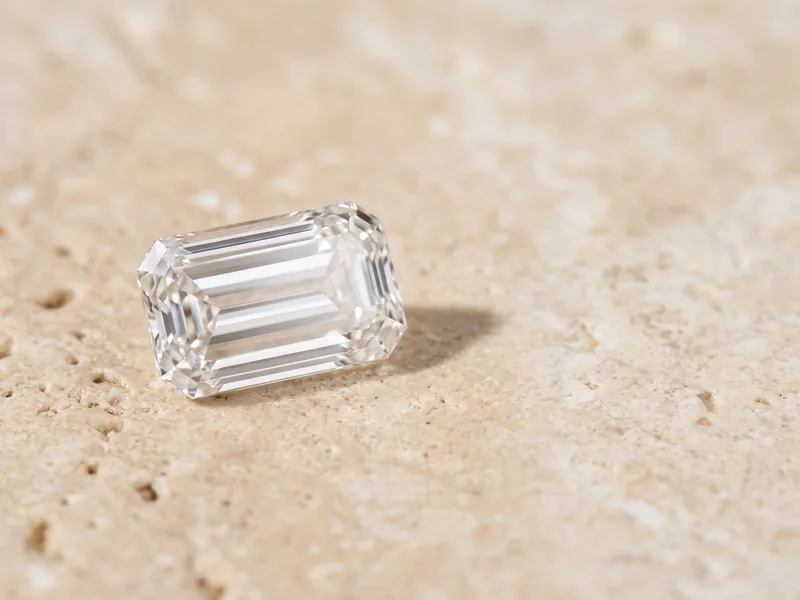
Step cuts such as the emerald and Asscher do not technically produce a classic nailhead, because they reflect light in broad flashes rather than many small sparkles. But a step cut that is too deep has a similar result: the central steps go dark and the stone loses the crisp hall-of-mirrors pattern in emerald cuts that makes the shape worth choosing.
In elongated shapes, depth interacts with the outline. A narrow oval or pear is more likely to show a dark centre at the same depth than a wider one, because light has less room to bounce across the short axis. Our guide to length-to-width ratios by shape sets out the usual ranges.
Antique cuts are a special case. Old mine and Old European cuts often have small tables, high crowns and deep pavilions by modern standards. Some show a dark centre; others look lively, especially in soft light. Judge an antique stone by eye rather than by modern proportion tables alone.
Not sure which one is right?
Send us the stones you are looking at and our gemologist will tell you which to choose and why.
How do you spot a nailhead diamond in photos and video?
A nailhead is often easy to see in person but surprisingly easy to miss online, because bright studio lights and still photos flatter a deep stone. Look for these signs:
- A centre that stays dark: in a 360° video, watch the middle of the table. If it stays grey or black in every position while the edges sparkle, suspect a nailhead.
- Small face-up size for the weight: a 1.00 carat round measuring 6.2 mm or less across is probably deep.
- High depth on the report: total depth above about 64% in a round, or well above the shape's usual range in a fancy shape.
- A dull, lifeless look in diffused light: daylight or office light shows a nailhead more honestly than spotlights.
- A black pupil around the culet: some deep rounds show a dark circle right in the middle that grows as you tilt the stone.
Do not confuse a nailhead with a general cloudy look. A diamond with many tiny inclusions can look milky or flat across the whole face, not just in the middle; that is a transparency problem rather than a cut one. Our page on haziness and poor transparency explains how to tell them apart. A nailhead is usually crisp at the edges and dark only in the centre.
What does a nailhead look like in ASET and Idealscope images?
Reflector images are the most reliable way to see a nailhead, because they show where light is returning and where it is leaking. An ASET (Angular Spectrum Evaluation Tool, developed by the American Gem Society) colours each part of the stone by the angle its light comes from. An Idealscope is a simpler viewer that shows light return in red and leakage in white or pale tones.
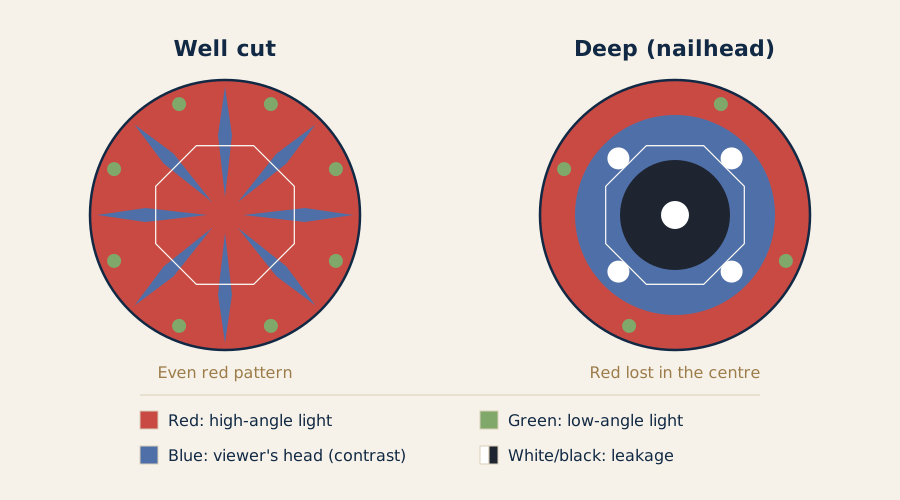
- Red in ASET: light coming from high angles above the stone, the brightest light. A well-cut round shows strong, even red across the table.
- Green in ASET: light from lower angles, nearer the horizon. Some green is normal; a lot suggests weaker brightness.
- Blue in ASET: areas reflecting the viewer's head, which gives contrast. Even, small blue areas are good; large patches are not.
- White or black in ASET: leakage, where light passes straight out. A nailhead often shows as a central zone of leakage or heavy blue in place of red.
- Idealscope: a nailhead usually shows as a pale or washed-out centre where the red pattern breaks down.
Our guide on how to read ASET and Idealscope images walks through real examples. A hearts and arrows viewer is different: it shows optical symmetry, meaning how precisely the facets line up, not how much light comes back. A deep round can still show a neat arrows pattern, so read what a hearts and arrows viewer shows before relying on one to rule out a nailhead.
Does a nailhead make a diamond look smaller?
Yes, usually. The extra depth that causes a nailhead sits underneath the girdle, where you cannot see it. You pay for that weight, but the stone measures less across the top. Diameter face-up is what people actually notice on the hand, which is why spread (the face-up size relative to weight) matters as much as carat.
| Round carat weight | Well-cut diameter (approx.) | Deep stone diameter (approx.) |
|---|---|---|
| 0.50 ct | 5.1–5.2 mm | 4.9–5.0 mm |
| 1.00 ct | 6.4–6.5 mm | 6.1–6.2 mm |
| 1.50 ct | 7.3–7.4 mm | 7.0–7.1 mm |
| 2.00 ct | 8.1–8.2 mm | 7.7–7.9 mm |
A deep 1.00 carat can face up about the same size as a well-cut 0.90 carat while looking darker in the centre. That is the double cost of a nailhead: less brightness and less visible size. Our spread and face-up size guide has measurements for every main shape.
Can lab-grown and natural diamonds both have a nailhead?
Yes. Natural diamonds and laboratory-grown diamonds are the same material, with the same refractive index of about 2.42 and the same critical angle, so they handle light in exactly the same way. A nailhead comes from how the stone was cut, not where the crystal formed. Both natural and lab-grown diamonds are cut in every quality, from excellent to poor.
The weight pressure is real for both. Lab-grown diamonds cost much less than natural ones, but price still rises with carat weight, so a cutter may still leave extra depth to keep a stone above a size threshold. Whichever you choose, check the proportions on the grading report from a laboratory such as GIA or IGI, and look at a video and, ideally, an ASET image.
Browse natural and lab-grown diamonds
How to avoid a nailhead diamond: step by step
- Read the report. Note the shape, measurements, total depth, table and, for rounds, the cut grade and pavilion angle if listed.
- Check the depth against the shape. For a round, look for total depth of about 59–62.5% and a pavilion angle near 40.6–41°; for fancy shapes, compare with the ranges in the table above.
- Check the face-up size. Compare the millimetre diameter or width with the typical figure for that carat weight; a small measurement points to a deep stone.
- Watch a 360° video in soft light. Keep your eye on the centre of the table. A centre that stays dark in every position is a warning sign.
- Ask for an ASET or Idealscope image. Look for even red across the table and no large central zone of leakage or heavy blue.
- Compare side by side. If you can, view two stones of similar weight together; the nailhead stone will look smaller and duller in the middle.
If a stone passes all six checks, a nailhead is very unlikely. If it fails one, it is not automatically a bad diamond, but it is worth asking a gemmologist to look at it with you before you decide.
Free consultation
Talk to a gemologist
Compare stones in person or online with Raj Sood, Graduate Gemologist (GIA), AJP (GIA).
Book a consultationShop this shape
FAQ
Common questions
What is a nailhead in a diamond?
A nailhead is a dark or grey area in the centre of a diamond, seen through the table. It happens when the pavilion is cut too steep and deep, so light entering the middle leaks out or returns away from your eye.
What pavilion angle causes nailhead?
In a round brilliant, the risk rises once the pavilion angle goes above about 42°, and it is usually obvious above about 42.5–43°. Well-cut rounds sit at about 40.6–41°.
Is nailhead the same as fisheye?
No, they are opposites. A nailhead comes from a pavilion that is too steep and shows a dark centre, while a fisheye comes from a pavilion that is too shallow and shows a grey ring inside the table.
Can a diamond with a GIA Excellent cut grade have a nailhead?
It is unlikely in a round, because GIA's Excellent grade excludes most steep pavilion combinations. Fancy shapes have no GIA cut grade, so a nailhead is more of a risk there and you need to check depth, video and ASET yourself.
Can you fix a nailhead by recutting the diamond?
Sometimes. A cutter can recut the pavilion to a shallower angle, but this removes weight and costs money, so it is usually only worth it for larger stones and should be assessed case by case.
Does the nailhead effect show in lab-grown diamonds?
Yes. Lab-grown diamonds have the same optical properties as natural diamonds, so a lab-grown stone cut too deep will show the same dark centre.

Ask a gemologist
Not sure which diamond to choose?
Raj Sood is a Graduate Gemologist (GIA) and master jeweller. Bring the stones you are considering, or send the reports, and he will tell you honestly which one is better and why.
Keep learning
Related guides
 Diamond Anatomy & LightFisheye Effect in Diamonds
 Diamond Anatomy & LightASET and Idealscope Images Explained
 Diamond Anatomy & LightDiamond Crown & Pavilion Angles ExplainedDiamond Anatomy & LightExtinction and Dark Zones in DiamondsDiamond Anatomy & LightAnatomy of a diamond: table, crown, girdle, pavilion and culet explained
 Diamond Anatomy & LightDiamond Bow Tie Effect
 Diamond ShapesEmerald-Cut Diamond Hall-of-Mirrors EffectDiamond Anatomy & LightHearts and Arrows Viewer Explained
Explore more
More guides on this topic
Education