
- Education
- Diamond Anatomy & Light
- Hearts and Arrows Viewer Explained: What It Shows and What It Doesn't
Diamond Anatomy & Light
Hearts and Arrows Viewer Explained: What It Shows and What It Doesn't
A hearts and arrows viewer is the quickest way to see how precisely a round diamond has been cut. Knowing how to read it, and where it stops being useful, saves you from paying for a pattern you cannot see on the hand.
 Reviewed by Raj Sood, Graduate Gemologist (GIA), AJP (GIA)Master jeweller and Graduate Gemologist (GIA) · reviewed 4 November 2026
Quick answer
A hearts and arrows viewer is a small magnifying scope with a coloured reflector that reveals a round brilliant diamond's optical symmetry. Face-up, a precisely cut stone shows eight even arrows; table-down, eight matching hearts. It confirms tight facet alignment, but not light return on its own, so pair it with an ASET image and the report's proportions.
What is a hearts and arrows viewer?
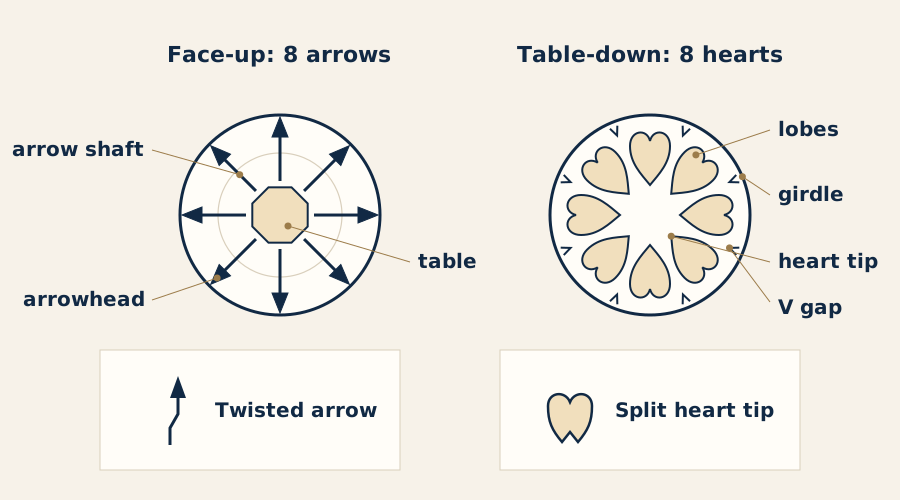
A hearts and arrows viewer (also sold as an H&A scope) is a small hand-held or desk tool that lets you see the reflections inside a round brilliant diamond as a clear, high-contrast pattern. Under normal light those reflections are a shifting jumble of bright and dark flashes. Inside the viewer they settle into a fixed picture: eight arrows when the diamond sits face-up, and eight hearts when you turn it over and look through the pavilion (the cone-shaped underside).
The pattern only appears when the stone has very tight optical symmetry. That means every facet is the same size, sits at the same angle and lines up exactly with its partner on the opposite side. A round brilliant has 57 facets, or 58 if it has a culet (a tiny flat facet at the very bottom). If any of the eight pavilion main facets or the sixteen lower girdle facets are even slightly off, the hearts and arrows lose their shape. If you would like a refresher on where each of those facets sits, our guide to the parts of a diamond, from table to culet has labelled drawings.
The idea took hold in Japan in the 1980s and 1990s, where cutters and buyers began using these scopes to prove a stone's precision. Today the term is used widely in marketing, but no major grading laboratory gives a formal hearts and arrows grade (some, such as IGI, may add a hearts and arrows comment or images to a report), which is why learning to read the viewer yourself is useful. Any unfamiliar word on this page is also defined in our jewellery glossary.
How does a hearts and arrows viewer work?
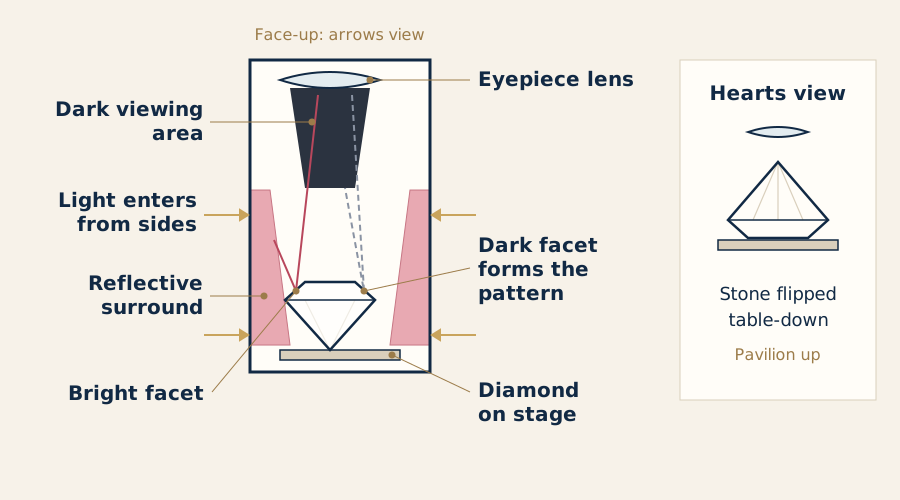
A diamond acts like a set of tiny angled mirrors. Each facet reflects whatever it is pointed at, whether that is the ceiling lights, the walls or your own head. A hearts and arrows viewer controls what the facets can see. It surrounds the stone with a coloured or white reflective surface, usually red, pink or white, and leaves a darker area where you look through the lens. Facets that reflect the bright surround light up; facets that reflect the dark viewing area go dark.
Because a well-cut round reflects the same thing in each of its eight sections, the dark areas repeat eight times in a regular ring. Face-up, they form arrow shafts running out from the table (the large flat top facet) with arrowheads near it. Table-down, looking through the pavilion, the reflections of the pavilion mains and lower girdle facets join into eight heart shapes with a small 'V' or arrowhead between them. Most hand-held viewers magnify the stone roughly 8 to 10 times so the pattern is easy to judge.
The same mirror logic explains much of what you see on the hand. The contrast between bright and dark facets is part of a diamond's fire, brilliance and scintillation, and the dark arrows you see in the viewer are a tidy, controlled version of that contrast. When the contrast is uncontrolled, you get problems such as dark zones and extinction in poorly cut stones.
What should you see in a hearts and arrows viewer?
A good pattern is about consistency more than perfection. Look at the arrows first, then the hearts, and compare all eight in each view.
- Arrows: eight straight shafts of equal width, evenly spaced, each pointing to the centre of the table. The arrowheads should all be the same size.
- Hearts: eight hearts of the same size and shape, with rounded lobes (the two curved tops) and tips that point cleanly to the centre.
- The gaps: small 'V' shapes between the hearts should be similar, and each heart should sit a little clear of the girdle (the thin outer edge).
- Centre: the culet area should look centred, not pushed to one side.
| What you see | What it usually means |
|---|---|
| Twisted or bent arrow shafts | Pavilion mains and crown facets are not lined up with each other |
| Arrows of different widths | Pavilion main facets cut at slightly different sizes or angles |
| Hearts with split or cloven tips | Lower girdle facets meet unevenly at the point of each heart |
| Hearts touching the girdle or merging | Lower girdle facets cut too long, or pavilion angle off |
| Some hearts noticeably larger | Uneven facet sizes; the stone may also be slightly out of round |
| Faint, blurry pattern overall | Facets not sharply meeting, or the stone needs cleaning |
Small faults in one or two hearts are common even in well-cut stones, and you will not see them without the viewer. Clear twisting or uneven arrows, though, suggest the cutter did not hold the optical symmetry the stone is being sold on.
What proportions create a hearts and arrows pattern?
Symmetry makes the pattern regular, but the proportions decide whether it can form at all. A hearts and arrows round needs its crown angle, pavilion angle and lower girdle length to sit within a fairly narrow band. Our guides to how crown and pavilion angles shape light return and how table and depth percentages work explain each measurement. As a rough guide, stones that show a strong pattern tend to sit in this range:
| Measurement | Typical hearts and arrows range |
|---|---|
| Table | about 53–57% of the diameter |
| Crown angle | about 34.0–35.0° |
| Pavilion angle | about 40.6–41.0° |
| Lower girdle length | about 75–80% |
| Total depth | about 60–62% |
| Polish and symmetry | Excellent (GIA) or Ideal (AGS) |
Move outside that band and the pattern changes in predictable ways. A pavilion that is too shallow, below about 40°, reflects the girdle back as a grey ring: the fisheye effect caused by a shallow pavilion. One that is too steep, above about 42°, darkens the centre of the stone, which cutters call a nailhead. Both show up in the viewer as fat, smeared or broken arrows. Shallow stones can also leak light straight through the middle, which looks glassy and is closely related to windowing in round and fancy shapes.
Not sure which one is right?
Send us the stones you are looking at and our gemologist will tell you which to choose and why.
What can't a hearts and arrows viewer tell you?
The viewer is a symmetry tool. It shows that the facets are matched, not that the stone returns as much light as possible. A diamond can show a neat hearts and arrows pattern and still be cut slightly shallow or deep within the band above. It also tells you nothing about the things that make a stone look lively or dull for other reasons:
- Light leakage: how much light escapes through the pavilion instead of coming back to your eye. You need an ASET or Idealscope image for this.
- Transparency: fine clouds of tiny inclusions or growth features can make a well-cut stone look soft. See our guide to transparency and haziness.
- Colour and clarity: those come from the grading report and your own eye.
- Origin: the viewer cannot tell a natural diamond from a lab-grown one, or a diamond from a simulant such as moissanite.
It is also worth knowing that GIA's Excellent cut grade does not require a hearts and arrows pattern, and plenty of Excellent stones do not have one. The pattern is a sign of extra precision on top of a good cut grade, not a replacement for it.
Hearts and arrows viewer vs ASET vs Idealscope: which tells you more?
Three reflector tools are used to judge round diamonds, and each answers a different question. The Idealscope uses a red reflector: areas that return light glow red, while areas where light leaks out look pale or white. The ASET (Angular Spectrum Evaluation Tool, developed by the American Gem Society) uses colours to show where the returned light comes from: red for light from high overhead angles, green for lower angles and blue for the contrast created by the viewer's own head.
| Hearts and arrows viewer | Idealscope | ASET | Report cut grade | |
|---|---|---|---|---|
| Main question | Are the facets matched? | Where does light leak? | Where does light come from? | Do the proportions fall within the grade? |
| Best view | Face-up and table-down | Face-up | Face-up | Numbers on paper |
| Shows symmetry | Yes, in detail | Partly | Partly | As a grade only |
| Shows light leakage | No | Yes | Yes | Indirectly |
| Shows contrast balance | Partly | Limited | Yes (blue areas) | No |
| Useful for fancy shapes | Rarely | Yes | Yes | GIA gives polish and symmetry only |
Used together, the three tell you far more than any one alone. A tidy pattern in the viewer plus an even red ASET image with consistent blue arrows is about as good as a round diamond gets. Our guide to reading ASET and Idealscope images shows what good and poor images look like side by side.
Related guideASET and Idealscope Images ExplainedDo fancy shapes have hearts and arrows?
The classic pattern belongs to the round brilliant, because it depends on eight identical sections arranged around a centre. Fancy shapes do not have that eight-fold symmetry, so they cannot show true hearts and arrows. Some branded princess and cushion cuts are marketed with their own patterns, such as crosses or squares, but these are designs specific to the cutter, not a standard.
For fancy shapes, judge the cut by proportions and by an ASET or Idealscope image instead. Elongated shapes have their own issues to watch, such as the bow-tie effect in elongated shapes, and the outline depends on their length-to-width ratios. Our proportion charts give target numbers for each shape:
- Oval: see the oval proportion chart for depth, table and ratio ranges.
- Cushion: the cushion cut proportions guide covers the chunky and crushed-ice styles.
- Radiant: the radiant cut proportions chart explains why radiants are usually cut deeper.
Are hearts and arrows diamonds worth it, natural or lab-grown?
A hearts and arrows round takes more time to cut and usually loses a little more weight from the rough crystal, so it generally costs more than a standard Excellent-cut round of the same carat, colour and clarity. How much more varies widely between cutters and sellers. On the hand, the difference between a true hearts and arrows stone and a very good Excellent stone is subtle: slightly crisper contrast and more even sparkle, best seen side by side. Our page on whether a hearts and arrows premium is worth paying goes through the trade-offs.
Both natural and laboratory-grown diamonds can be cut to hearts and arrows standard, because the pattern comes from the cutting, not the origin. Lab-grown diamonds are real diamond, grown in a laboratory rather than mined, with the same hardness (10 on the Mohs scale) and refractive index (about 2.42). They cost much less than natural diamonds of the same grades, which means a precision cut adds a smaller dollar amount on a lab-grown stone. Natural diamonds are rarer. Either way, ask for a grading report from a lab such as GIA or IGI, and for viewer and ASET images of the actual stone.
When you look at photos or videos online, check that the hearts and arrows images are of the same diamond (the report number or inclusions should match), that the stone is centred and in focus, and that the arrows image is shown as well as the hearts. A stock image of a perfect pattern tells you nothing about the stone in front of you.
Browse round diamonds: natural and lab-grown
How do you use a hearts and arrows viewer? Step by step
- Clean the diamond. Fingerprints and dust blur the pattern; wipe it with a lint-free cloth and handle it with tweezers.
- Check the arrows face-up. Place the stone table-up under the viewer and look through the lens. Count eight arrows and check they are straight, even and evenly spaced.
- Turn it table-down. Rest the table flat on the viewer's stage or a clean flat surface and look down through the pavilion.
- Check the hearts. Look for eight hearts of equal size with clean, pointed tips and rounded lobes, sitting clear of the girdle.
- Rotate and compare. Turn the stone slowly and compare each heart and arrow with the one opposite it; twisting or size differences show up this way.
- Match it to the numbers. Compare what you saw with the report's crown angle, pavilion angle and table, then ask for an ASET or Idealscope image to confirm light return.
If you are comparing two or three stones, look at them one after the other under the same viewer and the same light, so differences come from the diamonds rather than the set-up.
Free consultation
Talk to a gemologist
Compare stones in person or online with Raj Sood, Graduate Gemologist (GIA), AJP (GIA).
Book a consultationShop this shape
FAQ
Common questions
What does a hearts and arrows viewer show?
It shows a round diamond's optical symmetry as a pattern: eight arrows when the stone is face-up and eight hearts when it is table-down. Even, well-formed hearts and arrows mean the facets are precisely matched.
Can you see hearts and arrows without a viewer?
Not the full pattern. You may notice the arrows faintly face-up in some lighting, but the hearts only appear clearly through the pavilion with a viewer's controlled reflector.
Is a hearts and arrows diamond better than an Excellent cut?
It is an Excellent or Ideal cut with extra precision in facet alignment. The visible difference on the hand is usually subtle, so check light return with an ASET image rather than relying on the pattern alone.
Do lab-grown diamonds have hearts and arrows?
They can. The pattern comes from the cutting, so a lab-grown diamond cut to the same proportions and symmetry shows the same hearts and arrows as a natural one.
Does GIA grade hearts and arrows?
No. GIA reports give a cut grade, polish and symmetry for round brilliants, but there is no formal hearts and arrows grade; the term is used by cutters and sellers.
Can oval or princess cut diamonds have hearts and arrows?
Not the true pattern, which needs a round's eight-fold symmetry. Some branded fancy cuts show their own patterns, but fancy shapes are best judged by proportions and ASET or Idealscope images.

Ask a gemologist
Not sure which diamond to choose?
Raj Sood is a Graduate Gemologist (GIA) and master jeweller. Bring the stones you are considering, or send the reports, and he will tell you honestly which one is better and why.
Keep learning
Related guides
 Diamond Anatomy & LightHearts and Arrows Diamonds: What Are You Actually Paying For?
 Diamond Anatomy & LightASET and Idealscope Images ExplainedDiamond Anatomy & LightDiamond Crown & Pavilion Angles ExplainedDiamond Anatomy & LightAnatomy of a diamond: table, crown, girdle, pavilion and culet explained
 Diamond Anatomy & LightFisheye Effect in DiamondsDiamond Anatomy & LightExtinction and Dark Zones in DiamondsDiamond Anatomy & LightDiamond Table and Depth ExplainedDiamond Anatomy & LightDiamond Transparency & Haziness Explained
Explore more
More guides on this topic
Education