
- Education
- Diamond Anatomy & Light
- Fisheye Diamond: What Causes It, How to Spot It and How to Avoid It
Diamond anatomy & light
Fisheye Diamond: What Causes It, How to Spot It and How to Avoid It
A fisheye diamond can have good colour and clarity grades and still look grey and lifeless. Here is what causes the effect, how to spot it before you commit and the numbers that keep it out of the stone you choose.
 Reviewed by Raj Sood, Graduate Gemologist (GIA), AJP (GIA)Master jeweller and Graduate Gemologist (GIA) · reviewed 4 November 2026
Quick answer
A fisheye diamond shows a pale grey or white ring inside its table. The ring is a reflection of the girdle, caused by a pavilion cut too shallow, usually below about 40° in a round. To avoid it, check total depth and pavilion angle on the report, watch for the ring in daylight video, and favour well-proportioned stones.
What is the fisheye effect in a diamond?
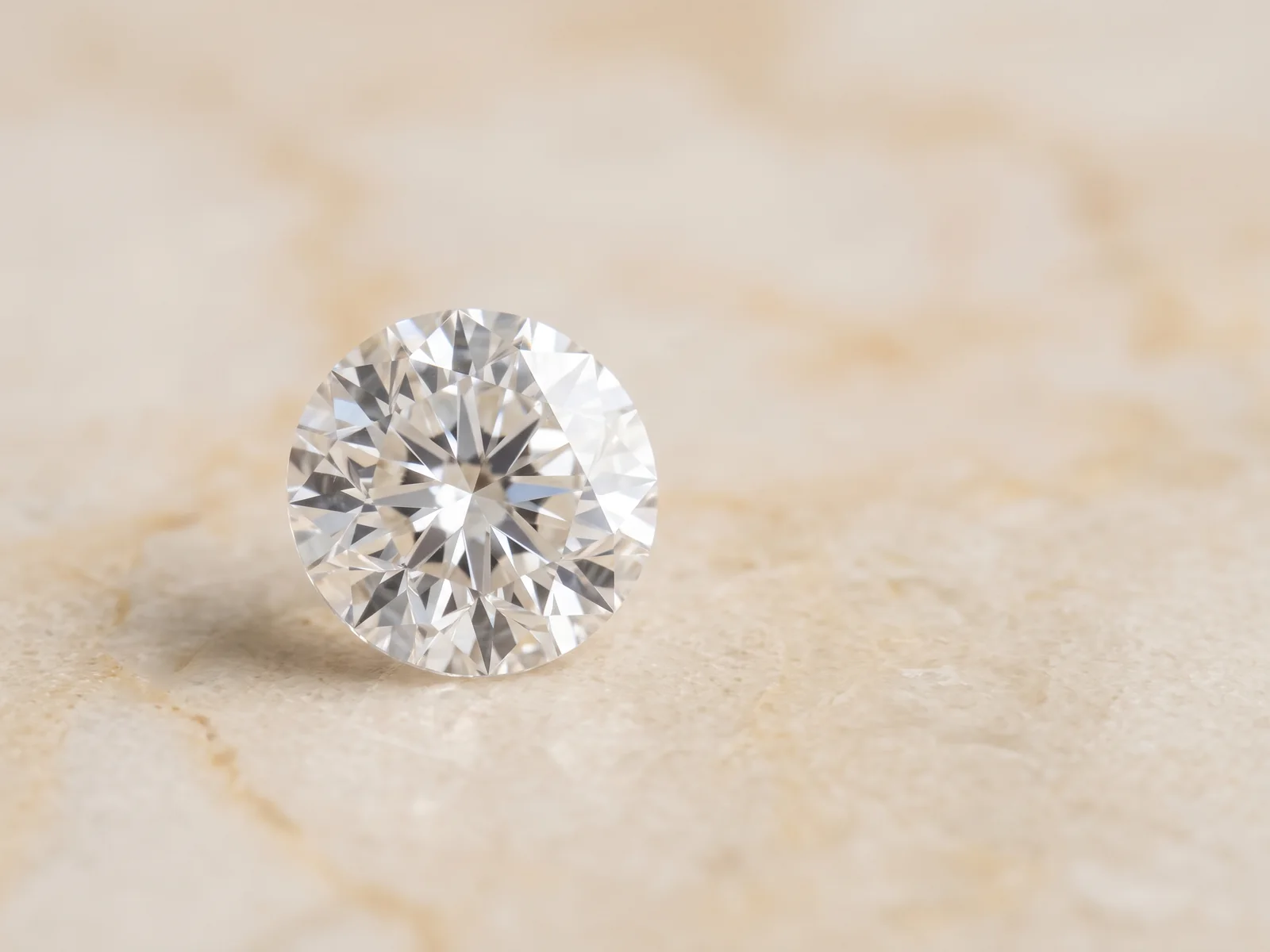
A fisheye is a pale grey or whitish ring you can see inside the table (the large flat facet on top) of some diamonds when you look straight down. It is not an inclusion and it is not a mark on the surface. It is a reflection of the girdle, the thin band around the widest part of the diamond, mirrored back up through the table by pavilion facets that are cut too shallow. If those parts are new to you, our guide to the parts of a diamond, from table to culet sets them out with diagrams.
The name comes from the look. A round stone with a hazy ring and a darker centre resembles the eye of a fish. A fisheye diamond tends to look glassy and washed out, because the zone where the ring sits returns grey reflections of the girdle instead of bright light from above. In mild cases you only see the ring in certain lighting. In strong cases it is the first thing you notice, even at arm's length.
Fisheye is a cutting problem, not a grade of its own. It sits alongside the nailhead, windowing, extinction and the bow-tie as one of the ways poor proportions show up face-up. It can appear in natural and lab-grown diamonds alike, and in any shape, though some shapes are far more prone than others. Diamond has a refractive index of about 2.42, which bends light strongly and gives it a critical angle of roughly 24.4°: light striking an inside surface at more than that angle from the perpendicular is reflected back, and light arriving closer to perpendicular escapes. Good cutting uses that rule to trap light and send it back to your eye. Fisheye is what you see when the geometry falls short. Any unfamiliar term here is also defined in the GemTrove jewellery glossary.
What causes a fisheye diamond?
The short answer is a shallow pavilion, the cone-shaped lower half of the stone. The easiest way to understand it is to trace your line of sight backwards. From your eye, a sightline enters the table, travels down and strikes a pavilion facet. In a well-cut stone it bounces across to the opposite pavilion facet, then back up through the crown, picking up light from the room above you. When the pavilion is too flat, those facets are tilted the wrong way for that path. Sightlines that enter a little way inside the table edge bounce towards the girdle on the far side of the stone instead of back towards the top. What you see at that spot is the girdle itself, mirrored inside the table. Because the girdle runs all the way around the stone, its reflection forms a ring.
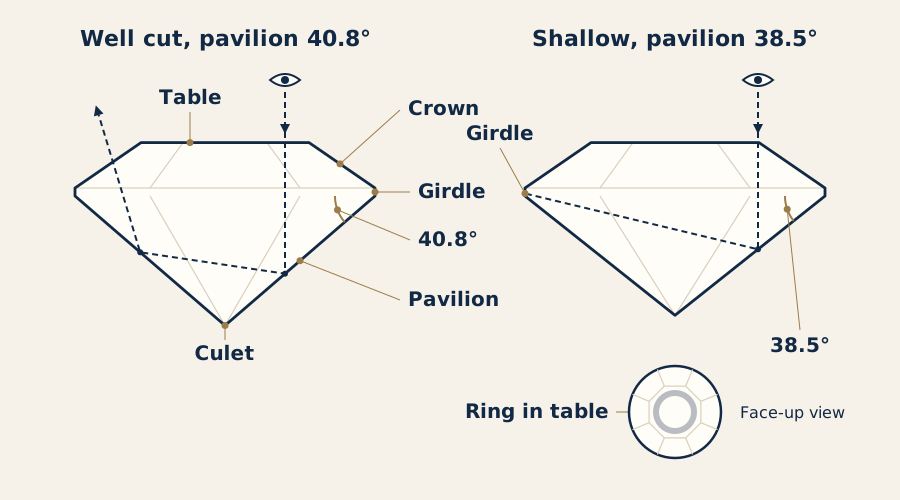
In a round brilliant, the number that matters most is the pavilion angle: the slope of the main lower facets, measured from the flat plane of the girdle. Top-performing rounds sit at about 40.6–41.0°. Below about 40° the reflected girdle starts to appear, and by 38–39° it is usually obvious. In depth terms, a well-cut round has a pavilion depth of about 43% of its diameter; below about 42% the risk rises quickly. Our page on how crown and pavilion angles work together explains why the two have to be balanced.
Several other features make an existing fisheye easier to see:
- A thick girdle: a Thick, Very Thick or Extremely Thick girdle is a wider band, so its reflection is a wider, more obvious ring.
- A frosted girdle: an unpolished (bruted) girdle has a slightly matte, whitish texture, which reflects as a pale grey ring. A polished or faceted girdle reflects less obviously, but the ring is still there if the pavilion is shallow.
- A large table: a wider table gives you a bigger window onto the zone where the ring sits.
- Diffuse lighting: overcast daylight and office lighting show the ring clearly, while bright spotlights can mask it with sparkle.
Why would anyone cut a diamond this way? Weight and spread. A shallower stone carries less weight below the girdle, so the same carat weight stretches across a wider diameter. A 1 carat round cut at about 56% total depth can measure around 6.6 mm or more across, while a well-proportioned 1 carat round is usually about 6.4–6.5 mm. On a flat piece of rough, cutting shallow also keeps weight that would otherwise be ground away. That extra width looks good on paper, which is exactly why fisheye stones turn up in listings. Our guide to spread and face-up size covers where extra width is a genuine gain and where it costs you brightness.
How do you spot fisheye in a diamond in photos and video?
Look at the stone face-up, straight down, and let your eye rest just inside the edge of the table. A fisheye shows as a soft grey or white ring, roughly following the outline of the table, with the brighter or darker centre inside it. In a round it is a circle; in an oval or pear it follows the elongated outline. It tends to look the same colour all the way round, which is how you tell it apart from a reflection of a window or a light.
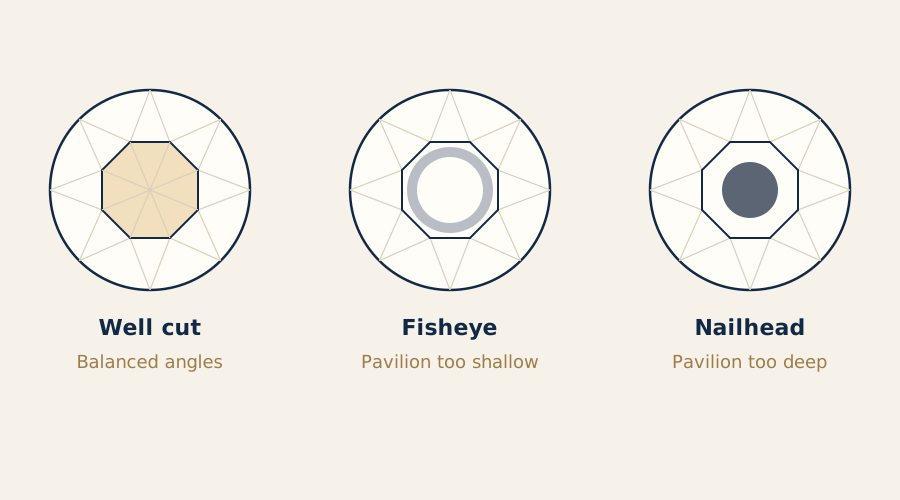
- In photos: a pale halo inside the table that does not match the sparkle around it. Heavily lit studio photos can hide it, so do not rely on a single still image.
- In 360° video: the ring stays in place as the stone turns, because it is a reflection of the stone's own girdle, not of the room. Sparkle moves; the fisheye ring does not.
- When tilted: a mild fisheye may only show at certain tilts; a strong one is visible face-up from every angle.
- Across the room: a strong fisheye makes the stone look flat and greyish compared with a well-cut stone of the same grades.
Fisheye also explains a puzzle many people meet when comparing listings: two diamonds with the same carat, colour and clarity that look nothing alike. Our article on why two diamonds of the same carat weight can look so different covers this and the other proportion effects behind it.
What does fisheye look like in ASET and Idealscope images?
Video shows you a fisheye; reflector scopes show you why. An ASET (Angular Spectrum Evaluation Tool) image colours the stone by where its light comes from. Red shows light gathered from high angles above the stone, the brightest and most useful light. Green shows light from lower angles. Blue shows areas reflecting the viewer's head, which give contrast. White or see-through areas show light leakage, where light passes out of the bottom of the stone instead of returning. An Idealscope image is simpler: red for light return, and pale or white for leakage.
In a stone with fisheye, both tools tend to show a pale or broken ring inside the table where the strong red pattern should be. Shallow stones also often show leakage under the table, towards the centre, because some sightlines meet the pavilion at less than the critical angle and escape. The ring in the ASET image lines up with the grey ring you see in video, which is a useful way to confirm what you are looking at. Our guide to reading ASET and Idealscope images walks through good and poor examples colour by colour.
For rounds, a hearts and arrows viewer adds another check. In a shallow round the arrows pattern seen face-up usually looks weak, thin or broken up rather than crisp and even. See how a hearts and arrows viewer works for what a precise pattern looks like. All of these tools sit within the bigger picture of how a diamond returns light to your eye: brightness, fire and scintillation.
Not sure which one is right?
Send us the stones you are looking at and our gemologist will tell you which to choose and why.
Which diamond shapes are most prone to fisheye?
Any shape can show fisheye, but fancy shapes are cut shallow more often, because buyers compare them by face-up size and because GIA does not give them an overall cut grade the way it does for rounds. The figures below are rough flags, not limits: a total depth below these ranges does not always mean a fisheye, but it is a reason to look harder at the video and scope images.
| Shape | Fisheye risk | Rough depth flag | What to watch for |
|---|---|---|---|
| Round brilliant | Low in well-graded stones | Below about 58%, or pavilion angle below 40° | Thick girdle plus shallow pavilion |
| Oval | High | Below about 56–57% | Often appears with a bow-tie |
| Pear | High | Below about 56% | Ring follows the rounded end and wings |
| Marquise | High | Below about 55–56% | Long, narrow stones cut flat for length |
| Heart | High | Below about 56% | Ring sits inside the lobes |
| Cushion | Moderate | Below about 60% | Spready cushions sold on width |
| Radiant | Moderate | Below about 60% | Shallow radiants also look glassy |
| Emerald and Asscher | Moderate | Below about 60% | Pale girdle outline seen through the steps |
| Princess | Low | Below about 64% | Usually cut deep, so less common |
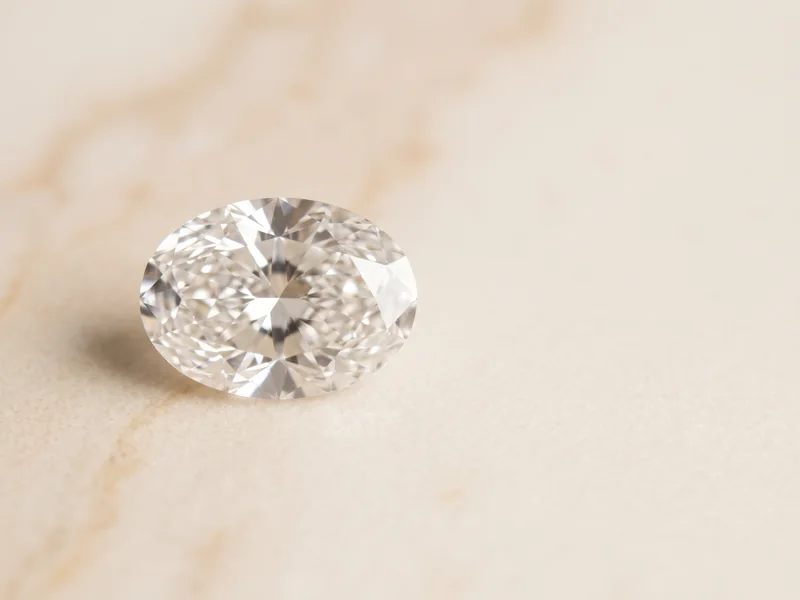
Ovals, pears and marquises are the most common offenders, because cutters are trying to maximise length and the shallow pavilion also worsens the dark band across the middle. Our guide to bow-tie shadows in elongated shapes explains how the two problems overlap. The shape's ratio matters too; a long, narrow stone cut flat is more likely to show both. See length-to-width ratios shape by shape for typical ranges.
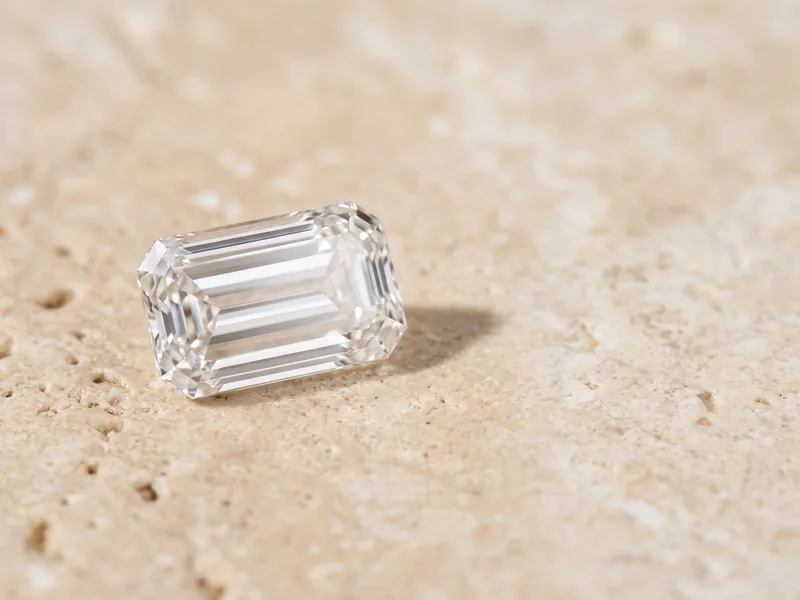
For the exact depth and table ranges to look for, use the shape charts: the pear diamond proportion chart, the ideal cushion proportions and the radiant cut depth and table ranges. Step cuts are a special case: in an emerald cut a shallow pavilion blurs the long, even flashes of the hall-of-mirrors look in emerald cuts and can leave a pale outline of the girdle visible through the steps.
How is a fisheye different from a nailhead, windowing or a bow-tie?
These effects are easy to confuse in photos, but each has a different cause and a different look. Fisheye and windowing come from a pavilion that is too shallow and often appear together; the nailhead comes from the opposite problem.
| Effect | What you see face-up | Main cause | Where it sits |
|---|---|---|---|
| Fisheye | Pale grey or white ring | Pavilion too shallow; girdle reflected | Inside the table edge |
| Windowing | Glassy, see-through patch | Pavilion too shallow; light passes straight through | Centre of the stone |
| Nailhead | Dark, almost black centre | Pavilion too deep; light leaks out the sides | Under the table |
| Bow-tie | Dark band across the middle | Uneven facet angles along an elongated stone | Across the belly of ovals, pears, marquises |
| Extinction | Dark patches that do not move | Poor angles, or stone blocking its own light | Anywhere, often near the edges |
The key difference is colour and position. A fisheye is grey or white and forms a ring; a nailhead is dark and fills the centre. If you are unsure, read our page on the nailhead effect, fisheye's deep-cut opposite, which uses the same diagrams for comparison. Dark areas are not always a fault: some dark contrast is what makes sparkle visible. Our guide to extinction and dark zones explains where normal contrast ends and light loss begins.
What proportions avoid a fisheye diamond?
For round brilliants the grading report gives you nearly everything you need, because GIA and IGI reports list the angles as well as the percentages. As a guide, these ranges are typical of rounds that do not show fisheye:
- Pavilion angle: about 40.6–41.0°; treat anything below 40.0° with caution.
- Pavilion depth: about 42.5–43.5% of the diameter.
- Crown angle: about 34–35°, balanced against the pavilion.
- Table: about 53–58% of the diameter.
- Total depth: about 59–62.5%.
- Girdle: Thin to Slightly Thick. Very Thick or Extremely Thick girdles make any girdle reflection stronger and add hidden weight.
A round with a GIA cut grade of Excellent is unlikely to show an obvious fisheye, because very shallow pavilions pull the cut grade down. Lower cut grades, or stones graded by labs that give no cut grade, need a closer look at the angles themselves.
Fancy shapes are harder. Reports usually list only the total depth, table percentage and girdle thickness, not the pavilion angle, and the angle varies around the stone anyway. Use the depth flags in the shape table above as a first filter, then rely on video and ASET or Idealscope images to judge each stone. A fancy shape at a healthy depth can still show a fisheye in one area, such as the ends of an oval, if the cutter flattened the pavilion there to gain length.
Is a slightly fisheye diamond worth buying?
It depends on how strong the effect is and what you are trading it for. A very mild fisheye, visible only at certain tilts in flat light, may not bother you on the hand, and these stones are usually priced below well-cut diamonds of the same carat, colour and clarity. They also face up a little wider. An obvious fisheye is different: the stone looks grey and glassy in everyday light, and no setting will hide it. A halo or bezel changes how the outline looks, but it does not change the path light takes inside the stone.
The effect has nothing to do with origin. Natural and lab-grown diamonds are cut on the same wheels using the same methods, and both can be cut well or shallow. Lab-grown diamonds are real diamond, grown in a laboratory rather than mined, and they cost much less than natural diamonds of similar grades, so there is generally less reason to accept a cut compromise to stay within budget. With natural diamonds, buyers sometimes weigh a slightly shallow cut against colour or clarity; if you do, see the stone in person or on good video first.
Browse natural and lab-grown diamonds
Can a fisheye be fixed? A shallow stone can be recut to steepen the pavilion, but that means grinding away the girdle region and making the stone narrower, so it loses weight and diameter. For most diamonds under about 1 carat the cost and weight loss make recutting impractical. It is far simpler to avoid the problem when choosing the stone.
How to check a diamond for fisheye: step by step
- Read the report. Note the total depth, table percentage and girdle thickness, and for rounds the pavilion angle and crown angle. Confirm whether the diamond is natural or lab-grown.
- Check the numbers. For a round, be cautious below about 40° pavilion angle or 58% total depth. For fancy shapes, compare the depth with the shape's proportion chart.
- Check the girdle. Thin to Slightly Thick is ideal; Very Thick or Extremely Thick makes a reflected ring more visible.
- Watch the video in flat light. Look just inside the table edge for a pale ring that stays still while the sparkle moves.
- Ask for an ASET or Idealscope image. Look for a pale or broken ring and white leakage under the table.
- Compare side by side. Put the stone next to a well-proportioned diamond of similar size; a fisheye looks flatter and greyer.
- See it in person if you can. View it face-up under daylight-type light, not spotlights, before you commit.
Free consultation
Talk to a gemologist
Compare stones in person or online with Raj Sood, Graduate Gemologist (GIA), AJP (GIA).
Book a consultationShop this shape
FAQ
Common questions
What does fisheye mean in a diamond?
It is a grey or white ring seen inside the table of a diamond. The ring is a reflection of the girdle, caused by a pavilion cut too shallow.
Is fisheye the same as windowing?
No, but they share a cause and often appear together. Windowing is a see-through patch in the centre where light passes straight out the bottom, while fisheye is a ring formed by the reflected girdle.
Can a fisheye diamond be fixed?
A shallow diamond can be recut to steepen the pavilion, but it will lose weight and diameter. For most stones it is not practical, so it is better to check the proportions before choosing.
Do lab-grown diamonds get fisheye?
Yes. Fisheye comes from how the stone is cut, not where it formed, so lab-grown and natural diamonds can both show it if the pavilion is too shallow.
Will a GIA Excellent cut round have a fisheye?
It is unlikely, because a very shallow pavilion lowers the GIA cut grade. Rounds graded Good or Very Good, or reports with no cut grade, deserve a closer look at the pavilion angle.
Do oval diamonds often have fisheye?
Ovals are among the shapes most often cut shallow to gain length and face-up size. Be cautious with ovals below about 56–57% total depth and check the video for a pale ring and a strong bow-tie.

Ask a gemologist
Not sure which diamond to choose?
Raj Sood is a Graduate Gemologist (GIA) and master jeweller. Bring the stones you are considering, or send the reports, and he will tell you honestly which one is better and why.
Keep learning
Related guides
 Diamond Anatomy & LightNailhead Effect in Diamonds
 Diamond Anatomy & LightASET and Idealscope Images Explained
 Diamond Anatomy & LightExtinction and Dark Zones in DiamondsDiamond Anatomy & LightDiamond Crown & Pavilion Angles ExplainedDiamond Anatomy & LightAnatomy of a diamond: table, crown, girdle, pavilion and culet explained
 Diamond Anatomy & LightDiamond Bow Tie Effect
 Diamond ShapesEmerald-Cut Diamond Hall-of-Mirrors EffectDiamond Anatomy & LightHearts and Arrows Viewer Explained
Explore more
More guides on this topic
Education