
- Education
- Diamond Anatomy & Light
- Hearts and Arrows Diamonds: What Are You Actually Paying For?
Diamond Anatomy & Light
Hearts and Arrows Diamonds: What Are You Actually Paying For?
Hearts and arrows diamonds carry a premium on the promise of perfect symmetry. Here is what that pattern actually tells you about sparkle, how to check it yourself, and when the extra money is well spent.
 Reviewed by Raj Sood, Graduate Gemologist (GIA), AJP (GIA)Master jeweller and Graduate Gemologist (GIA) · reviewed 4 November 2026
Quick answer
Hearts and arrows diamonds are round brilliants cut so precisely that a special viewer shows eight even arrows face-up and eight even hearts from below. You are paying for tighter angles and facet alignment, not extra carat or clarity. Over a well-cut GIA Excellent round the sparkle gain is real but small, so judge light performance, not just the pattern.
What are hearts and arrows diamonds?
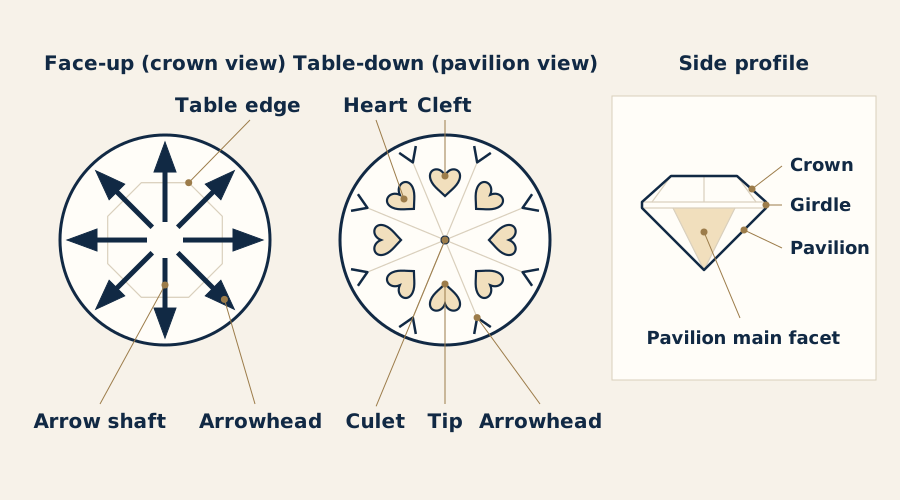
Hearts and arrows (often written H&A) describes a round brilliant diamond cut with such precise optical symmetry that it shows two repeating patterns. Look down through the table (the large flat top facet) with a special viewer and you see eight evenly spaced arrows radiating from the centre. Turn the stone over so it rests on its table, and the same facets form eight small, matching hearts around the culet (the point at the bottom). If the parts of a diamond are new to you, our guide to the parts of a diamond, from table to culet is a useful starting point.
Hearts and arrows is not a grade. GIA, the largest grading laboratory, does not mention it on its reports at all. IGI adds a 'Hearts & Arrows' comment to some reports, and the AGS Ideal 0 light performance grade often goes hand in hand with the pattern, but there is no single industry standard that defines how perfect the hearts must be. That is why two stones both sold as hearts and arrows can look noticeably different under a viewer, and why it is worth seeing the images yourself rather than relying on the label.
The pattern became widely known through Japanese cutters and buyers in the 1980s and 1990s, and it is now offered on both natural and lab-grown diamonds. It is a refinement of the modern round brilliant, which itself grew out of older styles; our page on how the round brilliant developed from the Old European cut tells that story. Many 'super ideal' cut brands use the pattern as their signature. Any term in this guide you have not met before is explained in our plain-English jewellery glossary.
How does the hearts and arrows pattern form?
A round brilliant has 57 facets, or 58 if it has a culet. The crown (the top half) has the table, 8 star facets, 8 crown mains (also called bezels) and 16 upper girdle facets. The pavilion (the bottom half) has 8 pavilion mains and 16 lower girdle facets.
The arrows are reflections of the eight pavilion mains, seen through the table and crown. The hearts appear when you look through the pavilion: each pavilion main and its neighbouring lower girdle facets reflect off the facets opposite them, building a small heart shape with a V-shaped 'arrowhead' sitting between each pair.
For those reflections to repeat perfectly eight times, every one of the eight sections of the diamond has to be nearly identical. Each pavilion main must sit directly beneath its crown main, each facet must be polished at almost the same angle as its partners, and each must be rotated to exactly the right position around the stone. A difference of a fraction of a degree is enough to make one heart fatter or split its cleft. Achieving that takes extra time on the polishing wheel and usually costs some weight from the rough crystal, which is part of what you pay for.
This is different from the symmetry grade on a report. A GIA Excellent symmetry grade means facets meet neatly and nothing looks misaligned under 10× magnification. Hearts and arrows is a stricter, optical test: it shows how the facets behave together as reflectors. When those sections are consistent, the stone returns light evenly, giving balanced, crisp flashes. Our guide to how brilliance, fire and scintillation differ explains what each of those effects looks like in real light.
What proportions do hearts and arrows diamonds need?
Precise alignment is only half of it. A clear hearts pattern also needs angles inside a fairly narrow window. The figures below are typical of stones that show a crisp pattern; individual cutters work to their own targets.
| Measurement | Typical H&A range | Why it matters |
|---|---|---|
| Pavilion angle | 40.6–41.0° | Controls how much light reflects back up; the single most important angle |
| Crown angle | 34.0–35.0° | Balances brightness with fire (flashes of colour) |
| Table | 53–58% of diameter | Larger tables trade some fire for brightness |
| Total depth | 59.5–62.5% | Too deep looks small; too shallow leaks light |
| Lower girdle facets | 75–80% of the way to the centre | Shape the hearts and set the size of the flashes |
| Star facets | 45–55% | Affect the arrow shafts and crown pattern |
| Girdle | Thin to medium | Very thick girdles add hidden weight |
| Culet | None or pointed | A large culet shows as a dark spot in the centre |
Crown and pavilion angles work as a pair: a slightly steeper crown can suit a slightly shallower pavilion and still give strong light return. Our guide to crown and pavilion angles in detail shows which combinations work. For how the table and depth figures on a report relate to each other, see what table and depth percentages mean.
Compare that with GIA's Excellent cut grade, which covers a much wider range of angle combinations. Every stone with a sharp hearts and arrows pattern will usually sit within GIA Excellent, but only a portion of GIA Excellent stones have tight enough angles and alignment to show it. That gap is the heart of the 'hearts and arrows vs excellent cut' question.
How do you see hearts and arrows with a viewer?
A hearts and arrows viewer (sometimes called a scope) is a small tube with a coloured or patterned reflector at one end and a magnifying lens at the other. The reflector blocks light from some angles and lets it in from others, which turns the faint reflections inside the diamond into a clear pattern. You view the stone face-up to see the arrows, then turn it over, table down, to see the hearts. Our page on how a hearts and arrows scope works covers the different types and how to use one.
When you look at the arrows, check that:
- All eight shafts are straight and run evenly from the table edge to the centre.
- The arrowheads are the same size and meet the edge of the table at the same point.
- No arrow is broken, bent or noticeably thicker than its neighbours.
When you look at the hearts, check that:
- All eight hearts are the same size and shape, with rounded, even lobes.
- Each cleft (the dip at the top of the heart) is cleanly separated from the V-shaped arrowhead above it, rather than touching or merging.
- The hearts point straight towards the girdle, not twisted to one side.
- No tips are split or missing at the bottom of the hearts.
Perfect hearts are rare even in premium stones. Small differences between them are normal and invisible to the naked eye once the diamond is set. What matters is whether the overall pattern is consistent.
Related guideHearts and Arrows Viewer ExplainedNot sure which one is right?
Send us the stones you are looking at and our gemologist will tell you which to choose and why.
What do ASET and Idealscope images show about a diamond?
A hearts and arrows image tells you the facets are consistent. It does not directly show how much light the diamond returns to your eye. For that, gemmologists use reflector images such as ASET and Idealscope, which map where the light inside the stone is coming from.
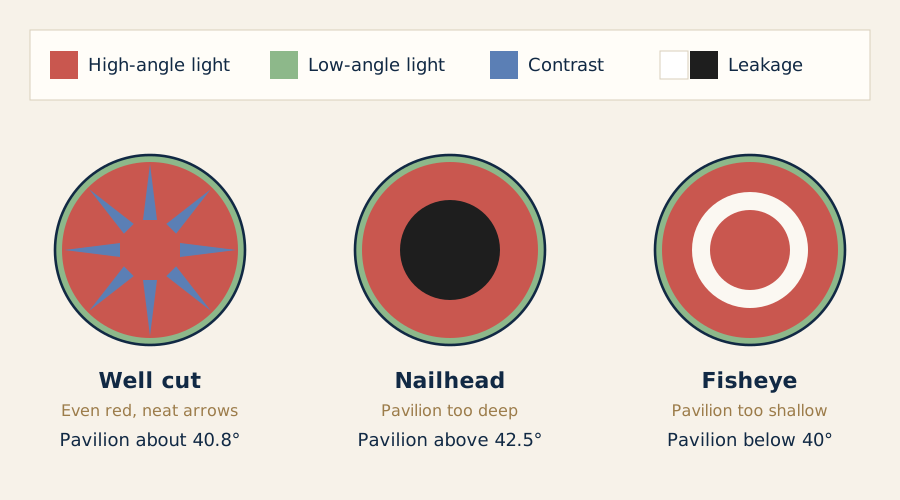
ASET (Angular Spectrum Evaluation Tool, developed by the American Gem Society) colours each part of the diamond according to the angle of the light it is returning:
| ASET colour | What it shows | What you want |
|---|---|---|
| Red | Light from high angles overhead, the brightest source | The dominant colour, evenly spread |
| Green | Light from lower angles, nearer the horizon | Some green is normal, especially near the edge |
| Blue | Contrast: areas reflecting the viewer's own head | A neat, even blue pattern, usually the arrows |
| White or black | Leakage: light passing straight out the back | Little or none |
An Idealscope image is simpler: red shows light returning to the eye, black shows contrast, and pale or white areas show leakage. A well-cut round looks almost entirely red with a crisp, symmetrical black pattern. Our guide to reading light performance images compares real examples side by side.
Light images cannot show transparency. A diamond with strong fluorescence or very fine internal graining can look slightly milky even with perfect hearts and a red ASET. If a stone looks dull in a video despite good images, read our page on haziness and poor transparency before you go further.
What are nailhead, fisheye and extinction in a diamond?
These three terms describe the main ways a round brilliant loses brightness. A true hearts and arrows stone sits in an angle window that avoids the first two, which is one practical thing the pattern does tell you.
- Nailhead: when the pavilion is too steep (roughly above 42–43°), light leaks out through the bottom instead of reflecting back up, and the centre of the stone looks dark grey or black, like the head of a nail.
- Fisheye: when the pavilion is too shallow (roughly below 40°), the girdle (the thin outer edge) reflects inside the table as a pale, whitish ring, like the eye of a fish. These stones are often cut shallow to look wider for their weight.
- Extinction: dark areas that do not light up as the stone moves. Some dark contrast is needed, because sparkle is the play between bright and dark. Too much, especially dark patches under the table that stay put, means light is being lost or blocked.
Because the pavilion angle decides whether light leaks out the bottom, it is worth understanding why the pavilion angle does most of the work. Shallow cuts can look bigger face-up, but the trade-off is brightness; our guide to spread and face-up size explains where a little extra width is worth having and where it is not, and our comparison of which shapes look biggest for their weight shows how much the outline itself changes face-up size.
Extinction can still appear in a hearts and arrows stone in some lighting, for example under a single strong downlight or when a large table reflects your head. This is normal behaviour rather than a fault, and it usually looks better in everyday mixed light.
Can other diamond shapes have hearts and arrows?
The classic pattern depends on the round brilliant's eight-fold layout, so it is really a round-diamond feature. Some cutters create similar effects in other shapes, but these are brand patterns rather than a shared standard. For a broad look at the options, see our overview of the main diamond shapes.
| Shape | Hearts and arrows? | How to judge the cut instead |
|---|---|---|
| Round brilliant | Yes, the classic 8 hearts and 8 arrows | H&A images plus ASET or Idealscope |
| Princess | Some cutters produce a 4-fold pattern | ASET for even light across all four corners |
| Cushion (modified) | Some show arrow-like patterns; most do not | Look for even 'chunky' or 'crushed ice' flashes in video |
| Oval, pear, marquise, heart | No | ASET and a 360° video, checking the bow-tie |
| Emerald, Asscher (step cuts) | No; they show a 'hall of mirrors' pattern | Even, wide flashes and transparency |
For fancy shapes, a good ASET image does the same job a hearts and arrows image does for a round, and it is the best way to spot a heavy bow-tie (a dark band across the middle). Our guides to choosing an oval diamond and ratio and symmetry in heart shaped diamonds cover what to check in those shapes. Each shape also balances light differently, so it helps to know the fire, brilliance and scintillation trade-offs before comparing stones of different shapes.
Are hearts and arrows diamonds worth the extra cost?
What you are paying for is extra cutting time, extra weight lost from the rough, and the selection and imaging involved. You are not paying for more carat, better colour or higher clarity. So the honest question is how much difference it makes to what you see.
Side by side, a hearts and arrows stone and a well-cut GIA Excellent round with good angles often look very similar to most people. The H&A stone may show slightly crisper, more evenly spread flashes, which some eyes notice and others do not. The bigger gap is between an H&A stone and a poorly proportioned Excellent, or a stone graded Very Good or below, which can show leakage, nailhead or fisheye.
| 1 ct round, G colour, VS2 | Approximate price range (AUD) |
|---|---|
| Natural, GIA Excellent cut | about $7,000–$14,000 |
| Natural, hearts and arrows | about $8,000–$16,000 |
| Lab-grown, Excellent cut | about $900–$2,500 |
| Lab-grown, hearts and arrows | about $1,000–$3,000 |
These are broad ranges only and move with the market. The premium for a hearts and arrows natural stone is commonly somewhere around 5–20% over a comparable Excellent round, though it varies widely between sellers. For lab-grown diamonds the gap is often smaller, because many laboratory-grown stones are cut to tight proportions as standard. Natural and lab-grown diamonds are both real diamond with the same hardness and refractive index; the main differences are origin, rarity and price.
If you have a fixed budget, think about where the money shows. Cut quality affects how every diamond looks across the room, while some upgrades, such as moving from VS2 to VVS clarity, are invisible without magnification. Our page on whether VVS clarity earns its premium works through that comparison. Many people find that a precisely cut stone at VS2 or a well-chosen SI1 gives more visible return than a higher clarity with average cutting.
Browse round diamonds: natural and lab-grown
How do you check hearts and arrows diamonds before buying? Step by step
- Read the report. Confirm the shape is a round brilliant, the cut, polish and symmetry grades (ideally Excellent for all three), and whether the diamond is natural or lab-grown.
- Check the proportions. Look for a pavilion angle of about 40.6–41.0°, a crown angle of about 34–35°, and table and depth limits from your report within the ranges above.
- Ask for all three images. Arrows face-up, hearts face-down and an ASET or Idealscope image of the same stone, not a stock example.
- Inspect the hearts. Even size, clean clefts separated from the arrowheads, no split or twisted tips.
- Check the light image. Mostly red, with an even contrast pattern and little white or black leakage; use our light performance checklist alongside it.
- Watch a video in normal light. Make sure the stone looks bright and clear, with no milky haze or dark centre.
- Compare like with like. Weigh the premium against a non-H&A Excellent round with similar angles and the same colour and clarity.
Free consultation
Talk to a gemologist
Compare stones in person or online with Raj Sood, Graduate Gemologist (GIA), AJP (GIA).
Book a consultationShop this shape
FAQ
Common questions
What does hearts and arrows mean on a diamond?
It means the round brilliant has been cut with very precise optical symmetry, so a viewer shows eight even arrows face-up and eight even hearts from underneath. It describes cut precision, not colour, clarity or carat.
Does GIA grade hearts and arrows?
No. GIA reports do not mention hearts and arrows. IGI adds a hearts and arrows comment on some reports, and AGS Ideal 0 grades often accompany the pattern, but there is no single industry standard.
Can you see hearts and arrows without a viewer?
You can sometimes see faint arrows face-up in good light, but the hearts need the stone turned over and a viewer to show clearly. Once a diamond is set in a ring, the hearts side cannot be seen at all.
Is hearts and arrows better than a GIA Excellent cut?
It is a stricter standard of precision, and many hearts and arrows stones sit at the top of the Excellent range. A well-proportioned Excellent round without the pattern can look very similar, so compare light performance images rather than labels.
Are lab-grown diamonds available in hearts and arrows?
Yes. Lab-grown diamonds can be cut to hearts and arrows standards, and many are cut to tight proportions as standard, so the premium is often smaller than for natural stones.
Do oval or pear diamonds have hearts and arrows?
No. The classic pattern relies on the round brilliant's eight-fold facet layout. For fancy shapes, judge the cut with an ASET image and a 360° video instead.

Ask a gemologist
Not sure which diamond to choose?
Raj Sood is a Graduate Gemologist (GIA) and master jeweller. Bring the stones you are considering, or send the reports, and he will tell you honestly which one is better and why.
Keep learning
Related guides
 Diamond Anatomy & LightHearts and Arrows Viewer ExplainedDiamond Anatomy & LightDiamond Light Performance Guide
 Diamond Anatomy & LightDiamond Crown & Pavilion Angles Explained
 Diamond Anatomy & LightDiamond Fire, Brilliance & Scintillation ExplainedDiamond Anatomy & LightAnatomy of a diamond: table, crown, girdle, pavilion and culet explainedDiamond 4Cs & GradingIs VVS Clarity Worth Paying More For?Diamond Anatomy & LightDiamond Spread and Face Up Size GuideDiamond Anatomy & LightDiamond Table and Depth Explained
Explore more
More guides on this topic
Education