
- Education
- Diamond Anatomy & Light
- Emerald Cut Diamond Proportions: Ideal Chart for Depth, Table and Ratio
Diamond Anatomy & Light
Emerald Cut Diamond Proportions: Ideal Chart for Depth, Table and Ratio
Emerald cut diamond proportions decide whether the stone shows broad, bright flashes or a flat, see-through centre. GIA gives emerald cuts no cut grade, so the numbers on the report and your own eye are all you have to judge them.
 Reviewed by Raj Sood, Graduate Gemologist (GIA), AJP (GIA)Master jeweller and Graduate Gemologist (GIA) · reviewed 4 November 2026
Quick answer
Ideal emerald cut diamond proportions are a total depth of about 61–68% and a table of about 61–69% of the width, a length-to-width ratio of 1.30–1.50, a thin to slightly thick girdle and no visible culet. These keep the step facets bright, avoid a see-through window, and stop the stone looking dark or small.
What are emerald cut diamond proportions?
Proportions are the measurements that describe a diamond's shape in profile: how deep it is, how wide the flat top is, how tall the crown sits above the girdle and how far the pavilion runs below it. If those parts are new to you, our guide to the table, crown, girdle, pavilion and culet explains each one with a diagram.
An emerald cut is a step cut. Instead of the triangular and kite-shaped facets of a brilliant, it has long, flat facets arranged in rows (steps) parallel to the edges, with the corners cropped off to form an octagon. Most emerald cuts have about 57–58 facets: usually three rows of steps on the crown and three or four on the pavilion. The pavilion does not end in a point; it narrows to a short ridge called the keel line. Our main emerald cut diamond guide covers the shape's history and styling.
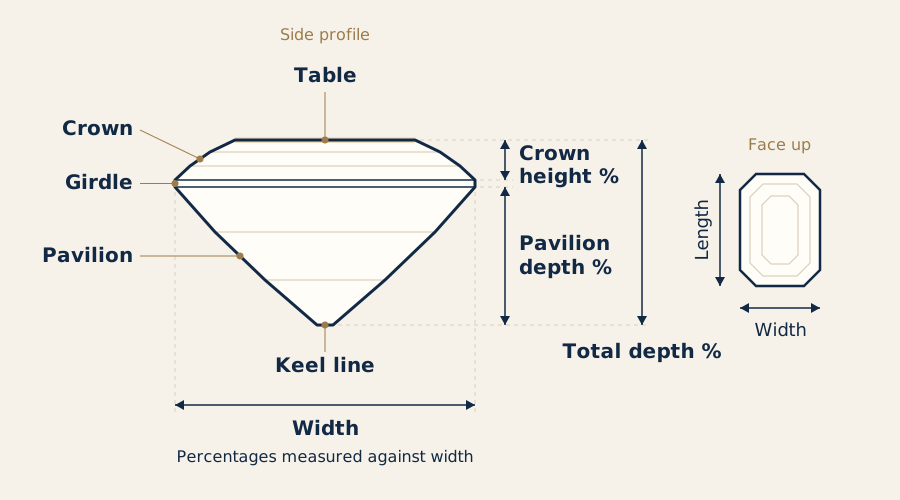
Two percentages matter most. Depth percentage is the total depth (table to keel) divided by the width, the shorter side. Table percentage is the width of the table facet divided by the same width. On a fancy shape, both are measured against width, not length, so a 7.0 × 5.0 mm stone that is 3.25 mm deep has a depth of 65%.
Why does this matter more for emerald cuts than for most shapes? A round brilliant's many small facets scatter light in every direction and forgive small errors. An emerald cut's broad, open steps act like mirrors, so a proportion that is a little off shows straight away as a dead zone or a clear window. That same openness is why inclusions are easier to see in an emerald cut, and why proportions and clarity need to be chosen together.
What are the ideal proportions for an emerald cut diamond?
There is no official ideal for emerald cuts. GIA grades polish and symmetry on a fancy shape but gives no overall cut grade, so the ranges below come from trade practice and from comparing how stones actually perform. Treat them as a guide to where good stones usually sit, not a pass or fail line.
| Proportion | Excellent range | Very good range | Watch out for |
|---|---|---|---|
| Total depth | 61–68% | 58–61% or 68–71% | Below 58% (windowing) or above 71% (dark, small face-up) |
| Table | 61–69% | 58–61% or 69–72% | Above 72% (little crown, weak flashes) |
| Length-to-width ratio | 1.30–1.50 | 1.25–1.30 or 1.50–1.60 | Below 1.25 looks squarish; above 1.70 very slim |
| Crown height | about 8–14% of width | 6–8% | Under 6% (flat, lifeless crown) |
| Pavilion depth | about 45–55% of width | 42–45% or 55–58% | Under 42% (window) or over 58% (extinction) |
| Girdle | Thin to slightly thick | Very thin to thick | Extremely thin (chip risk) or very thick (hidden weight) |
| Culet | None (keel line) | Very small | Medium or larger, visible through the table |
| Polish and symmetry | Excellent or very good | Good | Fair or poor; step lines look wavy |
Notice that the depth and table ranges are wider than you would see for a round diamond's tighter proportion ranges. That is because the step cut's appearance depends on how the individual rows of steps are angled, not just on the totals. Two emerald cuts both at 65% depth can look quite different if one has its weight in a thick girdle and the other in a well-angled pavilion.
Labels on retailer charts such as ideal or excellent are not lab grades for emerald cuts. If you want to understand where those words come from on rounds, read our explainer on what ideal and excellent cut actually mean.
How do depth and table percentage affect an emerald cut?
Depth is the number to check first, because it controls two things at once: how much light the pavilion returns and how big the stone looks for its weight.
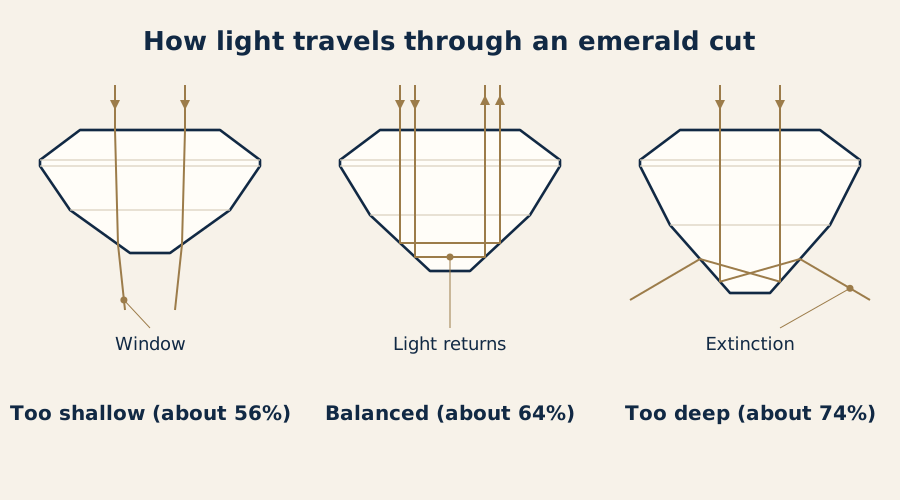
- Too shallow (under about 58%): the pavilion steps are too flat to bounce light back up. Light passes straight through and you see a pale, glassy patch in the centre called a window. The stone faces up large but looks washed out.
- Balanced (about 61–68%): the steps reflect light back through the table in broad flashes, with crisp dark steps between them for contrast.
- Too deep (over about 71%): weight sits underneath where you cannot see it. The stone faces up smaller for its carat weight, and the steep pavilion can leak light out of the sides, leaving dark areas called extinction.
Depth changes face-up size more than most people expect. Here is roughly how a 1 carat emerald cut at a 1.40 ratio measures at different depths:
| Depth percentage | Approximate size (length × width) | How it looks |
|---|---|---|
| 58% | about 7.4 × 5.3 mm | Large face-up, risk of a window |
| 64% | about 7.0 × 5.0 mm | Balanced size and brightness |
| 70% | about 6.7 × 4.8 mm | Smaller, can look darker |
| 74% | about 6.5 × 4.6 mm | Noticeably small for 1 ct |
Table percentage works hand in hand with depth. A table of 61–69% leaves room for a crown with two or three clear rows of steps. Push the table above about 72% and the crown becomes a thin band, so the stone loses the bold flashes that make an emerald cut worth choosing. A very small table, under about 58%, can make the stone look closed in and step-heavy.
Do crown height, pavilion depth and girdle matter for an emerald cut?
Yes, and they explain why two stones with the same total depth can look so different. Most reports list the crown height and pavilion depth as percentages of the width, and the girdle as a range such as thin to medium.
- Crown height (about 8–14%): the crown's steps catch light and send out the broad flashes emerald cuts are known for. A flat crown under about 6% gives a dull, glassy look.
- Pavilion depth (about 45–55%): the pavilion does most of the work of returning light. Each row of steps is cut at a slightly different angle, and the cutter balances them so light bounces from one side to the other and back out through the table.
- Girdle (thin to slightly thick): the thin band around the edge. Emerald cuts often have a slightly thicker girdle at the cropped corners, which is normal and protects them. An extremely thin girdle chips easily; a very thick one adds weight without adding size.
- Culet (none): the pavilion ends in a keel line. A visible culet shows as a small dark rectangle through the table.
The balance between crown and pavilion creates the hall-of-mirrors effect: the long, alternating bands of light and dark that seem to recede into the stone like reflections between two facing mirrors. A well-proportioned stone shows clear, evenly spaced bands; a poorly balanced one shows a blurred or one-sided pattern. Our page on the hall-of-mirrors look and what creates it has examples.
Related guideWhat Is Windowing in an Emerald-Cut Diamond?Not sure which one is right?
Send us the stones you are looking at and our gemologist will tell you which to choose and why.
What length-to-width ratio is ideal for an emerald cut diamond?
The length-to-width ratio is the length divided by the width. It does not change light return much, but it decides the outline you see on the hand. The classic emerald cut sits at about 1.40–1.50, and most people choose something between 1.30 and 1.50.
- 1.20–1.30: fuller and squarer; it begins to resemble an Asscher cut, which is a square step cut with larger corners.
- 1.30–1.50: the traditional rectangle most people picture.
- 1.50–1.70 and above: long and slim; it lengthens the finger and faces up longer for its weight.
Our guide to the emerald cut ratio and how each one looks on the hand shows the outlines side by side, and the page on long, slender emerald cuts above 1.50 covers the extra things to check when you go slimmer, such as keeping the step pattern even along the long sides.
How do you spot windowing and extinction in an emerald cut?
Numbers point you towards a good stone, but the way light actually behaves is what you will see every day. Here is how the two main faults look, and the tools gemmologists use to check them.
- Windowing in photos and video: a pale, transparent area in the centre where you can read through the stone or see the background. In a 360° video it stays see-through as the stone rotates. Our guide on spotting a window in an emerald cut shows real examples.
- Extinction in photos and video: dark steps or dark corners that stay dark in every position. Some dark steps that come and go are normal contrast; a dark band that never lights up is a fault.
- ASET image: the Angular Spectrum Evaluation Tool, developed by the American Gem Society, colour-codes where light comes from. Red shows light returning from steep, bright angles; green shows light from lower angles; blue shows contrast from the viewer's head; white or clear areas show light leaking through. A good emerald cut shows broad red steps with even blue contrast and little white.
- Idealscope image: a simpler viewer where red means light returned and white or pale areas mean leakage. A large pale centre confirms a window.
Other light faults you may read about, such as a fisheye (a grey ring from the girdle reflected in a shallow stone) or a nailhead (a dark centre in a deep stone), are named mostly for brilliant cuts. In an emerald cut the same causes simply show as a window or as extinction. The pavilion is the place to look in both cases, as it is in our radiant cut proportions chart and cushion diamond proportions chart.
How do emerald cut proportions compare with other shapes?
| Shape | Facet style | Typical ideal depth | Typical ideal table | Typical ratio | Main light fault |
|---|---|---|---|---|---|
| Emerald | Step cut | 61–68% | 61–69% | 1.30–1.50 | Windowing |
| Asscher | Step cut | 60–68% | 60–68% | 1.00–1.05 | Windowing |
| Radiant | Mixed (step outline, brilliant facets) | 61–67% | 61–69% | 1.00–1.40 | Bow-tie, dark centre if deep |
| Cushion | Brilliant or modified brilliant | 61–68% | 58–67% | 1.00–1.20 | Dark or crushed-ice look if deep |
| Oval | Brilliant | 58–63% | 53–63% | 1.30–1.50 | Bow-tie |
| Pear | Brilliant | 58–64% | 53–63% | 1.45–1.75 | Bow-tie |
The emerald and the Asscher share the same step faceting, so they share the same weakness for windowing; see how emerald and Asscher cuts differ for the trade-offs. The radiant has a similar rectangular outline but brilliant faceting underneath, which hides inclusions and windows better; our emerald vs radiant comparison goes further. If you are weighing up a brilliant shape instead, the oval proportions chart and pear diamond proportion ranges use the same format as this page.
Do proportions change the price of a natural or lab-grown emerald cut?
Emerald cuts usually cost less per carat than rounds of the same weight, colour and clarity, partly because more of the rough crystal is kept. Within emerald cuts, proportions shift the price less than carat, colour and clarity do, but they change how much stone you see for your money. A deep stone carries carat weight you pay for but cannot see.
Emerald cuts are cut from both natural and laboratory-grown diamond. Lab-grown diamonds are real diamond, with the same hardness (10 on the Mohs scale) and refractive index (about 2.42), grown in a laboratory rather than mined. They cost much less than natural diamonds. Because lab-grown rough is less costly, cutters are often freer to cut for appearance rather than weight retention, but you still need to check each stone's numbers.
| 1 ct emerald cut, G–H, VS2 | Approximate price range (AUD) |
|---|---|
| Lab-grown | about $1,000–$3,000 |
| Natural | about $6,000–$14,000 |
These are broad ranges only and move with the market and exact grades. Emerald cuts also show colour a little more than brilliants, especially at the ends, so G or H is a common choice in white metal.
Browse emerald cut diamonds: natural and lab-grown
How do you check emerald cut diamond proportions? Step by step
- Confirm the basics on the report. Shape, measurements, natural or lab-grown, colour, clarity, polish and symmetry.
- Check total depth. Aim for about 61–68%; be wary below 58% or above 71%.
- Check the table. About 61–69% of the width leaves room for a crown with clear steps.
- Work out the ratio. Divide length by width; 1.30–1.50 is the classic rectangle.
- Read the girdle and culet. Thin to slightly thick, culet none.
- Watch a 360° video. Look for a see-through centre (window) or steps that stay dark (extinction).
- Ask for an ASET or Idealscope image. Broad red steps with even contrast and little white or clear area is the pattern to look for.
- Compare face-up size. Check the millimetres, not just the carat weight.
The setting matters too. Emerald cuts have cropped corners that protect them, but a four-claw or double-claw setting at each corner, or a bezel, keeps those corners safe in daily wear.
Any term on this page you want to revisit is defined in our plain-English jewellery glossary.
Free consultation
Talk to a gemologist
Compare stones in person or online with Raj Sood, Graduate Gemologist (GIA), AJP (GIA).
Book a consultationFAQ
Common questions
What is the ideal depth for an emerald cut diamond?
Most well-cut emerald cuts sit at about 61–68% total depth, measured against the width. Below about 58% they tend to window; above about 71% they face up small and can look dark.
What table percentage is best for an emerald cut?
A table of about 61–69% of the width is the common target. It leaves enough crown for clear step flashes without closing the stone in.
Does GIA give emerald cut diamonds a cut grade?
No. GIA gives a cut grade only to standard round brilliants. For emerald cuts it grades polish and symmetry, so you judge the cut from the proportions, video and light images.
What causes windowing in an emerald cut diamond?
A pavilion that is too shallow lets light pass straight through instead of reflecting back up. It shows as a pale, see-through area in the centre of the stone.
What length-to-width ratio should an emerald cut have?
The classic range is 1.30–1.50. Below about 1.25 it looks squarer, closer to an Asscher; above 1.50 it looks long and slim.
Are lab-grown emerald cuts cut to the same proportions?
Yes, the same ranges apply because lab-grown diamond has the same optical properties as natural diamond. Check each lab-grown stone's report and video just as you would a natural one.

Ask a gemologist
Not sure which diamond to choose?
Raj Sood is a Graduate Gemologist (GIA) and master jeweller. Bring the stones you are considering, or send the reports, and he will tell you honestly which one is better and why.
Keep learning
Related guides
 Diamond ShapesWhat Is Windowing in an Emerald-Cut Diamond?Diamond ShapesEmerald-Cut Diamond Length-to-Width RatioDiamond ShapesEmerald Cut DiamondsDiamond ShapesEmerald-Cut Diamond Hall-of-Mirrors EffectDiamond Anatomy & LightAnatomy of a diamond: table, crown, girdle, pavilion and culet explained
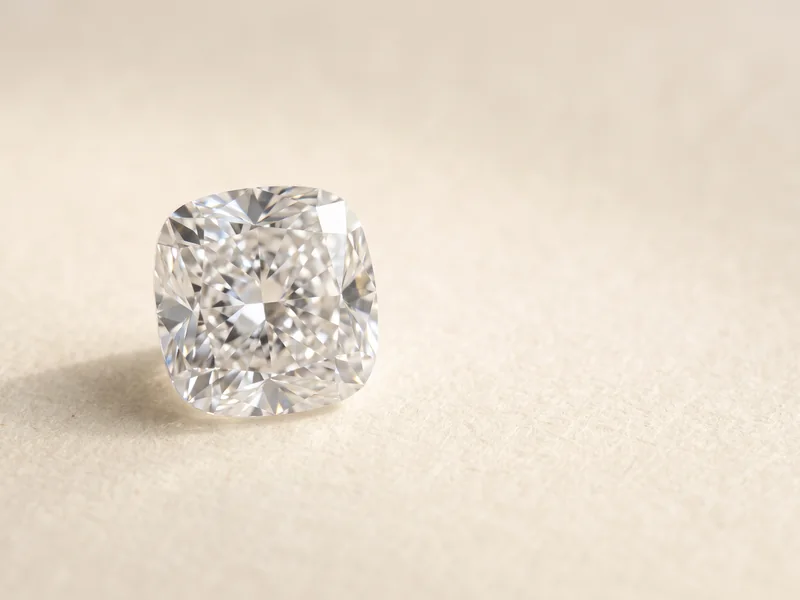 Diamond Anatomy & LightIdeal Proportions Chart: Cushion Diamonds
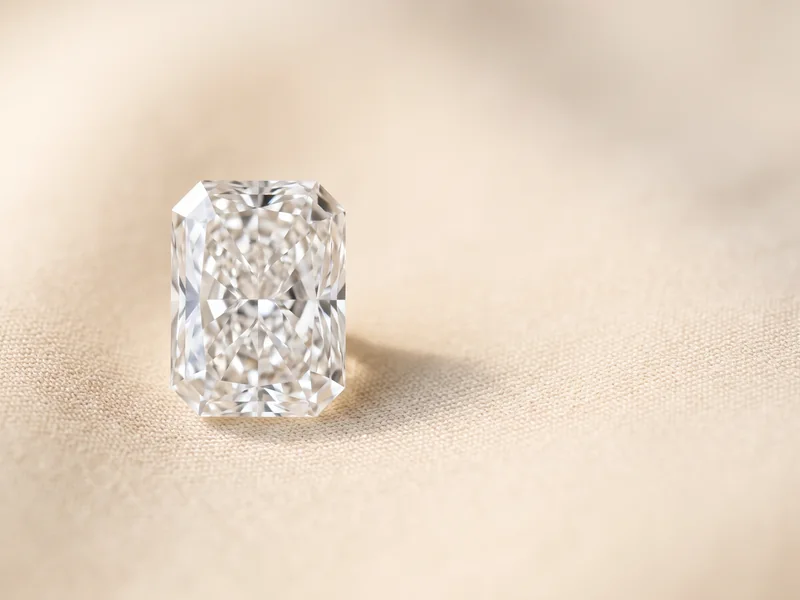 Diamond Anatomy & LightIdeal Proportions Chart: Radiant Diamonds
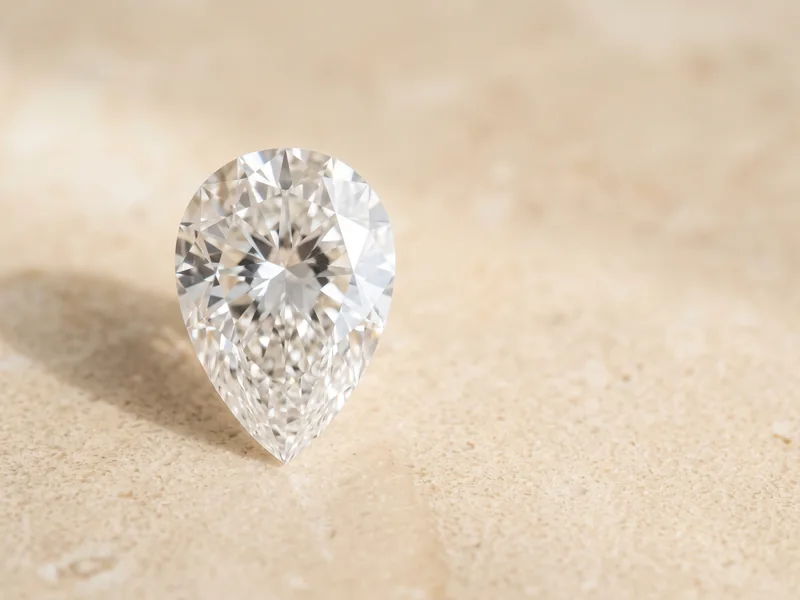 Diamond Anatomy & LightIdeal Proportions Chart: Pear Diamonds
Explore more
More guides on this topic
Education