
- Education
- Diamond Anatomy & Light
- Diamond Face Up Size and Spread Guide: Depth, mm and Light
Diamond Anatomy & Light
Diamond Face Up Size and Spread Guide: Depth, mm and Light
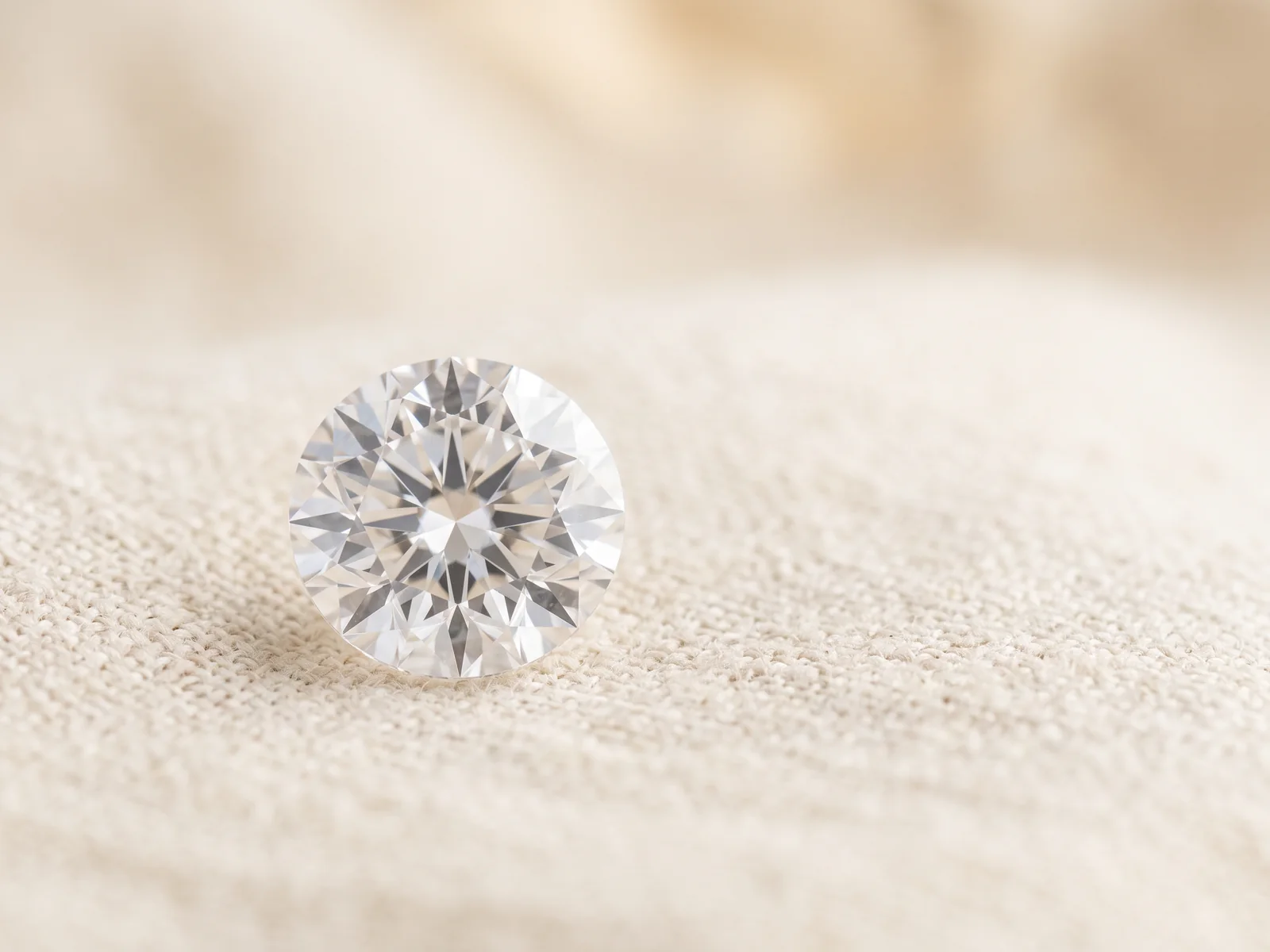
Carat is weight, not size, and two diamonds of the same weight can look noticeably different on the hand. This guide explains diamond face up size and spread: how the cut hides or shows weight, what the numbers should be for each shape, and how to check them.
 Reviewed by Raj Sood, Graduate Gemologist (GIA), AJP (GIA)Master jeweller and Graduate Gemologist (GIA) · reviewed 4 November 2026
Quick answer
A diamond's face up size is the diameter, or length and width, you see from above, measured in millimetres. Spread compares that size with carat weight. A well-cut 1 carat round measures about 6.4–6.5 mm. Deep stones hide weight below and look smaller; shallow stones spread wider but risk windowing, fisheye and dull, leaky light.
What is diamond face up size and spread?
Face up size is how big a diamond looks when you view it from above, the way it sits in a ring. For a round it is the diameter in millimetres; for fancy shapes it is the length and width. Spread is the relationship between that visible size and the carat weight. A diamond with good spread looks as big as its weight suggests, or a little bigger. A diamond with poor spread carries weight where you cannot see it, deep underneath or in a thick edge, so it looks smaller than another stone of the same carat.
Carat is a unit of weight (1 carat = 0.2 grams), not size. Two 1.00 carat rounds can differ by 0.3–0.5 mm across the top, which on the hand is the difference between a stone that reads as 1 carat and one that looks closer to 0.85. To see where hidden weight goes, it helps to know the table, crown, girdle, pavilion and culet. The crown is the top section, the girdle is the thin outer edge at the widest point, and the pavilion is the cone underneath. Only the girdle outline decides the face up size; the rest decides how bright that area looks.
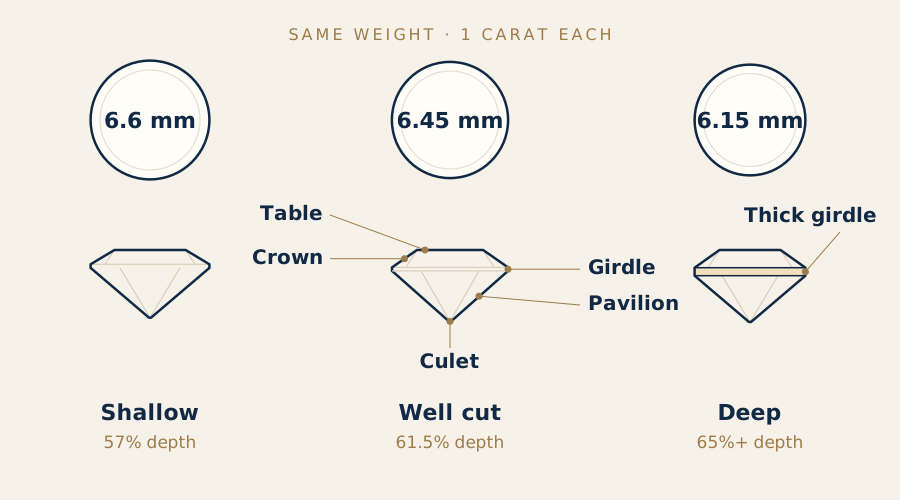
Spread is not the whole story. A stone cut to spread as wide as possible can leak light and look glassy, which defeats the point. The aim is the widest face up size that still returns light strongly. New to any of these words? Our jewellery glossary of cutting and grading terms explains each one in a line or two.
How is face up size measured on a grading report?
Every grading report from GIA, IGI or a similar laboratory lists measurements in millimetres. For a round it reads like 6.45–6.48 × 3.98 mm: the smallest and largest diameter across the girdle, then the total depth from the table to the culet. For fancy shapes it reads length × width × depth, for example 7.70 × 5.70 × 3.55 mm for an oval. The first two numbers are the face up size. The third disappears once the stone is set.
Rounds are never perfectly circular. A gap of up to about 0.05 mm between the minimum and maximum diameter is normal. A bigger gap means the outline is slightly out of round, which you will not see by eye but which tells you something about the cutter's care.
Cutters estimate weight from size with a simple formula. For a round brilliant it is roughly diameter × diameter × depth (mm) × 0.0061 = carat. Run the numbers above and you get about 1.00 carat. If a 1.00 carat round has a diameter well under 6.3 mm, the weight is going somewhere else: a deep pavilion, a thick girdle or a steep crown. Our millimetre-to-carat chart for every shape lists expected sizes so you can spot an under-spread stone quickly.
| Carat weight | Expected diameter, well-cut round | Approximate face-up area |
|---|---|---|
| 0.30 ct | about 4.3 mm | about 14.5 mm² |
| 0.50 ct | about 5.1–5.2 mm | about 21 mm² |
| 0.75 ct | about 5.8–5.9 mm | about 27 mm² |
| 1.00 ct | about 6.4–6.5 mm | about 33 mm² |
| 1.50 ct | about 7.3–7.4 mm | about 42 mm² |
| 2.00 ct | about 8.0–8.2 mm | about 52 mm² |
Doubling the weight from 1 to 2 carats increases the diameter by only about a quarter, but the face-up area by more than half. Your eye judges area rather than diameter, which is why a 2 carat looks markedly bigger even though the millimetre figure moves less than you might expect.
How do depth, table and girdle change a diamond's spread?
Total depth percentage is the depth divided by the average diameter. Most well-cut rounds sit at about 59–62.5%. See how table and depth percentages are calculated for the maths; here is what depth does to size for a 1.00 carat round.
| Total depth (1.00 ct round) | Approximate diameter | What you tend to see |
|---|---|---|
| Under 58% | about 6.6–6.7 mm | Biggest spread, but a real risk of fisheye and windowing |
| 59–62.5% | about 6.4–6.5 mm | Balanced spread and strong light return |
| 63–64.5% | about 6.35–6.4 mm | Slightly small for the weight; often still bright |
| 65% and over | about 6.2–6.3 mm | Looks under its weight; risk of a dark centre |
| 65%+ with a thick girdle | about 6.1–6.2 mm | Faces up like a 0.85–0.90 ct stone |
Depth on its own changes the diameter less than people expect. The bigger losses come when a deep pavilion is combined with a heavy girdle. Labs grade the girdle from extremely thin to extremely thick. A thin to slightly thick girdle protects the edge from chipping; a very thick or extremely thick girdle adds a ring of weight around the stone that you only ever see as a grey edge from the side. Our guide to girdle thickness grades from extremely thin to extremely thick shows how much weight each grade can hide.
A larger table (the flat top facet) does not make the diamond wider; the girdle diameter decides that. A big table with a low crown can look brighter and a touch bigger at a glance, but gives up fire, the flashes of colour. Most well-cut rounds have tables of about 54–58% and crown angles of about 34–35°. At the bottom, a large or very large culet can show as a small dark or see-through dot in the centre; see what a culet is and when it shows. Most modern rounds have no culet, which costs nothing in spread.
Some buyers deliberately look for rounds at the shallow end, about 58–60% depth, to get a little more diameter per carat. It can work, as long as the angles stay in range. We weigh up the trade-offs in shallow round diamonds and whether the extra spread is good value.
Which diamond shapes have the biggest face up size per carat?
Shape changes spread far more than depth does. Elongated shapes spread their weight along a length and are usually cut shallower than square shapes, so they face up larger. Square shapes with deep pavilions, such as the princess and Asscher, carry more weight underneath.
| Shape (1 ct) | Typical face-up size | Typical total depth | Compared with a round |
|---|---|---|---|
| Round | 6.4–6.5 mm | 59–62.5% | The baseline |
| Oval | about 7.7 × 5.7 mm | 58–63% | Looks a little larger, mainly from length |
| Pear | about 8.5 × 5.5 mm | 58–64% | Looks larger, mainly from length |
| Marquise | about 10.0 × 5.0 mm | 58–63% | Longest face-up outline per carat |
| Heart | about 6.8 × 6.3 mm | 56–62% | Looks a little larger |
| Emerald | about 7.0 × 5.0 mm | 61–68% | Similar; step facets show inclusions more |
| Radiant | about 6.5 × 5.0 mm | 61–69% | Often slightly smaller, deeper cut |
| Cushion | about 5.8–6.0 mm square | 61–68% | Usually slightly smaller |
| Princess | about 5.5 × 5.5 mm | 65–75% | Smaller face-up, weight sits deep |
| Asscher | about 5.5 × 5.5 mm | 60–68% | Smaller face-up, cut corners |
Two cautions. First, length is not area: a marquise looks big because the eye reads its length, but its face-up area is close to a round's. Second, a fancy shape cut very shallow for size often shows a window, a washed-out see-through patch in the centre. Our guide to how windowing shows up in ovals, pears and emeralds shows what to look for shape by shape.
GIA gives an overall cut grade only to round brilliants, so for fancy shapes you judge spread from the measurements and the stone itself. Length-to-width ratio matters too: an oval at 1.45 looks longer and slimmer than one at 1.30, even at the same weight.
Not sure which one is right?
Send us the stones you are looking at and our gemologist will tell you which to choose and why.
Can a diamond spread too much?
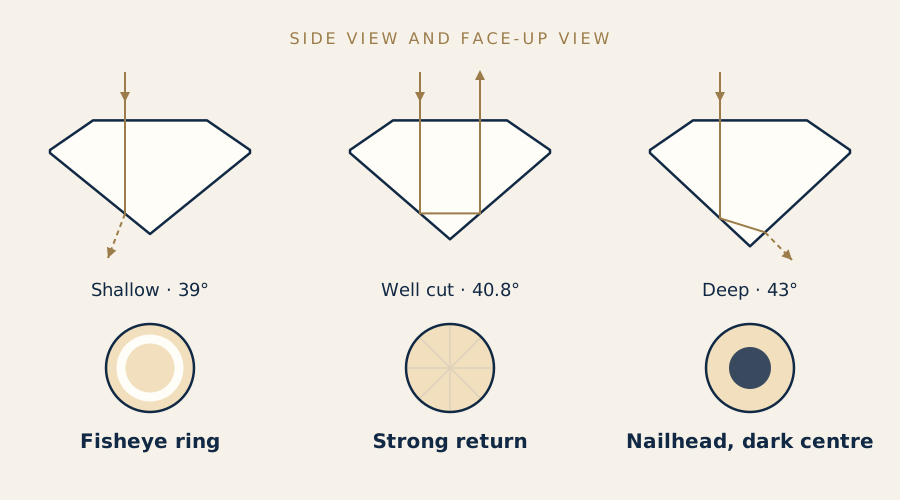
Yes. Diamond has a refractive index of about 2.42 and a critical angle of about 24.4°. Light that meets an inside facet more than 24.4° away from straight-on reflects back into the stone; light closer to straight-on escapes. The pavilion angles of a well-cut round, typically about 40.6–41°, are set so light bounces off both sides of the pavilion and comes back out the top. Cut the pavilion too shallow and light slips out through the bottom. That is light leakage, explained step by step in light leakage, the root cause of dull patches.
- Fisheye: when the pavilion angle drops below about 40° (depth often under 57–58%), the girdle reflects in the table as a grey or whitish ring just inside the table edge. Once you notice it you cannot stop seeing it. See the fisheye effect up close.
- Windowing: a glassy centre you can almost read print through. Most common in shallow ovals, pears and emerald cuts.
- Low contrast: very shallow stones can look flat and grey in ordinary room light, because there is not enough pattern of light and dark to create sparkle.
Transparency matters as well. A diamond with a hazy or milky look, from tiny inclusions or graining, scatters light and looks smaller and duller than its millimetres suggest. Our page on diamond transparency and haziness covers how to spot it on a report and in video.
What is the nailhead effect and why do deep diamonds look smaller?
Deep stones fail the other way. If the pavilion angle rises above about 42–43°, light hitting the first pavilion facet is sent across to the opposite side too close to straight-on, so it escapes through the pavilion instead of coming back up. The centre of the stone goes dark, like the head of a nail: the nailhead effect. Our guide to nailhead in deep rounds and princess cuts shows each stage, from a slightly grey centre to a black one.
So a deep stone loses twice. It is smaller across the top for its weight, and part of that smaller area is dark. A 1.00 carat at 65% depth with a thick girdle can measure 6.1–6.2 mm, about the diameter of a well-cut 0.85–0.90 carat, and look smaller again if the centre is dull.
Not every dark area is a fault. Every diamond shows extinction: darker zones where your own head and body block light from reaching the stone. Small dark areas spread evenly give contrast and make the sparkle readable. Large dark areas that stay put, such as a bow-tie across an oval or pear, shrink the bright area you actually see. Read how extinction and dark zones affect brightness for the difference between useful contrast and dead zones.
How do ASET and Idealscope images show a diamond's real face up size?
Millimetres tell you how wide the stone is. Reflector images tell you how much of that width actually works. An Idealscope is a viewer with a red reflector: areas returning light look red, and areas leaking light look white or pale pink. An ASET (Angular Spectrum Evaluation Tool, developed by the American Gem Society) adds colours that show the angle the returning light comes from.
| ASET colour | What it shows | What you want to see |
|---|---|---|
| Red | Light returning from high angles, overhead, the brightest source | Most of the stone |
| Green | Light from lower angles, nearer the horizon | Some, evenly spread |
| Blue | Contrast, where the viewer's head blocks light | A crisp, even pattern |
| White or black | Light leaking through the stone | As little as possible, and not in the centre |
Read the image for spread problems. A shallow stone with fisheye shows a pale ring under the table edge. A deep stone with nailhead shows a dark or green-blue centre. A window shows as a pale patch in the middle. A stone where red and blue cover nearly the whole face is using every millimetre of its spread. Our guide to reading ASET and Idealscope images walks through real examples.
Hearts and arrows viewers are a different tool: they check facet alignment, called optical symmetry, not light leakage. See how a hearts and arrows viewer works and whether a hearts and arrows premium is worth paying. For how all these tools fit together, start with the full light performance picture.
Do the setting and your finger size change how big a diamond looks?
Yes, and often by more than a tenth of a millimetre of spread ever could. Four slim claws cover less of the outline than six heavy ones. White gold or platinum blends with the stone's edge, while yellow gold frames it with a warm line.
- Halo: a ring of small diamonds, each about 1.0–1.3 mm, around the centre. A 6.5 mm round in a halo measures roughly 9–9.5 mm across the whole head, close to the diameter of a round of about 2.5–3 carats.
- Bezel: a metal rim around the edge. A slim, polished rim adds visual width; a thick rim can make the stone look smaller by contrast.
- Tall or cathedral settings: lift the stone so more light reaches it from the side, which helps brightness more than size.
- Illusion settings: a polished metal plate around a small diamond makes it read larger; common in older and cluster jewellery.
The same diamond also looks larger on a slender finger. An Australian size J is about 15.6 mm across inside, so a 6.5 mm round covers around two-fifths of the width; on a size R, about 19.0 mm, it covers just over a third. Check your size with our guide to Australian ring sizes from letters to millimetres, and for broader hands see sizing a man's ring properly. The same logic applies to tennis bracelets: 2.5 mm stones look bolder on a small wrist, so measure first with our step-by-step bracelet sizing guide.
Is better spread worth paying for, natural or lab-grown?
Diamond prices step up at round weights such as 0.50, 0.75, 1.00 and 1.50 carat, because demand bunches there. That creates a useful option: a well-cut 0.90 carat round measures about 6.2–6.3 mm, the same as many deep 1.00 carat stones, and usually costs noticeably less. A diamond that faces up big for its weight is often the better buy, as long as its light return is also strong.
Cutters of both natural and laboratory-grown diamonds sometimes keep extra weight in a deep pavilion or thick girdle, because a stone over a round weight sells for more per carat. Lab-grown diamonds are real diamond, with the same hardness (10 on the Mohs scale) and refractive index as natural, and they cost much less, so many people choose a larger carat weight. The spread checks are identical for both: a 62% deep round behaves the same whether it was mined or grown.
When you compare stones online, filter by diameter range rather than carat, then check depth, girdle and the reflector image before anything else.
Browse natural and lab-grown diamonds by size
How do you check diamond face up size before you buy?
- Read the measurements. Note the diameter, or length × width, and the depth in millimetres from the grading report.
- Compare with the expected size. A 1.00 carat round should be about 6.4–6.5 mm; use a mm-to-carat chart for other shapes and weights.
- Check depth and table. For rounds, aim for about 59–62.5% depth and a 54–58% table; for fancy shapes, compare with that shape's typical range.
- Look at the girdle grade. Thin to slightly thick is ideal; very thick or extremely thick hides weight.
- Ask for an ASET or Idealscope image. Look for even red and blue, no pale ring under the table and no dark centre.
- Watch a 360° video. Check for fisheye, windows, a fixed bow-tie or a dull centre as the stone moves.
- Picture it on your hand. Factor in the setting and your ring size before choosing between two close sizes.
Free consultation
Talk to a gemologist
Compare stones in person or online with Raj Sood, Graduate Gemologist (GIA), AJP (GIA).
Book a consultationShop this shape
FAQ
Common questions
What does spread mean in a diamond?
Spread is how large a diamond looks face up compared with its carat weight. A stone with good spread has a diameter at or slightly above the expected size for its weight, for example about 6.4–6.5 mm for a 1 carat round.
What mm size should a 1 carat diamond be?
A well-cut 1 carat round measures about 6.4–6.5 mm across. Deep stones can measure 6.2 mm or less, and very shallow ones 6.6 mm or more, with trade-offs in light return.
Does depth affect how big a diamond looks?
Yes. A deeper stone carries more weight below the girdle, so it is narrower for its carat, and very deep stones can also show a dark centre. A very shallow stone looks wider but can leak light and show fisheye or a window.
Which diamond shape looks biggest for its carat weight?
Elongated shapes such as marquise, pear and oval look largest per carat because they spread weight along their length. Princess, Asscher and cushion cuts usually face up smaller than a round of the same weight.
Is a shallow diamond a good way to get more size?
Only up to a point. Rounds around 58–60% depth can give a little more diameter and still perform well if the angles are right, but below about 57–58% fisheye and windowing become likely.
Do lab-grown diamonds have better spread than natural diamonds?
Not inherently. Spread depends on how the stone is cut, not on whether it is natural or lab-grown, so check the measurements, depth, girdle and reflector image for either.

Ask a gemologist
Not sure which diamond to choose?
Raj Sood is a Graduate Gemologist (GIA) and master jeweller. Bring the stones you are considering, or send the reports, and he will tell you honestly which one is better and why.
Keep learning
Related guides
 Diamond Anatomy & LightDiamond Table and Depth Explained
 Diamond Anatomy & LightNailhead Effect in Diamonds
 Diamond Anatomy & LightFisheye Effect in DiamondsDiamond Anatomy & LightASET and Idealscope Images ExplainedDiamond Anatomy & LightAnatomy of a diamond: table, crown, girdle, pavilion and culet explainedDiamond Anatomy & LightShallow Round Diamonds: Bigger Spread, Better Value?
 Buying Knowledge & Custom ProcessMen's Ring Size GuideDiamond 4Cs & GradingDiamond MM to Carat Size Chart (All Shapes)
Explore more
More guides on this topic
Education