
- Education
- Diamond Anatomy & Light
- Shallow Round Diamond Guide: Spread, Fisheye, Light Leakage and Value
Diamond Anatomy & Light
Shallow Round Diamond Guide: Spread, Fisheye, Light Leakage and Value
A shallow round diamond promises more size for your money, and sometimes it delivers. Here is how to tell a stone that spreads well from one that leaks light, using depth, angles, ASET images and your own eyes.
 Reviewed by Raj Sood, Graduate Gemologist (GIA), AJP (GIA)Master jeweller and Graduate Gemologist (GIA) · reviewed 4 November 2026
Quick answer
A shallow round diamond has a total depth below about 59% or a pavilion angle under about 40.5°. It spreads wider for its weight, about 0.1–0.2 mm on a 1 carat stone, but light can leak through the pavilion, causing glassy patches or a grey fisheye ring. Slightly shallow stones can be good value; very shallow ones rarely are.
What is a shallow round diamond?
A shallow round diamond is a round brilliant cut with less height than usual for its width. On a grading report this shows up as a low total depth percentage: the distance from the table (the flat top facet) to the culet (the bottom point), divided by the average diameter. Most well-cut rounds sit between about 59% and 62.5%. Below roughly 59%, a stone starts to be called shallow, and below about 57% most gemmologists treat it with real caution.
Total depth is made of three parts stacked on top of each other: the crown (the top section above the girdle), the girdle (the thin outer edge) and the pavilion (the cone underneath). If you want a refresher on how the table, crown, girdle and pavilion fit together, start there. A stone can be shallow because the crown is low, because the girdle is very thin, because the pavilion is flat, or a mix of all three. Those causes behave very differently, which is why depth on its own never tells the whole story.
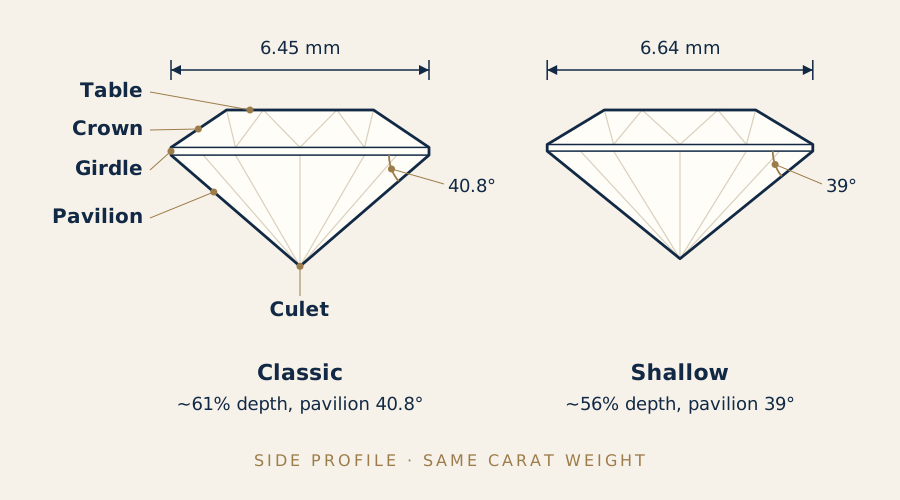
Everything about the classic 57-facet round brilliant is designed around one job: sending light that enters the top back out of the top. Diamond has a refractive index of about 2.42, which gives it a critical angle of roughly 24.4°. Light that strikes a pavilion facet at more than that angle from the perpendicular is reflected back inside; light that strikes closer to the perpendicular passes straight out the bottom. The pavilion angle decides which happens. Any unfamiliar term in this guide is also explained in our plain-English jewellery glossary.
What is the ideal depth for a round diamond, and how shallow is too shallow?
Gemmologists judge a round by its angles first and its depth second. The pavilion angle (how steeply the lower facets slope from the girdle) controls brightness and light leakage. The crown angle (the slope of the upper facets) controls fire, the flashes of spectral colour, along with brightness. The table and girdle then fine-tune the result.
| Measurement | Shallow | Classic well-cut range | Deep / steep |
|---|---|---|---|
| Total depth | Below about 59% | about 59–62.5% | Above about 63% |
| Pavilion angle | Below about 40.5° | about 40.6–41.0° | Above about 41.8° |
| Pavilion depth | Below about 42.5% | about 42.8–43.5% | Above about 44.5% |
| Crown angle | Below about 32° | about 33.5–35.5° | Above about 36.5° |
| Crown height | Below about 13% | about 14–16% | Above about 17% |
| Table | Often 60% or more | about 53–58% | Often 52–55% |
These ranges are typical rather than official; GIA and AGS each publish their own grading tolerances, and a stone can fall outside one row and still look good if the other angles compensate. A shallow crown can be partly balanced by a slightly steeper pavilion, for example. That interplay is covered in detail in reading round proportions beyond the cut grade.
There is also a deliberate style that sits at the shallow end: a table of about 60% and a depth of about 60%. These stones trade some fire for brightness and spread, and many are attractive. See 60/60 rounds compared with classic proportions for how they differ from an ideal-cut stone with a smaller table.
One important nuance: a depth of 58% caused by a thin crown and a thin girdle, with a pavilion angle of 40.8°, is a very different stone from a depth of 58% caused by a pavilion angle of 39°. The first may still grade Excellent; the second will usually leak light. Always look for the pavilion angle on the report's proportions diagram.
Does a shallow round diamond look bigger?
Yes, but by less than most people expect. Spread is the face-up size of a diamond, measured as its diameter in millimetres. Because carat is a weight, a stone that carries less weight below the girdle can be a little wider for the same carat. A useful jeweller's approximation for a round is: carat ≈ diameter² × depth (in mm) × 0.0061, adjusted for girdle thickness.
| Total depth (1.00 ct round) | Approximate diameter | Face-up area vs a 61% stone |
|---|---|---|
| 56% | about 6.64 mm | about 6% larger |
| 58% | about 6.56 mm | about 3% larger |
| 60% | about 6.49 mm | about 1% larger |
| 61% | about 6.45 mm | baseline |
| 62% | about 6.42 mm | about 1% smaller |
| 64% | about 6.35 mm | about 3% smaller |
| 66% | about 6.29 mm | about 5% smaller |
So a 1 carat stone cut at 57% depth instead of 61% gains roughly 0.15 mm in diameter. On the hand, at normal viewing distance, that is hard to see. A drop in brightness from light leakage is often easier to see than the extra width, because a glassy stone looks smaller and flatter than it measures. This is the heart of the trade-off between size and quality: a tenth or two of a millimetre is rarely worth losing the light that makes a round look lively.
If face-up size per carat is your main goal, shape matters far more than depth; our comparison of which diamond shapes face up largest for their weight sets the numbers side by side. An oval of the same weight shows noticeably more surface because it is long and spread out; see how an oval faces up next to a round for the measurements.
What happens to light in a shallow cut diamond?
In a well-cut round, light enters through the crown, bounces off one pavilion facet, crosses to the opposite pavilion facet, bounces again and leaves through the crown towards your eye. When the pavilion is too flat, the light reaches the second facet at too shallow an angle, below the critical angle, and escapes out the bottom. That is light leakage.
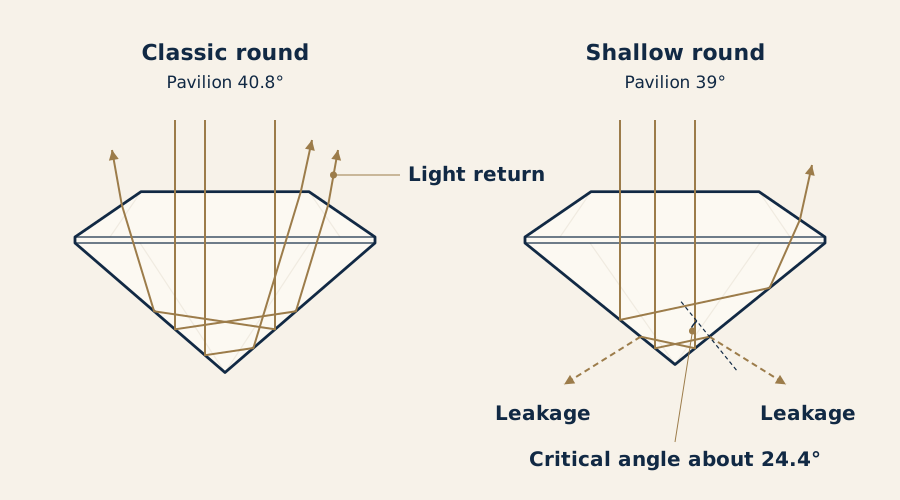
In a shallow diamond, leakage usually starts under the table, around the edge of the centre rather than in the very middle. It shows as areas that look watery, glassy or see-through, especially when the stone sits against a pale background or skin. You may also notice less contrast: the crisp pattern of bright and dark facets that gives a round its sparkle looks flatter and more uniform.
- Shallow pavilion (below about 40.5°): leakage under the table, weaker brightness, and fisheye at the extreme.
- Shallow crown (below about 32°): less fire, because light is bent less as it leaves; the stone can look bright but colourless in its sparkle.
- Very thin girdle: little optical effect, but a durability risk (see below).
- Large table (60%+): often paired with a shallow crown; more white brightness, less colour flash.
Cutters sometimes alter the girdle area to save weight or adjust the look, a practice known as painting and digging out. It can change how light behaves near the edge of the stone and how a shallow or deep round reads face-up. Our guide to painting and digging out at the girdle explains what to look for.
Not sure which one is right?
Send us the stones you are looking at and our gemologist will tell you which to choose and why.
What is a fisheye diamond, and how is it different from a nailhead?
A fisheye is a whitish or grey ring visible just inside the edge of the table. It happens when the pavilion is so shallow, usually below about 39°, that the girdle is reflected in the pavilion facets and seen through the table. It looks a little like the pale ring in a fish's eye, hence the name. Fisheye is more noticeable in stones with a large table and a thick or faceted girdle, and it does not go away when the diamond moves.
A nailhead is the opposite problem. When the pavilion is too steep, usually above about 42°, light that should return through the centre is lost out the sides, and the middle of the stone looks dark, like the flat head of a nail seen from above. Steep-deep stones are covered in steep-deep rounds and the nailhead effect.
| Shallow round | Classic round | Deep round | |
|---|---|---|---|
| Typical depth | Below about 59% | about 59–62.5% | Above about 63% |
| Pavilion angle | Below about 40.5° | about 40.6–41.0° | Above about 41.8° |
| Face-up size per carat | Slightly larger | Standard | Smaller |
| Main light problem | Leakage under the table | Minimal leakage | Dark centre, leakage at edges |
| Extreme defect | Fisheye (grey ring) | None | Nailhead (dark centre) |
| Fire | Lower if crown is shallow | Balanced | Can be strong but darker overall |
| Durability concern | Thin girdle, low crown | Low | Thick girdle hidden weight |
Extinction is the general word for dark areas in a diamond. Some extinction is good: the dark facets are what give contrast. In a shallow stone the issue is the reverse; there is often too little contrast, and the dark areas are replaced by transparent ones.
Related guideSteep-Deep Round Diamonds ExplainedHow do ASET and Idealscope images show a shallow diamond?
Photos and videos rarely show light leakage clearly, so reflector tools are useful. An ASET (Angular Spectrum Evaluation Tool) image shows where each part of the diamond gathers light from. An Idealscope image shows where light is returned and where it leaks.
- Red (ASET): light coming from high angles above the stone, the brightest and most important light.
- Green (ASET): light from lower angles, softer but still useful.
- Blue (ASET): areas reflecting the viewer's head, which create contrast. A balanced spread of blue is normal.
- White or pale (ASET and Idealscope): leakage, where light passes straight through.
- Red (Idealscope): good light return; black shows obstruction.
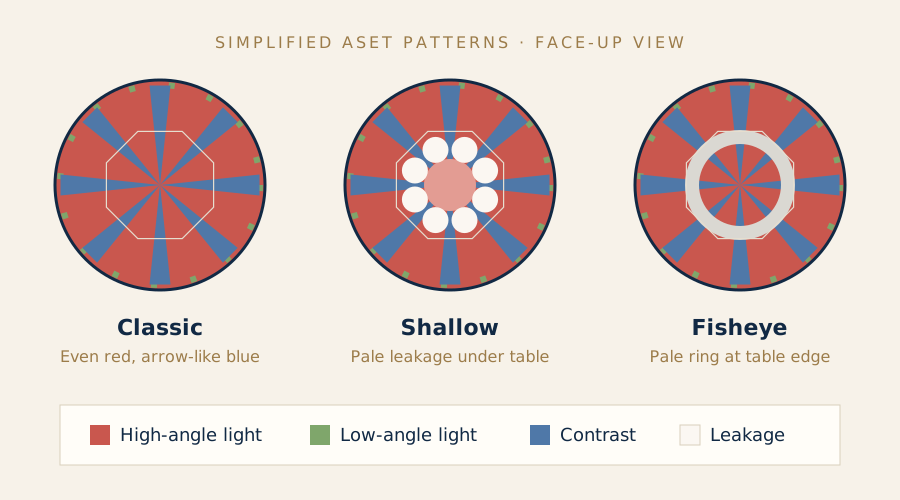
In a shallow round, the ASET image typically shows a ring of pale or washed-out areas under the table, with the red getting thinner towards the centre. In a fisheye stone, a distinct pale ring sits near the table edge. A mildly shallow stone with a good crown may show only small pale spots that you would never notice in daylight. These images help you compare angle combinations that reports do not spell out; for more on that, see angle combinations that grading reports don't spell out.
Is a shallow round diamond better value, natural or lab-grown?
It depends on how shallow and why. Diamonds are priced by weight, colour, clarity and cut grade, so a slightly shallow stone with good angles costs about the same per carat as a classic stone and gives you a fraction more spread. A clearly shallow stone with a pavilion below about 40°, which will usually grade Good or Very Good for cut, tends to be priced below an Excellent stone of the same grades. The question is whether the saving is worth the light you lose. For most people, a stone near the classic range is the more satisfying buy, and any money saved goes further in deciding whether to put budget into carat or into cut.
Natural and laboratory-grown diamonds are cut the same way and follow the same optics. Lab-grown diamonds are real diamond, grown in a laboratory rather than mined, and they cost much less than natural. Some lab-grown rough, especially CVD (chemical vapour deposition) crystals, grows in flat plates, and some lab-grown rounds are cut on the shallow side to make the most of that shape. Check the angles on a lab-grown report just as carefully as on a natural one.
| 1 ct round, G colour, VS2 | Approximate price range (AUD) |
|---|---|
| Natural, Excellent cut, classic proportions | about $8,000–$15,000 |
| Natural, shallow, Very Good or Good cut | usually somewhat below the Excellent range |
| Lab-grown, Excellent cut | about $1,000–$2,500 |
| Lab-grown, shallow | usually a little below the Excellent range |
These are broad ranges only and move with the market. If you like a round's look but want more face-up size or a softer outline, compare round versus cushion cut diamonds, or look at other members of the round brilliant family such as the star and Portuguese cuts.
Browse round diamonds: natural and lab-grown
Are shallow diamonds less durable?
Diamond is 10 on the Mohs hardness scale, but it can still chip along its cleavage planes if a thin edge takes a knock. Shallow rounds often have a low crown and a thin or very thin girdle, which leaves less material at the edge. A report grading the girdle as Extremely Thin is a warning sign for an engagement ring worn every day; Thin to Medium is generally sound. Knowing what the girdle does and why its thickness matters helps you read this line on the report.
A protective setting reduces the risk. Four or six claws placed evenly around the girdle, a bezel (a rim of metal around the edge) or a halo all shield a thin edge. A low-profile setting also keeps the stone away from knocks.
How do you check a shallow round diamond before buying? Step by step
- Read the total depth and table. Note whether depth is below about 59% and whether the table is 60% or more.
- Find the pavilion angle. It is on the proportions diagram of GIA and IGI reports; about 40.6–41.0° is the classic range, and below about 39° fisheye becomes likely.
- Check the crown angle. Below about 32° means less fire; pair a low crown only with a strong pavilion.
- Check the girdle. Avoid Extremely Thin for an everyday ring.
- Ask for an ASET or Idealscope image. Look for pale leakage under the table or a ring near its edge.
- Watch a 360° video or view the stone in person. Tilt it under a lamp and look for glassy zones.
- Compare the diameter. Set the millimetre measurement beside a 61% stone of the same weight to see how much spread you really gain.
- Plan the setting. Choose claws, a bezel or a halo that protect a thin girdle.
If you find yourself drawn to brighter, wider stones, the 60/60 style is a well-tested middle ground; our guide on why some cutters aim for a 60/60 balance shows where it sits between shallow and classic.
Free consultation
Talk to a gemologist
Compare stones in person or online with Raj Sood, Graduate Gemologist (GIA), AJP (GIA).
Book a consultationFAQ
Common questions
What depth is too shallow for a round diamond?
Most gemmologists start to worry below about 59% total depth, and below about 57% many stones show visible leakage. The pavilion angle matters more: below about 40.5° brightness drops, and below about 39° fisheye often appears.
Do shallow diamonds look bigger?
A little. A 1 carat round at 57% depth is roughly 0.15 mm wider than one at 61%, which is hard to see on the hand, while light leakage can make the shallow stone look flatter.
What does fisheye look like in a diamond?
It is a whitish or grey ring just inside the edge of the table, caused by the girdle reflecting in a pavilion that is too shallow. It stays visible as the stone moves.
Is a nailhead the same as a fisheye?
No. A nailhead is a dark centre caused by a pavilion that is too steep, while a fisheye is a pale ring caused by a pavilion that is too shallow.
Can a shallow diamond still get an Excellent cut grade?
Yes, if the shallow depth comes from a thin crown or girdle while the pavilion and crown angles stay within range. A stone with a pavilion well below about 40.5° usually grades lower.
Are lab-grown round diamonds often cut shallow?
Some are, partly because certain lab-grown crystals grow in flat shapes. Check the pavilion angle, crown angle and girdle on the report the same way you would for a natural diamond.

Ask a gemologist
Not sure which diamond to choose?
Raj Sood is a Graduate Gemologist (GIA) and master jeweller. Bring the stones you are considering, or send the reports, and he will tell you honestly which one is better and why.
Keep learning
Related guides
 Diamond Anatomy & LightSteep-Deep Round Diamonds Explained
 Diamond Anatomy & LightRound Diamond Proportions Beyond the Cut GradeDiamond Anatomy & Light60/60 Round Diamonds vs Classic Proportions
 Diamond Anatomy & LightPainting and Digging Out in Round DiamondsDiamond Anatomy & LightAnatomy of a diamond: table, crown, girdle, pavilion and culet explained
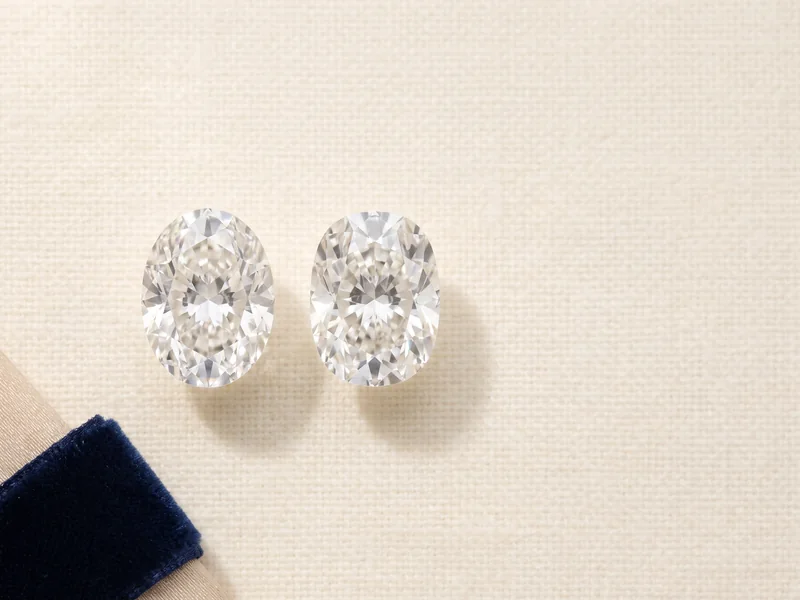 Diamond ShapesRound Brilliant Diamonds
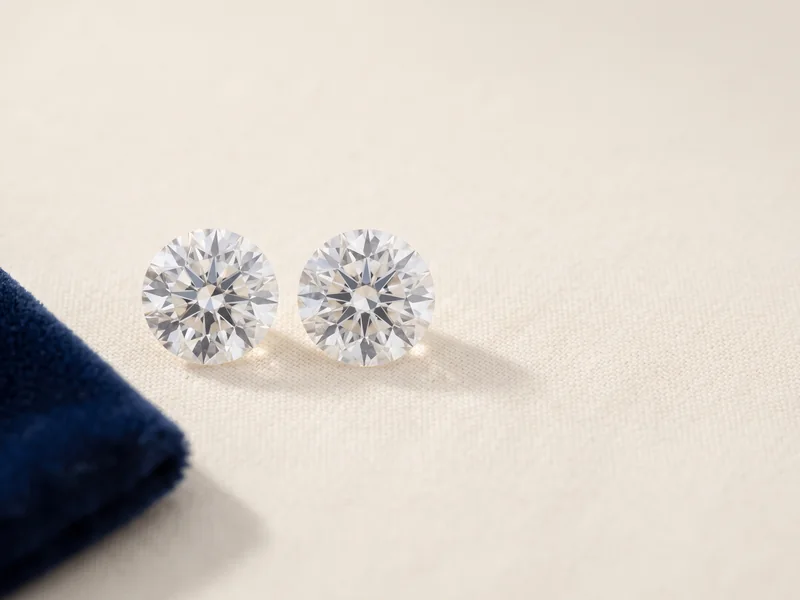 Diamond 4Cs & GradingBigger Diamond or Better Quality?
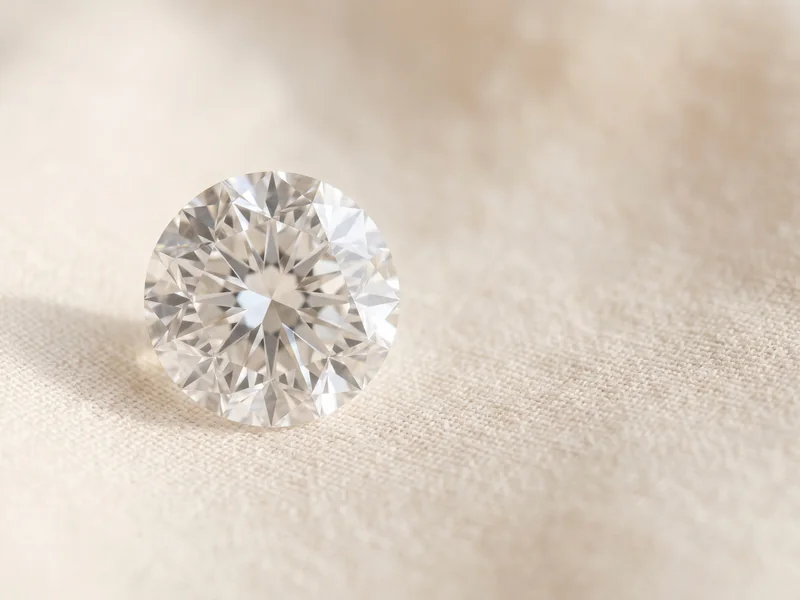 Diamond ShapesRound Brilliant Family: Round, Star and Portuguese Cuts
Explore more
More guides on this topic
Education