
- Education
- Diamond Anatomy & Light
- Diamond Symmetry vs Optical Symmetry: Report Grades, Light Patterns and What to Check
Diamond Anatomy & Light
Diamond Symmetry vs Optical Symmetry: Report Grades, Light Patterns and What to Check
Diamond symmetry on a grading report and optical symmetry in the light are related, but they are not the same thing. Knowing the difference helps you tell two diamonds with identical reports apart.
 Reviewed by Raj Sood, Graduate Gemologist (GIA), AJP (GIA)Master jeweller and Graduate Gemologist (GIA) · reviewed 4 November 2026
Quick answer
Diamond symmetry, the grade on a lab report, measures how precisely the facets, outline, table and culet are placed. Optical symmetry is how evenly those facets return light, seen as hearts and arrows patterns or ASET maps. A stone can grade Excellent for symmetry and still show uneven light, so check both the report and the images.
What is the difference between diamond symmetry and optical symmetry?
Two terms that sound alike describe different things. Symmetry, the grade printed on a GIA, IGI or HRD report, is a physical assessment: how exactly the facets (the small flat polished surfaces) are shaped, placed and lined up, and how even the outline is. Optical symmetry is what that physical precision does to light: whether the pattern of bright and dark you see in the diamond is even and repeating, or patchy and lopsided.
Think of it as cause and effect. Physical symmetry is the workmanship; diamond optical symmetry is the result your eye sees. The two are linked, but a report grade allows tolerances wide enough that two stones both graded Excellent can show quite different light patterns. If you want a refresher on the parts we mention throughout, start with the parts of a diamond, from table to culet.
Why do small errors matter so much? Diamond has a refractive index of about 2.42, which gives it a critical angle of roughly 24.4°. Light striking an inside facet at more than that angle from the perpendicular reflects back inside the stone; light striking at less escapes out the back. A pavilion facet that is tilted by a fraction of a degree, or rotated slightly out of line, sends light to a different place, and the pattern changes. The modern round's eight-fold layout, which makes these errors so visible, is a refinement of older styles; our page on how the round brilliant developed from the Old European cut explains how it came about.
Symmetry is always graded alongside polish, the quality of the facet surfaces themselves; our page on how polish and symmetry are graded together covers that partner grade. Terms such as indexing, obstruction and leakage are also defined in our jewellery glossary of diamond terms.
What does the diamond symmetry grade on a report measure?
Grading labs examine symmetry at 10× magnification, looking at the stone face-up, face-down and in profile. GIA uses five grades: Excellent, Very Good, Good, Fair and Poor. IGI and HRD use very similar wording. The grader notes each symmetry feature, judges how many there are and how easily they are seen, and gives one overall grade.
| Symmetry feature | What it means | What you might notice |
|---|---|---|
| Off-centre table | The large top facet is not centred on the stone | Uneven crown facets; one side looks busier |
| Off-centre culet | The bottom point is not under the centre | Light pattern shifts to one side |
| Crown and pavilion misaligned | Top and bottom facets do not line up at the girdle | Twisted or broken patterns |
| Wavy girdle | The girdle edge rises and falls unevenly | Hard to see face-up; can affect setting |
| Table not parallel to girdle | The stone is tilted relative to its own edge | Uneven brightness from one side to the other |
| Out of round or uneven outline | The outline is not a true circle, or not even in a fancy shape | Shape looks slightly off on the hand |
| Misshapen or pointing facets | Facets are uneven in size or their points do not meet | Irregular sparkle pattern |
| Extra or missing facets | Additional small facets, or a facet not cut | Usually invisible face-up |
Excellent means any features are very difficult to see at 10×. Very Good and Good allow progressively more, though most are still invisible to the unaided eye. Our guide to what each symmetry grade allows goes through the scale with examples.
One important point: the symmetry grade is not a light-performance measurement. For round brilliants, GIA gives an overall cut grade that combines proportions, polish and symmetry. For fancy shapes such as ovals, pears and hearts, GIA gives no cut grade at all, so polish and symmetry are the only workmanship grades on the report, and optical symmetry has to be judged from images or in person.
What is optical symmetry in a diamond?
Optical symmetry describes how evenly a diamond's facets return light, judged from the pattern you see. In a round brilliant, the best-known test is the hearts and arrows viewer, a small tube with a reflector that shows the facet pattern clearly. Face-up, a precisely cut round shows eight evenly spaced arrows, formed by the pavilion main facets reflecting up through the crown. Turned over, the same stone shows eight hearts, formed by the pavilion mains and lower girdle facets together.
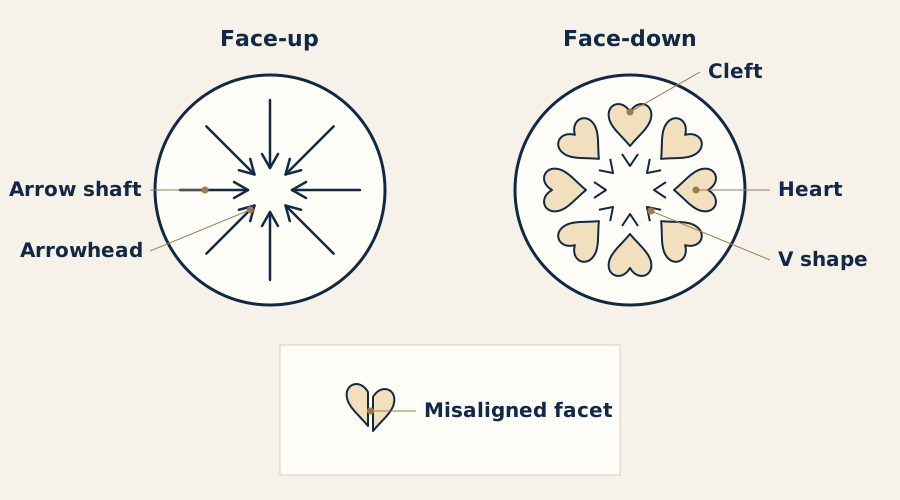
In a hearts and arrows diamond with strong optical symmetry, look for:
- Arrows: eight arrows of the same width, with straight shafts pointing to the centre and evenly spaced heads.
- Hearts: eight hearts of the same size, with clean clefts and even gaps between each one.
- Small V shapes: the little arrowhead shapes beneath each heart should be similar in size and sit centred.
- No split or twisted hearts: a heart that splits at the top or leans to one side shows a facet out of line.
Producing that pattern takes close tolerances. Hearts and arrows rounds typically sit at a crown angle of about 34–35°, a pavilion angle of about 40.6–41° and lower girdle facets of about 75–80% of the way from girdle to culet, with each facet indexed (rotated into position) within a small fraction of a degree. Changes at the girdle, such as painting and digging out of the girdle, also alter the shape of the hearts.
Hearts and arrows is not a grade on a GIA report. Some labs and cutters add it as a comment or a separate certificate, and the light-performance grading on former AGS Laboratories reports used ASET images as part of its assessment. Optical symmetry is about brilliance, fire and scintillation from the facets, which is different from the special effects such as asterism and chatoyancy covered in other optical effects in gemstones.
How do ASET and Idealscope images show diamond light performance?
A hearts and arrows viewer shows facet alignment. Two other tools show where light comes from and where it is lost. The ASET (Angular Spectrum Evaluation Tool), developed by the American Gem Society, colour-codes light by the angle it enters the diamond. The Idealscope is an older, simpler viewer with a red filter that shows light return and leakage.
| Colour | ASET meaning | Idealscope meaning |
|---|---|---|
| Red | Brightest light, from high angles (about 45–90° above the horizon) | Light returning to your eye |
| Green | Less intense light, from lower angles (about 0–45°) | Not used |
| Blue | Contrast: areas reflecting the viewer's head | Shown as black: contrast from the viewer's head |
| White or clear | Leakage: light passing straight out the back | Leakage: light passing straight out the back |
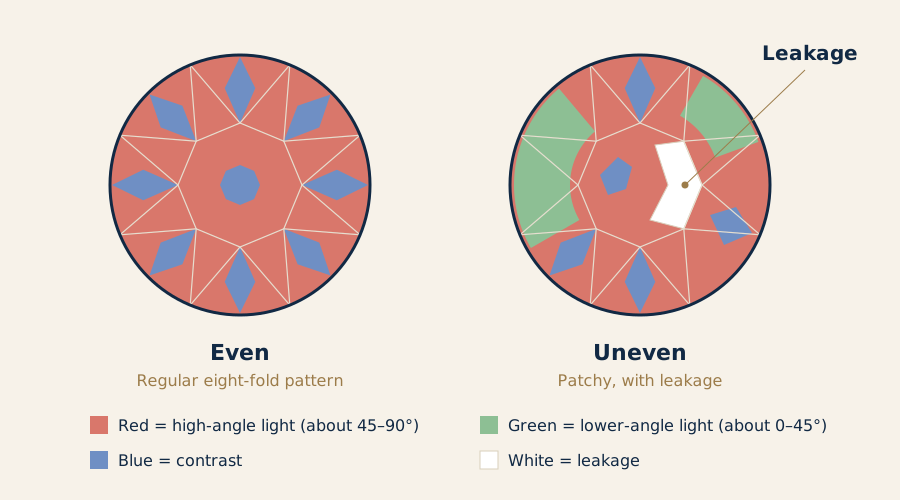
What you want in a round is mostly red, an even and repeating eight-fold pattern of blue contrast, and very little white. In a fancy shape you want the same colours arranged as a mirror image left and right. A map where red is patchy on one side, or white leakage appears in one sector only, tells you the optical symmetry is weaker even if the report says Excellent.
Images vary with the camera, the angle and the tool itself, so only compare ASET or Idealscope images taken the same way. If any of the colour terms are unfamiliar, the definitions of obstruction, leakage and contrast will help.
Not sure which one is right?
Send us the stones you are looking at and our gemologist will tell you which to choose and why.
What are nailhead, fisheye and extinction in a diamond?
Extinction is any area of a diamond that looks dark because light is not returning to your eye. Some extinction is good: the dark contrast reflected from your own head creates the pattern that makes sparkle visible, and when it moves as the stone moves it is called dynamic contrast. Extinction becomes a problem when it is large, fixed or caused by leakage. Several named effects come from proportions that pull optical symmetry and light return out of balance:
| Effect | Usual cause | Rough numbers in a round | How it looks |
|---|---|---|---|
| Nailhead | Pavilion too deep | Pavilion above about 42.5°; depth often above about 64% | Dark centre under the table, like a nail head |
| Fisheye | Pavilion too shallow | Pavilion below about 39.5°; depth often below about 57% | Grey ring under the table, a reflection of the girdle |
| Window | Shallow pavilion, often in fancy shapes | Varies by shape | Glassy, see-through area in the centre |
| Bow-tie | Elongated fancy shapes | Varies with ratio and angles | Dark band across the middle |
| Uneven extinction | Facets misaligned or poorly indexed | Within any proportions | Dark patches on one side only |
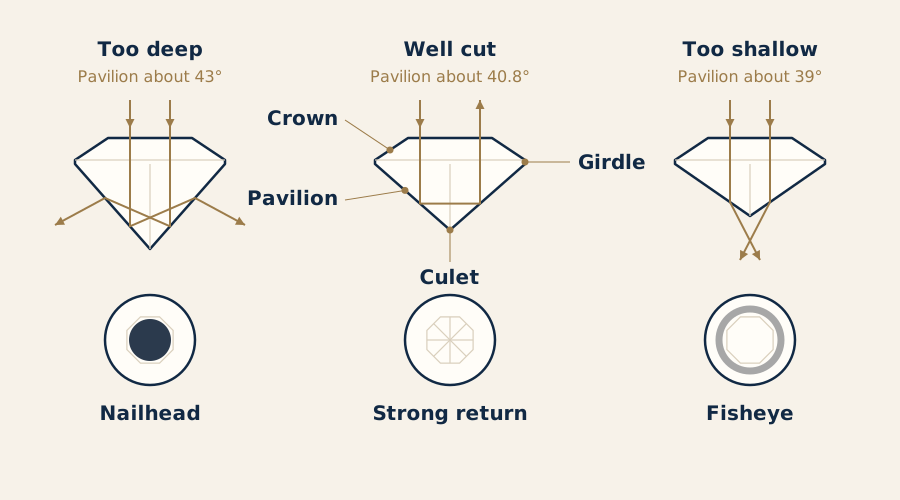
A nailhead diamond and a fisheye diamond can both have Excellent symmetry, because their facets may be perfectly aligned; the problem is the angles, not the alignment. That is why proportions matter as much as symmetry. Our guide to how the crown and pavilion angles steer light shows where each angle is measured.
How does optical symmetry work in fancy shape diamonds?
Most fancy shapes cannot show the classic hearts and arrows pattern, because their facets are not arranged in eight identical sectors. Instead, optical symmetry in a fancy shape means the light pattern on the left mirrors the pattern on the right, and the top mirrors the bottom where the shape allows. A bow-tie that is faint, centred and even on both sides is normal; one that is darker on one side, or sits off-centre, shows a cutting imbalance. For the outline and facet layout of each shape, see our overview of the main diamond shapes.
| Shape | Main optical symmetry check | Typical ratio range | Common issue |
|---|---|---|---|
| Round | Hearts and arrows, even eight-fold ASET | 1.00–1.01 | Nailhead, fisheye, twisted arrows |
| Oval | Bow-tie centred and faint | 1.30–1.50 | Strong bow-tie, uneven shoulders |
| Pear | Pattern mirrored down the centre line | 1.45–1.75 | Bow-tie, high or flat shoulders |
| Marquise | Both points and wings matching | 1.85–2.10 | Bow-tie, points out of line |
| Heart | Lobes and cleft mirrored | 0.90–1.10 | Uneven lobes, bow-tie |
| Princess | Even cross pattern to each corner | 1.00–1.05 | Dark corners |
| Cushion | Even pattern in each quarter | 1.00–1.20 | Patchy or one-sided brightness |
| Emerald | Even steps and corners | 1.30–1.50 | Windowing, uneven step widths |
Each shape has its own checklist. For pears, see judging symmetry in a pear diamond; for marquise cuts, our marquise symmetry checks point by point; and for hearts, the heart symmetry checklist. Ovals have no GIA cut grade either, so proportions are a useful starting filter: our oval proportions chart sets out depth and table ranges, and the oval diamond guide covers ratio, bow-tie and settings in more depth.
Related guideHow to Judge Pear Diamond SymmetryDoes an Excellent symmetry diamond always look better?
Not always. Here is how the two kinds of symmetry compare side by side.
| Diamond symmetry (report grade) | Optical symmetry | |
|---|---|---|
| What it describes | Physical placement and shape of facets and outline | Evenness of the light pattern you see |
| How it is judged | Grader at 10× magnification | Hearts and arrows viewer, ASET, Idealscope, your eye |
| On the report? | Yes, Excellent to Poor | No, except as an optional comment or extra certificate |
| Tolerance | Allows small deviations within each grade | Shows deviations that the grade can allow |
| Affected by proportions? | No, only alignment and shape | Yes, angles change the whole pattern |
| Relevance to fancy shapes | Same grading scale | Judged as a mirror-image pattern |
A well-proportioned round with Very Good symmetry can look brighter and more lively than an Excellent symmetry stone with a deep pavilion. Equally, among stones that already have good proportions, Excellent symmetry raises the chance of a crisp, even pattern. Treat the Excellent to Poor symmetry scale as a filter, then use images to choose between the stones that pass it.
Natural or lab-grown: does symmetry differ, and what does it cost?
Natural and laboratory-grown diamonds are both real diamond, with the same hardness (10 on the Mohs scale) and refractive index. They are cut on the same equipment and graded on the same symmetry scale, so optical symmetry depends on the cutter, not the origin. Lab-grown diamonds cost much less than natural diamonds of the same size and grades, which can make it easier to find a precisely cut stone within a budget.
| 1 ct round, G colour, VS clarity, Excellent cut | Approximate price range (AUD) |
|---|---|
| Lab-grown | about $1,000–$3,000 |
| Natural | about $9,000–$16,000 |
These are broad ranges only; prices move with the market and the exact grades. Stones sold with a hearts and arrows certificate often carry a premium over otherwise similar Excellent-cut rounds, reflecting the extra cutting time and weight lost. Polish affects the surface rather than the pattern, but it is worth reading the two grades together; see polish grades and surface finish for how they interact.
Browse diamonds with Excellent symmetry: natural and lab-grown
How do you check diamond optical symmetry before you buy?
- Read the report. Note the symmetry, polish and (for rounds) cut grade, and confirm whether the stone is natural or lab-grown.
- Check the proportions. For a round, look for a crown angle of about 34–35° and a pavilion angle of about 40.6–41°; avoid pavilions above about 42.5° or below about 39.5°.
- Ask for light images. Request an ASET, Idealscope or hearts and arrows image taken under the same conditions for each stone you compare.
- Look for even patterns. In a round, eight matching arrows and hearts and an even red map; in a fancy shape, a mirror-image pattern and a faint, centred bow-tie.
- Watch a 360° video. Check that dark areas move and flash rather than staying fixed in one place.
- Compare fancy shapes on their own terms. Use the ratio and the depth and table targets for ovals or the relevant shape guide before judging the pattern.
- View it in person if you can. Look under normal room light and daylight, at arm's length, as you would see it worn.
Free consultation
Talk to a gemologist
Compare stones in person or online with Raj Sood, Graduate Gemologist (GIA), AJP (GIA).
Book a consultationFAQ
Common questions
Is symmetry or optical symmetry more important in a diamond?
Optical symmetry is what you actually see, so it matters more to appearance. The symmetry grade is a useful filter, but proportions and light images tell you how the stone performs.
Do all Excellent symmetry diamonds show hearts and arrows?
No. Hearts and arrows requires tighter facet alignment and specific angles than the Excellent grade requires. Many Excellent symmetry rounds show irregular hearts under a viewer.
What does an ASET image show?
It colour-codes light by the angle it comes from: red for the brightest high-angle light, green for lower-angle light, blue for contrast and white for leakage. An even, mostly red map with a regular blue pattern indicates strong light return and optical symmetry.
What causes a nailhead diamond?
A pavilion cut too deep, typically steeper than about 42.5° in a round. Light leaks out the sides of the pavilion and the centre looks dark.
What is a fisheye diamond?
A diamond with a pavilion cut too shallow, which shows a grey ring under the table, a reflection of the girdle. It is most noticeable in rounds with pavilion angles below about 39.5°.
Can a lab-grown diamond have hearts and arrows?
Yes. Lab-grown diamonds are cut the same way as natural diamonds, so a precisely cut lab-grown round can show a full hearts and arrows pattern.

Ask a gemologist
Not sure which diamond to choose?
Raj Sood is a Graduate Gemologist (GIA) and master jeweller. Bring the stones you are considering, or send the reports, and he will tell you honestly which one is better and why.
Keep learning
Related guides
 Diamond 4Cs & GradingDiamond Symmetry Grades Explained
 Diamond 4Cs & GradingPolish and SymmetryDiamond Anatomy & LightPainting and Digging Out in Round Diamonds
 Diamond ShapesHeart-Shaped Diamond Symmetry GuideDiamond Anatomy & LightAnatomy of a diamond: table, crown, girdle, pavilion and culet explained
 Diamond ShapesHow to Judge Pear Diamond Symmetry
 Diamond ShapesHow to Judge Marquise Diamond Symmetry
 GemstonesOptical Phenomena in Gemstones
Explore more
More guides on this topic
Education