
- Education
- Diamond Anatomy & Light
- Round Diamond Proportions Beyond the Cut Grade: Angles, Nailhead, Fisheye and ASET
Diamond Anatomy & Light
Round Diamond Proportions Beyond the Cut Grade: Angles, Nailhead, Fisheye and ASET
Two diamonds can both carry an Excellent cut grade and still look quite different on the hand. Round diamond proportions explain why, and knowing the few numbers that matter lets you read a grading report the way a cutter does.
 Reviewed by Raj Sood, Graduate Gemologist (GIA), AJP (GIA)Master jeweller and Graduate Gemologist (GIA) · reviewed 4 November 2026
Quick answer
Round diamond proportions are the measurements behind the cut grade: table, depth, crown angle, pavilion angle, girdle and culet. For strong light return, most gemmologists look for a pavilion angle of about 40.6–41.0°, crown angle of 34–35°, table of 54–58% and depth of 59–62.5%. Outside these, a diamond can show nailhead darkness, fisheye rings or leakage.
What are round diamond proportions?
Proportions are the measured sizes and angles of a cut diamond, expressed as percentages of its average diameter or in degrees. They describe the shape of the stone in profile, which decides how light travels through it. If the parts of a diamond are new to you, start with our guide to the table, crown, girdle, pavilion and culet explained, then come back here.
On a round brilliant, the proportions that matter most are:
- Table %: the width of the large flat top facet as a percentage of the diameter.
- Total depth %: the height from table to culet as a percentage of the diameter.
- Crown angle: the slope of the upper part of the stone, measured from the girdle plane.
- Pavilion angle: the slope of the lower, cone-shaped part. This is the single most important number for brightness.
- Girdle thickness: the narrow band around the widest point, described from Extremely Thin to Extremely Thick.
- Culet: the point at the bottom, usually None or Pointed on modern rounds.
- Star and lower half lengths: the length of the minor facets as a percentage, which shapes the pattern of sparkle.
A round has 57 or 58 facets (58 if the culet is polished as a tiny facet). Because a round is symmetrical in every direction, small changes to these numbers show up clearly in how bright and lively it looks. Our complete round brilliant diamond guide covers colour, clarity and carat; this page focuses only on the geometry. The round is just one of the 34 diamond cuts we cover, but it is the one with the most tightly studied numbers. Any unfamiliar word is also defined in our jewellery glossary of trade terms.
Why isn't an Excellent cut grade enough on its own?
The cut grade on a GIA report (Excellent, Very Good, Good, Fair, Poor) is calculated from the proportions, plus polish and symmetry. It is a useful filter, but it is a band, not a point. GIA's Excellent grade accepts a wide range of crown and pavilion combinations, roughly crown angles from the low 30s to about 36° depending on the pavilion angle paired with it. A stone near the edge of that band can look noticeably different from one in the middle.
Other systems look at the same question differently. The AGS (American Gem Society) grades light performance directly, using ray-tracing and reflector images, and its top grade is called Ideal (0). Our page on how GIA and AGS cut grades are worked out explains the scales side by side. Neither scale tells you everything: two GIA Excellent stones of the same weight can differ in spread (face-up diameter), in how much light leaks out, and in the size and pattern of their flashes.
| What the report shows | What it tells you | What it does not tell you |
|---|---|---|
| Cut grade | The stone falls inside a broad acceptable band | Where in that band it sits |
| Table % and depth % | Overall shape and spread | Whether the angles work together |
| Crown and pavilion angles | How light is likely to travel | Leakage you can see, or optical symmetry |
| Polish and symmetry grades | Finish and facet alignment | Light return in real conditions |
| Plotting diagram | Where inclusions sit | Anything about proportions |
What are the ideal round diamond proportions?
There is no single perfect set of numbers, but decades of measurement and light-performance testing point to a fairly tight zone. The modern round brilliant grew from Marcel Tolkowsky's 1919 model, which suggested a table of about 53%, a crown angle of about 34.5° and a pavilion angle of about 40.75°. Our page on how the Old European cut evolved into the modern round traces that history. Today's cutters use slightly larger tables and add a girdle, but the angles have stayed remarkably close.
| Measurement | Tight range many gemmologists prefer | Wider acceptable range | What goes wrong outside it |
|---|---|---|---|
| Table % | 54–58% | 52–62% | Small: less brightness. Large: less fire |
| Total depth % | 59–62.5% | 57.5–63% | Shallow: fisheye. Deep: looks small, darker centre |
| Crown angle | 34–35° | 32–36° | Low: less fire. Steep: can leak with a deep pavilion |
| Pavilion angle | 40.6–41.0° | 40.4–41.2° | Shallow: fisheye. Deep: nailhead |
| Girdle | Thin to Slightly Thick | Very Thin to Thick | Very thin: chips. Very thick: hidden weight |
| Culet | None or Pointed | Very Small | Large: dark spot face-up |
| Star facets | 45–55% | 40–60% | Changes the size of flashes |
| Lower halves | 75–80% | 70–85% | Short: bold flashes. Long: finer, needle-like flashes |
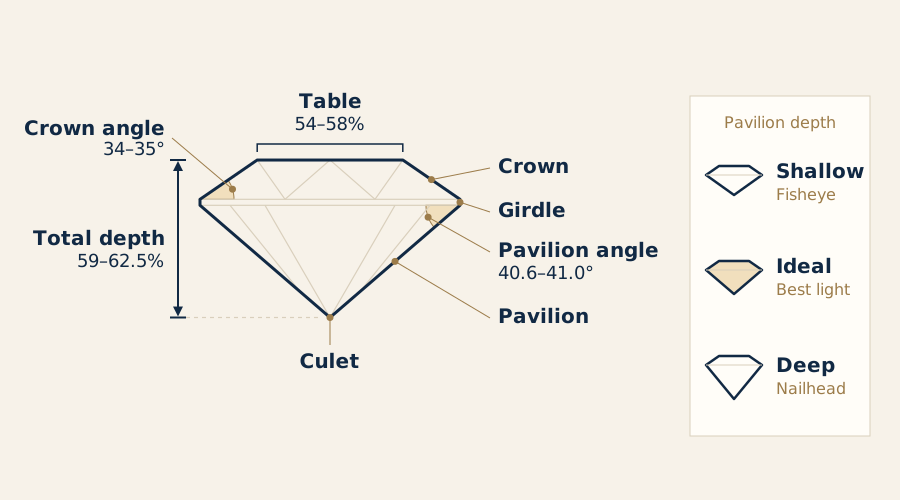
These ranges suit stones of roughly 0.30 carat and up. A 1.00 carat round in the tight zone measures about 6.4–6.5 mm across; the same weight cut at 64% depth may measure only about 6.2 mm, so it looks smaller for what you pay. Some cutters deliberately chase a different look, such as the larger-table 60/60 round compared with classic Tolkowsky proportions, which trades a little fire for a broader, brighter face. Related cuts with extra facets, explained in our page on star and Portuguese cuts in the round brilliant family, follow their own rules again.
How do crown and pavilion angles work together?
Crown and pavilion angles are a pair. The pavilion acts like a pair of mirrors that bounce light back up; the crown then bends that light as it leaves, splitting it into colour (fire). A slightly shallower pavilion can be balanced by a slightly steeper crown, and the other way round. This is called angle compensation, and it is why a stone with a 35.5° crown can still perform well if the pavilion sits near 40.6°.
Problems start when both angles push the same way. A steep crown with a deep pavilion is the classic case: light that should return to your eye exits at a low angle instead, and the stone looks darker under the table edge. Our guide to why steep-deep rounds leak light shows the combinations to avoid. GIA's grading allows some of these combinations, which is exactly why the angles matter beyond the grade.
Girdle shape adds another layer. Cutters sometimes paint (thicken) or dig out (thin) the girdle at the upper half facets to save weight or tidy the outline. Small amounts are normal; heavy painting can cause dark areas when the stone tilts, and heavy digging out can thin the girdle enough to raise chip risk. See our page on painting and digging out of the girdle for how to spot both on a report and in an image.
Related guideSteep-Deep Round Diamonds ExplainedNot sure which one is right?
Send us the stones you are looking at and our gemologist will tell you which to choose and why.
What are nailhead and fisheye diamonds?
These are the two classic signs of a pavilion angle that has drifted too far from about 41°. Both are easy to see once you know them, and both can appear in stones that still carry a respectable grade on older or less strict reports.
- Nailhead: the pavilion is too deep, usually above about 42°. Light hits the pavilion facets at too steep an angle and passes straight out the bottom. The centre of the table looks dark or grey, like the head of a nail. Total depth is often 64% or more.
- Fisheye: the pavilion is too shallow, usually below about 40°. The girdle is reflected in the pavilion and shows as a pale grey or whitish ring inside the table, like the eye of a fish. It is worse when the girdle is thick and the table is large. Total depth is often under about 58%.
A milder version of each is common. A pavilion at 41.4° will not show a true nailhead, but the centre may look a touch less bright, especially in low light. A pavilion at 40.2° will not show a clear fisheye ring, but the stone can look glassy rather than lively. These borderline stones are where knowing the angles pays off, because they often sit inside the grade band that cut grade cut-offs for pavilion depth allow.
What does an ASET or Idealscope image show?
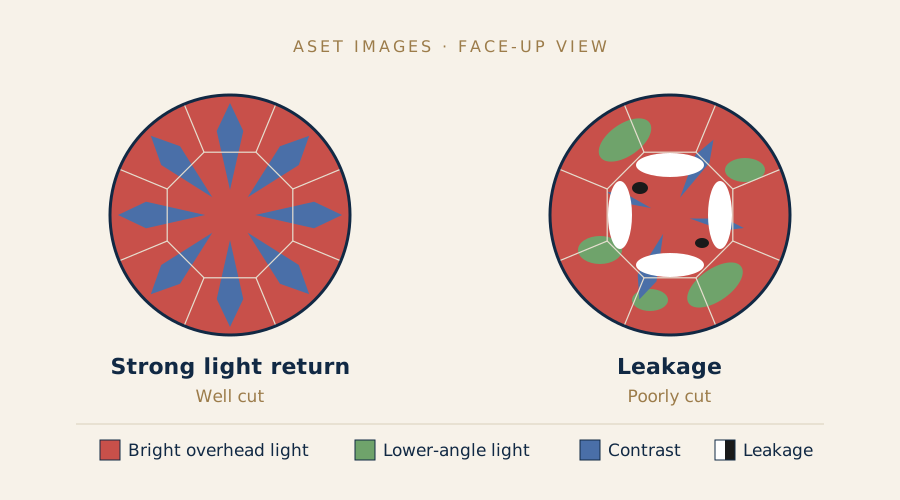
Numbers predict performance; reflector images show it. Both tools put a coloured or tinted reflector over the diamond and photograph it face-up, so you can see where the stone collects light from and where it loses it.
ASET (Angular Spectrum Evaluation Tool) was developed by the AGS. It colour-codes light by the angle it comes from:
- Red: light gathered from high angles, roughly overhead. This is the brightest light, and a strong, even red is what you want.
- Green: light from lower angles. Some green is normal; large green areas mean less brightness.
- Blue: areas reflecting the viewer's own head. This creates contrast, which makes sparkle readable. In a good round, blue forms neat, even arrows.
- White or black: light leakage, where light passes through instead of returning. Patches here are a warning sign.
An Idealscope is simpler: red shows light return, black shows contrast and white or pale areas show leakage. A well-cut round shows a fully red face with crisp black arrows and little or no white under the table edge. Ask for these images alongside the report; it is the most reliable way to compare stones that share the same grade, and it shows far more than any photo of what makes a round brilliant sparkle.
What is light leakage and extinction in a diamond?
Light leakage is light that escapes through the pavilion instead of coming back out of the crown. Extinction is the general term for dark areas you see face-up. They are related but not the same, and the difference matters.
Some darkness is good. The contrast from your own head and body blocking light (obstruction) is what creates the dark-and-bright pattern that makes a diamond look sparkly rather than flat, like a mirror ball rather than a light globe. A round with no contrast at all looks washed out. What you want to avoid is dead extinction: dark areas caused by leakage, which often spread under the table edge as you tilt the stone. Steep crowns combined with deep pavilions are the usual cause, as are heavily painted girdles.
Hearts and arrows describes a round with very precise optical symmetry: eight even arrows face-up and eight hearts when viewed through a special scope from the pavilion side. It needs tight proportions plus accurate facet alignment. It is a sign of careful cutting, not a grade, and a stone does not need a hearts and arrows label to perform well. Our explainer on steep crown and deep pavilion angles that cause extinction shows how tilting reveals leakage that a face-up photo hides.
How do round diamond proportions compare with other shapes?
The round is the only shape GIA gives an overall cut grade, and the only one with such well-tested target numbers. Fancy shapes have much wider acceptable ranges, because their outlines change how light bounces from facet to facet. As a guide:
| Shape | Typical depth % | Typical table % | GIA cut grade? |
|---|---|---|---|
| Round | 59–62.5% | 54–58% | Yes |
| Oval | 58–63% | 53–63% | No |
| Cushion | 61–68% | 58–68% | No |
| Pear | 58–64% | 53–63% | No |
| Princess | 64–75% | 67–75% | No |
| Emerald | 60–70% | 60–70% | No |
Rounds also face up smaller per carat than elongated shapes, because more weight sits in the cone of the pavilion; our page on which shapes face up largest for their carat weight sets out the numbers. The trade-off is brightness: a well-proportioned round returns more light than almost any fancy shape. For the full trade-offs, see our oval vs round comparison on size, sparkle and price and our guide to round vs cushion cut sparkle and proportions. To see every outline side by side, start with our overview of every diamond shape.
Do proportions matter the same for natural and lab-grown rounds?
Yes. Natural and laboratory-grown diamonds have the same refractive index (about 2.42) and the same hardness (10 on the Mohs scale), so light behaves identically inside both. The angles above apply equally. What differs is how the stones tend to be cut.
Natural rough is costly, so cutters are sometimes tempted to keep weight with a deeper pavilion or a thicker girdle, especially just above popular weights such as 0.50, 0.70 and 1.00 carat. Lab-grown rough is less costly to produce, so many lab-grown rounds are cut to tight proportions, but quality still varies between producers. Lab-grown diamonds cost much less than natural ones, which can leave room in the budget for a better cut. Either way, check the full proportions, not just the grade. Lab-grown reports, often from IGI or GIA, state that the stone is laboratory-grown.
Shop round diamonds: natural and lab-grown
How do you check round diamond proportions? Step by step
- Start with the report. Confirm cut, polish and symmetry grades, and whether the diamond is natural or lab-grown.
- Check depth and table. Look for depth of about 59–62.5% and a table of about 54–58%.
- Read the angles. Pavilion about 40.6–41.0°, crown about 34–35°, and make sure a steep crown is not paired with a deep pavilion.
- Check girdle and culet. Thin to Slightly Thick girdle; culet None or Pointed.
- Compare the diameter. A 1.00 ct round should measure about 6.4–6.5 mm; noticeably less means hidden weight.
- Ask for an ASET or Idealscope image. Look for even red, neat contrast arrows and no white leakage under the table edge.
- Watch a 360° video. Look for a dark centre (nailhead) or a pale ring (fisheye), and check whether the stone darkens as it tilts.
Free consultation
Talk to a gemologist
Compare stones in person or online with Raj Sood, Graduate Gemologist (GIA), AJP (GIA).
Book a consultationFAQ
Common questions
What is the most important proportion in a round diamond?
The pavilion angle. At about 40.6–41.0° it returns the most light; much deeper gives a dark nailhead centre and much shallower gives a fisheye ring.
Is a GIA Excellent cut always well proportioned?
It is always within an acceptable band, but the band is wide. Two Excellent stones can differ in brightness, spread and leakage, so check the angles and an ASET image too.
What is a good depth percentage for a round diamond?
About 59–62.5% for most well-cut rounds. Above about 63% the stone looks smaller for its weight and can darken; below about 58% it risks a fisheye effect.
How can I tell if a diamond is a fisheye?
Look face-up for a pale grey or whitish ring inside the table, which is the girdle reflecting in a too-shallow pavilion. It shows most in stones with a pavilion angle below about 40° and a thick girdle.
Do I need a hearts and arrows diamond?
No. Hearts and arrows shows very precise optical symmetry, but a round with good angles and a clean ASET image can perform just as well without the label.
Are lab-grown round diamonds cut to better proportions?
Not automatically. Many are cut to tight proportions, but quality varies, so check the angles and reflector images exactly as you would for a natural diamond.

Ask a gemologist
Not sure which diamond to choose?
Raj Sood is a Graduate Gemologist (GIA) and master jeweller. Bring the stones you are considering, or send the reports, and he will tell you honestly which one is better and why.
Keep learning
Related guides
 Diamond Anatomy & LightSteep-Deep Round Diamonds Explained
 Diamond Anatomy & LightPainting and Digging Out in Round DiamondsDiamond 4Cs & GradingDiamond Cut GradeDiamond Anatomy & Light60/60 Round Diamonds vs Classic ProportionsDiamond Anatomy & LightAnatomy of a diamond: table, crown, girdle, pavilion and culet explained
 Diamond ShapesRound vs Cushion Cut Diamonds
 Diamond ShapesRound Brilliant Diamonds
 Diamond ShapesRound Brilliant Family: Round, Star and Portuguese Cuts
Explore more
More guides on this topic
Education