
- Education
- Diamond Anatomy & Light
- Pear Diamond Proportions Chart: Depth, Table, Ratio and Light
Diamond Anatomy & Light
Pear Diamond Proportions Chart: Depth, Table, Ratio and Light
GIA and IGI do not give a pear a cut grade, so the numbers on the report are your best clue to how it will handle light. Here is what each pear diamond proportions figure means, and how to spot the light problems the wrong numbers cause.
 Reviewed by Raj Sood, Graduate Gemologist (GIA), AJP (GIA)Master jeweller and Graduate Gemologist (GIA) · reviewed 4 November 2026
Quick answer
Ideal pear diamond proportions are a total depth of about 58–64%, a table of about 53–63%, a length-to-width ratio of 1.45–1.75, a thin to slightly thick girdle and no or a very small culet. Inside those ranges, judge the stone by eye: a faint, moving bow-tie is normal; a dark centre, grey ring or fixed black band is not.
What are ideal pear diamond proportions?
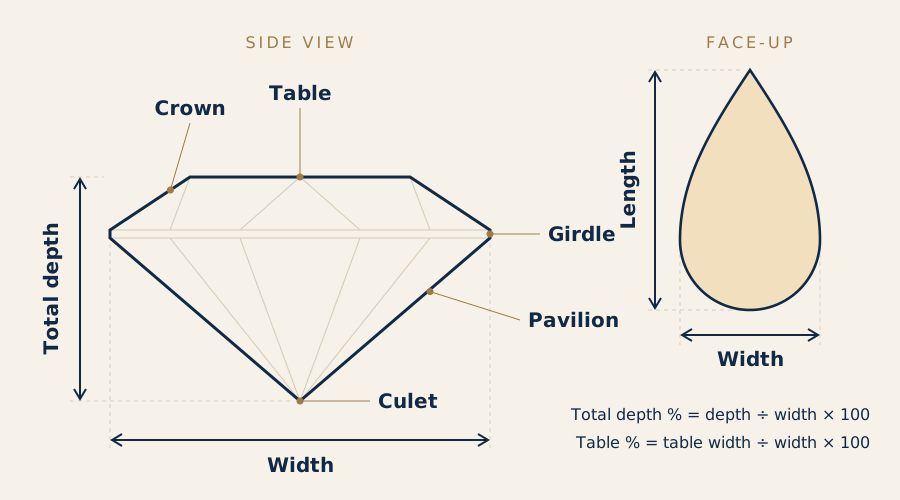
Proportions are the measurements that describe a diamond's shape in three dimensions: how deep it is, how wide the flat top is, how thick the edge is and how the length compares with the width. If the parts of a diamond are new to you, our guide to the table, crown, girdle, pavilion and culet explains each one. In short, the table is the large flat facet on top, the crown is the sloping section above the edge, the girdle is the thin edge at the widest point, the pavilion is the cone underneath and the culet is the tip at the very bottom.
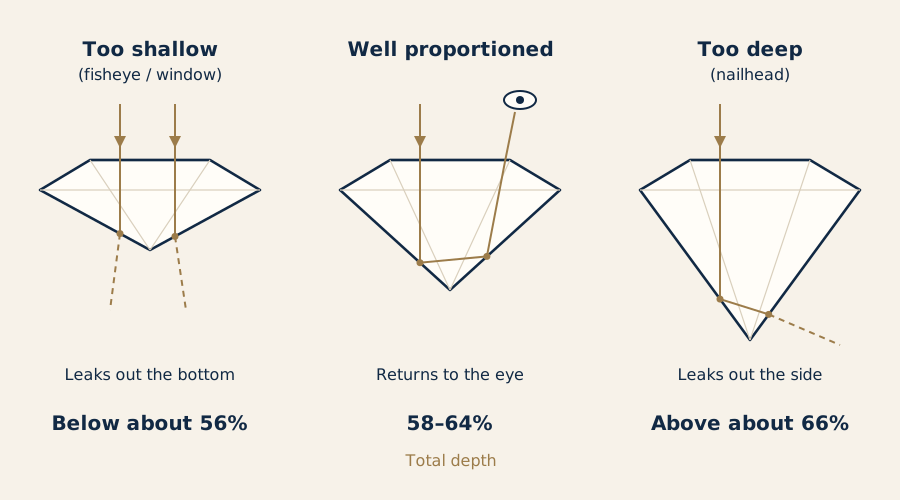
Proportions matter because they control what happens to light inside the stone. Diamond has a refractive index of about 2.42, which bends light strongly and gives it a critical angle of about 24.4°. Light that meets a pavilion facet at more than that angle from straight-on is reflected back inside and, in a well-cut stone, up to your eye. Light that meets the facet more directly passes straight out the back. Get the pavilion angles right and the stone looks bright across its face. Get them wrong and parts of it go dark or glassy.
For round brilliants, GIA gives an overall cut grade from Excellent to Poor. For a pear, it does not. The report lists the measurements, depth, table, girdle, culet, polish and symmetry, and leaves the judgement to you. That is why there is no single perfect proportion chart for fancy shapes, only ranges that well-cut stones tend to fall inside.
The pear cut is a modified brilliant, with one rounded end and one point, and usually about 56–58 facets. Its long, tapering outline makes some light problems more likely than in a round, which is what most of this guide is about. Any term you have not met before is also in our glossary of jewellery terms.
Pear diamond proportions chart: which numbers matter?
Total depth percentage is the depth from table to culet divided by the width, multiplied by 100. For a pear, the width is measured across the widest part of the rounded end. Table percentage is the width of the table facet divided by that same width. Both appear on GIA and IGI reports, and they are the two numbers that most affect how bright a pear looks face-up.
| Measurement | Ideal range | Acceptable range | What happens outside it |
|---|---|---|---|
| Total depth | 58–64% | about 55–67% | Too shallow: grey, glassy centre (fisheye or window). Too deep: dark centre (nailhead) and a stone that looks small for its weight |
| Table | 53–63% | about 50–66% | Too large: flatter look with less fire (flashes of colour). Too small: can look dark and closed |
| Length-to-width ratio | 1.50–1.70 | 1.45–1.80 | A matter of taste, but extremes look stubby or very slim and tend to strengthen the bow-tie |
| Girdle | Thin to slightly thick | Very thin to thick | Very thin at the point risks chipping; very thick hides weight in the edge |
| Culet | None or very small | Small | A medium or large culet shows as a dark dot visible through the table |
| Polish and symmetry | Excellent or Very Good | Good | Poor symmetry shows as uneven shoulders, a crooked point and patchy light |
Treat this chart as a filter, not a verdict. Two pears with identical numbers can look quite different, because a report does not show you the individual pavilion angles across the stone, how the facets are arranged or how evenly the outline curves. Crown and pavilion angles, which carry so much weight when judging a round, are generally not reported for fancy shapes at all.
Depth also changes how big a stone looks for its weight. A 1 carat pear cut at about 60% depth usually measures around 8.5 × 5.5 mm face-up. The same weight cut at 68% puts more of its carats underneath, so it faces up noticeably smaller and often darker. You pay for every point of carat weight, so excess depth is weight you cannot see.
What length-to-width ratio suits a pear diamond?
The length-to-width ratio is the length (from the top of the rounded end to the point) divided by the width. It does not decide brightness on its own, but it changes the outline and how strongly the bow-tie shows.
| Ratio | How it looks | Light notes |
|---|---|---|
| Below 1.45 | Short and wide, a full teardrop | Bow-tie often milder, but can look stubby |
| 1.45–1.55 | Rounded and soft | Bright and full; a popular choice for pendants |
| 1.55–1.70 | The classic teardrop | The range most engagement ring buyers settle on |
| 1.70–1.80 | Slim and elongated | Lengthens the finger; watch the bow-tie more closely |
| Above 1.80 | Very slim, edging towards a marquise | Bow-tie and a thin, fragile point more likely |
Ratio is personal, and our pear ratio guide with outlines at each ratio shows how each one looks on the hand. If you are torn between a pear and its rounder or sharper neighbours, the oval versus pear comparison and the marquise and pear side-by-side guide set out the differences in outline, ratio and durability.
What causes the bow-tie in a pear diamond?
A bow-tie is a dark band running across the widest part of an elongated diamond, shaped roughly like a bow tie. It appears because the pavilion of a pear has to stretch across a long length and a much shorter width. Across the belly, the facets sit at angles that either let light leak out the back or reflect the dark shape of your own head back at you. The result is a dark zone across the middle of the stone.
That dark zone is a type of extinction: any area of a diamond that looks dark because it is not returning light from the light source. Some extinction is useful. Small dark flashes moving across the stone create contrast, and contrast is what makes sparkle visible. Large, fixed dark areas are the problem.
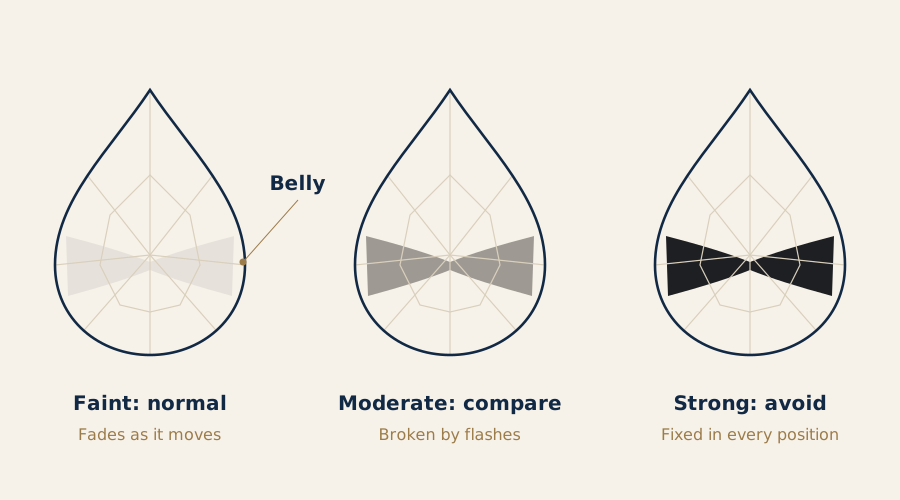
- Faint: a soft grey band that fades in and out as the stone moves. Present in most pears and not a fault.
- Moderate: clearly visible but broken up by flashes of light when the stone tilts. Acceptable to many people; compare it with other stones.
- Strong: a solid black band that stays put in every position. A sign of poor pavilion angles.
Every elongated shape carries this risk. Hearts show the same effect across their belly, as our comparison of heart and pear shapes explains, while rounds, being symmetrical in every direction, do not.
Not sure which one is right?
Send us the stones you are looking at and our gemologist will tell you which to choose and why.
What are nailhead and fisheye diamonds?
A nailhead is a dark area right in the centre of the stone, under the table, that looks like the flat head of a nail. It happens when the pavilion is too deep or its facets too steep. Light that enters the table hits the first pavilion wall, reflects across to the opposite wall at too direct an angle and leaks out the side instead of coming back up. Nailheads are most common in pears with a total depth above about 66%, which also tend to look small for their carat weight.
A fisheye is the opposite fault. When the pavilion is too shallow, the girdle is reflected in the table, showing as a grey or whitish ring just inside the outline. In a pear, it often looks like a faint second pear drawn inside the first. A closely related fault is a window, a washed-out patch in the centre where you can almost see through the stone, because light passes straight out the back. Both are more likely below about 56–57% total depth.
| Problem | Cause | How it looks | Numbers to watch |
|---|---|---|---|
| Bow-tie | Pavilion angles across the width leak light or reflect your head | Dark band across the belly | Ratio above about 1.75; depth outside 58–64% |
| Nailhead | Pavilion too deep or too steep | Dark centre under the table | Total depth above about 66% |
| Fisheye | Pavilion too shallow; girdle reflected in the table | Grey or white ring inside the outline | Total depth below about 56% |
| Window | Pavilion too shallow | Glassy, see-through centre | Total depth below about 57% |
| Dark point | Steep or crowded facets at the tip | The point looks grey or black | Thick girdle at the point; poor symmetry |
How do you spot light problems in photos, video and ASET images?
A single still photo can hide almost anything, because the photographer controls the lighting. These tools tell you far more:
- 360° video: watch the belly as the stone turns. A bow-tie that stays dark is built in; one that comes and goes is normal.
- Face-up video under daylight-style light: look for a dark centre (nailhead) or a pale ring inside the outline (fisheye).
- ASET image: a colour map of where the stone gathers light, explained below.
- Idealscope image: a simpler red-and-white map showing light return and leakage.
- Side-by-side comparison: view two or three pears with similar grades in the same video lighting. Differences jump out.
ASET stands for Angular Spectrum Evaluation Tool, developed by the American Gem Society. It photographs a diamond through a coloured filter. Red shows areas returning the brightest light from high above; green shows light from lower angles, which is softer; blue shows areas reflecting the viewer, which create contrast; and white or clear areas are leaking light. In a well-cut pear, you want mostly red, with blue contrast spread evenly and a pattern that mirrors from left to right. A solid blue or black band across the belly is the bow-tie made visible.
An Idealscope image works on a similar idea with fewer colours: red means light coming back to you, while white or transparent patches mean leakage, often around the point or near the girdle in a pear.
Symmetry and light are linked. A pear with uneven shoulders or an off-centre point usually shows a lopsided ASET pattern too. Our step-by-step pear symmetry checks show what to look for in the outline before you even get to light performance.
Related guideHow to Judge Pear Diamond SymmetryHow do pear proportions compare with oval, cushion, radiant and emerald cuts?
Each shape has its own sweet spot, because the facet style and outline change how light travels. This table puts the commonly quoted ranges side by side.
| Shape | Total depth | Table | Typical ratio | Main light issue |
|---|---|---|---|---|
| Pear | 58–64% | 53–63% | 1.45–1.75 | Bow-tie; dark point |
| Oval | 58–63% | 53–63% | 1.30–1.50 | Bow-tie |
| Cushion | 61–68% | 56–68% | 1.00–1.10 square; 1.15–1.25 elongated | Dark centre if too deep |
| Radiant | 61–67% | 61–69% | 1.00–1.05 square; 1.20–1.35 rectangular | Dark corners; bow-tie in longer stones |
| Emerald | 61–68% | 61–69% | 1.30–1.50 | Windowing; inclusions easy to see |
| Round | 59–62.5% | 53–58% | 1.00 | Rarely an issue; graded for cut |
Pears and ovals share very similar depth and table ranges, because both are brilliant-cut and elongated. For the full numbers on each of the others, see our charts for ideal oval proportions, cushion cut depth and table ranges, radiant cut proportions and emerald cut step-cut proportions. Step cuts like the emerald are deeper and use larger tables, so never apply a pear's numbers to them.
How thick should the girdle be at the point of a pear?
The girdle is reported as a range, such as 'thin to slightly thick', because it varies around the outline. On a pear, the part that matters most is the point. A very thin or knife-edge girdle at the tip is the most common place for a pear to chip, since diamond, though 10 on the Mohs hardness scale, can still split along its cleavage planes if a thin edge takes a knock. An extremely thick girdle, on the other hand, hides carat weight in the edge and can show as a grey outline face-up.
Look for a girdle of about thin to slightly thick, ideally a touch thicker at the point than along the sides. A culet of none or very small keeps the facets meeting cleanly; a large one shows as a dark spot looking down through the table.
Even a well-proportioned point needs a setting that covers it. Our page on how a V-claw or bezel protects a pear's point covers the options, and setting styles that suit a pear shows how each looks finished. If you are adding pears either side of a centre stone, the trilliant and pear side stone comparison explains how their proportions and points behave in a three-stone ring.
Do lab-grown pear diamond proportions differ from natural?
Natural and lab-grown pears are both real diamond, with the same refractive index, hardness and optical behaviour, so the same proportion ranges apply to both. Lab-grown diamonds are grown in a laboratory rather than mined, and they cost much less than natural diamonds of the same size and grade.
What can differ is how the cutter balanced weight against appearance. Natural rough is costly, so some natural pears are cut deeper to keep carats on the scale. Lab-grown pears vary too: some are cut for brightness, others for maximum spread. Either way, check the depth and table on the report rather than assuming.
| 1 ct pear, G–H, VS, well proportioned | Approximate price range (AUD) |
|---|---|
| Lab-grown | about $1,000–$3,000 |
| Natural | about $6,000–$14,000 |
These are broad ranges only and move with the market. Within pears, proportions affect price indirectly: a deep stone weighs more for the same face-up size, so a well-proportioned pear can look as large as a heavier, deeper one while costing less.
Shop pear diamonds: natural and lab-grown
How do you check pear diamond proportions? Step by step
- Read the report. Confirm the shape, measurements, colour, clarity, polish, symmetry and whether the diamond is natural or lab-grown.
- Check total depth. Aim for about 58–64%. Under 56% raises fisheye and window risk; over 66% raises nailhead risk.
- Check the table. About 53–63% of the width suits most pears.
- Work out the ratio. Divide length by width; most people choose between 1.45 and 1.75.
- Look at the girdle and culet. Thin to slightly thick, not very thin at the point, and no or a very small culet.
- Watch a 360° video. Judge the bow-tie, look for a dark centre or pale ring, and check the point is not dark.
- Ask for an ASET or Idealscope image if one is available. Look for even red, balanced contrast and little white leakage.
- Plan the setting. Make sure the point will be protected before you commit to the stone.
Free consultation
Talk to a gemologist
Compare stones in person or online with Raj Sood, Graduate Gemologist (GIA), AJP (GIA).
Book a consultationFAQ
Common questions
What is the ideal depth for a pear diamond?
Most well-cut pears sit between about 58% and 64% total depth. Below about 56% the stone can look glassy, and above about 66% it often shows a dark centre and looks small for its weight.
What table percentage is good for a pear diamond?
A table of about 53–63% of the width suits most pears. Within that range, judge brightness and contrast by eye rather than chasing a single figure.
Can you avoid a bow-tie in a pear diamond?
Almost every pear shows some bow-tie, and a faint one that moves is normal. You can avoid a strong, fixed one by choosing balanced proportions, checking a 360° video and, where possible, an ASET image.
What is a nailhead diamond?
A nailhead is a diamond with a dark centre caused by a pavilion that is too deep or steep, so light leaks out the sides instead of returning to your eye. It is most common in stones with a total depth above about 66%.
What is a fisheye diamond?
A fisheye shows a grey or white ring inside the outline, which is the girdle reflected in the table because the pavilion is too shallow. It usually appears in stones with a total depth below about 56%.
Do lab-grown pear diamonds need different proportions?
No. Lab-grown and natural pears are both real diamond with the same optics, so the same depth, table and ratio ranges apply to both.

Ask a gemologist
Not sure which diamond to choose?
Raj Sood is a Graduate Gemologist (GIA) and master jeweller. Bring the stones you are considering, or send the reports, and he will tell you honestly which one is better and why.
Keep learning
Related guides
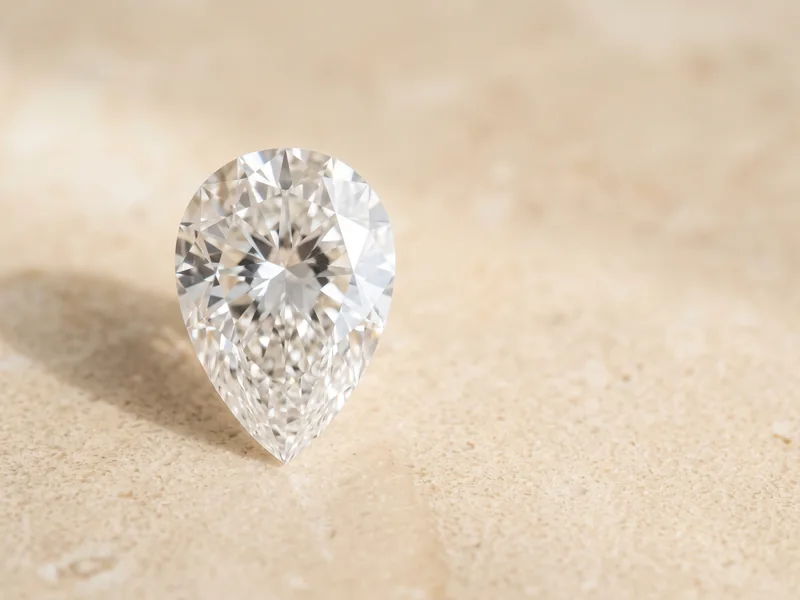 Diamond ShapesPear Diamond Length-to-Width Ratio GuideDiamond ShapesHow to Judge Pear Diamond SymmetryDiamond ShapesProtecting the Point of a Pear DiamondDiamond ShapesPear Cut DiamondsDiamond Anatomy & LightAnatomy of a diamond: table, crown, girdle, pavilion and culet explained
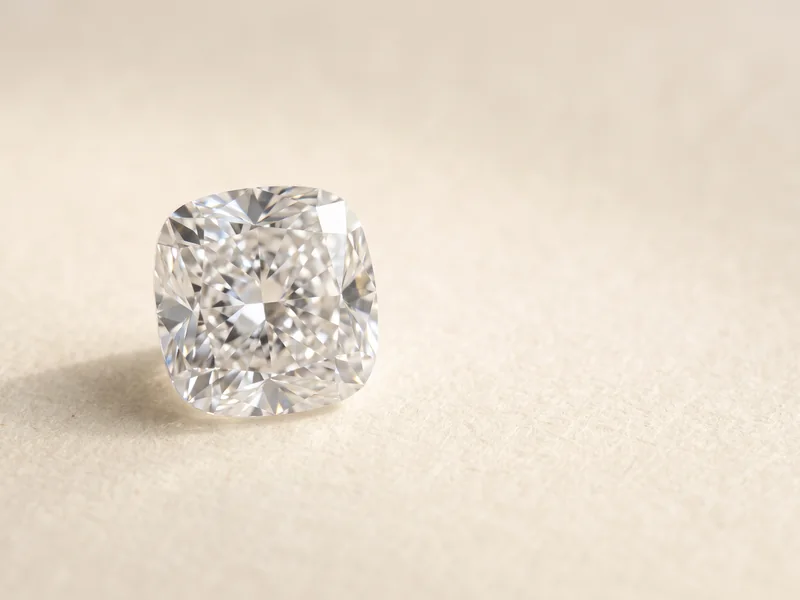 Diamond Anatomy & LightIdeal Proportions Chart: Cushion Diamonds
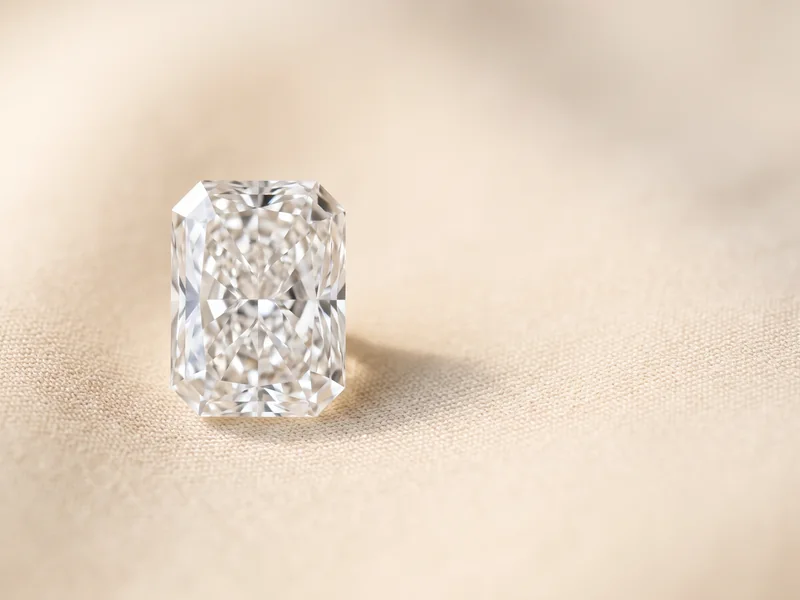 Diamond Anatomy & LightIdeal Proportions Chart: Radiant Diamonds
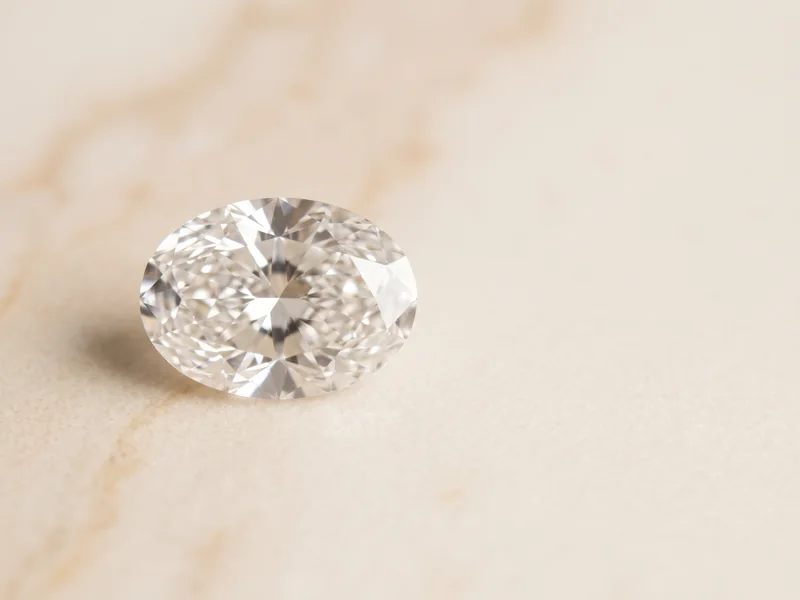 Diamond Anatomy & LightIdeal Proportions Chart: Oval Diamonds
Explore more
More guides on this topic
Education