
- Education
- Diamond Anatomy & Light
- Hazy Diamond? Diamond Transparency and Haziness Explained
Diamond Anatomy & Light
Hazy Diamond? Diamond Transparency and Haziness Explained
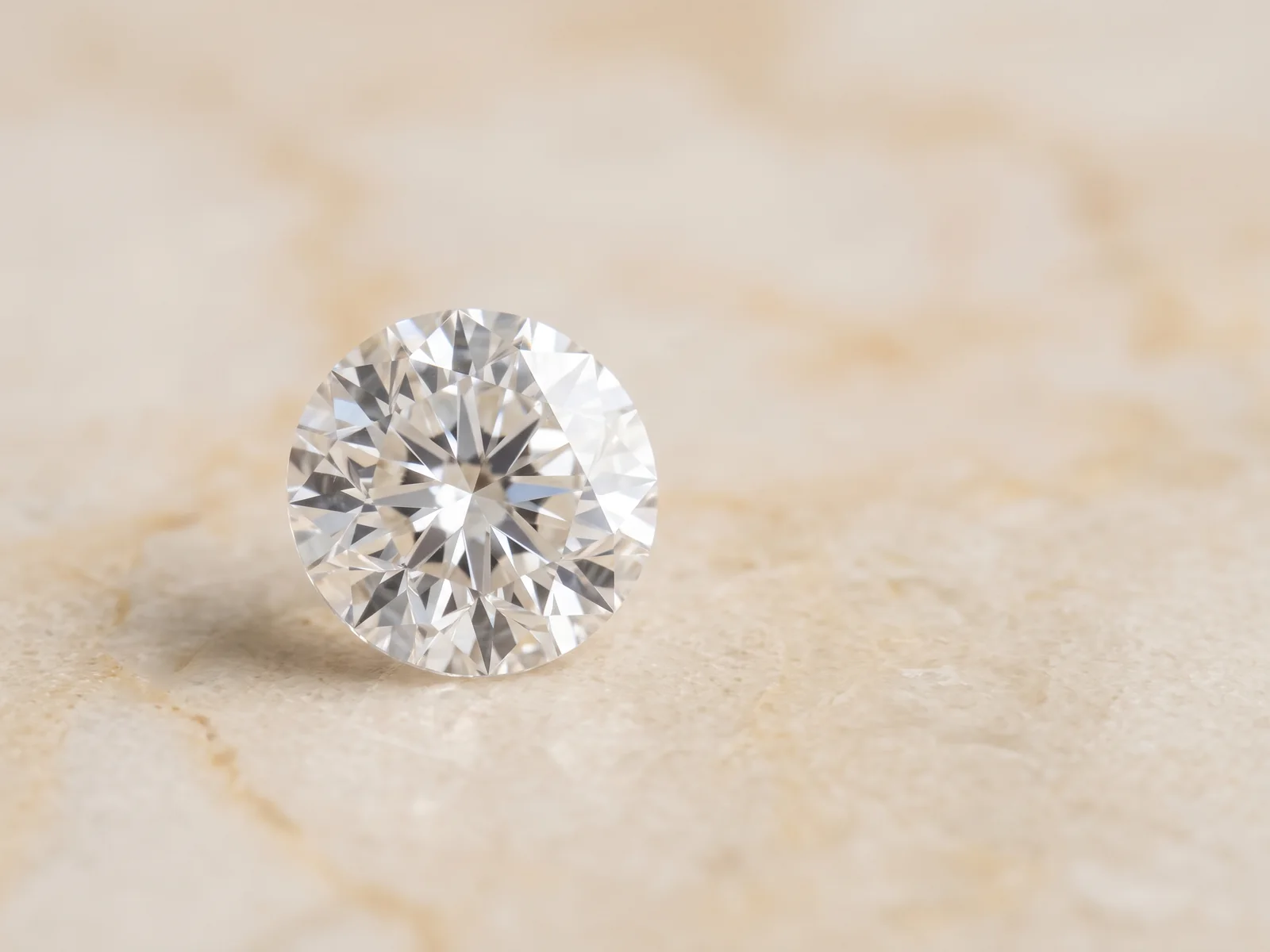
A hazy diamond can carry excellent grades on paper and still look soft and milky on the hand. Here is what causes haze, how to tell it apart from cut problems, and how to check a stone before you commit.
 Reviewed by Raj Sood, Graduate Gemologist (GIA), AJP (GIA)Master jeweller and Graduate Gemologist (GIA) · reviewed 4 November 2026
Quick answer
A hazy diamond looks milky, oily or slightly foggy instead of crisp, because something scatters light inside or on the stone. The usual causes are a film of skin oil, dense clouds of tiny pinpoint inclusions, rare cases of strong blue fluorescence, or graining. Cut problems like windowing and nailhead are different: they leak light, not blur it.
What is diamond transparency?
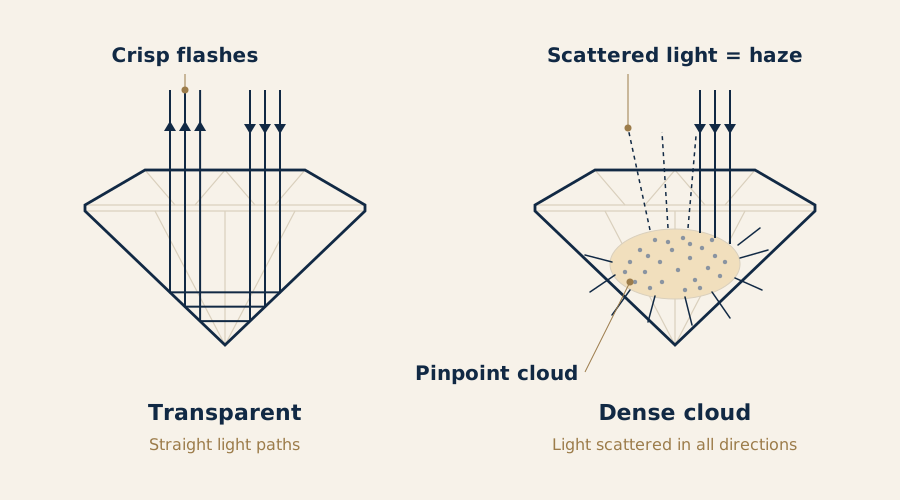
Transparency is how freely light travels through a diamond. A highly transparent stone looks crisp and almost wet: facet edges are sharp, the flashes of light are bright, and the dark areas between them are clean and black. When something inside the stone or on its surface scatters that light, the diamond looks soft, milky or oily. Gemmologists call this haze, and a hazy diamond can look dull even with a strong cut, colour and clarity grade on its report.
Transparency is not the same as brightness. Brightness comes from the cut: the angles of the crown and pavilion that bounce light back out through the top of the stone. If you want to see where those parts sit, our guide to the parts of a diamond labels the table, crown, girdle, pavilion and culet. A diamond can be perfectly transparent and still look dull because the cut leaks light. Another can be well cut and still look hazy because the material itself scatters light. Working out which problem you are looking at is the point of this guide.
What makes a hazy diamond look milky?
There are five common reasons a diamond looks milky, foggy or greasy. Only some of them are permanent, so it helps to know which is which.
| Cause | What it is | How it looks | Can it be fixed? |
|---|---|---|---|
| Oil and dirt film | Skin oil, soap, lotion or hand cream on the pavilion | Flat, greasy, slightly grey; sparkle drops sharply | Yes, by cleaning |
| Clouds | Dense groups of tiny pinpoint inclusions | Soft whitish veil, in one area or through the whole stone | No |
| Graining | Irregularities in the crystal from uneven growth | Faint whitish or glassy lines; in some stones a general softness | No |
| Very strong fluorescence (rare) | Blue glow under ultraviolet light | Oily or milky look in daylight in a small minority of stones | No |
| Surface damage | Polish lines, burn marks or abrasions from cutting or wear | Frosted or fuzzy facet edges | Often, by repolishing |
Clouds are the main internal cause. A cloud is a cluster of pinpoints, inclusions so small they look like tiny dots even under a 10× loupe. One small cloud is harmless and very common. A cloud spread through much of the stone acts like fog on a window: no single spot looks wrong, but the whole diamond loses contrast. This can happen at VS and SI clarity, because the clarity grade is set mainly by the size, number, position and visibility of inclusions, and does not fully capture how much they soften the light.
Graining is a record of how the crystal grew. Most graining is invisible face-up, but whitish or reflective graining can reduce transparency, and when it is significant it can affect the clarity grade.
Dirt is by far the most frequent reason a diamond in a ring you already own looks cloudy. Diamond attracts grease, and a thin film on the underside blocks light from entering and leaving the pavilion. Before you judge any stone, clean it gently in warm water with a drop of mild detergent and a soft toothbrush, then rinse and dry with a lint-free cloth.
Terms such as cloud, pinpoint, graining and fluorescence are explained as they come up here, and you will also find short definitions in our glossary of jewellery trade terms.
Does a diamond report show transparency or haze?
Not directly. Standard reports from GIA and IGI do not include a separate transparency grade. There are clues, though, if you know where to look.
- "Clarity grade is based on clouds that are not shown": the clouds are too fine to plot on the diagram, yet they set the clarity grade. This is the comment to look at most carefully, because those clouds may be spread through the stone.
- "Additional clouds not shown": there are more clouds than the plot shows, but they did not set the grade. Usually minor, worth a look on video.
- "Internal graining is not shown" or "Surface graining is not shown": graining is present. Most is harmless, but check the stone for softness.
- Fluorescence: Strong or Very Strong Blue: not a problem in itself, but it is the group where rare hazy stones are found.
- Cloud listed as the main clarity characteristic: the grade is driven by clouds rather than a crystal or feather.
None of these comments means a diamond is hazy. Many stones with a clouds comment look perfectly crisp. They are simply the reason to ask for a video or to see the stone in person before deciding.
Does fluorescence make a diamond look hazy?
Fluorescence is a glow some diamonds give off under ultraviolet (UV) light, most often blue. It is linked mainly to nitrogen in the crystal, and reports grade it as None, Faint, Medium, Strong or Very Strong. A sizeable share of natural diamonds show some fluorescence, most of it faint.
For almost all diamonds, fluorescence has no visible effect on transparency. A GIA study published in 1997 found that average observers could not see a consistent difference in transparency, and that strong blue fluorescence was often seen as improving the face-up colour of slightly warmer stones. The exception is a small minority of strong and very strong stones that look oily or milky in daylight, sometimes called overblue. The haze in those stones is generally associated with very fine structural features inside them, so strong fluorescence is a reason to check, not a reason to reject.
Bright Australian sunlight carries a lot of UV, so a strongly fluorescent diamond can glow noticeably blue outdoors. Some people like this, others do not. Under indoor lighting the effect is usually much weaker.
Not sure which one is right?
Send us the stones you are looking at and our gemologist will tell you which to choose and why.
Haze or a cut problem? Windowing, fisheye, nailhead and extinction
Many diamonds described as hazy or dull are actually perfectly transparent stones with a cut that leaks light. The difference matters: haze is in the material, while these effects come from the angles and can be predicted from the measurements.
| Effect | What you see | Usual cause | Material or cut? |
|---|---|---|---|
| Haze | Whole stone looks soft, milky or oily | Clouds, graining, rare strong fluorescence, dirt | Material (or surface) |
| Windowing | A pale, see-through area; you can almost read through it | Pavilion too shallow | Cut |
| Fisheye | A grey-white ring inside the table | Girdle reflected by a very shallow pavilion | Cut |
| Nailhead | A dark centre under the table | Pavilion too steep or stone too deep | Cut |
| Extinction | Dark patches that stay dark as the stone moves | Angles sending light out the back or toward your head | Cut |
| Bow-tie | Dark band across the middle of an elongated stone | Light leakage across the width | Cut |
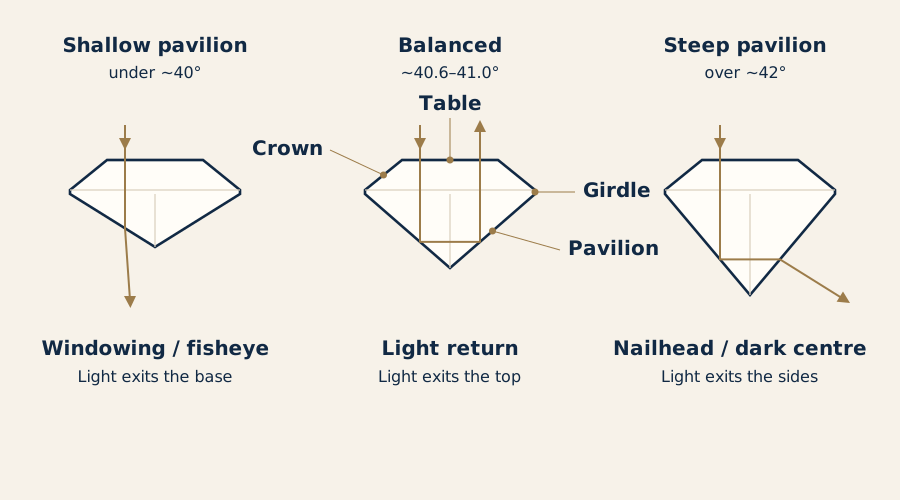
Windowing is the cut problem most often mistaken for haze, because the pale centre looks washed out. It is especially common in fancy shapes, and our guide to how windowing shows in each shape goes through it shape by shape. The fisheye ring looks like a grey halo inside the table; in a round it typically appears once the pavilion angle drops below about 40°. Nailhead is the opposite: a pavilion steeper than about 42° sends light out the sides and leaves a dark centre.
Dark areas that do not move are covered in extinction and dark zones, and the dark band in ovals, pears and marquises has its own guide on the bow-tie in elongated diamonds. For a round brilliant, a pavilion angle of roughly 40.6–41.0° and a total depth around 59–62.5% avoid both fisheye and nailhead; our page on how table and depth percentages work explains how to read those numbers.
Two smaller details can also confuse the eye. A large open culet shows as a dark or see-through dot under the table; what a culet is and why size matters covers when that is visible. In rounds, the way the lower girdle facets are cut can shift how bright or contrasty the stone looks; see painting and digging out on round girdles.
How do windowing and nailhead vary by diamond shape?
Each shape has its own comfortable depth range. Outside it, cut-related light leakage becomes more likely. These are typical ranges used in the trade, not hard rules, and the angles matter more than depth alone.
| Shape | Typical depth range | If too shallow | If too deep | Haze visibility |
|---|---|---|---|---|
| Round brilliant | about 59–62.5% | Fisheye, windowing | Nailhead, dark centre | Hidden fairly well by brilliant faceting |
| Oval | about 58–63% | Windowing in the belly | Strong bow-tie, looks smaller | Moderate |
| Pear | about 58–64% | Windowing in the centre | Dark bow-tie, weight underneath | Moderate |
| Cushion | about 61–68% | Windowing under the table | Dark centre, looks small | Moderate |
| Radiant | about 61–67% | Windowing, glassy centre | Dark corners and centre | Moderate |
| Emerald cut | about 61–68% | Large window, lifeless look | Dark, closed-in look | High: step cuts show haze and clouds clearly |
Step cuts such as the emerald and asscher are the least forgiving for transparency. Their long, flat facets work like a series of mirrors, so any softness in the material shows straight away. Brilliant cuts break light into many small flashes, which hides mild haze better.
For the detailed numbers on each shape, see our proportion charts for oval diamond depth and table, pear-shaped diamond proportions, cushion cut angles and ratios, radiant cut proportion ranges and emerald cut depth guidelines.
Can ASET and Idealscope images show a hazy diamond?
Only partly. ASET (Angular Spectrum Evaluation Tool) and Idealscope images map where a diamond gathers light from. In an ASET image, red shows light gathered from high angles (the brightest), green shows lower-angle light, blue shows contrast from the viewer's head, and white or clear areas show leakage. An Idealscope shows strong light return as red and leakage as pale or white.
These tools are excellent for spotting windowing, fisheye, nailhead and extinction, because those are all about angles. They say very little about haze. A cloudy diamond can produce a near-perfect ASET image, because the facets are still sending light in the right directions; the cloud simply blurs it on the way. Our guide to reading ASET and Idealscope colours shows examples of each pattern.
The same goes for a hearts and arrows viewer, which checks how precisely the facets line up. That alignment is what our page on symmetry grades versus optical symmetry describes, and it is a cut measure, not a transparency one. To judge haze you need to see the stone itself, ideally next to another one.
Related guideASET and Idealscope Images ExplainedDo lab-grown diamonds look hazy more often than natural?
Haze occurs in both natural and laboratory-grown diamonds, and both are checked the same way. In natural diamonds, it usually comes from clouds or graining formed deep in the earth, and occasionally sits alongside strong fluorescence.
Lab-grown diamonds are made by two methods. CVD (chemical vapour deposition) stones grow in layers and can show growth strain or graining; some are given a post-growth heat treatment to improve colour, which a lab report will usually note. HPHT (high pressure, high temperature) stones more often contain small metallic inclusions than clouds. Lab-grown diamonds rarely show strong fluorescence. A well-grown lab-grown diamond is just as transparent as a fine natural one, and a poorly grown one can look soft, so judge each stone on video rather than by type.
Browse natural and lab-grown diamonds in our stock
Whichever you choose, the report checks in this guide apply equally. Lab-grown diamonds cost much less than natural diamonds of the same size and grades, which leaves more room to be choosy about crispness.
Is a slightly hazy diamond worth buying?
It depends how hazy, and whether you can see it. Very mild softness that only shows in a side-by-side under studio light may never be noticed on the hand. Obvious milkiness is different: it lowers contrast in every lighting condition, and no setting or cleaning will change it.
Hazy diamonds are generally priced below crisper stones with the same grades, because the trade knows the difference even when the report does not show it. If a stone seems unusually cheap for its colour and clarity, a clouds comment or very strong fluorescence is often the reason. That is not a problem if you have seen the stone and are happy with it, but it is worth knowing before you compare prices. Haze is also one reason two diamonds of the same carat and grades can look different.
- Usually fine: a clouds comment with a crisp-looking video; faint to medium fluorescence; graining comments on a stone that looks clean.
- Look closely: clouds as the grade-setting characteristic in an SI stone; strong or very strong blue fluorescence; step cuts with any clouds comment.
- Usually avoid: a stone that looks soft or oily on a clean video next to a reference stone.
How to check a hazy diamond before you buy: step by step
- Clean before you judge. If it is a stone you own or are viewing in a ring, make sure it is free of oil and lotion first.
- Read the report comments. Look for "Clarity grade is based on clouds that are not shown", graining comments and the fluorescence entry.
- Check the measurements. Compare depth and, for rounds, the pavilion angle with the typical ranges for the shape to rule out windowing, fisheye or nailhead.
- Look at ASET or Idealscope images. Use them to confirm the cut is sending light back, remembering they will not show haze.
- Watch a video in two lights. Ask for daylight and indoor footage on a white background, ideally beside a known crisp stone, and look for a milky veil.
- See it under a loupe if you can. At 10×, check whether the clouds are spread through the stone or confined to one area.
Free consultation
Talk to a gemologist
Compare stones in person or online with Raj Sood, Graduate Gemologist (GIA), AJP (GIA).
Book a consultationShop this shape
FAQ
Common questions
Why does my diamond look cloudy?
The most common reason is a film of skin oil, soap or lotion on the underside of the stone. Clean it in warm water with mild detergent and a soft brush; if it still looks milky, the cause may be clouds or graining inside the diamond.
What does "clarity grade is based on clouds that are not shown" mean?
It means fine clouds, too small to plot on the diagram, set the clarity grade. The stone may still look crisp, but it is worth checking on video for any milky softness.
Does fluorescence make a diamond look milky?
Almost never. Only a small minority of diamonds with strong or very strong blue fluorescence look oily or hazy in daylight, so check those stones individually rather than avoiding fluorescence altogether.
Can a hazy diamond be fixed?
Haze from dirt can be cleaned off, and surface marks from polishing or wear can often be repolished. Haze from clouds, graining or fluorescence is part of the stone and cannot be removed.
Is windowing the same as a hazy diamond?
No. Windowing is a pale, see-through area caused by a shallow pavilion letting light escape, while haze is a milky veil caused by light being scattered inside or on the stone. Windowing can be predicted from the measurements; haze has to be seen.
Are lab-grown diamonds hazy?
Most are not. Laboratory-grown diamonds can show haze from growth strain or graining, just as natural diamonds can from clouds, so each stone should be checked on video regardless of origin.

Ask a gemologist
Not sure which diamond to choose?
Raj Sood is a Graduate Gemologist (GIA) and master jeweller. Bring the stones you are considering, or send the reports, and he will tell you honestly which one is better and why.
Keep learning
Related guides
 Diamond Anatomy & LightFisheye Effect in DiamondsDiamond Anatomy & LightExtinction and Dark Zones in Diamonds
 Diamond Anatomy & LightWindowing Across Diamond Shapes
 Diamond Anatomy & LightASET and Idealscope Images ExplainedDiamond Anatomy & LightAnatomy of a diamond: table, crown, girdle, pavilion and culet explainedDiamond Anatomy & LightDiamond Table and Depth ExplainedDiamond Anatomy & LightHearts and Arrows Viewer Explained
 Diamond Anatomy & LightPainting and Digging Out in Round Diamonds
Explore more
More guides on this topic
Education