
- Education
- Diamond Anatomy & Light
- Painting and Digging Out in Round Diamonds: What It Is and How to Spot It
Diamond Anatomy & Light
Painting and Digging Out in Round Diamonds: What It Is and How to Spot It
Painting and digging out are small cutting choices at the edge of a round diamond that rarely appear on a report, yet they can change its weight, durability and sparkle. Here is what they are and how to check for them before you choose a stone.
 Reviewed by Raj Sood, Graduate Gemologist (GIA), AJP (GIA)Master jeweller and Graduate Gemologist (GIA) · reviewed 4 November 2026
Quick answer
Painting and digging out are ways of cutting the girdle facets (the halves around the edge) of a round diamond at non-standard angles. Painting leaves the girdle thicker to save weight; digging out cuts it thinner. Both can change the contrast near the edge. Check ASET or Idealscope images and the girdle range, and choose evenly cut stones.
What is painting and digging out in a round diamond?
A round brilliant has 57 or 58 facets. Most attention goes to the big ones: the table on top, the eight bezel facets on the crown and the eight main facets on the pavilion. Around the edge sit 32 much smaller facets called girdle facets, or halves: 16 upper halves on the crown and 16 lower halves on the pavilion. If those names are new, our guide to the parts of a diamond, from table to culet shows where each one sits.
Painting and digging out describe what happens when a cutter polishes those halves at angles that differ noticeably from the usual pattern. In painting, the halves are cut at a shallower angle so extra material is left at the girdle (the thin band around the widest part of the stone). In digging out, the halves are cut steeper, so they bite into the girdle and leave it thinner. Either can be done on the crown, the pavilion or both.
Neither is a flaw in the clarity sense, and neither is listed as a line item on most grading reports. They are cutting decisions, and they matter because the halves sit right where light enters and leaves the stone near its edge. The wider rules for how a round should be cut are covered in our round brilliant diamond guide. Any unfamiliar term here is also explained in our jewellery glossary.
How do girdle hills and valleys normally look?
On a faceted round, the girdle is not a band of even height. Seen side-on, it rises and falls eight times around the stone. It is thinnest where a bezel facet above meets a pavilion main facet below. These thin points are called valleys, and they are where labs measure girdle thickness. Between them, where pairs of halves meet the girdle, it is thicker. These thick points are called hills.
In a well-cut stone the difference between hills and valleys is modest and repeats evenly all the way round. The report then describes the girdle with a range such as "thin to medium" or "medium to slightly thick". GIA uses eight terms, from extremely thin to extremely thick, and most well-made rounds fall between thin and slightly thick.
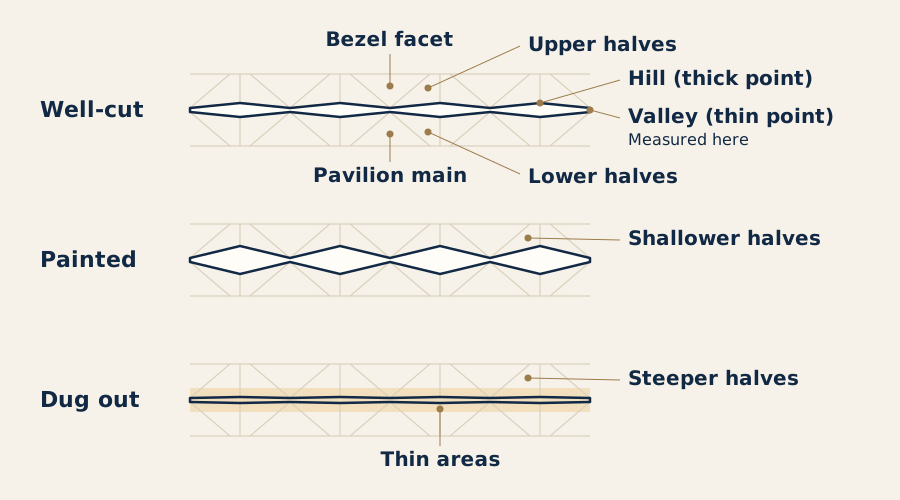
| Well-cut | Painted | Dug out | |
|---|---|---|---|
| Angle of the halves | Standard for the cutter's pattern | Shallower than usual | Steeper than usual |
| Girdle at the hills | Moderately thicker than at valleys | Noticeably thicker | Thin, sometimes nearly level with the valleys |
| Weight kept | Normal | Extra weight held at the edge | Weight removed |
| Effect on spread | Normal for the weight | Looks a little smaller for its carat | Normal or slightly larger for its carat |
| Durability at the edge | Good | Good | Thin areas can chip more easily |
| Face-up effect | Even, crisp pattern near the edge | Patchy brightness or leakage near the edge possible | Darker or uneven areas near the edge possible |
Why do cutters paint or dig out a diamond?
Almost always the reason is weight. Diamond prices step up at popular weights such as 0.50, 0.70, 0.90, 1.00 and 1.50 carat. A stone that would finish at 0.98 carat with a normal girdle might finish at 1.00 carat if the cutter leaves extra material in the hills. On a 1 carat round, a strongly painted girdle can hold a few hundredths of a carat, and that can be enough to cross the line.
Digging out usually happens for a different reason. If the rough crystal or an earlier cut left the girdle too thick in places, the cutter can steepen the halves to thin it and bring the report description back into a more acceptable range. It can also be used to polish away a small chip or natural (an unpolished patch of the original crystal surface) at the edge without recutting the whole stone.
These choices sit alongside the bigger proportion decisions. A cutter keeping weight may also cut a deeper pavilion, which leads to steep-deep rounds that look small for their weight. One spreading the stone wider may go the other way, towards shallow rounds with a bigger spread. Painting and digging out are the finer adjustments at the edge, and they apply equally to natural and lab-grown diamonds, because both are cut on the same wheels to the same patterns.
How does painting and digging out change a diamond's sparkle?
The halves sit in the outer ring of the stone. Light that enters through the crown halves reflects off the lower halves and pavilion mains before returning to your eye. Change the angle of the halves and you change where that light goes. This is why GIA's research into cut quality found that painting and digging out can affect face-up appearance even when the main angles are good.
- Painted halves: can create areas near the edge that look flatter or lighter, because some light is returned less sharply or leaks out through the pavilion. In reflector images this often shows as pale or white patches under the halves.
- Dug-out halves: can make areas near the edge look darker, or break up the even arrow and contrast pattern of a well-cut round.
- Mild cases: are usually invisible to the eye in normal room light. The effect becomes noticeable when it is strong or combined with other proportion problems.
Diamond has a refractive index of about 2.42 and a critical angle of about 24.4°. Light striking a pavilion facet at more than that angle from the perpendicular reflects back inside the stone; light striking closer to the perpendicular passes out through the back. Small angle changes near the girdle therefore have a real effect on how much light comes back from the edge of the stone. They are the same physics behind the dark centre of the nailhead effect and the grey ring of a fisheye, only on a smaller scale.
Not sure which one is right?
Send us the stones you are looking at and our gemologist will tell you which to choose and why.
How can you spot painting and digging out in photos and video?
Because reports do not usually name painting or digging out, you have to read the clues. Start with the numbers and finish with images.
- Girdle range: a wide spread such as "medium to thick" or "thin to very thick" suggests uneven hills and valleys. Strong painting often pushes the upper end to slightly thick or thick.
- Weight just over a step: a stone at 1.00–1.02 carat with a thick girdle and a slightly small diameter (well under about 6.4 mm for 1 carat) is worth a closer look.
- Side-profile photo: if available, look at the girdle line. Big, regular bumps between the mains suggest painting; a girdle that looks paper-thin and wavy suggests digging out.
- ASET image: ASET (Angular Spectrum Evaluation Tool) shows light returned from high angles as red, lower angles as green, contrast from the viewer's head as blue, and leakage as white. Look for white or pale areas in the outer ring, under the halves, that repeat around the stone.
- Idealscope image: shows light return as red and leakage as white or transparent. Even arrows with clean edges are a good sign; patchy leakage near the girdle points to the halves.
- 360° video: watch the outer ring as the stone turns. It should flash in step with the centre, not sit flatter or darker.
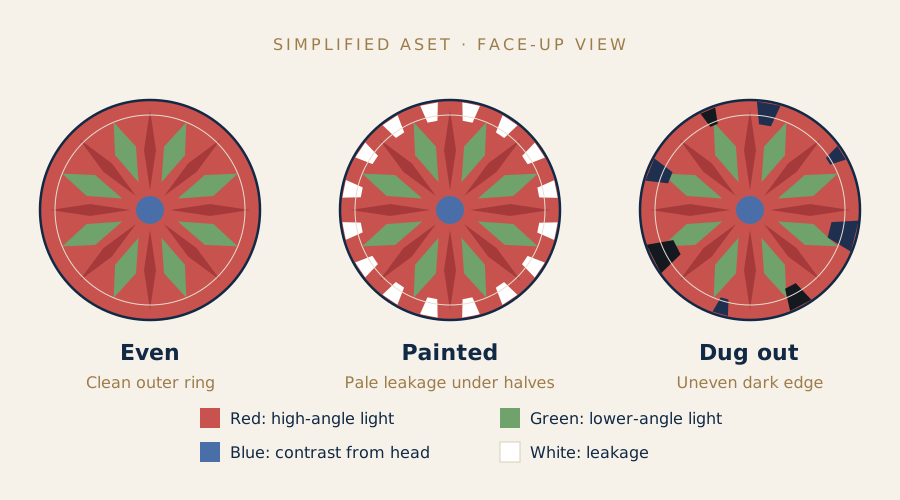
Where the outer ring looks dark rather than leaky, compare it with the patterns in our guide to extinction and dark zones. Dark areas caused by the halves sit right at the edge, while extinction from steep main angles usually spreads further inward.
Related guideNailhead Effect in DiamondsDoes the GIA cut grade account for painting and digging out?
Yes, to a degree. GIA's cut grade for round brilliants looks at more than the main proportions. It also considers weight ratio (how much the stone weighs for its diameter), durability, polish, symmetry and painting or digging out. A strongly painted or dug-out stone can be held below Excellent even if its table, crown and pavilion angles fall in the top range.
The catch is that mild and moderate cases can still reach Excellent, and the report does not tell you which way the halves lean. Two Excellent stones with the same table and depth can look different near the edge. That is why it pays to look at proportions that matter beyond the cut grade, such as the lower half length and the girdle range, alongside the grade itself.
| Light issue | Main cause | How it looks | Best place to see it |
|---|---|---|---|
| Painting | Halves cut shallower to keep weight | Flatter or leaky outer ring | ASET, Idealscope, side profile |
| Digging out | Halves cut steeper to thin the girdle | Darker or uneven outer ring | ASET, video |
| Nailhead | Pavilion too deep or steep | Dark centre under the table | Face-up photo, video |
| Fisheye | Pavilion too shallow | Grey ring reflecting the girdle | Face-up photo, tilting |
| Extinction | Angles that return little light, or viewer shadow | Dark patches that stay dark | Video, ASET |
As a reference point, many rounds that perform well sit at a table of about 54–58%, a crown angle of about 34–35°, a pavilion angle of about 40.6–41°, total depth of about 59–62.5%, lower halves of about 75–80% and a girdle in the thin to slightly thick range. Stones cut to 60/60 proportions follow a slightly different recipe, and the halves still matter there.
Which diamond shapes are prone to painting and digging out?
Any shape with girdle facets can be painted or dug out, but the terms come from round brilliant grading, and round is the only shape where GIA builds it into a cut grade. Round brilliants have 16 hills and valleys in a regular pattern, so changes are easy to measure and easy to see in reflector images.
- Round brilliants: most often affected, because weight steps and cut grades are so closely watched.
- Star and Portuguese cuts: extra rows of facets near the girdle give cutters more room to adjust; see our page on star and Portuguese cuts in the round family.
- Ovals, pears and marquises: cutters often vary the halves to manage the bow-tie, so similar effects exist but are not graded. Our oval and round comparison explains how the light behaves differently.
- Cushions: many cushion patterns have extra pavilion facets and wide girdle variation; see how a cushion compares with a round.
- Old European cuts: cut by eye before modern proportion standards, with small tables, high crowns and often irregular halves. The Old European versus modern round story shows how the edge has changed.
Does a thin, dug-out girdle need a protective setting?
Diamond is 10 on the Mohs hardness scale, but hardness is not toughness. A very thin girdle, which strong digging out can create, is the part of a round most likely to chip if the ring knocks a hard edge. A thick, painted girdle is the opposite: durable but heavy. It can also sit awkwardly in a setting, because claws have to be cut to fit the girdle's height.
If a stone's report shows very thin or extremely thin at the lower end of the range, choose claws placed over valleys rather than hills, or a bezel that wraps the edge. Our guide to settings that protect a round diamond's edge covers the options. It is also worth having claws checked regularly, because a band that has been knocked out of shape can loosen them; see why rings go out of round.
Is painting more common in natural or lab-grown diamonds?
Both natural and laboratory-grown diamonds are cut on the same equipment, and both can be painted or dug out. The pressure to keep weight is usually stronger with natural rough, because each fraction of a carat costs more. Lab-grown diamonds cost much less per carat, so there is less incentive to hold weight at the girdle, though it still happens. Either way, the report must state whether the diamond is natural or lab-grown, and the same checks apply to both.
Shop round diamonds: natural and lab-grown
How do you avoid a painted or dug-out round diamond? Step by step
- Read the girdle range. Prefer thin to medium or medium to slightly thick. Be cautious with very thin or thick to very thick.
- Compare weight with diameter. A 1 carat round usually measures about 6.4–6.5 mm across. Noticeably less, with a thick girdle, suggests weight held at the edge.
- Check the key angles. Crown about 34–35°, pavilion about 40.6–41° and lower halves about 75–80% are a sound starting point.
- Ask for ASET or Idealscope images. Look for an even, repeating pattern with no pale leakage or dark patches in the outer ring.
- Watch a 360° video. The edge should sparkle in step with the centre as the stone turns.
- Ask for a side profile if in doubt. Regular, even girdle undulation is what you want to see.
- Match the setting to the girdle. Protect a thin girdle with well-placed claws or a bezel.
Free consultation
Talk to a gemologist
Compare stones in person or online with Raj Sood, Graduate Gemologist (GIA), AJP (GIA).
Book a consultationFAQ
Common questions
What does painting mean on a diamond?
Painting means the girdle facets (halves) were cut at a shallower angle than usual, leaving the girdle thicker between the main facets. It is mainly done to keep carat weight and can slightly change how bright the outer ring looks.
What does digging out mean in diamond cutting?
Digging out means the halves were cut steeper than usual, thinning the girdle between the main facets. It is often used to correct a thick girdle, but it can leave thin areas that chip more easily.
Is painting listed on a GIA report?
Not as a separate line item. GIA considers painting and digging out within its cut grade for round brilliants, so a strong case can lower the grade, but mild cases are not called out.
Can you see painting in a diamond with the naked eye?
Usually not in mild cases under normal light. Strong painting or digging out can show as a flatter or darker outer ring, which is easier to see in ASET or Idealscope images and in 360° video.
Does painting make a diamond look smaller?
Slightly. The extra weight sits in the girdle, not in the face-up area, so a painted stone can measure a little smaller across than a well-cut stone of the same carat weight.
Do lab-grown diamonds have painting and digging out too?
Yes. Lab-grown diamonds are cut the same way as natural diamonds, so the same girdle choices and the same checks apply. The incentive to keep weight is usually smaller because lab-grown costs much less per carat.

Ask a gemologist
Not sure which diamond to choose?
Raj Sood is a Graduate Gemologist (GIA) and master jeweller. Bring the stones you are considering, or send the reports, and he will tell you honestly which one is better and why.
Keep learning
Related guides
 Diamond Anatomy & LightSteep-Deep Round Diamonds Explained
 Diamond Anatomy & LightRound Diamond Proportions Beyond the Cut GradeDiamond Anatomy & LightExtinction and Dark Zones in Diamonds
 Diamond ShapesRound Brilliant DiamondsDiamond Anatomy & LightAnatomy of a diamond: table, crown, girdle, pavilion and culet explainedDiamond Anatomy & LightShallow Round Diamonds: Bigger Spread, Better Value?Diamond Anatomy & Light60/60 Round Diamonds vs Classic Proportions
 Diamond ShapesRound Brilliant Family: Round, Star and Portuguese Cuts
Explore more
More guides on this topic
Education