
- Education
- Diamond Anatomy & Light
- Steep Deep Diamond Explained: Angles, Nailhead and Light Leakage in Round Diamonds
Diamond Anatomy & Light
Steep Deep Diamond Explained: Angles, Nailhead and Light Leakage in Round Diamonds
A steep deep diamond can carry a respectable grade on paper and still look darker and smaller than it should. Here is how to recognise one from the angles, the photos and an ASET image before you choose a round diamond.
 Reviewed by Raj Sood, Graduate Gemologist (GIA), AJP (GIA)Master jeweller and Graduate Gemologist (GIA) · reviewed 4 November 2026
Quick answer
A steep deep diamond is a round brilliant whose pavilion angle is too steep (about 41.2° or more) combined with a high crown angle (about 35° or more), usually with total depth above 62.5–63%. Light escapes through the pavilion, so the centre can look dark (nailhead), and the stone faces up smaller than its carat weight suggests.
What is a steep deep diamond?
A steep deep diamond is a round brilliant cut with a pavilion (the cone-shaped lower half) angled too steeply, usually paired with a tall crown (the upper half above the girdle). Together these push the total depth, the height of the stone from table to culet as a percentage of its width, above about 63%. If any of those parts are new to you, our page on the parts of a diamond, from table to culet sets them out with diagrams.
The name comes from the two measurements that matter most: the pavilion angle is steep, and the stone is deep. Neither on its own tells the whole story. A round can be a little deep because of a thick girdle and still perform well, and a stone can have a slightly steep pavilion balanced by a shallower crown. Steep-deep describes the combination where both angles sit high at the same time, and light stops coming back to your eye the way it should.
It matters because the round brilliant is a precise optical design. Its 57 or 58 facets are arranged so that light entering the top strikes the pavilion facets at an angle steep enough to reflect, not escape, and then travels back up through the crown. Our round brilliant diamond guide explains how that design developed, and the wider family of round cuts shows how related patterns vary it. Deeper proportions are not new either: older rounds were often cut deep with small tables, as our page on how the modern round grew out of the Old European cut explains. Change the angles by a degree or so and the light paths change with them. Diamond's refractive index of about 2.42 gives it a critical angle of roughly 24.4°: light hitting an inside surface more steeply than that escapes instead of reflecting. A steep pavilion sends more rays past that limit on their second bounce.
You will meet several technical terms in this guide, including nailhead, fisheye, extinction and ASET. Each is explained as it comes up, and you can look up any of them in our glossary of jewellery terms.
Which pavilion and crown angles make a round diamond steep-deep?
The pavilion angle is the angle between the girdle plane and the pavilion main facets. The crown angle is the angle between the girdle plane and the crown bezel facets. Both are printed on GIA and IGI reports for rounds, along with the table percentage, girdle thickness and total depth.
| Measurement | Classic well-cut round | Borderline | Steep-deep |
|---|---|---|---|
| Pavilion angle | 40.6°–41.0° | 41.1°–41.2° | 41.3° and above |
| Crown angle | 33.5°–35.0° | 35.0°–35.5° | 35.5° and above (or 35°+ with a 41.2°+ pavilion) |
| Pavilion depth | about 42.5–43.5% | about 43.5–44% | about 44% and above |
| Total depth | about 59–62.5% | about 62.5–63% | about 63% and above |
| Table | about 53–58% | 58–60% | often 54–57%, a smaller table with a tall crown |
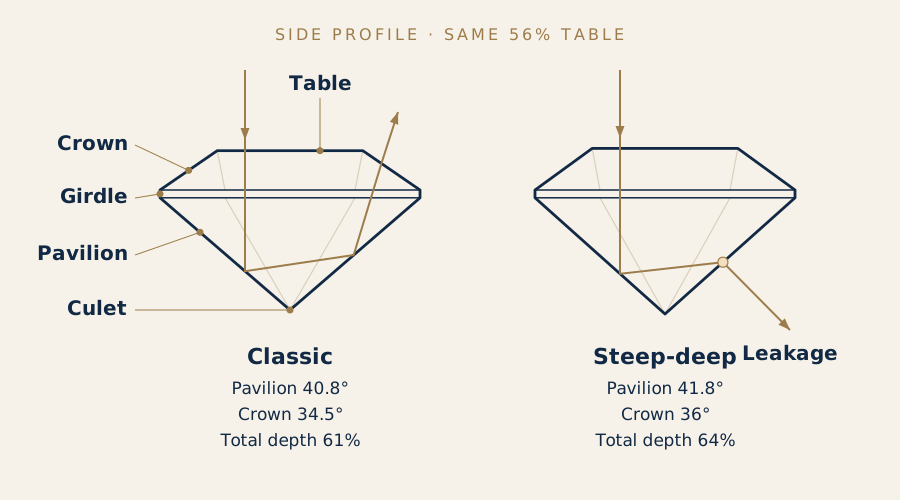
These bands are a working guide used by cut analysts, not an official standard. The key idea is that pavilion and crown angles trade off against each other. A pavilion at 41.0° is happy with a crown anywhere from about 33.5° to 35°. At 41.4° the crown needs to come down, roughly 33°–34°, to keep light returning well. When a 41.4° pavilion meets a 36° crown, the stone is steep-deep. That is why proportions should always be read as a pair, which our page on round proportions beyond the cut grade covers in more depth.
You can check the arithmetic yourself. A pavilion angle of 40.8° gives a pavilion depth of about 43.1% of the diameter; at 41.8° it is about 44.7%. With a 56% table, a 34.5° crown gives a crown height of about 15.1%, while 36° gives about 16%. Add a medium girdle of around 3% and the classic stone totals about 61%, the steep-deep one about 63.5–64%. The profile diagram above shows the same sum side by side.
What does a steep deep diamond look like?
Face-up, a steep deep diamond tends to show a few tell-tale signs. None of them is always obvious in a photo under bright studio light, which is partly why these stones sell.
- Darker centre: the area under the table looks grey or inky, especially under soft or overhead light.
- Nailhead: in severe cases the whole centre goes dark, like looking down at the head of a nail. This usually appears once the pavilion reaches about 42° or more.
- Dark ring or patchy mains: a darker ring around the table or under the pavilion main facets, where light is leaking out the bottom.
- More extinction: extinction means areas that stay dark as the stone moves. Some dark contrast is good and makes sparkle visible, but too much, in the wrong places, makes the stone look dull.
- Smaller look: more weight sits below the girdle, so the stone measures narrower across than a well-cut round of the same carat weight.
How the girdle is finished can make this worse. Cutters sometimes adjust the angles of the small facets near the girdle to save weight, a practice called painting or digging out. These tweaks change how the edge of the stone looks and can hide or exaggerate leakage. Our page on painting and digging out explains what to watch for.
Steep-deep stones are not always ugly. A stone at 41.2° and 35.5° with a 62.8% depth can look bright in a ring and just slightly less lively than a classic cut. The issue grows with each extra fraction of a degree, and at 42° with a 36° crown the difference is easy to see side by side.
What is the difference between a nailhead diamond and a fisheye diamond?
Both are light leakage problems, but they come from opposite ends of the pavilion angle range. A nailhead comes from a pavilion that is too steep, as in a steep deep diamond. A fisheye comes from a pavilion that is too shallow. Both terms, along with light leakage itself, are among the definitions of cut and light terms we keep for reference.
| Nailhead (too steep) | Fisheye (too shallow) | |
|---|---|---|
| Pavilion angle | about 42° and above | about 39° and below |
| Total depth | often 64% and above | often below 57–58% |
| What you see | dark or black centre under the table | a whitish or grey ring under the table, the reflection of the girdle |
| Why it happens | light passes through the second pavilion facet instead of reflecting | light passes straight through and the girdle reflects in the pavilion |
| Face-up size | smaller than expected for the weight | larger than expected for the weight |
| Where light leaks | mainly through the centre of the pavilion | mainly through the pavilion near the girdle |
Shallow stones carry their own trade-off: they look bigger for their weight, but go too far and the fisheye ring and a glassy, washed-out look appear. We weigh up that side of the coin in shallow rounds and the fisheye trade-off. Between the two lies the band of angles where the round brilliant does what it was designed to do.
Related guideShallow Round Diamonds: Bigger Spread, Better Value?Not sure which one is right?
Send us the stones you are looking at and our gemologist will tell you which to choose and why.
How do ASET and Idealscope images show light leakage?
You do not have to rely on your eye alone. Two simple viewers, used by many cut-focused jewellers, turn light return into colours you can read.
- ASET (Angular Spectrum Evaluation Tool), developed by the American Gem Society, shows where the diamond gathers light from. Red is the brightest light from high overhead (roughly 45°–90° above the horizon), green is lower-angle light, and blue shows contrast from the viewer's own head. Clear or white areas are leakage, where light goes straight through.
- Idealscope is a simpler red-filter viewer. Red shows light returning, black shows contrast, and pale pink or white shows leakage.
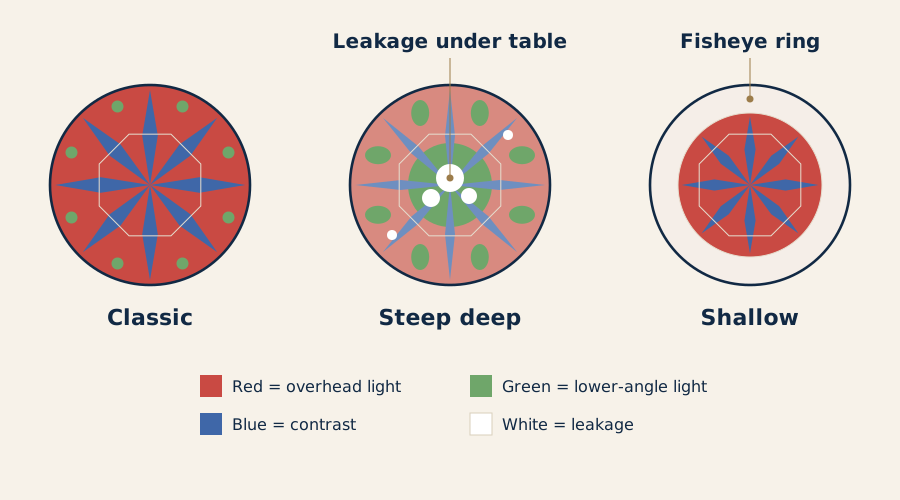
A steep deep diamond in ASET typically shows green or white patches under the table and a weaker, uneven red, because the steep pavilion is collecting lower-angle light or letting it escape. A nailhead stone may show an almost white centre. In a classic well-cut round, the red is strong and even, and the blue arrows (the eight-fold pattern of the pavilion mains) are sharp and symmetrical. Our look at how a well-cut round handles light shows what that balanced pattern looks like. Painted or dug-out girdle facets also show up in ASET as uneven colour near the edge, as our guide to girdle facet tweaks and how they read illustrates.
Does a steep deep diamond look smaller than its carat weight?
Yes. Carat measures weight, not size. A deeper stone puts more of that weight below the girdle, where you cannot see it, so its diameter is smaller. Cutters call the face-up size the spread.
| Total depth (1.00 ct round) | Approximate diameter | How it reads face-up |
|---|---|---|
| 59–60% | about 6.50–6.55 mm | full spread, check it is not shallow |
| 61–62% | about 6.40–6.45 mm | classic proportions |
| 63% | about 6.35–6.38 mm | slightly small for the weight |
| 64.5% | about 6.30–6.33 mm | noticeably small, like a 0.92–0.95 ct |
| 66% | about 6.25–6.28 mm | small; often a thick girdle too |
The difference looks small in millimetres, but face-up area scales with the square of the diameter. A 1 ct round at 6.32 mm covers roughly the same area face-up as a well-cut round of about 0.95 ct, rather than the 6.45 mm you would expect from a classic 1 ct. Add the darker centre and many people would guess the steep-deep stone is the lighter one. A thick or very thick girdle makes this worse, because it adds hidden weight around the widest part of the stone.
Some well-known cutting styles sit at the other extreme, such as the shallow 60% depth and 60% table combination discussed in our comparison of 60/60 rounds against classic proportions. If face-up size per carat matters most to you, it is also worth seeing which diamond shapes look biggest for their weight, since elongated shapes such as ovals spread wider than rounds.
Can a steep deep round diamond still get a GIA Excellent cut grade?
Sometimes, yes. GIA's cut grade for rounds is built from a large table of angle combinations, and the Excellent band is wider than many people expect. Some combinations at the steep end, for example a pavilion around 41.4°–41.6° with a crown around 35°, can still receive Excellent, provided polish, symmetry, girdle and other factors are in range. A report reading Excellent / Excellent / Excellent therefore does not rule out a steep-deep stone.
Other systems are stricter on this point. The American Gem Society's light performance grade uses ray tracing of the actual facet model, and tends to penalise leakage from a steep pavilion more heavily. Independent tools such as the Holloway Cut Adviser (HCA), which scores a round from its table, depth, crown and pavilion angles, are also quick to flag steep-deep combinations. Learning to read the angle combinations a cut grade can hide is the most reliable protection.
Steep-deep is a round brilliant problem in particular, because the round's facet pattern is tuned so closely to a narrow band of angles. Related cuts work from different patterns: the star and Portuguese cuts in the round brilliant family use more facets, and their ideal angles are not the same. Fancy shapes are different again. A cushion, for instance, is often cut deeper by design, which is one reason the round vs cushion cut comparison treats depth so differently for each shape.
Is a steep deep diamond worth it, natural or lab-grown?
Why do steep-deep stones exist at all? Mostly because of weight. When a cutter can keep a stone above a weight threshold, such as 0.90, 1.00 or 1.50 ct, by leaving the pavilion a little steep, the stone may be worth more per carat than a lighter, better-cut result. The buyer pays for weight they cannot see. This pressure is strongest in natural diamonds, where rough is costly and each point of weight matters.
Lab-grown diamonds are real diamond, grown in a laboratory rather than mined, with the same refractive index and the same optics. A steep pavilion leaks light in a lab-grown round exactly as it does in a natural one. Because lab-grown rough costs much less, there is often less reason to cut steep and deep, but it still happens, and the same checks apply.
Steep-deep stones are often priced somewhat below classically cut rounds of the same colour, clarity and weight. That can look like good value, but compare them on face-up size and light return rather than carat alone. A borderline stone, say 41.2° and 35° at 62.8% depth, can be a sensible choice if the ASET looks good. A stone at 42° with a 64%+ depth is usually a poor trade, because you give up both brightness and spread. If value per millimetre is what draws you, read whether a shallower round gives better value, or consider a different shape altogether: our page on price differences between diamond shapes is a good starting point.
Browse round diamonds: natural and lab-grown
How do you spot a steep deep diamond? Step by step
- Read the report. Note the pavilion angle, crown angle, table, total depth and girdle thickness, and confirm whether the stone is natural or lab-grown.
- Check the pavilion angle first. About 40.6°–41.0° is classic; 41.2° and above needs a closer look; about 42° and above risks nailhead.
- Pair it with the crown angle. A steep pavilion with a crown of 35° or more is the steep-deep combination; a steep pavilion needs a lower crown.
- Check total depth and girdle. Depth above about 63%, especially with a thick girdle, points to hidden weight.
- Compare the diameter. A 1 ct round should measure about 6.40–6.45 mm; around 6.30 mm suggests it is deep.
- Ask for ASET or Idealscope images. Look for green or white patches under the table and an uneven arrow pattern.
- Look in soft light. View the stone or video away from spotlights; a steep deep round shows its darker centre most in diffuse light.
If you are still deciding between shapes, it helps to see where an oval beats a round on spread and where it does not, and to browse our overview of every diamond shape before you settle on a round.
Free consultation
Talk to a gemologist
Compare stones in person or online with Raj Sood, Graduate Gemologist (GIA), AJP (GIA).
Book a consultationFAQ
Common questions
What depth percentage is too deep for a round diamond?
Most classically cut rounds sit at about 59–62.5% total depth. Above about 63% the stone usually faces up small for its weight, and if the pavilion angle is also 41.2° or more it is likely to be steep-deep.
What is a nailhead diamond?
A nailhead is a round diamond with a dark or black centre, caused by a pavilion angle so steep (usually about 42° or more) that light leaks out through the bottom instead of reflecting back to your eye.
Is a steep deep diamond bad?
Not always. A borderline stone can still look bright, but the further the angles go, the darker the centre and the smaller the spread. Check the pavilion and crown angles together and ask for an ASET image.
Can a GIA Excellent cut diamond be steep-deep?
Yes, some steep angle combinations still fall within GIA's Excellent cut grade. Read the pavilion and crown angles on the report rather than relying on the grade alone.
Do lab-grown diamonds have the same steep-deep problem?
Yes. Lab-grown diamonds have the same optics as natural diamonds, so a steep pavilion leaks light in exactly the same way. The same angle checks apply to both.
What is the ideal pavilion angle for a round diamond?
Most cut analysts look for about 40.6°–41.0°, paired with a crown angle of about 33.5°–35°. Within that range light return is strong and the stone faces up at its full size.
Terms in this guide

Ask a gemologist
Not sure which diamond to choose?
Raj Sood is a Graduate Gemologist (GIA) and master jeweller. Bring the stones you are considering, or send the reports, and he will tell you honestly which one is better and why.
Keep learning
Related guides
 Diamond Anatomy & LightRound Diamond Proportions Beyond the Cut Grade
 Diamond Anatomy & LightShallow Round Diamonds: Bigger Spread, Better Value?
 Diamond Anatomy & LightPainting and Digging Out in Round DiamondsDiamond Anatomy & LightAnatomy of a diamond: table, crown, girdle, pavilion and culet explained
 Diamond ShapesRound Brilliant Diamonds
 Diamond ShapesRound Brilliant Family: Round, Star and Portuguese CutsDiamond ShapesOval vs Round Diamonds
 Diamond ShapesRound vs Cushion Cut Diamonds
Explore more
More guides on this topic
Education