
- Education
- Care, Repairs & Remodelling
- Lost Stone Replacement Melbourne
Jewellery services in Melbourne
Lost Stone Replacement Melbourne
A stone has gone from your ring, earring or pendant. We find out why it fell out, match a replacement to the stones beside it, and set it into a setting that has been made sound again.
 Reviewed by Raj Sood, Graduate Gemologist (GIA), AJP (GIA)Founder and Graduate Gemologist (GIA) · reviewed 17 November 2026
Quick answer
GemTrove replaces lost and missing diamonds and gemstones at our Melbourne CBD showroom, Unit 903/125 Swanston St, Melbourne VIC 3000. Raj Sood, a Graduate Gemologist (GIA), matches the replacement to your other stones by size, cut, colour and clarity, and our master jewellers repair the setting before the new stone goes in. You get a quote before any work begins. Allow up to 5 weeks.
What does lost stone replacement involve?
Replacing a lost stone is two jobs, not one. The first is finding and fixing the reason the stone came out. The second is sourcing a stone that matches and setting it. Skip the first and the new stone goes the same way as the old one.
- Small diamonds missing from a halo, a pavé band or an eternity ring.
- A centre stone lost from an engagement ring.
- Coloured gemstones such as sapphires, rubies and emeralds.
- One of a pair in earrings, or one stone from a row.
- Old cuts in antique and inherited pieces.
- A stone you still have that needs setting back in.
If the stone has only just gone and you are not sure what to do first, read a diamond fell out of my ring: what to do. This service sits beside our ring repair and restoration and claw retipping work.
Which stones can be replaced, and in which pieces?
Any stone, in any piece. The work is the same whether the stone is a single point of diamond in a wedding band or the centre stone of an engagement ring: find out why it fell out, make the setting sound, and set a stone that matches.
| What is missing | How it is replaced |
|---|---|
| A small diamond from a halo, pavé or channel | Matched by millimetre size, colour and cut to its neighbours |
| A centre diamond | Chosen with you from natural or lab-grown stones, like for like, with its report |
| A sapphire, ruby or emerald | Matched by eye for colour as well as size; treatments stated |
| An opal, a pearl or another soft stone | Cut or selected to fit the old setting; pearls re-pegged |
| A birthstone or semi-precious stone | Amethyst, garnet, topaz, peridot, citrine, aquamarine and others, matched to the piece |
| A baguette, a trapezoid or another shaped side stone | Cut to fit the gap exactly where no stock stone will |
| An old mine, old European or rose cut | Matched with another old cut, so it does not look newer than the rest |
| One of a pair, in earrings | Matched to the earring you still have |
| A stone in a tennis bracelet or eternity band | Matched to the line, then every other setting checked |
| A stone in a watch bezel, a cufflink or a brooch | Matched and set in the same way |
| A synthetic or imitation stone | Replaced with the same kind, or upgraded if you prefer, and always named for what it is |
Sizes for small diamonds are explained in the pointer guide to small stone sizes. If the stone that fell out was in a channel, see channel-set diamonds and their repairs.
Why did the stone fall out?
Stones do not fall out of sound settings. Something let go, and it is nearly always one of these:
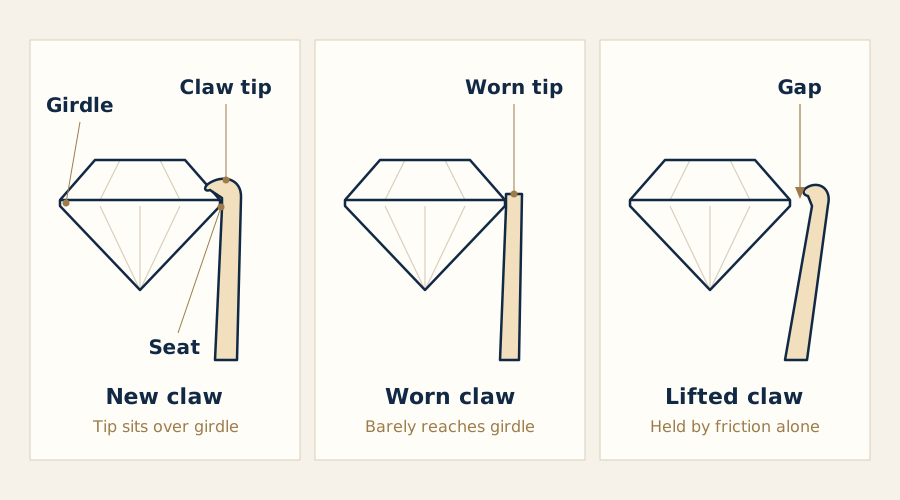
- Worn claws. The most common cause. See when ring claws need retipping.
- A knock. One hard hit can bend a claw or open a channel wall.
- A bent band. When a ring goes out of round, the seats holding small stones open. See why rings go out of round.
- Worn beads in pavé. Each tiny bead holds two stones, so one worn bead can release both. See pavé settings explained.
- A thin band. A band worn thin underneath flexes, and the setting flexes with it.
What is done to the setting before the new stone goes in?
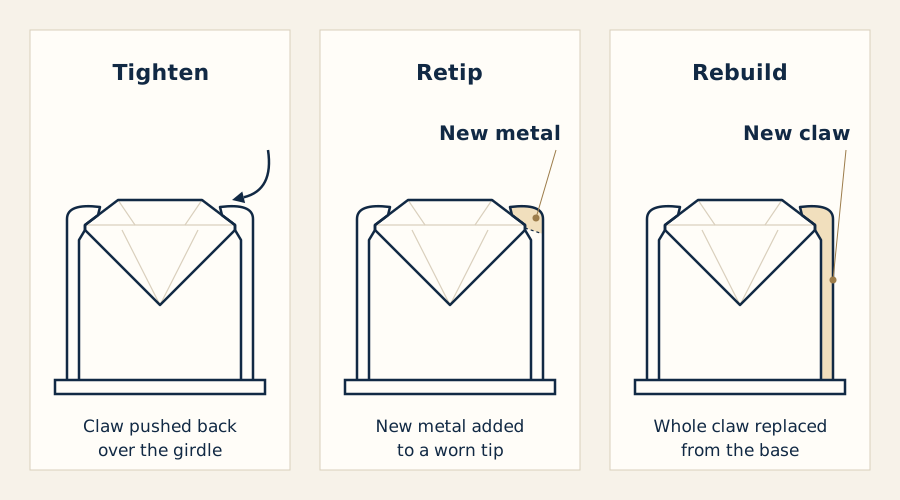
A new stone in a worn setting will be lost again. So the setting is repaired first, and how depends on how the stone was held.
- Claw settings: the worn or bent claws are retipped or replaced. See claw retipping.
- Pavé and bead settings: new beads are raised from the metal to hold the stone.
- Channel settings: the channel wall is rebuilt where it has worn or spread.
- Bezel settings: the rim is built up and burnished back over the stone.
- Flush (gypsy) settings: the seat is re-cut and the metal pressed over the edge of the stone.
- Tension and bar settings: assessed case by case, because the band itself holds the stone.
- Pearls and glued stones: the peg is checked or replaced and the stone fixed with the correct adhesive.
Not sure what your piece needs?
Bring it in, or send us clear photos, and our gemologist will tell you what needs doing, what can wait and what we would leave alone.
How is a replacement stone matched?
A replacement should disappear into the piece. Under a loupe, a mismatched stone is obvious; to the eye, it shows as one stone that looks dull, dark or bright beside the rest. Matching is gemologist's work.
| What is matched | Why it matters |
|---|---|
| Size in millimetres | The stone has to fill its seat exactly |
| Shape and cut style | Modern and older cuts reflect light differently |
| Colour grade | A whiter or warmer stone stands out in a row |
| Clarity | Close enough that nothing shows to the eye |
| Origin | Natural replaces natural; lab-grown replaces lab-grown |
For diamonds, see the diamond colour scale, diamond clarity grades and lab-grown vs natural diamonds. Older rings often hold old mine or old European cuts, which a modern brilliant will not match: see old mine diamonds and their settings.
Coloured stones are harder. Two sapphires of the same size can differ in hue, tone and saturation, and in whether they have been heated. See gemstone colour grading and heated vs unheated gemstones. We tell you what the replacement is, including any treatment. Please check the lab report before you commit if the stone comes with one.
How much does it cost to replace a lost stone?
There is no single price, because the cost is the stone plus the work, and both vary widely. You get a quote after we have inspected the piece and you have chosen the replacement, and nothing is done until you agree. These are the things that move the price:
- The stone itself. A tiny pavé diamond costs little; a centre stone is priced by its carat weight, cut, colour and clarity. See the diamond price guide.
- Natural or lab-grown. The replacement matches what the piece already holds, and the two are priced very differently.
- The setting repair. Rebuilding the claw, bead or channel that failed is part of the job.
- How many stones. A row that has lost one stone often needs several others tightened.
- The setting style. Pavé and channel settings take more bench time than a single claw-set stone.
- Hard-to-match stones. Old cuts, fancy shapes and coloured gemstones can take longer to source.
For a centre diamond, you can look at replacements with their prices before you visit. Every diamond in our catalogue is listed with its grading report and price.
Look at replacement diamonds
If the piece is covered by insurance, the insurer may need a written quote: see insurance jewellery replacement.
How long does replacing a lost stone take?
Allow up to 5 weeks. Many jobs are finished much sooner, and some simple ones take a day or two. The time depends on the work itself, the metal, and whether a stone or a part has to be sourced.
We confirm the time for your piece with the quote, before any work begins. If you need it back for a date, tell us when you book and we will tell you honestly whether it can be done.
A common size of small diamond is quick to match. A large centre stone, an old cut or a coloured gemstone that has to be matched by eye can take longer to find.
What do GemTrove customers say?
These are Google reviews from GemTrove customers, quoted word for word.
5.0 on Google
★★★★★
“We got the sizing dramatically wrong and Raj was patient… He had it fixed quickly and delivered an excellent ring.”
Richard L.
Google review · ring sizing corrected
★★★★★
“… His prompt communication and willingness to help made what could have been a stressful situation completely hassle-free. The craftsmanship, attention to detail, and level of care provided by Neeraj and the Gemtrove team exceeded my expectations. …”
Seno R.
Google review · engagement ring
★★★★★
“… Trusts isn't something that can be written in a few words, it is something to be earned. Buying something with not only high monetary value but of sentimental value depends on a lot of trusts. …”
Whiz
Google review · anniversary ring upgrade
★★★★★
“… His deep knowledge of diamonds and the do's and don'ts of ring design was invaluable. … The craftsmanship and attention to detail are outstanding, and the rings turned out even more beautiful than we imagined. …”
Tanveer D.
Google review · engagement and wedding rings
★★★★★
“Raj is very friendly and knowledgeable on all things diamonds. I went to him to make an engagement ring for me after seeing all his positive reviews. He helped me design the perfect ring. He listened to everything I was looking for and gave me great advice along the way.”
The Adsta
Google review · engagement ring
Read all GemTrove reviews on Google
What happens from drop-off to pick-up?
- Book a visit. Book an appointment and bring the piece. If you found the stone, bring it in a small sealed bag.
- We inspect. The empty seat, the claws or beads around it, the neighbouring stones and the band are checked under magnification.
- We identify what is needed. The stones still in the piece are measured and graded so the replacement can be matched.
- You choose and approve. We show you the options, explain the setting repair, and give you a quote. Nothing starts until you agree.
- The setting is repaired. Worn claws, beads or channel walls are rebuilt first.
- The stone is set. The replacement is seated and secured, and every other stone is tested.
- You collect it. The piece is cleaned and polished, and you are told what was done and what to watch.
After a centre stone has been replaced, the paperwork for the ring is out of date. See how often to revalue jewellery and our jewellery and diamond valuation service.
What if you found the stone?
Bring it. A stone that has been found can usually go back in, and that is the simplest outcome. Before it is reset we check it for chips, because a stone that has hit a tiled floor or been through a vacuum cleaner may have damage along its edge. See diamond cavities and chips.
If the stone is chipped, it may still be usable with the chip hidden under a claw, or it may be better repolished: see our gemstone and diamond repair service. Do not glue a stone back in. Glue does not hold, and it has to be cleaned out of the setting before the proper repair can be done.
What can we not do, and when would we advise against it?
- Promise an identical stone. A diamond can be matched very closely. A rare coloured gemstone can only be matched as nearly as the market allows, and we will show you the difference before you decide.
- Set a stone into a worn-out setting. If the head or channel is past repair, it is remade first. Setting into it would be taking your money for a repair that will not last.
- Swap origin without telling you. A natural diamond is replaced with a natural diamond unless you ask otherwise, and the invoice says which it is.
- Guess at an unknown stone. If we cannot be sure what the other stones are, they are tested before a match is sourced. See natural, synthetic and simulant gemstones.
When a piece has lost stones more than once, a different setting may protect them better than another repair. See bezel vs claw settings and channel-set diamonds and their repairs, or our jewellery remodelling service.
Where can you have a lost stone replaced in Melbourne?
At our showroom on Swanston Street, opposite Melbourne Town Hall. GemTrove has been in business since 2008 and our family has been in the jewellery trade since 1984. A replacement is quoted once we have seen the piece and you have chosen the stone; we do not quote a price over the phone. Allow up to 5 weeks; many jobs are ready sooner, and some take a day or two.
- Showroom: Unit 903/125 Swanston St, Melbourne VIC 3000 (Level 9), opposite Melbourne Town Hall, by appointment.
- Hours: Monday to Friday 9:30 am to 5:30 pm, Saturday 11:30 am to 1:00 pm, Sunday closed.
- Phone: 0488 878 000.
- Book: book a visit. Bring the piece, the stone if you found it, and any valuation or grading report.
Free consultation
Talk to a gemologist
Compare stones in person or online with Raj Sood, Graduate Gemologist (GIA), AJP (GIA).
Book a consultationShop this shape
FAQ
Common questions
How much does it cost to replace a diamond that fell out of a ring?
It depends on the size and quality of the diamond, whether it is natural or lab-grown, and how much setting repair is needed. GemTrove quotes after inspecting the ring, and nothing is done until you agree.
Can you replace a missing diamond in a ring?
Yes. We match the replacement to the other stones by size, cut, colour and clarity, repair the setting that let the stone go, and set the new stone.
How long does it take to replace a lost stone?
Allow up to 5 weeks. Many jobs are finished much sooner, and some simple ones take a day or two. We confirm the time with your quote, before any work begins.
Will the new stone match the others?
For diamonds, very closely: we match millimetre size, cut style, colour and clarity. Coloured gemstones vary more from stone to stone, so we show you the match before it is set.
Can a lab-grown diamond replace a natural one?
Only if you ask for that. We replace like with like, and the invoice states whether the stone is natural or lab-grown. See lab-grown vs natural diamonds.
Is a lost stone covered by insurance?
It depends on your policy. Some home and contents policies cover it, some only when the item is listed separately. See how jewellery insurance works in Australia.
Can you replace a stone in jewellery from another jeweller?
Yes. We work on pieces from any jeweller. We check the metal and identify the existing stones first, so the replacement and the repair suit the piece.
Can you replace a small diamond that fell out of my wedding band?
Yes. The replacement is matched to its neighbours by size, colour and cut, and the setting is repaired first so it stays in.
Terms in this guide

Ask a gemologist
Not sure whether to repair, restore or remake?
Raj Sood is a Graduate Gemologist (GIA) who works alongside our master jewellers. Bring the piece in and he will tell you honestly what it needs, what it does not, and what we would advise against.
Keep learning
Related guides
 Care, Repairs & RemodellingLoose Stones and Stone Tightening
 Care, Repairs & RemodellingWhen Do Ring Claws Need Retipping?
 Buying Knowledge & Custom ProcessHow Jewellery Insurance Works in Australia
 Buying Knowledge & Custom ProcessDiamond Buying Guide
 Engagement Rings & SettingsBest Settings for Old Mine Diamonds
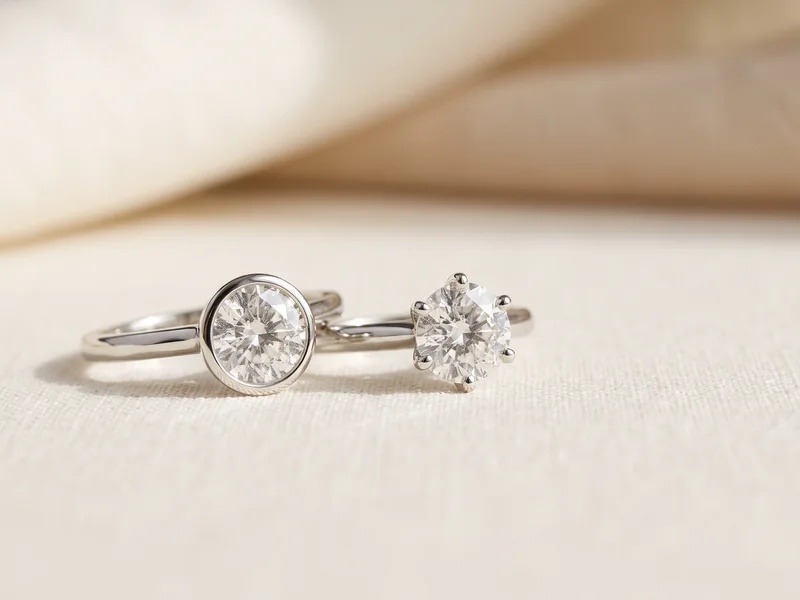 Engagement Rings & SettingsBezel vs Claw Settings for Everyday Wear
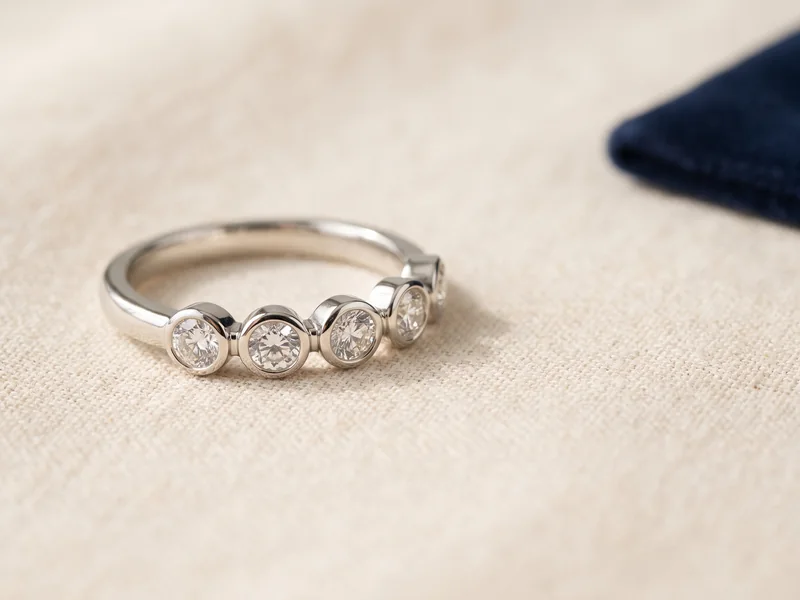 Engagement Rings & SettingsChannel-Set Diamonds: Pros, Cons and Repairs
 Care, Repairs & RemodellingClaw Retipping Melbourne
Explore more
More guides on this topic
Education