
- Education
- Diamond 4Cs & Grading
- Diamond Inclusions: The Complete Australian Guide
Diamond 4Cs & Grading
Diamond Inclusions: The Complete Australian Guide
Almost every diamond has inclusions, and the clarity grade on the report is built entirely around them. Knowing which diamond inclusions matter, and which you will never see, is how you avoid paying for perfection nobody can see.
 Reviewed by Raj Sood, Graduate Gemologist (GIA), AJP (GIA)Master jeweller and Graduate Gemologist (GIA) · reviewed 4 November 2026
Quick answer
Diamond inclusions are tiny internal features, such as crystals, feathers, clouds and pinpoints, most of which formed while the diamond grew. They decide the clarity grade from Flawless to I3. Most are invisible without 10× magnification; what matters is size, position and type. An eye-clean VS2 or SI1 usually looks identical to a Flawless stone face-up.
What are diamond inclusions?
An inclusion is any feature inside a diamond: a tiny trapped crystal, a hairline fracture, a cluster of specks or a twist in the crystal's growth. A blemish is the surface equivalent, such as a scratch, a polish line or a small chip. Together they are called clarity characteristics, and they set the clarity grade, one of the four Cs of diamond grading.
Most natural diamonds formed between about 1 and 3.5 billion years ago, roughly 150 to 200 kilometres below the surface, and other minerals often get caught up as the crystal forms. Laboratory-grown diamonds grow in weeks, and they pick up their own kinds of inclusions from the growth process. Either way, a diamond with no inclusions visible at 10× is rare, and it is priced accordingly.
Inclusions are not a flaw in the everyday sense. Most are smaller than a grain of fine sand, sit deep inside the stone and have no effect on how it looks or wears. A gemmologist's job is to tell you which ones are cosmetic, which could affect sparkle and the few that could affect durability. If any of the terms here are new, our jewellery glossary defines them in plain English.
What are the main types of diamond inclusions?
Graders use a fixed vocabulary, and the same names appear on the plot of every GIA or IGI report. These are the types of diamond inclusions you will meet most often:
| Inclusion | What it is | Usually visible to the eye? | Durability concern? |
|---|---|---|---|
| Pinpoint | A single tiny crystal, seen as a white or dark dot | No | No |
| Cloud | A cluster of pinpoints; large ones can look hazy | Only if large or dense | No |
| Crystal | A mineral grain trapped inside, such as garnet, olivine or another diamond | Sometimes, if large or dark | Rarely |
| Needle | A long, thin crystal like a fine rod | Rarely | No |
| Feather | A small fracture, white and wispy when seen side-on | Sometimes, if large | Yes, if large or reaching the surface |
| Knot | A crystal that reaches the polished surface | Sometimes | Some, at the surface |
| Cavity | An opening left where a crystal broke out during polishing | Sometimes | Can collect dirt |
| Twinning wisp | A ribbon of pinpoints, clouds or crystals along a growth plane | Rarely | No |
| Internal graining | Faint lines or haze from uneven crystal growth | Rarely | No |
| Bearding | Hair-like feathers along the girdle from the shaping process | Rarely | Only if heavy |
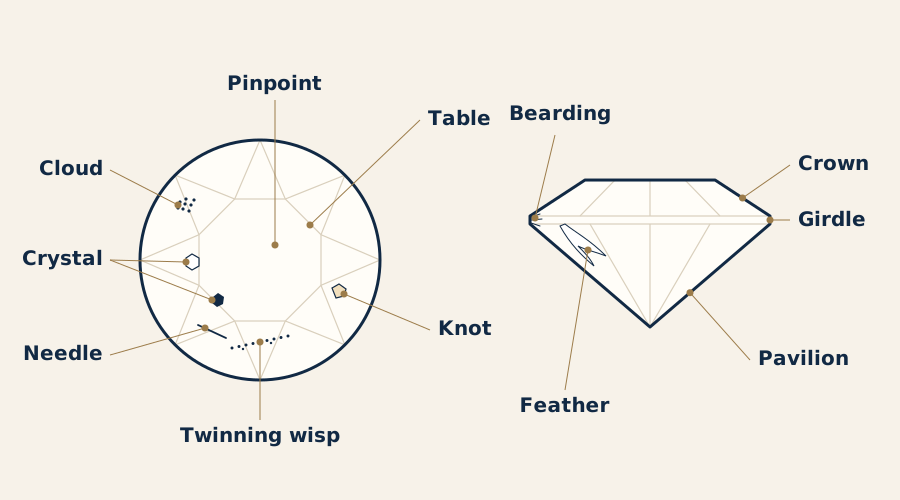
Each type has its own guide. Pinpoints and cloud inclusions are the most common and the least concerning, unless a cloud is large enough to dull the light. Crystal inclusions vary most: a clear diamond crystal can be nearly invisible, while a dark one stands out. Needle inclusions are long and fine, and knots matter mainly because they reach the surface.
The one most worth understanding is the feather. Our guide on what a feather inclusion is explains why its size, angle and position decide whether it is harmless or a weak point. Growth-related features such as twinning wisps and internal graining in diamonds are part of how the crystal formed and rarely affect beauty, while bearding around the girdle comes from shaping the stone and is usually tidied away by good polishing.
How do inclusions affect diamond clarity grades?
Clarity is graded face-up, under 10× magnification, by trained graders. The grade describes how easy the inclusions are to see at that magnification, not simply how many there are. GIA's scale has eleven grades:
| Grade | What a grader sees at 10× | To the naked eye |
|---|---|---|
| FL (Flawless) | No inclusions or blemishes | Clean |
| IF (Internally Flawless) | No inclusions; only minor surface blemishes | Clean |
| VVS1–VVS2 | Inclusions extremely difficult to see, even for a grader | Clean |
| VS1–VS2 | Minor inclusions, difficult to somewhat easy to see | Almost always clean |
| SI1 | Noticeable inclusions, easy to see at 10× | Often clean, check each stone |
| SI2 | Noticeable inclusions, very easy to see at 10× | Sometimes visible, especially in larger stones |
| I1–I3 (Included) | Obvious inclusions | Usually visible; may affect brilliance or durability |
The big practical divide is not between VVS and VS, which no one can see without a loupe, but around SI1 and SI2, where some stones are eye-clean (nothing visible from about 25–30 centimetres) and some are not. Our comparison of VS1 and VS2 diamonds side by side shows how small the gap is between neighbouring grades.
Related guideVS1 vs VS2 Diamonds: Can You See the Difference?Are diamond inclusions bad, and which ones actually matter?
Graders weigh five things for each inclusion, and you can use the same checklist:
- Size: the bigger it is, the easier it is to see and the lower the grade.
- Number: one small crystal is very different from dozens of pinpoints spread through the stone.
- Position: an inclusion under the table (the large top facet) is most visible; one near the girdle is often hidden by a claw.
- Nature: whether it is internal, reaches the surface, or is a fracture that could open under a knock.
- Colour and relief: how much it contrasts with the diamond. White and colourless inclusions blend in; dark ones show.
Colour is where many buyers worry. Dark crystals are often graphite, sulphides or other dark minerals, and they stand out against white light. Our guide to whether black inclusions are bad explains when a dark spot is a deal-breaker and when a small one near the edge is fine.
Durability is the other question. Diamond is 10 on the Mohs hardness scale, so it resists scratching, but it can still cleave along its crystal planes if struck hard. A large feather that reaches the surface near the girdle or a point is the one inclusion to take seriously, especially in a ring worn every day. Most other inclusions have no effect on strength.
Some diamonds are treated to hide inclusions. Laser drilling burns a fine channel to a dark crystal so it can be bleached, and fracture filling injects a glass-like material into feathers. Both must be disclosed. GIA grades laser-drilled stones and notes the drill holes, but does not grade fracture-filled diamonds. This is different from coloured gems: our guide to emerald inclusions and oil treatment explains why emeralds are expected to be included and routinely enhanced.
Not sure which one is right?
Send us the stones you are looking at and our gemologist will tell you which to choose and why.
Do some diamond shapes hide inclusions better?
Yes. Diamond's refractive index of about 2.42 bends light strongly, and in a brilliant cut the many small facets break light into a busy pattern that camouflages small inclusions. Step cuts have long, flat facets arranged like steps, which act like windows into the stone.
| Cut style | Examples | How inclusions show | Typical eye-clean starting point |
|---|---|---|---|
| Brilliant | Round, oval, cushion, pear, heart | Well hidden by sparkle | VS2 to SI1 |
| Modified brilliant | Princess, radiant | Fairly well hidden; watch the corners | VS2 to SI1 |
| Step cut | Emerald, Asscher, baguette | Easy to see through the open table | VS1 to VS2 |
Our guide to the shapes that hide colour and inclusions ranks each shape, and why inclusions show more in emerald cuts explains the step-cut problem in detail. Size matters too: an SI1 at 0.50 carat is usually easier to keep eye-clean than an SI1 at 2 carats, because the inclusions allowed at the same grade are larger in a bigger stone and the table is larger.
How do you read the clarity plot on a diamond report?
A full GIA Diamond Grading Report includes a plot: a map of the diamond face-up and face-down with each clarity characteristic drawn in place. Inclusions are marked in red, surface blemishes in green, and a key lists the types in order of importance. The first item in the key is the one that set the grade.
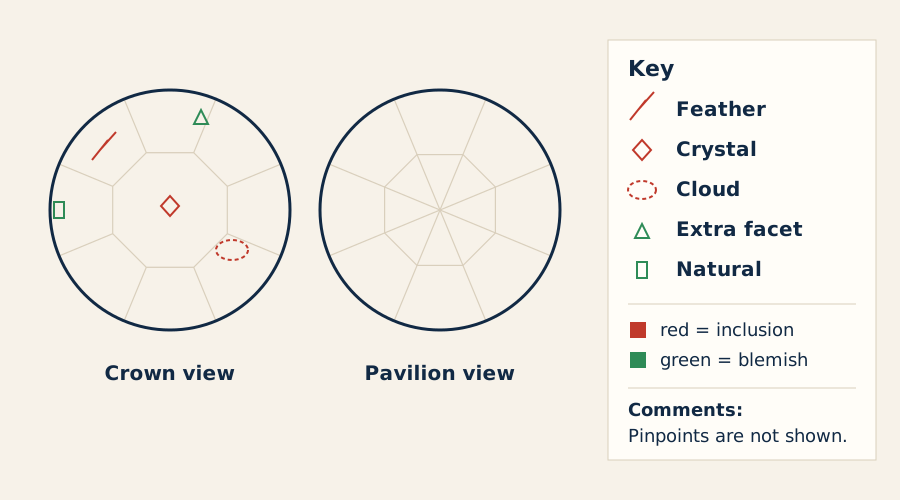
Read the comments line as well. Phrases such as "pinpoints are not shown" or "additional clouds not shown" mean there are more features than the drawing suggests, which matters if you are checking for haziness. IGI reports, common for lab-grown diamonds, use a similar plot. Plots exaggerate size so features are legible, so always pair the plot with a magnified photo or video.
Do lab-grown diamonds have inclusions?
Yes. Laboratory-grown diamonds are real diamond, and labs such as IGI grade them on the same FL to I3 scale, but their inclusions come from the growth method rather than from the Earth. That is one of the ways gemmological labs tell them apart.
| Natural diamond | HPHT lab-grown | CVD lab-grown | |
|---|---|---|---|
| Typical inclusions | Mineral crystals, feathers, clouds, needles | Metallic flux inclusions, pinpoints | Dark pinpoints of non-diamond carbon, growth striations |
| Appearance | Varied; often colourless or white | Dark, metallic, sometimes rod or plate-shaped | Small dark specks, often scattered |
| Other clues | Twinning wisps, natural graining | Large ones can make the stone weakly magnetic | Layered growth structure seen by labs |
| Graded on FL–I3 scale (e.g. IGI)? | Yes | Yes | Yes |
HPHT (high pressure, high temperature) diamonds grow from a molten metal solvent of iron, nickel or cobalt, and small pieces can become trapped. Our guide to metallic inclusions in HPHT lab-grown diamonds shows what they look like. CVD (chemical vapour deposition) stones grow layer by layer from carbon-rich gas and tend to show tiny dark specks. Many lab-grown diamonds on the market grade VS or better, so clean stones are easy to find.
Browse natural and lab-grown diamonds in our stock
Is an SI1 diamond with inclusions worth it?
Often, yes. Because the grade is about what shows at 10×, the price falls with each step down the clarity scale while the stone can look exactly the same to you. In natural diamonds the step is meaningful: for a 1 carat round of around G colour, moving from VS2 to an eye-clean SI1 commonly frees up somewhere in the order of AUD $1,000–$3,000, money many people move into a better cut or a slightly larger stone. In lab-grown diamonds the gap between neighbouring grades is much smaller, often a few hundred dollars, so many buyers simply choose VS.
Where SI1 makes sense: brilliant shapes, stones up to about 1.5 carats, and inclusions that are white, off-centre or near the girdle where a claw can cover them. Where to be careful: step cuts, large stones, dark crystals under the table and feathers near the edge. Our guide on when an SI1 diamond is a smart choice works through real examples.
How to check a diamond's inclusions before you buy: step by step
- Start with the grade and shape. In a brilliant cut, VS2 to SI1 is a sensible range to look at; in a step cut, start at VS1 to VS2.
- Read the plot key. Note the first-listed inclusion, its type and whether it is a feather or knot that reaches the surface.
- Find it on the plot. Is it under the table, or out near the girdle where a claw or bezel could sit over it?
- Check the comments. Look for notes about clouds or pinpoints not shown, or any clarity treatment.
- Watch a magnified video. Look for dark crystals, haze from clouds and white feathers, then view the stone face-up at normal distance.
- Plan the setting around it. Ask your jeweller to orientate the stone so claws cover edge inclusions and protect any feather near the girdle.
Free consultation
Talk to a gemologist
Compare stones in person or online with Raj Sood, Graduate Gemologist (GIA), AJP (GIA).
Book a consultationShop this shape
FAQ
Common questions
Do all diamonds have inclusions?
Nearly all do, natural and lab-grown. Flawless and Internally Flawless stones exist but are rare, and most inclusions in VS and good SI stones are invisible without magnification.
Are diamond inclusions bad?
Most are purely cosmetic and have no effect on how the diamond looks or wears. The ones to watch are large or dark inclusions under the table and large feathers that reach the surface near the girdle or a point.
Can inclusions be removed from a diamond?
Not truly. Recutting can sometimes polish away a surface-reaching inclusion at the cost of weight, and treatments such as laser drilling or fracture filling make inclusions less visible but must be disclosed.
What is the most common diamond inclusion?
Pinpoints and clouds are the most common, followed by small crystals and feathers. They are usually the least concerning types when small.
Do lab-grown diamonds have fewer inclusions?
Many lab-grown diamonds grade VS or better, but they still have inclusions, such as metallic flux in HPHT stones and dark carbon specks in CVD stones. Labs such as IGI grade them on the same clarity scale as natural diamonds.
Can a feather inclusion make a diamond crack?
A small internal feather is very unlikely to cause problems. A large feather reaching the surface near the girdle can be a weak point under a hard knock, so it should be protected by the setting.
Terms in this guide

Ask a gemologist
Not sure which diamond to choose?
Raj Sood is a Graduate Gemologist (GIA) and master jeweller. Bring the stones you are considering, or send the reports, and he will tell you honestly which one is better and why.
Keep learning
Related guides
 Diamond 4Cs & GradingWhat Is a Feather Inclusion in a Diamond?
 Diamond 4Cs & GradingWhat Is a Cloud Inclusion in a Diamond?
 Diamond 4Cs & GradingWhen Can an SI1 Diamond Be a Smart Choice?Diamond 4Cs & GradingAre Black Inclusions Bad in a Diamond?Diamond 4Cs & GradingDiamond 4CsDiamond 4Cs & GradingCrystal Inclusions in Diamonds
 Diamond 4Cs & GradingPinpoint Inclusions in DiamondsDiamond 4Cs & GradingNeedle Inclusions in Diamonds
Explore more
More guides on this topic
Education