
- Education
- Buying Knowledge & Custom Process
- Diamond Prices in Australia: The Complete AUD Guide
Buying Knowledge & Custom Process
Diamond Prices in Australia: The Complete AUD Guide
Diamond prices in Australia are hard to compare because most guides quote US dollars and leave out GST. This guide gives approximate AUD ranges, explains what moves them, and shows how to judge value before you commit.
 Reviewed by Raj Sood, Graduate Gemologist (GIA), AJP (GIA)Master jeweller and Graduate Gemologist (GIA) · reviewed 4 November 2026
Quick answer
Diamond prices in Australia depend mostly on carat, colour, clarity, cut and whether the stone is natural or lab-grown. As an approximate guide, a 1 carat natural round in G–H colour and VS clarity costs about AUD 6,000–14,000 (VS2–SI1), while a comparable lab-grown diamond costs about AUD 700–2,000. The setting adds AUD 1,500–4,000 or more.
What are diamond prices in Australia right now?
Australian retail diamond prices are quoted in Australian dollars and, by law, the shelf price includes 10% GST (Goods and Services Tax). Many online price guides quote US dollars before any tax, which makes local prices look higher than they really are. Before you compare, convert the currency at the day's rate and add the tax and shipping you would actually pay. Our guide to buying overseas versus at home works through those sums.
Diamonds are priced per carat, not per stone. A carat is a unit of weight, 0.2 grams, and the price per carat climbs as the stone gets heavier because large rough crystals are rarer. That is why a 1 carat diamond costs far more than two 0.50 carat diamonds of the same quality. Dealers trade against wholesale price lists quoted in US dollars per carat, so the Australian dollar exchange rate also moves local prices over time.
The ranges in this guide are approximate, for loose round diamonds with an independent grading report and a good to excellent cut. We check them against GemTrove's live stock each month, but they are a starting point, not a quote. If a term is new to you, our jewellery glossary explains it in a sentence.
How much does a 1 carat diamond cost in Australia?
Here is how approximate prices change with size for round brilliants in G–H colour (near-colourless) and VS2–SI1 clarity (small inclusions you normally cannot see without magnification). The millimetre figures are typical face-up diameters for a well-cut round.
| Carat | Typical diameter | Natural (approx. AUD) | Lab-grown (approx. AUD) |
|---|---|---|---|
| 0.30 ct | about 4.3 mm | 800–1,800 | 200–600 |
| 0.50 ct | about 5.1 mm | 1,800–4,000 | 300–900 |
| 0.70 ct | about 5.7 mm | 3,000–6,500 | 500–1,300 |
| 1.00 ct | about 6.4 mm | 6,000–14,000 | 700–2,000 |
| 1.50 ct | about 7.3 mm | 12,000–25,000 | 1,200–3,000 |
| 2.00 ct | about 8.1 mm | 20,000–45,000 | 1,800–4,500 |
| 3.00 ct | about 9.3 mm | 45,000–110,000 | 3,000–8,000 |
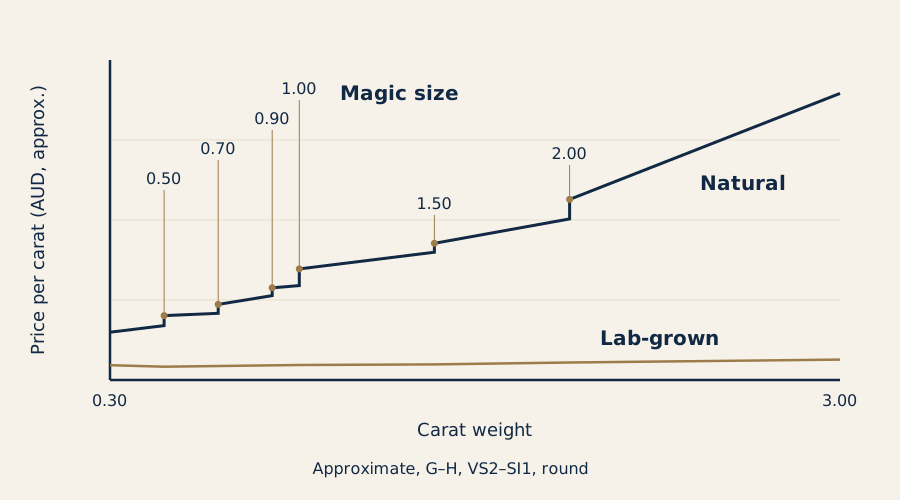
Notice the steps. Prices jump at the so-called magic sizes: 0.50, 0.70, 0.90, 1.00, 1.50 and 2.00 carats. Demand clusters at round numbers, so a 0.90–0.95 carat stone often costs noticeably less than a 1.00 carat stone, yet it is only about 0.1–0.2 mm smaller across, a difference nobody can see on the hand.
Size also grows more slowly than weight. Going from 1 to 2 carats doubles the weight but adds only about 1.7 mm to the diameter, because the extra weight spreads through the depth as well as the width.
How do colour, clarity and cut change the price?
After carat, the other three Cs set the price. Colour is graded from D (colourless) to Z (light yellow or brown). Clarity runs from Flawless to I3 and describes internal features called inclusions. Cut grades how well the facets return light; for rounds, GIA grades it from Excellent to Poor.
| Factor | Grade range | Effect on price | Gemmologist view |
|---|---|---|---|
| Colour | D–F colourless | Highest premium | Hard to tell apart from G once set |
| Colour | G–H near-colourless | Middle of the market | Looks white in white gold or platinum |
| Colour | I–J | Noticeably lower | Often looks white in yellow or rose gold |
| Clarity | FL–VVS2 | Strong premium | Differences only visible under 10× magnification |
| Clarity | VS1–SI1 | Good value range | Usually eye-clean; check each stone |
| Clarity | SI2–I1 | Much lower | Inclusions may be visible; look carefully |
| Cut | Excellent / Very Good | Pays for itself | Drives sparkle more than any other C |
| Fluorescence | Medium–strong blue | Natural stones often trade lower | Rarely visible; occasionally looks hazy |
The gemmologist view: spend on cut, and save on colour and clarity. An eye-clean stone, one with no inclusions you can see at normal viewing distance, is what matters on the hand. Paying for VVS clarity buys a difference only a loupe can find.
Grades are not the whole story. Two stones on paper can look and price differently because of proportions, the position of inclusions, the grading lab and the shade of colour within a grade. We explain this in why two stones with identical 4Cs can differ in price.
Related guideWhy Two Diamonds With the Same 4Cs Can Have Different PricesDo diamond shapes change the price?
Yes. Round brilliants cost the most per carat. Cutting a round from a rough crystal usually loses more of the original weight than cutting an oval, pear or cushion, and rounds are also the most requested shape. Fancy shapes typically cost less per carat than a round of the same weight, colour and clarity.
Elongated shapes such as ovals, pears and marquises also spread their weight over a larger face-up area, so a 1 carat oval can look bigger than a 1 carat round. Emerald and asscher cuts are the exception for clarity: their open, step-cut facets show inclusions more readily, so buyers usually need a higher clarity grade. Our shape-by-shape price comparison sets out typical gaps.
Coloured diamonds follow different rules. For pink, yellow or blue diamonds, the intensity and rarity of the colour outweigh almost everything else, and prices can range from below a white diamond to many times above it. See fancy colour diamond pricing for how those are valued.
Not sure which one is right?
Send us the stones you are looking at and our gemologist will tell you which to choose and why.
Natural vs lab-grown diamond prices in Australia: what is the difference?
A lab-grown diamond (also called laboratory-grown) is real diamond, carbon in the same crystal structure, with the same hardness of 10 on the Mohs scale and the same refractive index of 2.42. It is grown above ground by one of two methods: CVD (chemical vapour deposition, building the crystal layer by layer from carbon-rich gas) or HPHT (high pressure, high temperature, recreating the conditions deep in the earth). Natural diamonds formed deep underground, most of them between 1 and 3.5 billion years ago.
The two look identical to the eye, but they are priced very differently. Lab-grown diamonds cost much less than natural, roughly a tenth to a fifth of the price at 1 carat, and the gap has widened as production capacity has grown. Our breakdown of what drives lab-grown prices down explains why, and the lab-grown diamond price guide for Australia gives detailed AUD ranges by size.
Browse natural and lab-grown diamonds in our stock
In Australia, any lab-grown stone must be clearly disclosed as lab-grown, laboratory-grown or lab-created, and its report should say so. The ACCC rules on lab-grown wording cover what sellers can and cannot say. Neither choice is wrong: natural diamonds are rare and formed by nature; lab-grown diamonds give more size for the money. Choose the one that suits what matters to you.
What does a finished engagement ring cost in Australia?
The diamond is usually the largest part of the price, but the setting matters too. A setting is the metal part that holds the stone: the band, the head and the claws.
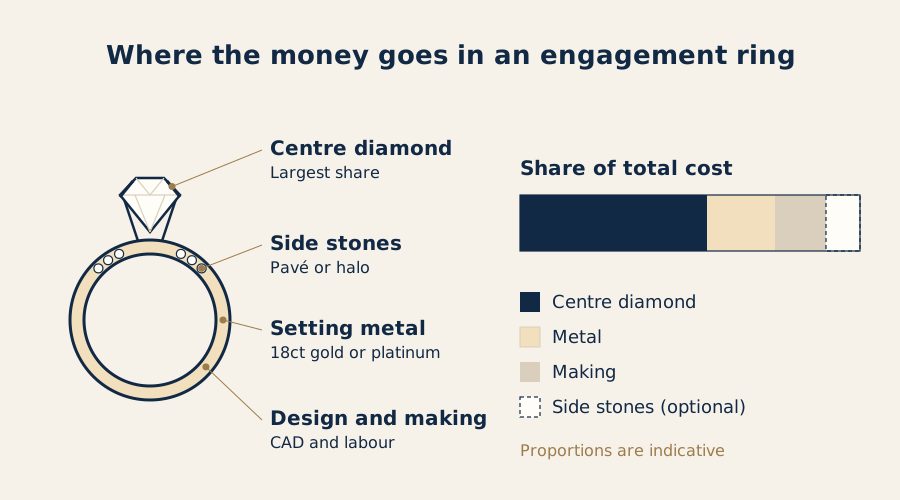
- Plain solitaire, 18ct gold: about AUD 1,500–3,000 for the setting alone.
- Solitaire in platinum: usually AUD 500–1,500 more than 18ct gold, because platinum is denser and harder to work.
- Pavé or shoulder-set band: about AUD 2,500–5,000, depending on how many small diamonds are set.
- Halo: about AUD 3,000–6,000; the ring of small diamonds adds both stones and labour.
- Custom design: priced on the design; CAD modelling lets you see the ring before it is made.
Metal prices move daily. 18ct gold is 75% pure gold, so a rise in the world gold price feeds straight into ring prices; our guide on how the gold price feeds into ring prices explains the maths. Heavier bands and larger heads use more metal and cost more.
Ring size also affects cost a little. Australia uses letter sizes from A to Z, with half sizes, the same system as the UK and different from US numbers. Larger sizes use more metal, and a fully set eternity band cannot easily be resized later. Check your size with our Australian letter ring sizes chart before ordering.
Is it cheaper to buy a diamond overseas?
Sometimes the sticker price is lower, but the comparison is rarely like for like. Imported goods valued above AUD 1,000 attract 10% GST at the border (lower-value goods are usually taxed by the seller), and jewellery may also attract customs duty unless a free trade agreement applies. Add insured shipping, currency conversion fees and broker charges, and the gap often narrows or disappears.
| Cost or protection | Buying in Australia | Buying overseas |
|---|---|---|
| Price shown | AUD, includes 10% GST | Often USD, usually before tax |
| GST | Already included | 10% collected at the border or by the seller |
| Duty | None extra | May apply to finished jewellery |
| Shipping and insurance | Usually none | Insured courier, often AUD 50–200 |
| Currency | No conversion | Exchange rate plus card fees |
| Consumer protection | Australian Consumer Law | Depends on the country |
| Resizing and repairs | Done locally | Return shipping or a local jeweller |
The other cost is risk. Seeing the actual stone, or at least a 360° video and the grading report, matters more than a small price difference. If the report number does not match the inscription on the girdle, you are not buying the stone you think you are.
Do diamonds hold their value?
Not in the way shares or property might. Retail prices include cutting, grading, setting, the retailer's costs and GST, and a buyer offering to purchase a diamond from you will usually pay well below what you paid. Natural diamonds generally have a resale market; lab-grown diamonds have very little, because new lab-grown stones keep getting less expensive. Buy a diamond because you will love wearing it, not as a financial asset.
Value for insurance is different again. An insurance valuation usually states the replacement value, what it would cost to replace the ring new at retail, which is often higher than the price you paid. Read the policy carefully: some insurers replace rather than pay out cash. Our guide to how jewellery insurance works here covers what to ask.
How to set a diamond budget: step by step
- Start with a number you are comfortable with. Ignore the old three-month salary rule; it began as advertising. Our guide on how much to spend on an engagement ring offers more realistic ways to decide.
- Decide together, or not. Many couples now shop as a pair; see choosing the ring together. If you want a surprise, a proposal ring first lets your partner choose the final design.
- Split the budget. Set aside about AUD 1,500–4,000 for the setting, then work out what is left for the diamond.
- Choose natural or lab-grown. At the same budget, lab-grown gives a larger stone; natural gives rarity. Both should come with an independent report.
- Prioritise cut, then size. Pick Excellent or Very Good cut, then find the weight just under a magic size, such as 0.90 instead of 1.00 carat.
- Relax colour and clarity. G–H and an eye-clean VS2 or SI1 usually look the same as higher grades once set.
- Confirm the ring size and the total. Check the letter size, the metal, any resizing costs and insurance. Our full engagement ring buying guide pulls every step together.
Free consultation
Talk to a gemologist
Compare stones in person or online with Raj Sood, Graduate Gemologist (GIA), AJP (GIA).
Book a consultationShop this shape
FAQ
Common questions
How much is a 1 carat diamond in Australia?
As an approximate guide, a 1 carat natural round in G–H colour and VS–SI clarity costs about AUD 6,000–14,000. A comparable lab-grown diamond costs about AUD 700–2,000. Cut quality, the grading lab and fluorescence move the price within those ranges.
Do Australian diamond prices include GST?
Yes. Australian retail prices must include the 10% GST. Overseas prices are often shown before tax, so add GST and shipping before comparing.
Why are lab-grown diamonds so much less expensive?
Lab-grown diamonds can be produced to order, and production capacity has grown quickly, so supply is not limited the way natural diamond supply is. They are real diamond, simply grown in a laboratory rather than mined.
Is a 0.90 carat diamond better value than a 1 carat?
Often, yes. Prices step up at 1.00 carat, so a 0.90–0.95 carat stone can cost noticeably less while looking almost the same size, only about 0.1–0.2 mm smaller across.
Can you resell a diamond for what you paid?
Usually not. Resale offers are typically well below the retail price, and lab-grown diamonds have little resale market, so choose a diamond for the pleasure of wearing it rather than for money.
What ring sizes are used in Australia?
Australia uses letter sizes from A to Z with half sizes, the same as the UK. US sizes use numbers, so convert carefully if you are comparing overseas listings.

Ask a gemologist
Not sure which diamond to choose?
Raj Sood is a Graduate Gemologist (GIA) and master jeweller. Bring the stones you are considering, or send the reports, and he will tell you honestly which one is better and why.
Keep learning
Related guides
 Buying Knowledge & Custom ProcessLab-Grown Diamond Price Guide Australia
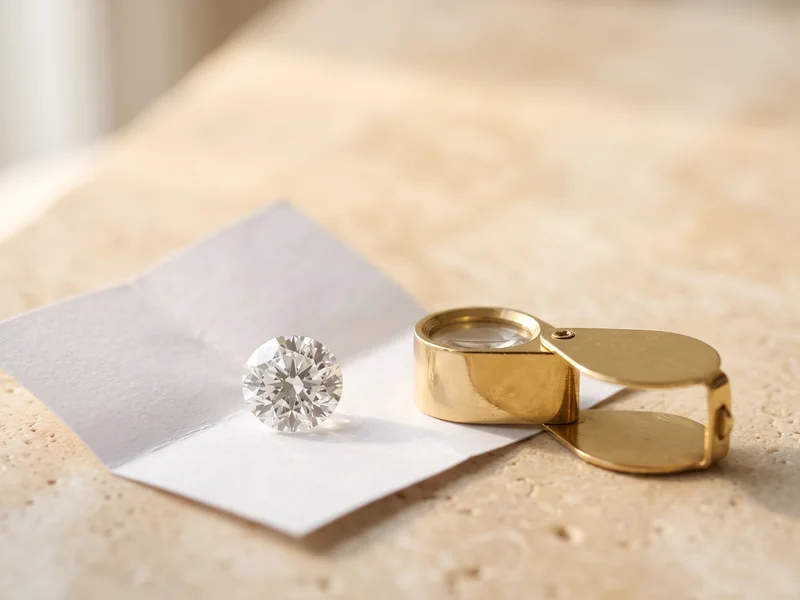 Buying Knowledge & Custom ProcessBuying a Diamond Overseas vs in Australia
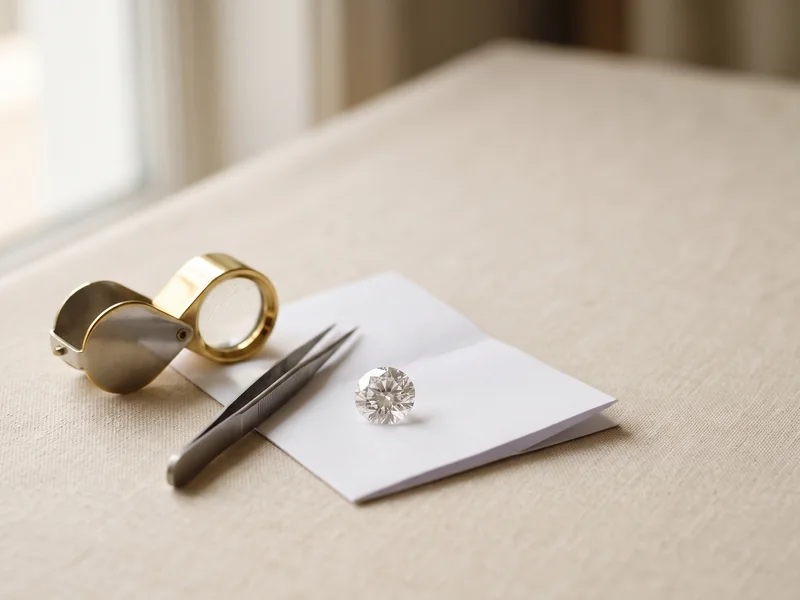 Buying Knowledge & Custom ProcessHow Much Should You Spend on an Engagement Ring?
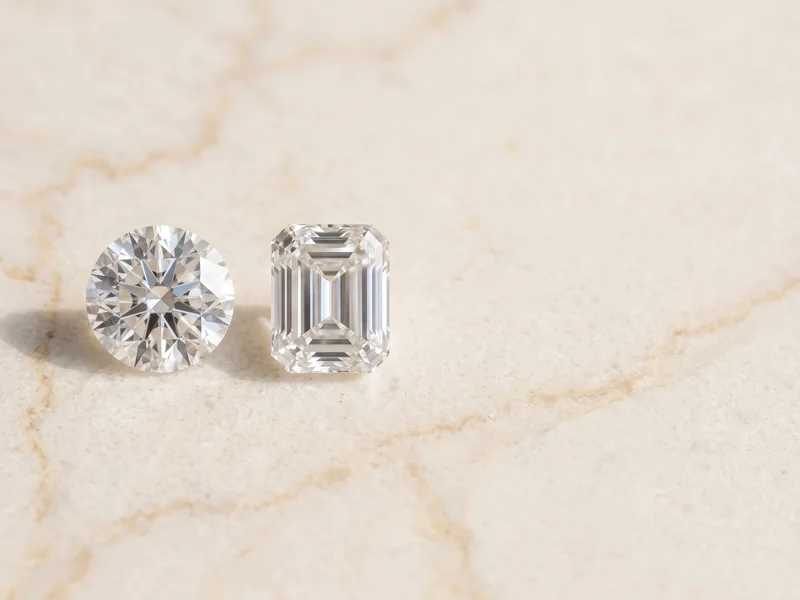 Diamond ShapesDiamond Shape Price ComparisonBuying Knowledge & Custom ProcessEngagement Ring Buying Guide
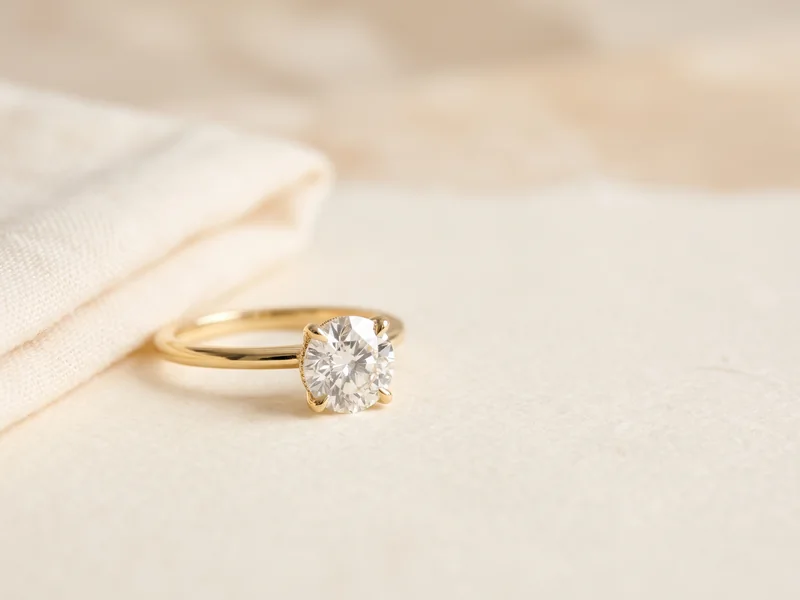 Buying Knowledge & Custom ProcessRing Size Guide Australia
 Buying Knowledge & Custom ProcessWhy Two Diamonds With the Same 4Cs Can Have Different PricesBuying Knowledge & Custom ProcessHow Jewellery Insurance Works in Australia
Explore more
More guides on this topic
Education