
- Education
- Care, Repairs & Remodelling
- Loose Stone in Ring: How to Check It, Tighten It and Prevent It
Care, Repairs & Remodelling
Loose Stone in Ring: How to Check It, Tighten It and Prevent It
Finding a loose stone in ring claws is unsettling, but it is one of the most common jewellery repairs and usually simple to fix if caught early. Here is how to spot one, what not to do, how often to have stones checked and what a jeweller actually does at the bench.
 Reviewed by Raj Sood, Graduate Gemologist (GIA), AJP (GIA)Master jeweller and Graduate Gemologist (GIA) · reviewed 4 November 2026
Quick answer
A loose stone in a ring usually shows as a faint rattle, a stone that turns or tilts, a claw that catches on fabric or a gap under a claw tip. Stop wearing the ring, store it safely and have a jeweller check it. Tightening sound claws is quick and usually inexpensive; badly worn claws need retipping or rebuilding.
Why does a stone come loose in a ring?
Gemstones do not shrink or loosen by themselves. What changes is the metal holding them. Every stone in a ring sits in a seat (a small ledge cut into the metal so the stone sits level) and is held there by claws (also called prongs), a bezel (a rim of metal pressed over the edge of the stone), the walls of a channel or tiny raised beads of metal. Over months and years that metal wears, bends or fatigues, and the grip relaxes. If any of these words are new, our plain-English jewellery glossary explains them.
In our workshop the same handful of causes come up again and again:
- Everyday wear: claw tips are the highest point of a ring, so they rub against desks, steering wheels, keyboards and gym bars. Gold claws gradually lose thickness. Platinum tends to push and smear rather than wear away as quickly, but it still thins and moves over time.
- Knocks: diamond is 10 on the Mohs hardness scale, but gold and platinum are far softer. One hard knock on a doorframe can bend a claw just enough to open a gap.
- Snagging: a claw that catches on knitwear, hair or a towel gets lifted a fraction each time.
- Resizing and bending: changing the size flexes the band and can distort the head that holds the stone. For larger fit problems, sizing beads or sizing bars can be gentler on the setting than a big resize.
- A thin band: once the underside of a ring wears thin it flexes in daily wear, and that movement travels up to the setting.
- The original setting: if the seat was not cut evenly, the stone can rock from day one, and the claws work loose faster.
Rings with more stones have more places to go wrong. Side-stone engagement rings and three-stone ring designs have several sets of claws to watch, and the small side stones are the ones most often lost because nobody notices them go. In a two-stone ring, setting both stones at a similar height matters for security as well as looks, which is part of balancing the two stones in a toi et moi. Full eternity rings take wear on the stones underneath the finger too; our guide to eternity ring stone sizes in points explains how stone size affects how thin the metal between them becomes.
| Setting type | How it usually loosens | Early warning sign |
|---|---|---|
| Four-claw solitaire | Claw tips wear thin or one claw bends | Stone tilts, clicks or a claw catches |
| Six-claw solitaire | Same as four-claw, but losing one claw is less critical | Stone turns slightly in the claws |
| Bezel | Rim wears thin or lifts after a knock | Hairline gap or a dark dirt line at the edge |
| Pavé | Tiny metal beads wear flat | Sparkle changes, then a small dark hole |
| Channel | Channel walls spread when the band bends | Stones shift sideways or gaps appear |
| Tension | Band springs open if bent | Stone moves at all; return it to the maker |
How can you tell if you have a loose stone in your ring?
Most loose stones give a warning before they fall out. The trick is noticing it. Look for any of these:
- A rattle or click: hold the ring next to your ear and tap it gently with a fingernail. A secure stone is silent.
- Movement: press the stone gently with a wooden toothpick from a few directions. It should not turn, rock or sink.
- Catching: a claw that suddenly snags on clothing has usually lifted or worn to a sharp edge.
- A gap under a claw: if you can see light between the claw tip and the stone, the claw no longer grips.
- Flat or thin claw tips: a healthy tip is rounded and sits over the girdle (the outer edge of the stone). A worn tip looks flat, shiny and short.
- The stone looks different: sitting higher, lower, crooked or off-centre compared with photos from when it was new.
- Dark spots in pavé or channel work: a missing small stone often shows as a little black hole.
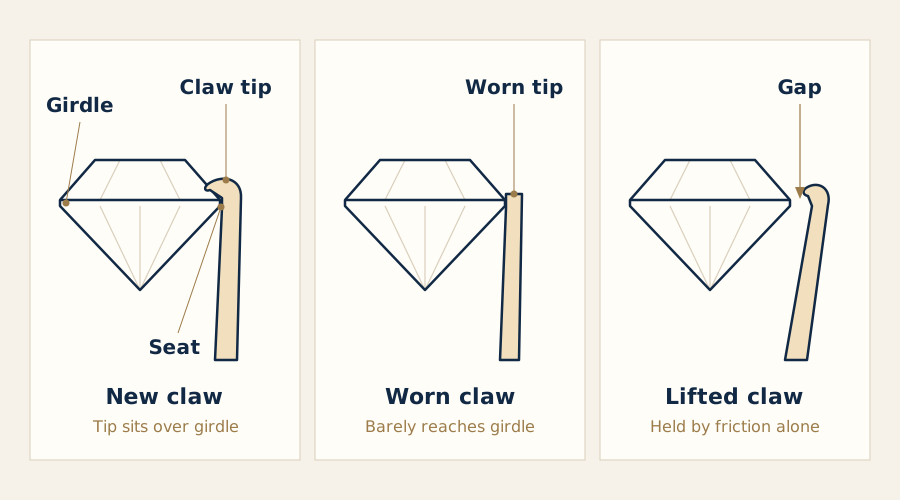
A 10× loupe is the standard magnification jewellers use, and it is cheap to buy. Your phone camera's zoom also works well: take a close photo of each claw from the side and compare the tips with each other. One tip that looks much smaller than its neighbours is the one to point out to your jeweller. Keeping a few clear close-ups from when the ring was new makes later changes much easier to spot, and it is one of the simple habits in our everyday jewellery maintenance routine.
What should you do if you find a loose stone in your ring?
Take the ring off straight away and put it in a small hard box or a sealed zip bag. Do not wear it "just for today". A claw that has started to move can let go completely with one more knock, and diamonds are very hard to find once they are on the floor, in a car or down a drain.
If the stone has already come out, check your clothing, bag and the area you have been in, and do not run the sink until you have checked the trap. If you find it, keep it in a sealed bag rather than loose. If it is lost and the ring is insured, contact your insurer promptly, because most policies set time limits for claims.
Just as important is what not to do:
- Do not push the claws yourself. Pliers or a fingernail can crack an old claw, chip the girdle of the stone or leave it sitting crooked.
- Do not use superglue. It fills the seat, traps dirt, hides the real damage and has to be dissolved before a jeweller can repair the ring properly.
- Do not put it in an ultrasonic cleaner. The vibration that shakes dirt loose can also shake a loose stone out. Ultrasonic cleaning is also unsafe for emeralds, opals, pearls and many treated gems; check which gems can safely go in an ultrasonic cleaner before you use one at all.
- Do not wrap it in tissue. Rings wrapped in tissue are often thrown out by accident.
- Do not leave it for later. Tightening is quick; replacing a lost stone is not.
A stone that moves now and then is the cheapest problem to fix. The same ring with a missing stone becomes a much larger job.
How does a jeweller tighten a loose stone?
At the bench the job starts with inspection, not cleaning. Under a loupe or microscope, the jeweller checks every claw, the seat and the stone itself, and tests each stone with tweezers. Only then is the ring cleaned, gently, so dirt does not hide wear and a loose stone is not shaken out.
What happens next depends on the setting:
- Claws: each claw is pressed back over the girdle with a setting pusher or setting pliers, a little at a time and in opposite pairs, so the stone stays centred and level.
- The seat: if the stone rocks, the seat may be recut with a small bur so the stone sits flat before the claws are closed.
- Bezels: the rim is worked back over the edge with a burnisher or a hammer handpiece, then smoothed.
- Pavé: worn beads are pushed back over the stone, or new metal is added and fresh beads raised.
- Channels: the channel walls are carefully closed so every stone is gripped again, often after checking the band has not bent.
Finally the claws are smoothed so nothing snags, the ring is polished and every stone is checked again under magnification. A sound tightening job leaves claw tips rounded, even and sitting firmly on the stone.
When metal needs to be added, as in retipping or rebuilding a claw, the jeweller uses either a torch and solder or a laser welder. A laser focuses heat into a tiny spot, so many claw repairs can be done with the stone left in place. Torch work near heat-sensitive gems such as emerald, opal, tanzanite or pearl means removing them first, and many jewellers also unset diamonds with surface-reaching inclusions before using a torch.
Not sure which one is right?
Send us the stones you are looking at and our gemologist will tell you which to choose and why.
Tightening, retipping or rebuilding: which repair does your ring need?
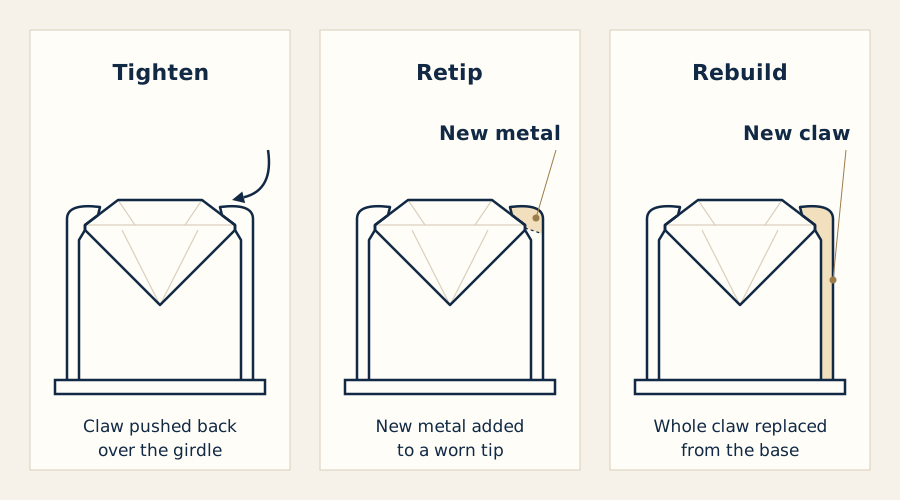
Tightening only works if there is enough healthy metal left to push. As a rough rule, once a claw tip has worn to around half its original thickness, pushing it over will only buy a short time, and new metal is needed. The choice usually looks like this:
| Repair | What it involves | When it's needed | Approximate cost (AUD) |
|---|---|---|---|
| Check and tighten | Claws pushed back, seat checked, polished | Claws sound but the stone moves | about $30–$80 |
| Retipping | New metal added to the top of each worn claw | Tips thin or flat, claw body still sound | about $50–$120 per claw |
| Rebuilding a claw | Whole claw replaced from the base | Claw cracked, broken or worn right down | about $80–$200 per claw |
| New head (setting) | The complete claw basket replaced | Several claws worn or broken | about $200–$600+ |
| Pavé or channel stone reset | Beads or walls reworked, stones reset | Small stones loose or missing | about $40–$150 per stone, plus any replacement stone |
Platinum work and large stones usually sit at the upper end of these ranges, and prices depend heavily on the ring, so always ask for a quote after inspection. If the band itself has worn thin, a setting repair alone will not last; replacing the worn band with a new shank fixes the flex that loosens stones. On white gold, claw work removes some of the rhodium plating (a thin bright-white coating), so the ring is usually replated afterwards; our rhodium replating timetable explains how often that is needed anyway.
If a stone has been lost, you can replace it with a matching stone or use the repair as a chance to trade up to a larger or better diamond. Our guides to having a new diamond set into the ring you already own and reading a loose diamond tweezer video before you choose walk through that process. Natural and lab-grown diamonds are set and repaired in exactly the same way, so either can go back into the original setting.
Which gemstones and settings are most at risk of coming loose?
Hardness (resistance to scratching, on the Mohs scale of 1 to 10) is only part of the story. Toughness, how well a stone resists chipping and cracking, matters just as much when a claw lifts and the edge of the stone is exposed. Softer or brittle gems also limit how much force and heat a jeweller can use when tightening.
| Stone | Mohs hardness | What it means for setting and repair |
|---|---|---|
| Diamond (natural or lab-grown) | 10 | Very hard but can chip at the girdle if a claw gap lets it take knocks |
| Sapphire and ruby (natural or lab-created) | 9 | Durable and tolerant; lead-glass-filled rubies are heat-sensitive |
| Emerald | 7.5–8 | Often oiled and usually included; no ultrasonic, steam or torch heat |
| Aquamarine and morganite | 7.5–8 | Fairly durable; claws need checking as these stones are often large |
| Tanzanite | 6–6.5 | Brittle and heat-sensitive; protective settings suit it |
| Opal | 5.5–6.5 | Soft and heat-sensitive; doublets and triplets must not be soaked |
| Pearl | 2.5–4.5 | Usually glued onto a peg; loosening is glue failure, not claw wear |
Stones that are both soft and set in high, exposed claws are the most vulnerable. For softer gems, a bezel or a lower setting with thicker claws gives far better protection in daily wear. Our guide to caring for each gemstone type covers cleaning and storage for every stone in this table.
How often should you have your ring's stones checked?
For a ring worn every day, have a jeweller check the claws and stones every 6–12 months. If you work with your hands, garden, lift weights or wear the ring constantly, lean towards every six months. Rings worn now and then can go longer, but still deserve a check every year or two.
There are also moments when a check makes sense regardless of the calendar:
- After any hard knock, even if the stone seems fine.
- When a claw starts catching on clothing.
- Before a long holiday, when a lost stone would be hard to sort out.
- Whenever the ring is resized or replated, because the setting is already on the bench.
- When you notice the stone looks dull or dirty underneath, which can hide wear.
Small habits make claws last much longer. Take rings off for the gym, gardening and heavy lifting, and think about whether to sleep or train in your ring at all. Chlorine and sand are hard on settings too: see wearing your ring in the shower, pool or at the beach. For a complete routine, our engagement ring care routine and the broader guide to looking after all your jewellery cover cleaning, storage and checks in one place.
Related guideEngagement Ring Care GuideHow much does stone tightening cost in Australia?
A simple check and tighten of a solitaire typically costs about $30–$80 in Australia, with retipping and claw rebuilds charged per claw as shown in the table above. The final price depends on a few things:
- Metal: platinum takes longer to work and usually costs more than gold.
- Number of stones: a solitaire is one job; a pavé band with 30 small stones is many.
- Stone size and type: large or heat-sensitive stones may need to be removed and reset.
- Condition: a claw that only needs pushing back costs far less than one that needs new metal.
- Extras: polishing, rhodium replating and replacing missing stones are usually priced separately.
Ask for an itemised quote after the ring has been inspected under magnification. A quote given without looking at the claws can only be a guess, and the honest answer may be that the ring needs less work, or more, than you expected.
Jewellery repairs service: stone checks and tightening
How to check your ring for a loose stone at home: step by step
- Work over a soft surface. Sit at a table with a folded towel underneath, never over a sink or carpet.
- Listen. Hold the ring near your ear and tap each stone lightly with a fingernail. Any click or rattle means it needs checking.
- Press gently. Use a wooden toothpick to push each stone lightly from two or three directions. It should not turn, rock or sink.
- Look at every claw. Use a 10× loupe or your phone's zoom. Check that each tip is rounded, even and sitting over the edge of the stone with no visible gap.
- Run it over fabric. Draw the ring lightly across a knitted jumper or stocking. If it catches, note which claw.
- Check the small stones. Look along pavé and channel rows for dark gaps or stones sitting unevenly.
- Act on what you find. If anything moves, catches or looks worn, stop wearing the ring, store it in a sealed box or bag and have a jeweller inspect it.
Free consultation
Talk to a gemologist
Compare stones in person or online with Raj Sood, Graduate Gemologist (GIA), AJP (GIA).
Book a consultationShop this shape
FAQ
Common questions
Can I tighten a loose stone in my ring myself?
It is not a good idea. Pushing claws without the right tools and magnification can crack old metal, chip the stone or leave it crooked, and glue makes the proper repair harder.
How much does it cost to tighten a stone in a ring?
In Australia a basic check and tighten usually costs about $30–$80. Retipping or rebuilding worn claws costs more and is often charged per claw, so ask for a quote after inspection.
Is it safe to keep wearing a ring with a loose stone?
No. A claw that has started to move can release the stone with one more knock. Take the ring off and have it checked as soon as you can.
How long does stone tightening take?
A simple tightening is often done the same day or within a few days. Retipping, claw rebuilds or a new head usually take longer, depending on the metal and the workshop's schedule.
How do I know if my ring needs retipping rather than tightening?
If the claw tips look flat, thin or much smaller than when the ring was new, there may not be enough metal left to push over the stone. A jeweller can tell under magnification whether new metal is needed.
Will my insurance cover a lost stone?
Many jewellery insurance policies do, but terms vary and some expect the ring to have been maintained. Read your policy and keep receipts from regular checks and repairs.
Terms in this guide

Ask a gemologist
Not sure which diamond to choose?
Raj Sood is a Graduate Gemologist (GIA) and master jeweller. Bring the stones you are considering, or send the reports, and he will tell you honestly which one is better and why.
Keep learning
Related guides
 Care, Repairs & RemodellingEngagement Ring Care GuideCare, Repairs & RemodellingRe-Shanking a Ring
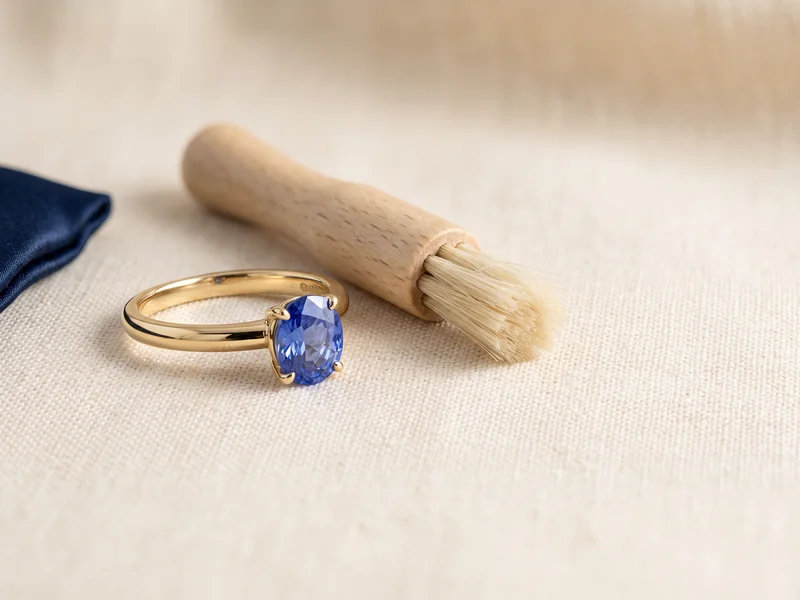 GemstonesGemstone Care by Stone
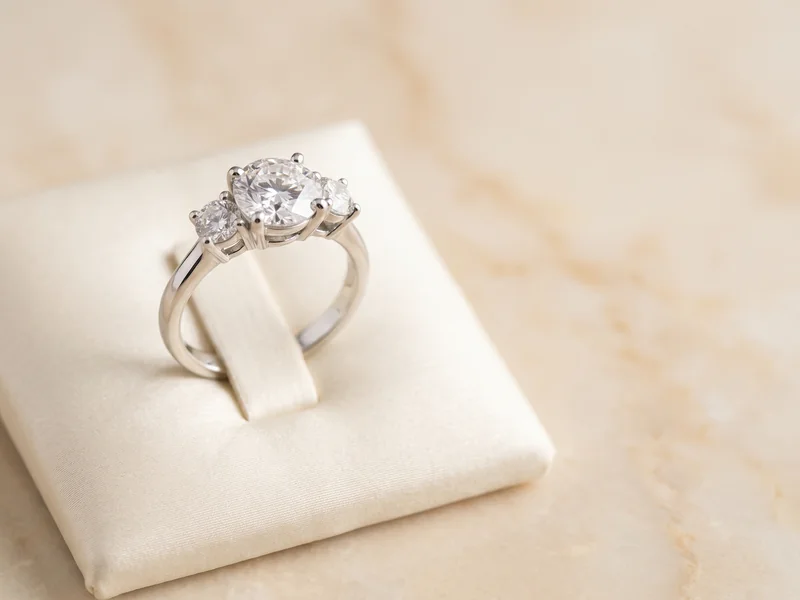 Engagement Rings & SettingsSide-Stone Engagement RingsEngagement Rings & SettingsThree-Stone Engagement Rings
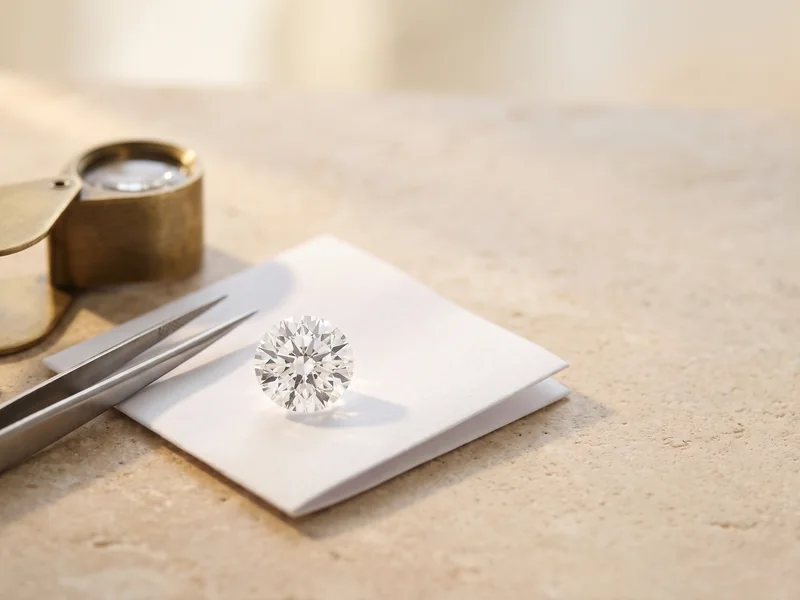 Care, Repairs & RemodellingSetting a Loose Diamond Into an Existing Ring
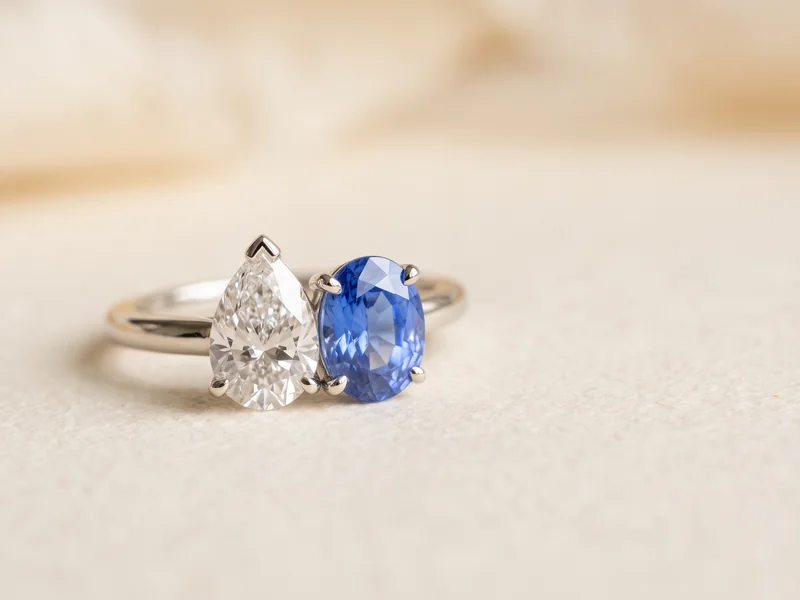 Engagement Rings & SettingsHow to Balance Two Stones in a Toi et Moi Ring
Explore more
More guides on this topic
Education