
- Education
- Diamond 4Cs & Grading
- Eye Clean Diamonds: How to Find One Without Overpaying
Diamond 4Cs & Grading
Eye Clean Diamonds: How to Find One Without Overpaying
Most people never need a flawless stone; they need one that looks flawless on the hand. Eye clean diamonds are where clarity stops changing what you see and only changes what you pay.
 Reviewed by Raj Sood, Graduate Gemologist (GIA), AJP (GIA)Master jeweller and Graduate Gemologist (GIA) · reviewed 4 November 2026
Quick answer
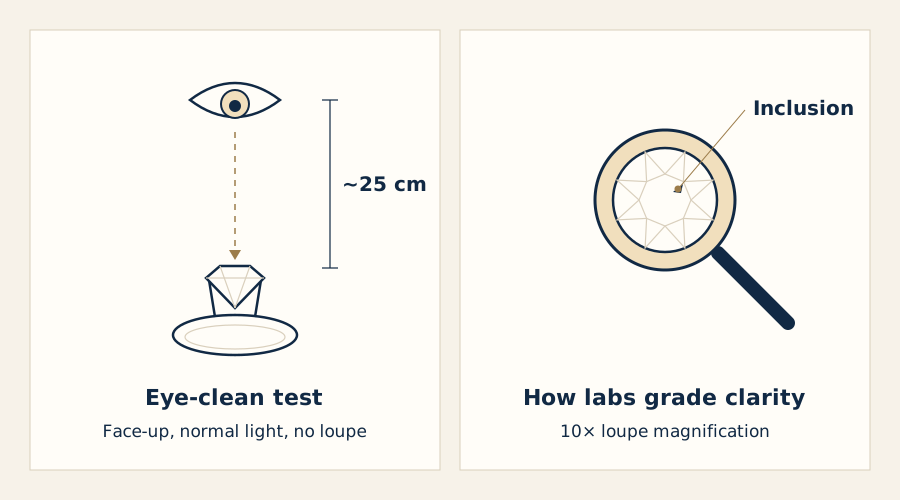
Eye clean diamonds have no inclusions you can see with the naked eye, looking face-up from about 25 cm in normal light. It is not a lab grade. In round brilliants, VS2 is almost always eye-clean and many SI1 stones are too; emerald and Asscher cuts usually need VS1 or better, and larger stones need higher grades.
What are eye clean diamonds?
An eye-clean diamond is one with no inclusions (internal crystals, feathers or clouds) or blemishes (surface marks) that you can see with your unaided eye. The usual test is to look at the stone face-up, meaning from the top as it sits in a ring, from about 20–30 cm away, in ordinary daylight or office light, with normal vision and no loupe.
It is important to know what eye-clean is not. It is not a grade on a laboratory report. Labs such as GIA and IGI grade clarity under 10× magnification, a standard jeweller's loupe, and place each stone somewhere on the full clarity scale from FL to I3. Eye-clean is a practical judgement about how that stone looks to a person at a normal distance. Two diamonds with the same grade can fall either side of the line.
Clarity is one of the 4Cs, alongside cut, colour and carat, and it is the one where the gap between what the report says and what you actually see is widest. That gap is where most of the value sits. If any term here is new, our jewellery glossary defines it in a line or two.
Which clarity grades are eye clean diamonds?
As a rule of thumb, the higher the grade the more certain you can be. The table shows how often each grade is eye-clean in a well-cut round brilliant of about 0.50–1.50 carat. These are a gemmologist's working estimates, not lab statistics.
| Clarity grade | What 10× shows | Eye-clean in a round? |
|---|---|---|
| FL / IF | Nothing (IF: nothing inside) | Always |
| VVS1 / VVS2 | Minute inclusions, very hard to find at 10× | Always |
| VS1 | Minor inclusions, hard to see at 10× | Virtually always |
| VS2 | Minor inclusions, somewhat easy to see at 10× | Almost always |
| SI1 | Noticeable inclusions at 10× | Often; check each stone |
| SI2 | Easily noticed inclusions at 10× | Sometimes, mainly in smaller rounds |
| I1–I3 | Obvious inclusions, often visible without magnification | Rarely |
The real decision for most buyers sits between VS1, VS2 and SI1. Our VS1 versus VS2 comparison shows why the two are usually identical on the hand, and our guide on when an SI1 makes sense explains how to pick the SI1 stones that pass.
A grade is only a range. An SI1 sits at the boundary of what a grader thinks is noticeable at 10×, so one SI1 may have a single white pinpoint near the edge while another has a dark crystal under the table. That is why the grade narrows the field and your eyes, or a good video, make the final call.
Does the diamond shape change what counts as eye-clean?
Yes, a lot. Brilliant cuts (round, oval, cushion, pear, princess, radiant) have many small triangular and kite-shaped facets that break light into bright and dark flashes. That busy pattern hides small inclusions well. Step cuts (emerald, Asscher, baguette) have long, flat facets arranged like steps, with a large open table. They show clarity like a window, so inclusions that would vanish in a round can be plain to see.
| Shape | Faceting style | Clarity that is usually eye-clean |
|---|---|---|
| Round brilliant | Brilliant | VS2, many SI1, some SI2 under 1 ct |
| Oval, pear, marquise, heart | Modified brilliant | VS2, carefully chosen SI1 |
| Cushion, radiant, princess | Modified brilliant | VS2, carefully chosen SI1 |
| Emerald, Asscher | Step cut | VS1 or better; VS2 only after checking |
| Baguette (side stones) | Step cut | VS or better |
Cut quality matters too. A diamond with a strong cut grade returns more light and has crisper contrast, which helps mask small inclusions. A poorly cut stone, with dull or leaky areas, gives inclusions nowhere to hide. For an emerald cut in particular, budget for a higher clarity and give up a little colour instead.
Do bigger diamonds need a higher clarity to stay eye-clean?
They do. Inclusions allowed within a grade scale with the stone: an SI1 feather that is a speck in a 0.40 carat diamond about 4.8 mm across can be a visible line in a 2 carat stone about 8.1 mm across. Bigger tables are also bigger windows. As carat weight rises, it pays to move up a grade.
| Carat weight (round) | Approx. diameter | Clarity that is usually eye-clean |
|---|---|---|
| 0.25–0.40 ct | 4.1–4.8 mm | SI1, often SI2 |
| 0.50–0.90 ct | 5.1–6.2 mm | SI1 (check), VS2 |
| 1.00–1.50 ct | 6.4–7.4 mm | VS2, selected SI1 |
| 2.00 ct and above | 8.1 mm+ | VS2 or VS1 |
Small stones are where you can relax most. Our page on small diamonds between 0.25 and 0.4 carat covers how much clarity those sizes really need. If you are trying to stretch your budget towards a bigger look, put the savings from a sensible clarity into spread and setting; see our guide to making a diamond look bigger.
Not sure which one is right?
Send us the stones you are looking at and our gemologist will tell you which to choose and why.
Which inclusions stop a diamond being eye-clean?
Grade aside, three things decide whether you will see an inclusion: its type, its colour and its position.
- Dark crystals: black or grey mineral crystals (often graphite-like) are the easiest to spot. A dark crystal under the table can fail an SI1 that a white crystal would pass.
- White crystals and pinpoints: tiny, colourless and usually invisible face-up, even in SI grades.
- Feathers: small internal fractures. Most are harmless, but a long feather that reaches the surface, especially near the girdle (the outer edge), is both more visible and a durability risk.
- Clouds: clusters of tiny pinpoints. You may not see a single spot, but a large cloud can make a stone look slightly hazy or soft. A stone can be eye-clean and still lack transparency.
- Twinning wisps and graining: internal growth lines. Usually invisible face-up, occasionally a faint streak in larger stones.
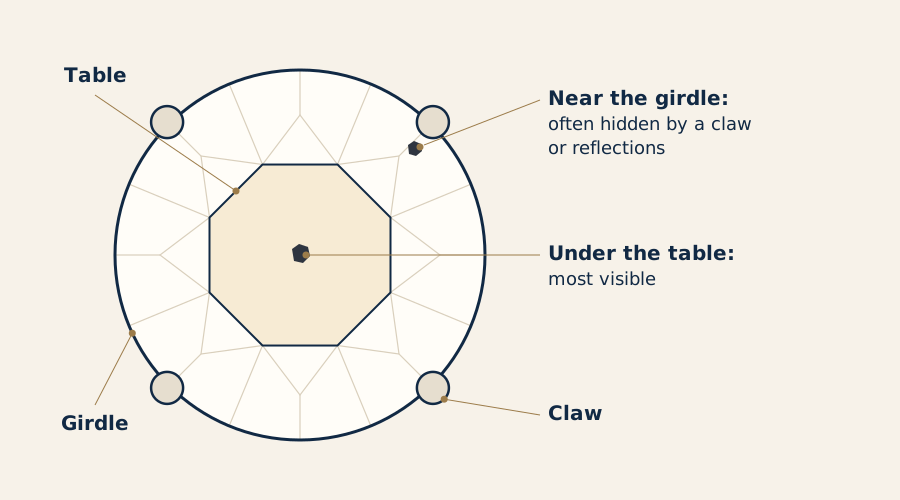
Position is the big one. Under the table (the large flat top facet) there is nowhere to hide. Near the girdle, inclusions are often reflected, broken up by facets or covered by a claw. Surface features matter less: pits and extra facets or burn marks and lizard skin are graded as blemishes and are almost never visible face-up.
Are eye clean diamonds worth paying more for than an SI?
Paying for eye-clean is sensible; paying far beyond it usually is not. Once a stone is eye-clean, a higher clarity grade changes the report and the price, not the look. Clarity is one of several factors in what sets a diamond's value, and it is the easiest to overspend on.
| 1.00 ct round, G colour, Excellent cut | Approx. natural price (AUD) | Looks different face-up? |
|---|---|---|
| VVS2 | $11,000–$15,000 | No, if the VS2 is eye-clean |
| VS1 | $10,000–$13,500 | No |
| VS2 | $9,000–$12,500 | Baseline eye-clean choice |
| SI1 (eye-clean) | $7,500–$10,500 | No, once checked |
| SI2 | $6,000–$8,500 | Sometimes; inclusions may show |
These are broad market ranges and move with the market; actual stones vary with cut, fluorescence and the report. The pattern is what matters: each step up costs real money, and above eye-clean you cannot see what you paid for. Many buyers put that difference into a better cut or a higher colour grade instead, or go the other way and save on colour, since a J colour stone in yellow gold can look just as white.
One more thing to check alongside clarity: strong blue fluorescence occasionally gives a stone a slightly milky look, and combined with a large cloud that can make a technically eye-clean SI look less bright. It is uncommon, but worth asking about.
Are lab-grown diamonds usually eye-clean?
Most are. Laboratory-grown diamonds are real diamond, grown by one of two methods: HPHT (high pressure, high temperature) or CVD (chemical vapour deposition). HPHT stones can contain small metallic flux inclusions; CVD stones can show dark pinpoints or faint growth lines. Most lab-grown diamonds on the market grade VS2 or higher, so eye-clean is the norm rather than the exception.
The clarity premium is also much smaller in lab-grown. A 1 carat laboratory-grown round of good colour and VS clarity is roughly AUD $1,000–$2,500, and moving from VS2 to VVS often costs only a little. In natural diamonds, by contrast, the same step can cost thousands, which is why choosing an eye-clean VS2 or SI1 matters more there. Both types are graded on the same scales and should come with an independent report.
Browse eye-clean natural and lab-grown diamonds
Can a setting hide inclusions?
Within limits, yes. A claw placed over an inclusion near the edge can hide it completely, and a bezel (a thin metal rim) covers the whole girdle. A halo frames the stone and draws the eye outwards. What a setting cannot do is hide anything under the table, so plan claw positions around edge inclusions, not central ones. Never let a claw sit over a feather that reaches the surface; pressure there can make it worse.
Dirt matters more than people expect. Hand cream and soap film on the pavilion (the underside) dull the stone and can make clouds look worse. Before judging a diamond you already own, try cleaning a diamond ring at home; a grimy VS1 can look less clean than a freshly cleaned SI1.
How to tell if a diamond is eye-clean: step by step
- Read the report's plot. The clarity diagram shows where each inclusion sits. Note anything under the table, and any feather marked near the girdle.
- Read the comments. Lines such as 'clouds not shown' or 'additional clouds' can signal haziness worth checking.
- Watch an actual-size video or view in person. Zoomed photos at 20–40× make every stone look included. Judge at the size it will be worn.
- Look face-up at 20–30 cm in normal light. Daylight or office light, not a jewellery-case spotlight. Try both a clean and a slightly tilted angle.
- Compare with the grades either side. If you can, look at the stone next to one a grade higher and one lower. If you cannot tell them apart, you do not need the higher grade.
- Check durability, not just looks. Ask whether any feather reaches the surface and where the claws will sit.
Free consultation
Talk to a gemologist
Compare stones in person or online with Raj Sood, Graduate Gemologist (GIA), AJP (GIA).
Book a consultationShop this shape
FAQ
Common questions
What does eye clean mean for a diamond?
It means you cannot see any inclusions with the naked eye when looking at the diamond face-up from about 20–30 cm in normal light. It is a practical judgement, not a grade printed on a lab report.
Is VS2 eye clean?
In round and most brilliant-cut diamonds under about 2 carats, VS2 is almost always eye-clean. In emerald and Asscher cuts, check each VS2 individually or choose VS1.
Is SI1 eye clean?
Often, but not always. Many SI1 rounds up to about 1.5 carats are eye-clean when the inclusions are white or near the edge; a dark crystal under the table can make an SI1 visible.
What is the lowest clarity that can be eye clean?
In small, well-cut rounds, some SI2 diamonds are eye-clean, especially below about 0.50 carat. I1 stones are rarely eye-clean because their inclusions are usually visible without magnification.
Do emerald cut diamonds need a higher clarity?
Yes. Step cuts have long, open facets that show inclusions clearly, so VS1 or better is the usual starting point for an eye-clean emerald or Asscher cut.
Is an eye clean diamond the same as a flawless diamond?
No. A flawless diamond shows nothing even under 10× magnification, while an eye-clean diamond may have inclusions under a loupe that you simply cannot see on the hand.

Ask a gemologist
Not sure which diamond to choose?
Raj Sood is a Graduate Gemologist (GIA) and master jeweller. Bring the stones you are considering, or send the reports, and he will tell you honestly which one is better and why.
Keep learning
Related guides
 Diamond 4Cs & GradingUnderstanding Diamond Clarity Grades: FL to I3 Explained
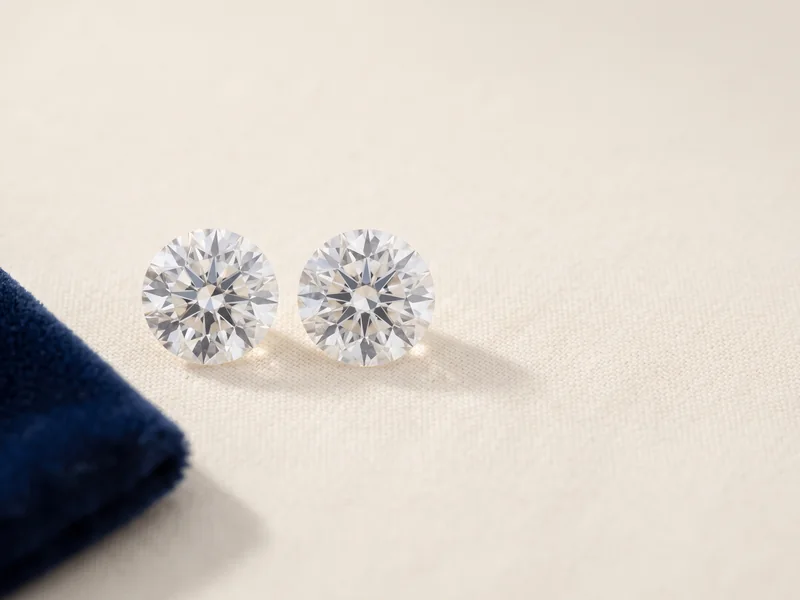 Diamond 4Cs & GradingVS1 vs VS2 Diamonds: Can You See the Difference?
 Diamond 4Cs & GradingWhen Can an SI1 Diamond Be a Smart Choice?Diamond 4Cs & GradingDiamond 4Cs
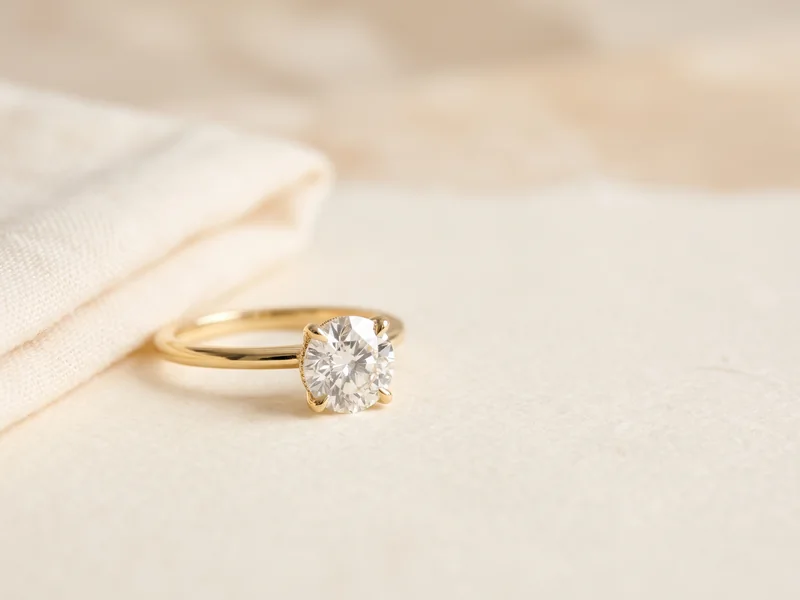 Care, Repairs & RemodellingHow to Clean a Diamond Ring at Home
 Care, Repairs & RemodellingHow to Clean Silver Jewellery
 GemstonesChrysoberyl and Cat's-Eye
 Diamond 4Cs & GradingSmall Diamonds: 0.25 to 0.4 Carat
Explore more
More guides on this topic
Education