
- Education
- Diamond Shapes
- Marquise Cut Diamonds: From Half a Carat to a 3 Carat Marquise Diamond Ring
Diamond shapes
Marquise Cut Diamonds: From Half a Carat to a 3 Carat Marquise Diamond Ring
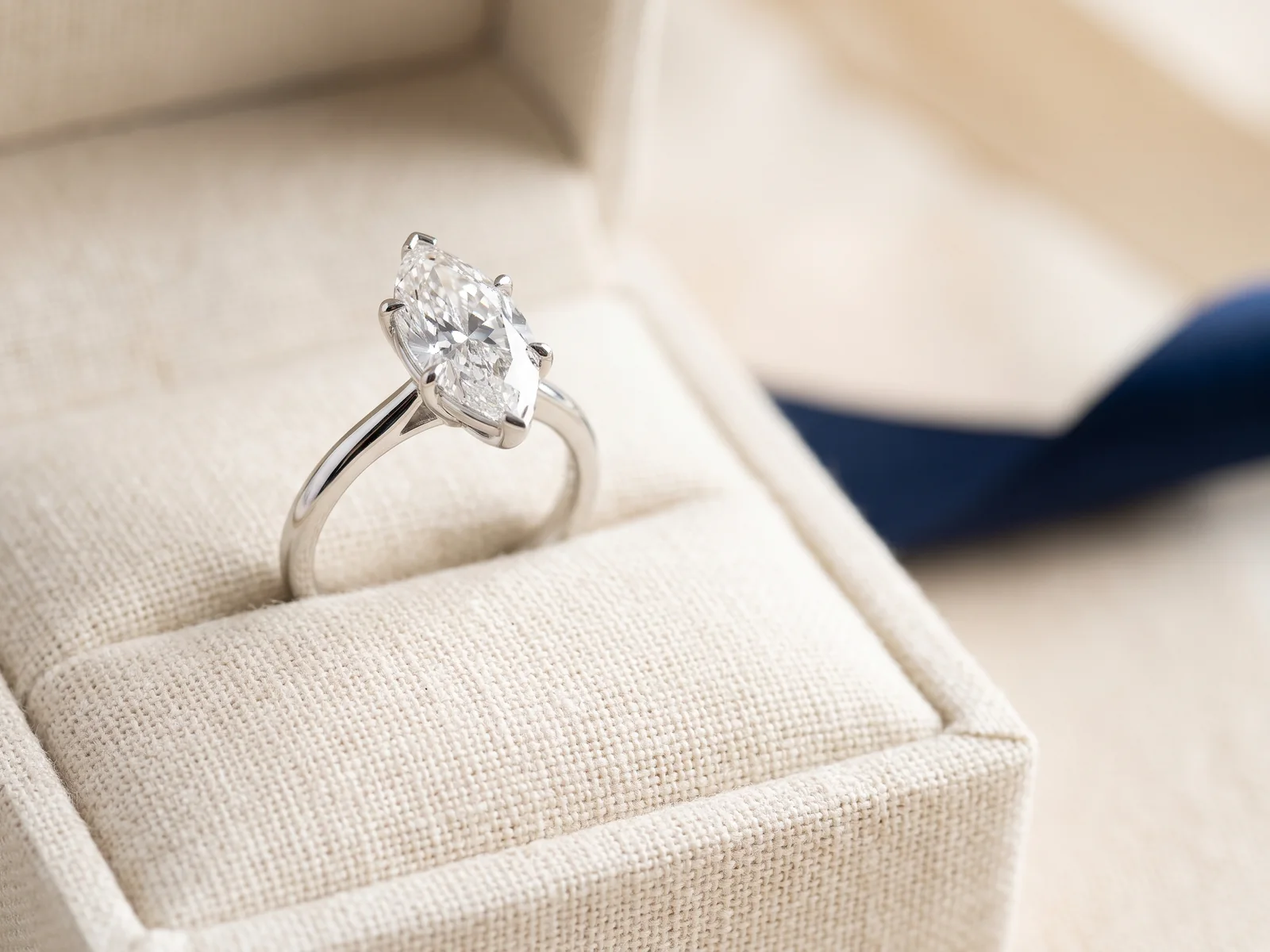
The marquise gives you more length on the finger per carat than almost any other shape, but its two points and its bow-tie need care. Here is what to check before you choose one.
 Reviewed by Raj Sood, Graduate Gemologist (GIA), AJP (GIA)Master jeweller and Graduate Gemologist (GIA) · reviewed 4 November 2026
Quick answer
A marquise cut diamond is a long, boat-shaped modified brilliant with a point at each end. Choose a length-to-width ratio of about 1.85–2.10, points that line up, even wings and a mild bow-tie. A 3 carat marquise diamond ring shows roughly 15 × 7.5 mm of diamond, so check colour and clarity closely and protect both points.
What is a marquise cut diamond?
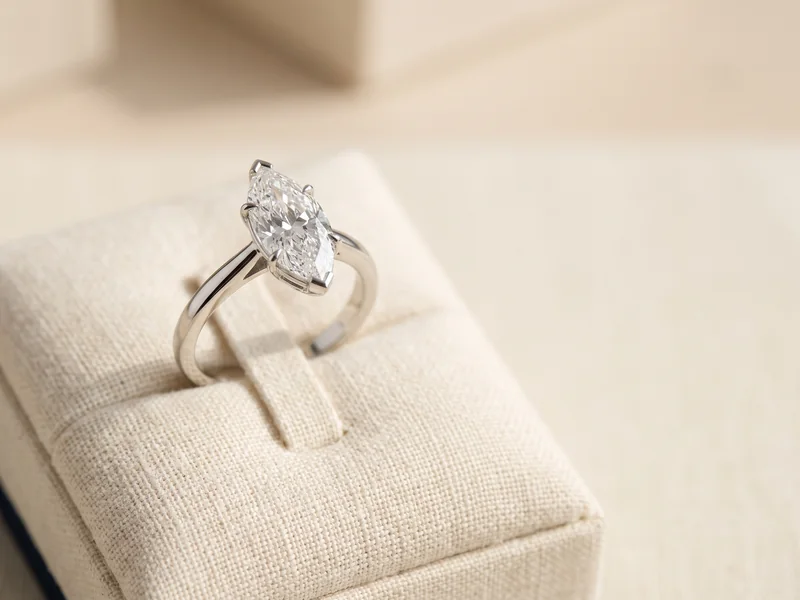
A marquise (say 'mar-KEEZ') is a modified brilliant cut shaped like a narrow boat or an eye: two curved sides that meet in a point at each end. A modified brilliant uses the same triangular and kite-shaped facets as a round brilliant, rearranged to suit a different outline; our guide to brilliant faceting compared with the rose cut explains how that facet style returns light. Most marquise diamonds have 56 to 58 facets, depending on the cutter and whether there is a culet (a tiny flat facet at the bottom).
The shape is often linked to 18th-century France and the court of Louis XV, where the story goes that it was cut to echo the smile of the Marquise de Pompadour. It is a good story rather than a documented fact. What is certain is that the marquise was very popular in the 1970s and 1980s and has come back strongly, often in vintage-inspired and east-west designs.
It belongs to the elongated diamond family with the oval, pear and moval, and it is one of the 34 diamond cuts we compare side by side. Like every diamond it is 10 on the Mohs hardness scale with a refractive index of about 2.42, but hardness is not the same as toughness: a sharp point can still chip if it takes a hard knock at the wrong angle.
What is the best length-to-width ratio for a marquise diamond?
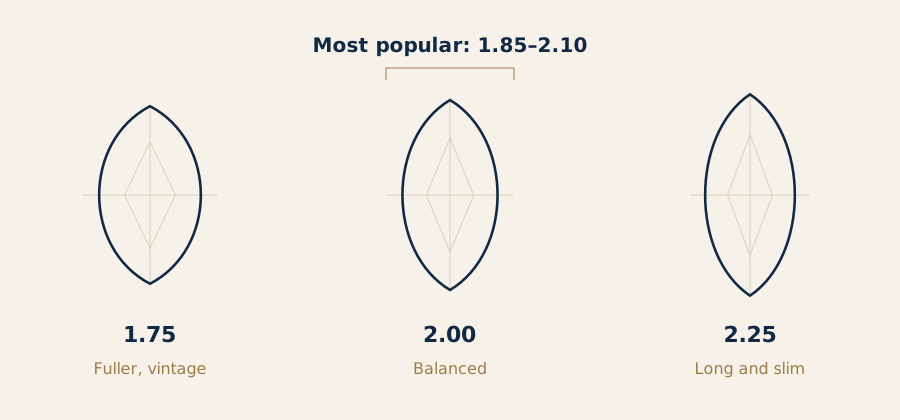
The length-to-width ratio is the stone's length divided by its width. A marquise that is 10 mm long and 5 mm wide has a ratio of 2.00. Because the marquise is the longest of the common shapes, small changes in ratio change its look a lot.
| Ratio | How it looks | Who tends to choose it |
|---|---|---|
| Below 1.75 | Short and wide, with full wings | A softer look; can read close to an oval with points |
| 1.75–1.85 | Slightly plump, classic vintage outline | Shorter fingers, cluster and vintage designs |
| 1.85–2.10 | Balanced and slim, the most popular range | Most solitaire engagement rings |
| Above 2.10 | Very long and narrow | Dramatic north-south or east-west settings |
The ratio is not the only number on the report. Many well-cut marquise diamonds have a table (the large top facet) of roughly 53–63% of the width and a total depth of roughly 58–63%. A much deeper stone hides weight underneath and looks smaller from above; a much shallower one can leak light and look glassy. There is no single correct figure, and our separate guide to the marquise length-to-width ratio shows more real examples.
How do you judge marquise symmetry and the bow-tie?
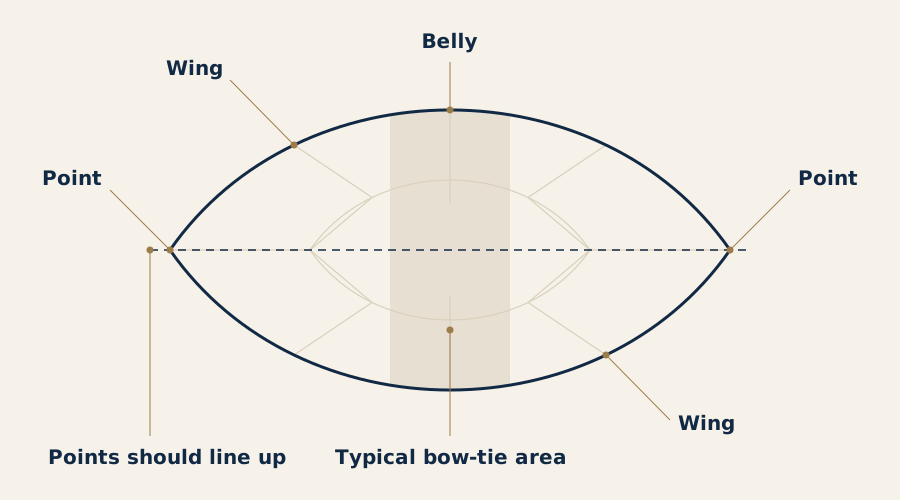
A marquise is mirrored both lengthways and across the middle, so imbalance shows quickly. Look at the stone face-up and check:
- Points: the two tips sit on one straight line through the centre, not offset.
- Wings: the curves on each side match; one flatter side makes the stone look bent.
- Ends: both halves are the same length, so neither end looks stubby.
- Bow-tie: a dark band across the belly that shifts as the stone moves is normal; one that stays black from every angle is not.
Almost every marquise shows some bow-tie effect, a dark band where light leaks out across the narrow middle instead of returning to your eye. GIA gives marquise diamonds polish and symmetry grades but no overall cut grade, so those grades help but do not replace looking at the outline and a 360° video. Our guide on judging marquise symmetry by eye goes through it step by step.
How big does a marquise diamond look?
Because so much of its weight is spread along its length, a marquise usually looks larger face-up than a round of the same carat weight, and much larger than a compact princess cut of the same weight. Typical sizes at a ratio of about 2.00:
| Carat weight | Typical size (length × width) |
|---|---|
| 0.50 ct | about 8 × 4 mm |
| 0.75 ct | about 9 × 4.5 mm |
| 1.00 ct | about 10 × 5 mm |
| 1.50 ct | about 12 × 6 mm |
| 2.00 ct | about 13 × 6.5 mm |
| 3.00 ct | about 15 × 7.5 mm |
These are guides only: a deeper stone carries more weight underneath and looks smaller from above, and a longer ratio adds length while taking away width. Two stones of the same weight can differ by a millimetre or more in length, so compare the measurements on the report rather than the carat figure alone.
Not sure which one is right?
Send us the stones you are looking at and our gemologist will tell you which to choose and why.
What should you check in a 3 carat marquise diamond ring?
At 3 carats a marquise is roughly 15 mm long, about the full width of many fingers from knuckle to knuckle, so every detail is easier to see. The checks change slightly at this size:
- Colour shows more. Bigger stones and long points hold colour; in white metal, look at G–H or better if you are sensitive to warmth.
- Inclusions are larger. Even an SI1 that is eye-clean at 1 carat may not be at 3. Ask for magnified photos and a video.
- The bow-tie is bigger. Watch the belly in a 360° video and make sure the dark area is lively, not fixed.
- Setting weight matters. A long stone needs a sturdy head and a band wide enough to balance it, usually 2 mm or more.
- Side stones change the look. Tapered baguettes or small marquise side stones follow its lines; rounds soften them.
If you are thinking about side stones, our guide to straight and tapered baguette side stones shows which ones sit neatly against a long centre. Many people consider a lab-grown stone at this size because the price gap between natural and lab-grown widens as carat weight rises.
Related guideBest Settings for Marquise DiamondsWhat colour and clarity should a marquise be?
Like most fancy shapes, the marquise shows colour at its points more than in the centre, because light travels further through the narrow ends. In white gold or platinum, most people are happy from H colour or better; in yellow or rose gold, I or J can look just as white because the metal warms everything around it. Colour is graded from D (colourless) to Z (light yellow or brown).
For clarity, aim for an eye-clean marquise, meaning no inclusions visible without magnification at normal viewing distance. In a 1 carat stone that usually means VS2 or a well-chosen SI1; at 3 carats, VS2 or better is safer. Avoid inclusions at or near the points: they are more visible there and can weaken the thinnest part of the stone. Our jewellery glossary explains the grading terms you will see on a report.
Which settings suit a 3 carat marquise diamond ring?
The two points are the most fragile parts of a marquise, and a knock on an unprotected tip can chip it. A good setting covers both, and at 3 carats the head also has to carry more weight. The usual choices:
- Six claws with V-claws: a V-shaped claw wraps each point, with two claws on each side holding the wings.
- Bezel or half-bezel: a rim of metal around the stone, or around just the points. Very secure for active hands.
- Halo: small diamonds around the marquise frame it and help shield the edge.
- East-west: the stone sits across the finger, which keeps the points away from the most common knocks along the length of the hand.
- Three-stone and cluster: marquise side stones in vintage clusters, or a marquise centre with smaller side stones.
Our guides to protecting marquise points and the settings that suit marquise diamonds show each option, and choosing a wedding band for a marquise covers the curved and contoured bands that sit neatly against it.
Marquise vs pear, oval and moval: which suits you?
| Marquise | Pear | Oval | Moval | |
|---|---|---|---|---|
| Outline | Two points | One point, one round end | No points | Oval body, slightly pointed ends |
| Typical ratio | 1.85–2.10 | 1.45–1.75 | 1.30–1.50 | Between oval and marquise |
| Bow-tie | Common | Common | Common | Common |
| Fragile points | Two | One | None | Softer tips |
| Face-up size per carat | Among the largest | Large | Large | Large |
If you like the length but worry about two points, the marquise vs pear comparison and the marquise vs moval guide are worth reading. If it is the romance of a fancy outline you love, the heart shape is another option with one point rather than two. To see every shape together, start with an overview of diamond shapes.
Should you choose a natural or lab-grown marquise diamond?
Marquise diamonds are cut from both natural and laboratory-grown diamond. The two are the same material, carbon in a diamond crystal, and look the same to the eye; only lab testing tells them apart. Lab-grown marquise diamonds cost much less and are easier to find in large sizes; natural ones are rarer. Either way, choose a stone with an independent grading report from a lab such as GIA or IGI, and a lab-grown stone should always be identified as lab-grown on that report.
Browse marquise diamonds in our stock
As a very rough guide, a 3 carat lab-grown marquise with good colour and clarity often sits somewhere around AUD 3,000–10,000 for the stone, while a natural 3 carat marquise of similar grades can run from about AUD 40,000 to well over AUD 100,000. A marquise usually costs less per carat than a round of the same weight, colour and clarity, partly because cutters keep more of the rough crystal and partly because demand is lower. Within marquise diamonds, the best-matched outlines with crisp points cost more.
How to choose a marquise diamond: step by step
- Read the report. Check shape, measurements, colour, clarity, polish and symmetry, and whether the stone is natural or lab-grown.
- Work out the ratio. Divide length by width; aim for about 1.85–2.10 unless you want a particular look.
- Line up the points. Check both tips sit on one straight line and the wings match.
- Watch a 360° video. Look for a bow-tie that stays dark and any inclusions near the points.
- Check the size against your hand. Compare the length in millimetres, especially for a 3 carat stone of around 15 mm.
- Plan the setting first. Make sure both points will be covered by V-claws, a bezel or a halo.
Free consultation
Talk to a gemologist
Compare stones in person or online with Raj Sood, Graduate Gemologist (GIA), AJP (GIA).
Book a consultationFAQ
Common questions
How big is a 3 carat marquise diamond?
Roughly 15 mm long and 7.5 mm wide at a ratio of about 2.00. The exact size depends on the stone's depth and ratio, so check the measurements on the report.
Are marquise diamonds cheaper than round diamonds?
Usually, yes. A marquise typically costs less per carat than a round of the same weight, colour and clarity, and it looks larger face-up for its weight.
What is the best ratio for a marquise diamond?
Most people prefer about 1.85 to 2.10. Below that the stone looks short and wide; above it, very long and slim.
Do marquise diamonds chip easily?
The two points are thin and can chip if they take a knock unprotected. V-claws, a bezel or a halo protect them, and with a protective setting a marquise is fine for everyday wear.
Do all marquise diamonds have a bow-tie?
Nearly all show some bow-tie. What matters is whether it is faint and changes as the stone moves, or stays dark from every angle.
Can you get a lab-grown marquise diamond?
Yes. Lab-grown marquise diamonds are widely available, cost much less than natural ones and are graded by labs such as IGI and GIA (GIA now uses simpler descriptive grades for lab-grown rather than the full D–Z and clarity scales).

Ask a gemologist
Not sure which diamond to choose?
Raj Sood is a Graduate Gemologist (GIA) and master jeweller. Bring the stones you are considering, or send the reports, and he will tell you honestly which one is better and why.
Keep learning
Related guides
 Diamond ShapesMarquise Diamond Length-to-Width Ratio
 Engagement Rings & SettingsBest Settings for Marquise DiamondsDiamond ShapesMarquise vs Pear DiamondsDiamond ShapesProtecting Marquise Diamond PointsDiamond ShapesUnderstanding Diamond Shapes
 Diamond ShapesAll 34 Diamond Cuts: Every Shape Explained and ComparedDiamond ShapesElongated Diamond Cuts: Oval, Pear, Marquise, Moval and More
 Diamond ShapesOval Diamonds
Explore more
More guides on this topic
Education