
- Education
- Care, Repairs & Remodelling
- Ring Claw Retipping: When Ring Claws Need It and What the Repair Involves
Care, Repairs & Remodelling
Ring Claw Retipping: When Ring Claws Need It and What the Repair Involves
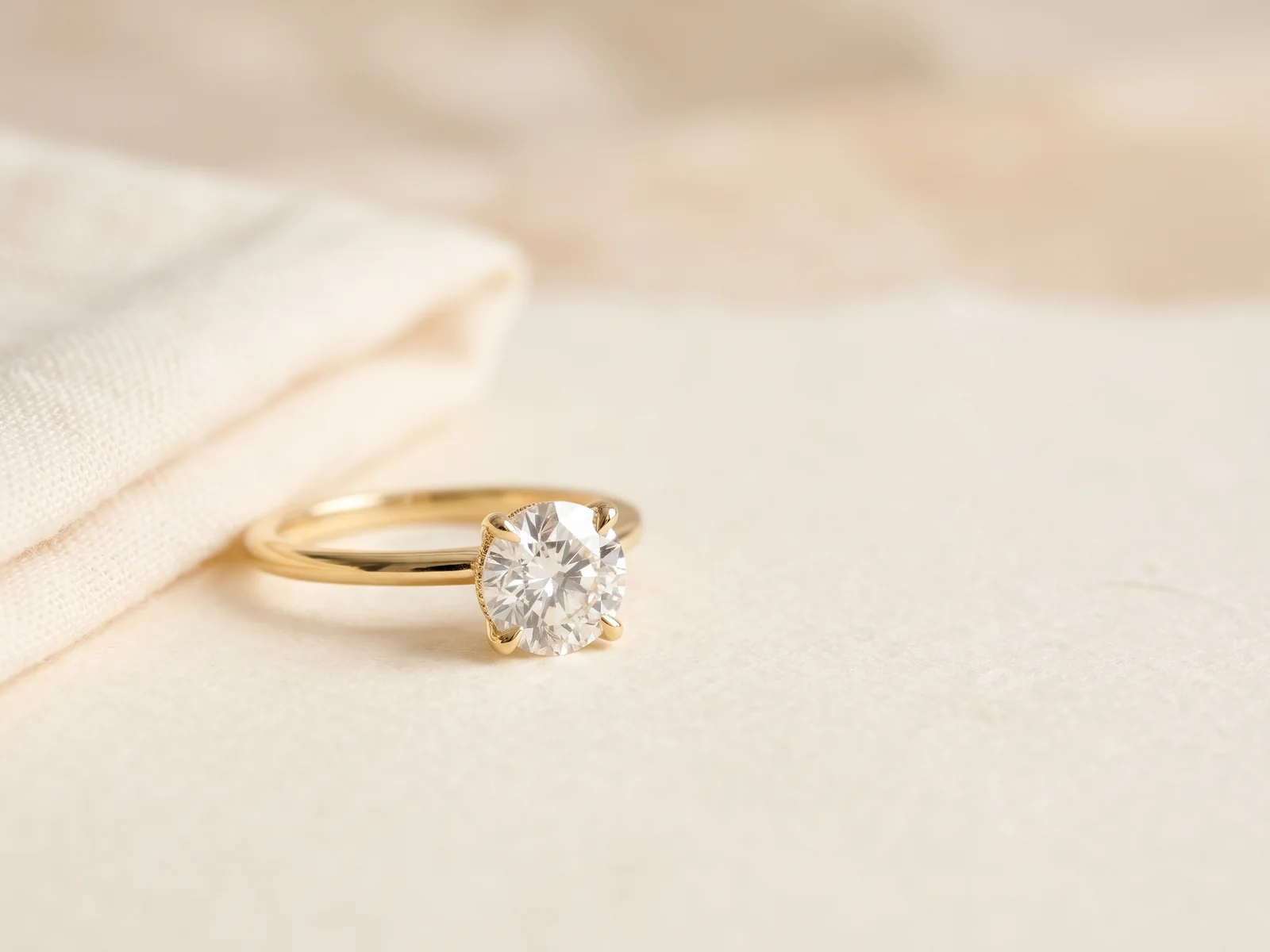
Claws are the small metal prongs that hold your stone, and they wear down a little every day you wear the ring. Ring claw retipping rebuilds them before a stone works loose, so knowing the warning signs is the simplest way to keep your diamond or gemstone where it belongs.
 Reviewed by Raj Sood, Graduate Gemologist (GIA), AJP (GIA)Master jeweller and Graduate Gemologist (GIA) · reviewed 4 November 2026
Quick answer
Ring claws need retipping when the tips have worn flat, thin or short, when a stone moves, rattles or sits crooked, or when a claw catches on clothing. Most daily-worn rings should be checked by a jeweller every six to twelve months. Retipping adds new metal to each worn tip, typically about AUD $40–$120 per claw.
What is ring claw retipping?
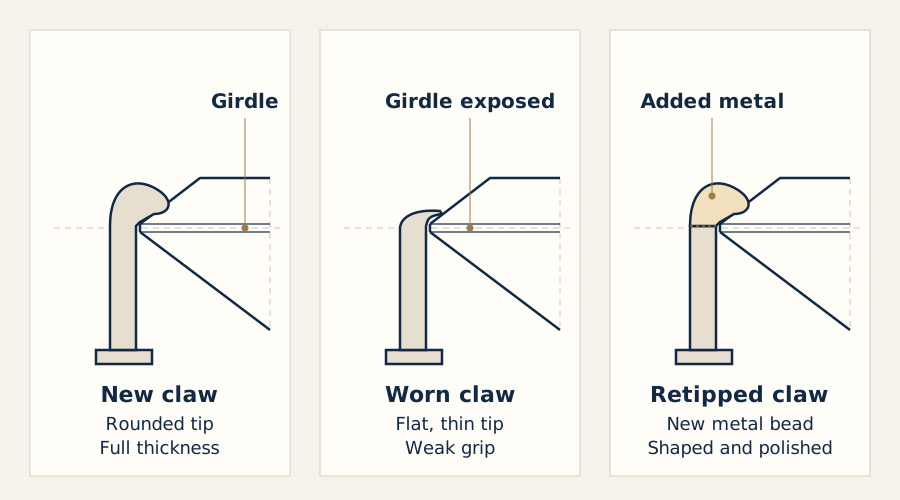
A claw (also called a prong) is a small post of metal that rises from the setting and bends over the edge of the stone to hold it in place. Most solitaire engagement rings have four or six claws, and each one grips the girdle, the thin outer edge where the top and bottom halves of a stone meet. If any word here is new to you, our plain-English jewellery glossary explains it.
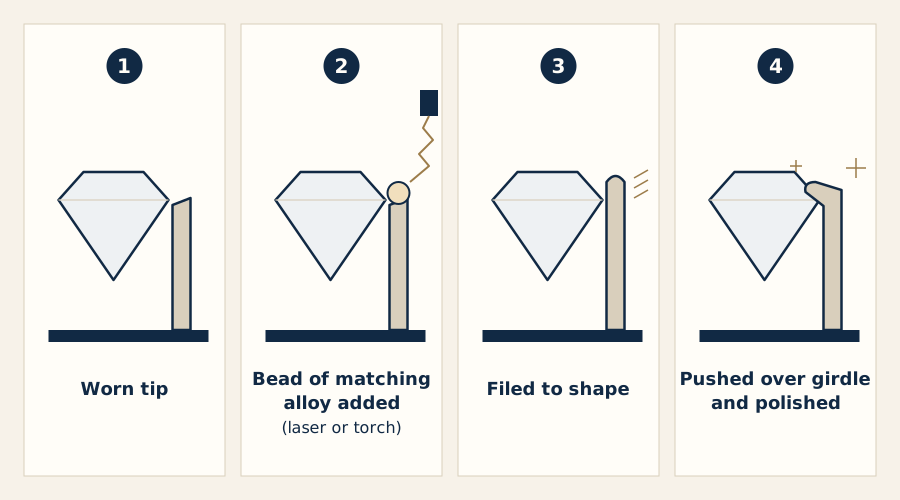
Retipping is the repair that rebuilds the top of a worn claw. The jeweller adds a small bead of new metal, matched to the ring's alloy, onto the worn tip, then files and shapes it, pushes it back over the stone and polishes it. The claw ends up close to its original thickness and grips the stone firmly again. The rest of the claw, and the ring, stay as they are.
Retipping is different from re-clawing (replacing the whole claw from the base up) and re-heading (replacing the entire head, the cluster of claws that holds the stone). Retipping is the smallest, quickest and least costly of the three, which is exactly why it pays to catch wear early. Claws come in many shapes, and the shape affects how they wear; our guide to round, eagle, tab, V-prong and double claws shows each one.
What are the signs ring claws are worn?
Claws wear slowly, over months and years, so the change is easy to miss when you see the ring every day. These are the signs a jeweller looks for, roughly in order of urgency:
| Sign | What you notice | How urgent |
|---|---|---|
| Flat, shiny tips | The rounded bead on top of each claw has become a flat, polished pad | Book a check within a few weeks |
| Thin or short claws | Claws look slimmer than when new; you can see more of the stone's edge | Retip soon |
| Snagging | The ring catches on jumpers, hair or tights | A claw may have lifted; get it seen this week |
| Gap under a claw | Light shows between a claw and the stone | Stop wearing it until checked |
| Rattle or movement | The stone clicks when tapped or turns when pushed | Stop wearing it; the stone is loose |
| Crooked stone | The stone sits tilted or off-centre | Stop wearing it; a claw has bent or broken |
| Missing tip | A claw ends below the girdle or is gone | Stop wearing it immediately |
Snagging is often misread. People assume a catching claw is too long, but it usually means the claw has been knocked and lifted slightly away from the stone. That claw is no longer holding, and the stone is relying on the others. A good way to understand what a healthy claw should look like is to compare yours against how each claw style looks when it leaves the bench.
As a working rule, many jewellers suggest retipping once roughly half of the original tip has worn away, or once a claw has thinned to well under 1 mm at the point where it meets the stone. New claws on a solitaire are often about 1.0–1.5 mm thick, so the change can be just a few tenths of a millimetre, which is why a loupe (a 10x jeweller's magnifier) helps.
How often should engagement ring claws be checked?
For a ring worn every day, such as an engagement ring, a professional check every six to twelve months is a sensible routine. Rings worn only occasionally can usually go twelve months or more. Between visits, a quick look at home once a month catches most problems early. Folding the claw check into your everyday jewellery care routine makes it a habit rather than a chore.
- Every month at home: look at the claws side-on, tap the stone gently and listen for a click, and run the ring over a fine fabric to feel for snagging.
- Every 6 months (daily wear): a jeweller cleans the ring and checks each claw under magnification.
- Every 12 months (occasional wear): the same professional check.
- Straight away: after any hard knock, if the ring catches on fabric, or if the stone looks different.
How fast claws wear depends on how you use your hands. Office work wears claws slowly. Gardening, gym weights, rock climbing, nursing, trades and anything involving sand or concrete wears them far faster, because grit acts like sandpaper. Two rings worn side by side also rub against each other at the claws, so if your engagement ring and wedding band touch, read about whether a spacer band reduces rubbing.
With daily wear and normal care, many rings need their first retip somewhere around five to ten years after they are made, and sooner with hands-on work. That range varies widely, so treat regular checks, not a calendar, as the real guide.
Why do some rings need retipping sooner than others?
Wear is never quite even. The claws on the side of the finger that faces your palm, and the claws nearest your other fingers, take more contact and usually wear first. Beyond that, a few design choices make a real difference:
- Number of claws: with four claws, each one carries more of the load and losing one is more serious. Six claws share the job and give a safety margin. Our comparison of four-claw versus six-claw solitaires weighs this against the look.
- Claw thickness: very fine, delicate claws look elegant but have less metal to lose before they need work.
- Height of the setting: a stone set high above the band catches more knocks than a low-set one.
- Pointed shapes: pear, marquise, heart and princess stones depend on the claw guarding each point. A worn V-claw exposes the thinnest part of the stone, so the placement shown in our guide to where claws should sit on pointed shapes matters for repair as much as for design.
- Metal and carat: softer alloys such as high-carat yellow gold wear faster than harder ones (more in the metals section below).
The stone itself is not the issue. A natural diamond and a lab-grown diamond are both diamond, 10 on the Mohs hardness scale, and wear the metal claws in exactly the same way. What changes is the risk if a claw fails: a hard stone can survive a knock that would chip a softer gem, but any stone can fall out of a worn setting.
Not sure which one is right?
Send us the stones you are looking at and our gemologist will tell you which to choose and why.
Ring claw retipping vs re-clawing: which do you need?
Once a jeweller has the ring under magnification, the choice of repair comes down to how much good metal is left in each claw and in the head.
| Repair | What is done | When it suits | Approximate cost (AUD) |
|---|---|---|---|
| Retipping | New metal added to the top of a worn claw, shaped and polished | Tips worn but the claw body is sound | about $40–$120 per claw |
| Re-clawing (re-pronging) | Whole claw cut back and a new claw built from the base | Claw thin along its length, cracked or snapped | about $80–$200 per claw |
| Re-heading | Entire head replaced with a new one | Several claws badly worn, or the head is cracked | about $250–$800+ |
| New setting | Stone moved into a new ring or a different setting style | The ring is worn throughout, or you want a change | quoted per design |
A claw can only be retipped so many times. Each retip adds metal at the top but cannot replace metal lost lower down, so after two or three rounds the claw may have become thin at its base and re-clawing becomes the sounder repair. The same thinking applies to the shank (the band part of the ring); our guide to deciding whether to repair or replace a worn band covers it.
If the head needs replacing anyway, it is a natural moment to rethink the ring. Some people move the stone into a lower, more protective style, or rework an inherited ring entirely; see redesigning an old ring into a modern engagement ring for how that process works.
Related guideBezel vs Claw Settings for Everyday WearHow is a ring claw retipped, and can the stone stay in?
Retipping is skilled bench work rather than a complicated job. A typical retip follows this sequence:
- Clean and inspect: the ring is cleaned (ultrasonic cleaning only if the stone tolerates it) and every claw is checked under a loupe or microscope.
- Decide on the stone: the jeweller decides whether the stone can stay in during heating, or must come out.
- Add metal: a small bead of matching alloy is fused to each worn tip, using a laser welder or a jeweller's torch with solder.
- Shape and set: the new tip is filed to shape, pushed firmly over the girdle and checked so the stone is tight and level.
- Finish: the ring is polished, and white gold is usually re-plated with rhodium.
A laser welder delivers a tiny, highly focused pulse of heat, often to an area well under a millimetre across, so the stone and surrounding metal barely warm. That is why many stones can stay in place for laser retipping. A torch heats a wider area, so stones are often removed or protected first. Whether the stone can stay in depends mostly on the gem:
| Stone | Mohs hardness | Heat sensitivity | Usual approach |
|---|---|---|---|
| Diamond (natural or lab-grown) | 10 | Tolerates heat well, but the surface can burn under a direct flame | Laser in place, or torch with the stone protected |
| Fracture-filled diamond | 10 | Filling can be damaged by heat | Laser only, or stone removed |
| Sapphire and ruby | 9 | Most tolerate heat; glass-filled rubies do not | Usually laser or protected torch; check treatment first |
| Emerald | 7.5–8 | Oiled fissures and inclusions react to heat | Laser or stone removed |
| Morganite, aquamarine | 7.5–8 | Colour and inclusions can change with heat | Laser or stone removed |
| Tanzanite | 6–7 | Prone to cracking from heat shock | Laser or stone removed |
| Opal | 5.5–6.5 | Contains water; can craze or crack | Stone removed |
| Pearl | 2.5–4.5 | Organic; damaged by heat and chemicals | Always removed |
Lab-created gems, such as lab-created sapphire, behave much like their natural counterparts here, but a treated or filled stone of either kind needs extra care, so tell your jeweller about any treatment you know of. A retip is also a good time to combine other work; if your ring feels tight or loose, it is worth knowing what decides whether a ring can be resized so both jobs can be done in one visit.
Does platinum claw retipping differ from gold?
Yes, because the metals wear differently. Gold wears by losing tiny amounts of metal, so gold claws gradually become thinner and shorter. Platinum tends to move rather than disappear: knocks push the metal sideways, forming a soft grey surface called a patina, and the claw can hold its bulk for longer. Platinum still thins over the years, though, and still needs checking.
| Metal | How claws wear | Retipping notes |
|---|---|---|
| 9ct gold | Harder alloy, wears slowly but can be more brittle | Retipped with 9ct alloy of matching colour |
| 18ct yellow or rose gold | Softer, wears steadily | Retipped with 18ct alloy; colour match matters |
| 18ct white gold | Wears like yellow 18ct; rhodium plating wears off first | Retipped, then re-plated with rhodium |
| Platinum (usually 950) | Displaces rather than wears away; durable over time | Retipped with platinum, usually by laser or a high-temperature torch |
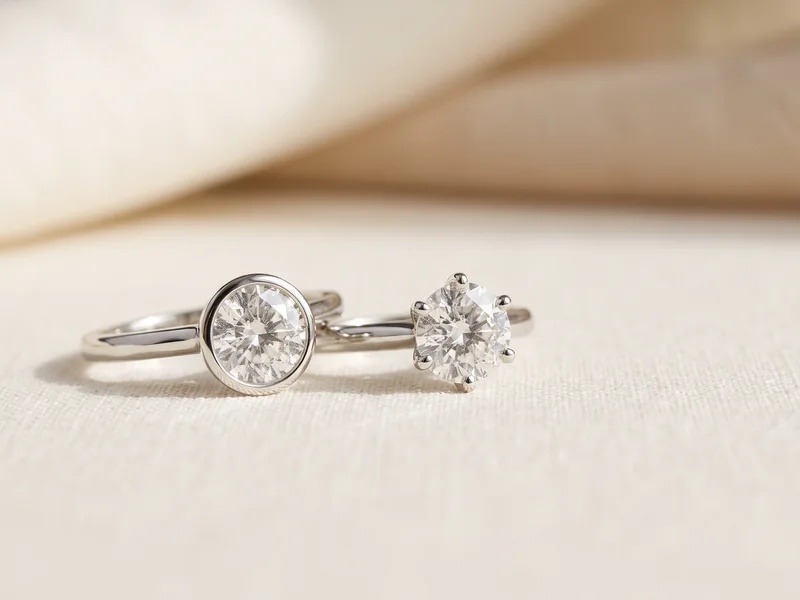
Matching the alloy matters. A claw retipped with the wrong carat or colour can show a visible line and may wear at a different rate, and platinum should always be repaired with platinum, not white gold. If you find claws wearing quickly in any metal because of the work you do, a bezel setting for hard everyday wear may suit you better in the long run.
How much does ring claw retipping cost in Australia?
As a broad guide, retipping costs about AUD $40–$90 per claw in gold and about $60–$120 per claw in platinum. A four-claw solitaire retipped all round might therefore cost roughly $160–$480. These are approximate ranges only; the final quote depends on the metal, how worn the claws are, whether the stone must be removed and reset, and whether polishing or rhodium plating is included.
Several things push the price up: platinum, tiny claws on a halo or pavé ring (where a jeweller may be checking dozens of small claws at once), heat-sensitive stones that must be removed, and claws so worn that re-clawing is needed. Turnaround is often a few days to about two weeks, depending on the work and the workshop's load.
Compared with replacing a lost stone, retipping is a small cost. It is also worth checking whether your contents or jewellery insurance requires regular maintenance; some policies ask that settings be inspected, and a lost stone from a visibly worn claw may be treated differently. If you are planning a new ring and want one that needs fewer repairs, our guide on less traditional engagement ring designs includes low, protective settings.
Jewellery repairs in Melbourne
How do you check your ring claws at home? Step by step
This takes about two minutes and is worth doing once a month. Do it over a soft cloth or a closed sink plug, never over an open drain.
- Clean the ring first. Soak it in warm water with a drop of mild dishwashing liquid and brush gently with a soft toothbrush, so dirt is not hiding wear.
- Look side-on, not just from above. Each claw should have a rounded tip curving over the stone's edge. A flat pad or a thin skin means wear.
- Count and compare. Check every claw is present and all look the same thickness and height.
- Tap and listen. Hold the ring near your ear and tap the stone gently with a fingernail. A click or rattle means it is loose.
- Push gently. Press the stone lightly with a fingertip; it should not turn, tilt or move.
- Feel for snagging. Run the ring over a fine fabric such as a stocking or a silk scarf. Any catch points to a lifted claw.
- Act on what you find. If anything moves, clicks or catches, put the ring away and have it checked before wearing it again.
Between checks, simple habits slow claw wear: take rings off for the gym, gardening and cleaning, keep them away from chlorine, and store each piece separately so claws do not rub against other jewellery. Our page on cleaning and storage habits that protect settings covers the rest, and if you are unsure what style your claws are, a visual guide to claw shapes will help you describe them to your jeweller.
Free consultation
Talk to a gemologist
Compare stones in person or online with Raj Sood, Graduate Gemologist (GIA), AJP (GIA).
Book a consultationShop this shape
FAQ
Common questions
How do I know if my ring claws need retipping?
Look for tips that have worn flat or thin, a stone that clicks, moves or sits crooked, or a ring that catches on clothing. If you see any of these, have a jeweller check the ring before wearing it again.
How often should engagement ring claws be checked?
Every six to twelve months for a ring worn daily, with a quick check at home once a month. Have it looked at straight away after a hard knock or if it starts snagging.
Can claws be retipped with the diamond still in the ring?
Often, yes. With a laser welder many diamonds, natural or lab-grown, can stay in place; heat-sensitive stones such as opal, emerald and tanzanite, and treated or filled stones, are usually removed first.
How much does it cost to retip ring claws in Australia?
Roughly AUD $40–$90 per claw in gold and $60–$120 per claw in platinum, as a broad guide. The quote depends on the metal, the amount of wear and whether the stone must be removed.
How many times can a claw be retipped?
Usually two or three times. Each retip rebuilds only the top, so once the claw has thinned lower down, re-clawing or a new head is the sounder repair.
Do platinum claws need retipping?
Yes, though usually less often than gold. Platinum moves rather than wears away, but claws still thin and lift over the years and should be checked on the same schedule.
Terms in this guide

Ask a gemologist
Not sure which diamond to choose?
Raj Sood is a Graduate Gemologist (GIA) and master jeweller. Bring the stones you are considering, or send the reports, and he will tell you honestly which one is better and why.
Keep learning
Related guides
 Engagement Rings & SettingsEngagement Ring Claw Styles ExplainedEngagement Rings & SettingsFour-Claw vs Six-Claw Solitaire Engagement Rings
 Engagement Rings & SettingsBezel vs Claw Settings for Everyday WearCare, Repairs & RemodellingJewellery Care and Maintenance
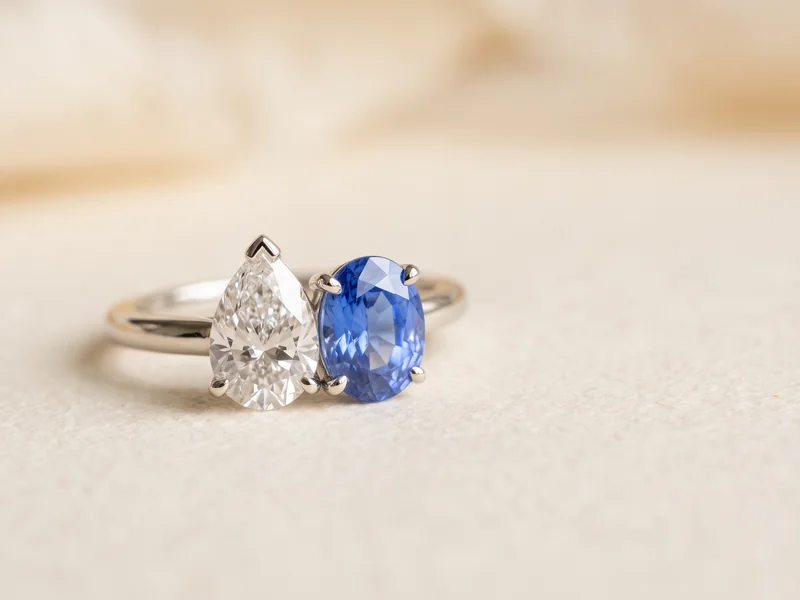 Engagement Rings & SettingsClaw Placement for Pointed Shapes
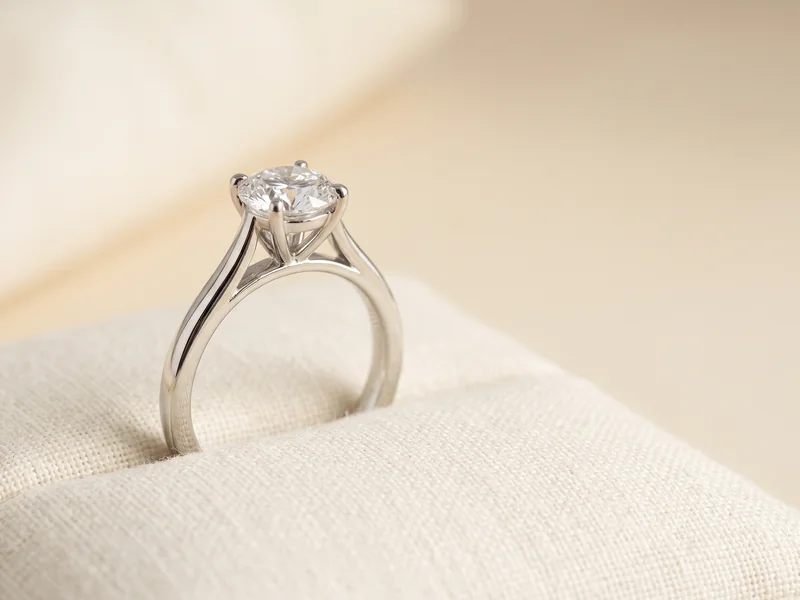 Engagement Rings & SettingsClaw Types: Round, Eagle, Tab, V-Prong, Double
 Care, Repairs & RemodellingWhen to Repair vs Replace a Band
 Wedding Bands & EternityDo You Need a Spacer Band Between Rings?
Explore more
More guides on this topic
Education