
- Education
- Diamond 4Cs & Grading
- Diamond Cavities and Chips: What Buyers Should Know
Diamond 4Cs & Grading
Diamond Cavities and Chips: What Buyers Should Know
Diamond cavities and chips are openings in a diamond's surface, and they can show up on a grading report without you ever noticing them. Knowing where they sit and what caused them tells you whether a stone is a sensible buy or one to pass on.
 Reviewed by Raj Sood, Graduate Gemologist (GIA), AJP (GIA)Master jeweller and Graduate Gemologist (GIA) · reviewed 4 November 2026
Quick answer
A cavity is an opening in a diamond's surface, often left where a crystal fell out during polishing; a chip is a small break caused by a knock, usually at the girdle, corners or culet. Both are graded as inclusions. Small ones in SI or VS stones are usually harmless, but chips at points or thin girdles need care.
What are diamond cavities and chips?
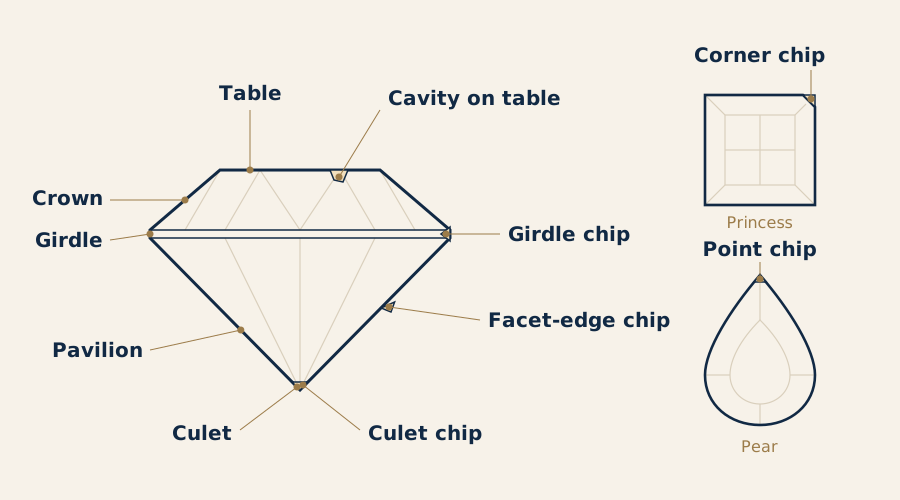
A cavity is an opening in a diamond's surface that reaches some way into the stone. Most cavities form when a small included crystal, or part of a feather (a tiny internal crack), sits right at the surface and breaks away during cutting and polishing, leaving a hollow behind. A chip is a shallow break in the surface caused by a knock or by pressure. Chips are most often found on the girdle (the thin outer edge where the top and bottom halves of the stone meet), on a corner, at the culet (the small point or facet at the very bottom) or along the sharp edge where two facets meet.
Both are clarity characteristics: the features a gemmologist records when grading clarity, one of the four Cs of diamond grading. GIA classes both cavities and chips as inclusions rather than blemishes, because they break into the body of the diamond instead of sitting only on its polished surface. That matters, because inclusions count more heavily towards the clarity grade than surface blemishes do.
It surprises people that the hardest natural material can chip at all. Diamond is 10 on the Mohs scale, so it scratches everything else, but hardness is resistance to scratching, not resistance to breaking. Diamond has cleavage: four directions in its crystal structure along which it can split cleanly if struck at the wrong angle. A sharp knock on a thin edge against a stone benchtop or a steel door frame can take out a small piece.
If any term on this page is new, our plain-English jewellery glossary explains it, and the full diamond education hub covers grading from the ground up.
How do cavities and chips affect a diamond's clarity grade?
Clarity is graded under 10× magnification on an 11-step scale, from Flawless (FL) down to Included (I3). A grader weighs five things for every feature: size, number, position, nature (what kind of feature it is) and relief (how much it contrasts with the diamond around it). A cavity or chip can be the feature that sets the grade, or one small detail among several.
| Clarity grade | Can a cavity or chip be present? | Visible to the eye? |
|---|---|---|
| FL, IF | No; these grades allow no inclusions | No |
| VVS1–VVS2 | Only minute ones, very hard to find at 10× | No |
| VS1–VS2 | Small ones, seen with some effort at 10× | Almost never |
| SI1–SI2 | Noticeable at 10×, often the grade-setting feature | Sometimes, more often in SI2 and step cuts |
| I1–I3 | Obvious, may affect brightness or durability | Often |
Position changes everything. A small cavity in the centre of the table (the large flat top facet) is seen straight away and can catch dirt, so it may cost a grade. The same cavity near the girdle, where a claw may later cover it, has much less effect on how the stone looks. Cavities also trap skin oil, soap and polishing residue, which makes them look darker than they are; a stone that looks clean after a steam clean may look less clean after a month of wear.
On a GIA report the plotting diagram maps each feature. Inclusions, including cavities and chips, are drawn in red; surface blemishes such as nicks and scratches are drawn in green. Read the key beside the diagram: if cavity or chip is listed, find it on the plot and see where it sits. Whether it shows without magnification is a separate question, covered in our guide to what makes a diamond eye-clean.
Related guideEye Clean DiamondsGrading strictness also varies between labs. A stone with a chip that one lab calls SI1 another may call VS2, which is one reason to understand how GSI and EGL reports compare with GIA before you compare prices across reports.
How is a diamond cavity different from a chip, nick, pit or bruise?
These five words describe related features, and reports use them precisely. The difference tells you how the feature formed and whether it can be fixed.
| Cavity | Chip | Nick | Pit | Bruise | |
|---|---|---|---|---|---|
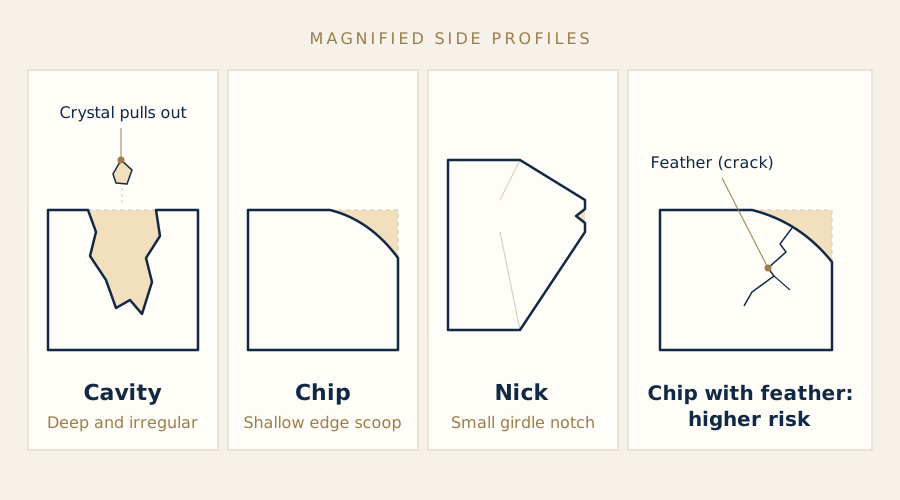
| What it is | Opening with depth, often irregular | Shallow break with a curved, shell-like surface | Small notch on the girdle or a facet edge | Tiny pinpoint-sized hole in the surface | Small impact mark with fine root-like cracks |
| Usual cause | Crystal or feather breaking away during polishing | A knock or pressure, during cutting, setting or wear | A light knock | Polishing pulling out a tiny pinpoint | A sharp blow |
| Usual location | Anywhere, often on table or crown | Girdle, corners, points, culet | Girdle, facet junctions | Table and crown facets | Facet junctions, girdle |
| GIA class | Inclusion | Inclusion | Blemish | Blemish | Inclusion |
| Usual fix | Mostly left; sometimes reduced by recutting | Repolishing if worthwhile | Light repolish | Usually left | Repolishing if shallow |
A few other features reach the surface and can look like a cavity under a loupe. A laser drill hole is a fine tunnel burned in by laser so a dark inclusion can be bleached or dissolved with acid, and the report will note it. An indented natural is a piece of the original crystal surface left dipping into the stone. Some cavities and fractures are fracture filled with a glass-like material to hide them. Filling is a treatment that must be disclosed; GIA does not issue standard clarity grades for fracture-filled diamonds, and the filling can be damaged by heat during jewellery repairs.
What causes diamond cavities and chips?
Most diamond cavities and chips come from one of four moments in a stone's life:
- Cutting and polishing: the polishing wheel can drag out a crystal that sits near the surface, leaving a cavity. Cutters sometimes leave a small girdle chip rather than lose weight polishing it away.
- Setting: claws tightened against a girdle that already has a feather can break off a small piece. A good setter checks for this before the claws go over.
- Everyday wear: knocks on door frames, car doors, gym bars and stone benchtops. Rings worn stacked can chip each other, since only diamond scratches diamond.
- Cleaning and heat: ultrasonic cleaners do not normally chip a sound diamond, but vibration can extend an existing feather that reaches the surface, and a torch used in repairs can damage fracture filling.
Cut proportions play a large part. A girdle graded extremely thin is close to a knife edge and chips far more easily than a medium or slightly thick girdle. Cut grading considers girdle thickness alongside angles and finish, which is part of what separates ideal versus excellent cut grades. As a general guide, a girdle from thin to slightly thick suits everyday wear; very thick girdles are durable but add hidden weight.
Fancy shapes with points and corners carry more risk. The tip of a pear cut diamond, both ends of a marquise with its two fine points, the point of a heart and the four corners of a princess are the thinnest parts of those stones, and they are where most wear chips appear.
Not sure which one is right?
Send us the stones you are looking at and our gemologist will tell you which to choose and why.
Are diamond cavities and chips a durability risk?
Usually not, provided you know where they are. Most cavities are cosmetic: they reduce clarity but do not weaken the stone. Chips deserve a closer look, because a chip on a thin edge can be a sign that the edge is vulnerable, and a chip with a feather running from it can extend with another knock.
| Where it sits | Risk to the stone | What to do |
|---|---|---|
| Cavity on the table or crown | Low; mainly cosmetic | Keep it clean; check it is not visible face-up |
| Girdle chip under a claw | Low | Tell the setter so the claw does not press into it |
| Exposed girdle chip with a feather | Moderate | Repolish, or choose a bezel or protective setting |
| Chip at a point or corner | Higher | Protect with a V-claw, corner claw or bezel, or repolish |
| Culet chip | Usually low; hidden by the setting | Check the report; rarely worth repolishing |
Point shapes need the most care. A heart, for example, has a thin point and a thin cleft, which is why size and setting go together; our guide to how large a heart must be for its outline to show explains the trade-off between a small, delicate heart and a larger one that sits more securely. For any stone with a chip at a corner or tip, plan a setting that covers or wraps that spot.
Do lab-grown diamonds get cavities and chips too?
Yes. Lab-grown diamonds are real diamond, with the same hardness of 10 and the same cleavage as natural diamond, so they chip in exactly the same way when an edge takes a knock. Being grown in a laboratory does not make a diamond tougher or weaker.
Cavities are a little different. Natural diamonds often contain mineral crystals that can break away at the surface. Laboratory-grown diamonds made by the HPHT method (high pressure, high temperature) can contain metallic flux inclusions, and where one sits at the surface, polishing can leave a small cavity. Diamonds grown by CVD (chemical vapour deposition) more often show dark pinpoints of graphite or growth features; our page on CVD growth striations and whether they matter covers those in detail.
The practical difference is cost. Because lab-grown diamonds cost much less than natural, it is usually easy and affordable to choose a lab-grown stone with no chips at all, so there is less reason to accept one. For a natural stone, a small chip in a hidden spot can be a reasonable compromise. Either way, accidental chips during wear are a common jewellery insurance claim; see insuring a lab-grown diamond against chips and loss for what policies tend to cover.
Can a chipped diamond be repaired?
Often, yes, by repolishing. A diamond cutter grinds and polishes the damaged area away, reshaping the girdle or the facets around the chip. A small girdle chip may cost about 0.01–0.05 carat on a 1 carat stone; a chip on the table or crown may mean repolishing whole facets, which takes more weight and can change the proportions and cut grade.
| Job | Approximate cost (AUD) | Notes |
|---|---|---|
| Polish out a small girdle chip | about $150–$500 | Stone must be removed from the setting |
| Repolish a crown or table chip | about $300–$900+ | More weight loss; proportions may change |
| Unset and reset the stone | about $80–$300 | Depends on the setting style |
| Re-grade at a lab | about $150–$400 plus freight | Needed because the old report no longer matches |
Weight loss can matter more than the repair fee. Prices step up at weights such as 0.50, 0.70, 0.90 and 1.00 carat, so a 1.01 carat stone that drops to 0.98 carat after repolishing can be worth noticeably less. Our guide to how carat weight is measured and priced explains those steps. A cavity, by contrast, is rarely repolished away, because it usually runs deeper and removing it would cost too much weight.
Allow time. Unsetting, cutting, re-grading and resetting can take several weeks. If a ring needs work before an engagement, see how early to order an engagement ring so the timing does not catch you out.
When is a diamond with a cavity or chip a smart buy?
A clarity characteristic you will never see, in a place where it does no harm, is a fair trade for a lower price. That is the gemmologist's view in a sentence. Clarity is the C you see least once a diamond is set, so moving down a grade can free up budget for cut quality, colour or size; balancing clarity against colour, cut and carat is where most of the value lies.
- Usually a sensible pick: a small cavity or chip near the girdle in a VS2 or SI1 round, eye-clean, which a claw will cover.
- Worth a closer look: a cavity in the table of an SI1 or SI2; check it is not visible face-up and does not collect dirt.
- Usually pass: a chip with a feather at the point of a pear, marquise or heart, or on the corner of a princess; an extremely thin girdle with chips; any I-grade stone where the cavity is visible.
| 1 ct round, G colour, excellent cut | Approximate price range (AUD) |
|---|---|
| Natural, VS2 | about $9,000–$14,000 |
| Natural, SI1 | about $7,500–$11,500 |
| Natural, SI2 | about $6,000–$9,000 |
| Lab-grown, VS2 | about $800–$2,500 |
These are broad ranges only and move with the market. The step between VS2 and SI1 is often where a well-placed cavity or girdle chip represents the most value, as long as the stone is eye-clean. See our guide to eye-clean clarity on a budget, and compare stones just under and over the weight bands where diamond prices jump.
Browse natural and lab-grown diamonds
How to check a diamond for cavities and chips: step by step
- Read the key to symbols. Look for cavity, chip, bruise or feather on the report and note whether the stone is natural or lab-grown.
- Find each one on the plot. Red marks are inclusions; note whether a chip sits on the girdle, a corner, the culet or the table.
- Check for a trailing feather. A chip with a crack running from it, especially at a point, is a durability concern.
- Check girdle thickness. Avoid extremely thin girdles, particularly on fancy shapes.
- Look at it face-up without magnification. At about 25–30 cm, in normal light, ask whether you can see the feature.
- Confirm the lab. Know why the grading lab on the report matters before comparing prices.
- Plan the setting. Ask the setter to position claws over any girdle chip and to protect points and corners.
Free consultation
Talk to a gemologist
Compare stones in person or online with Raj Sood, Graduate Gemologist (GIA), AJP (GIA).
Book a consultationShop this shape
FAQ
Common questions
Is a chip in a diamond a big deal?
It depends on where it is. A small chip on the girdle hidden under a claw is mostly cosmetic, while a chip at the point of a pear or the corner of a princess, especially with a feather running from it, is a durability concern.
Can a chipped diamond be fixed?
Usually. A cutter can repolish the area, which removes some weight, typically about 0.01–0.05 carat for a small girdle chip on a 1 carat stone. The diamond then needs re-grading, because its weight and possibly its clarity will have changed.
What is a cavity in a diamond?
A cavity is an opening in the surface that reaches into the stone, usually formed when a crystal or part of a feather near the surface breaks away during polishing. GIA classes it as an inclusion.
Does a cavity make a diamond weaker?
Most cavities are cosmetic and do not weaken the stone. The exception is a large cavity linked to a feather, which is more often seen in I-grade diamonds.
Are diamond chips covered by insurance?
Many jewellery insurance policies cover accidental damage such as chips, but terms vary. Check your policy wording and keep the grading report and a recent valuation.
Can lab-grown diamonds chip?
Yes. Lab-grown diamonds have the same hardness and cleavage as natural diamonds, so a knock on a thin edge can chip either kind.
Terms in this guide

Ask a gemologist
Not sure which diamond to choose?
Raj Sood is a Graduate Gemologist (GIA) and master jeweller. Bring the stones you are considering, or send the reports, and he will tell you honestly which one is better and why.
Keep learning
Related guides
 Diamond 4Cs & GradingEye Clean DiamondsDiamond 4Cs & GradingDiamond 4Cs
 Diamond 4Cs & GradingIdeal Cut vs Excellent Cut Diamonds
 Lab-Grown DiamondsShould a Lab-Grown Diamond Be Insured?
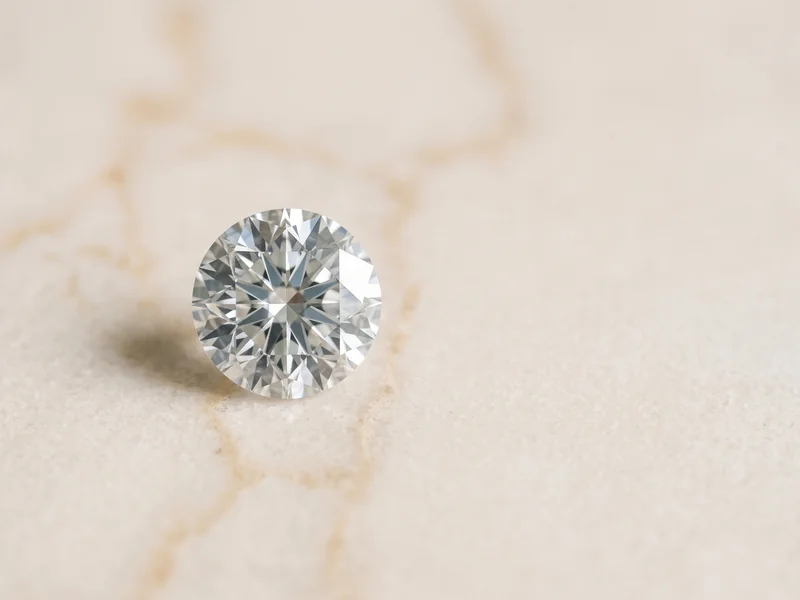 Lab-Grown DiamondsCVD Growth Striations: Should Buyers Worry?
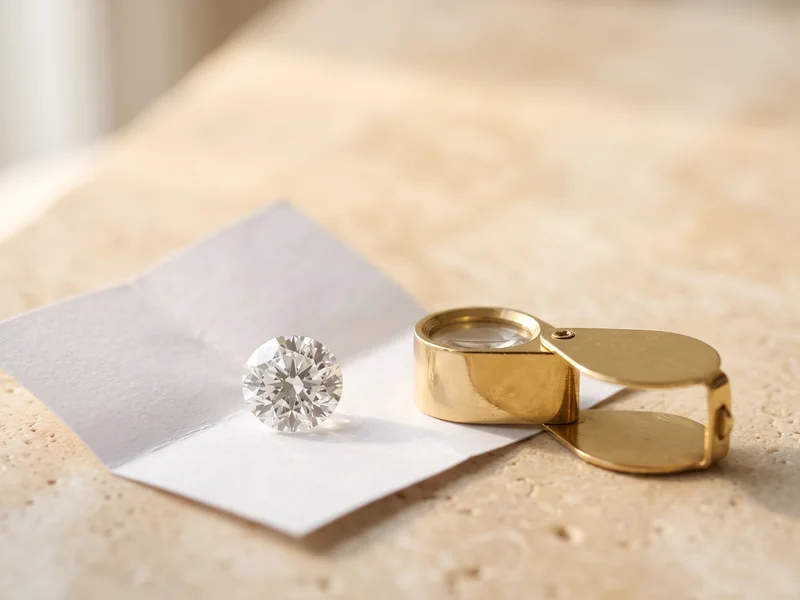 Certificates & ValuationsGSI and EGL Diamond Reports: What to Know
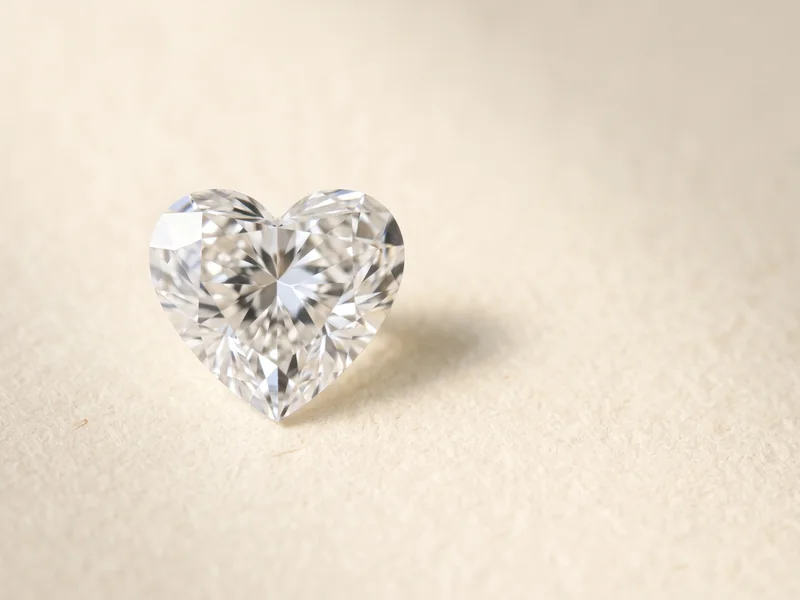 Diamond ShapesHow Big Should a Heart-Shaped Diamond Be to Show Its Shape?Diamond 4Cs & GradingDiamond Education
Explore more
More guides on this topic
Education