
- Education
- Fancy Colour Diamonds
- Pink Diamonds: Colour, Rarity and How to Choose One
Fancy Colour Diamonds
Pink Diamonds: Colour, Rarity and How to Choose One
Pink diamonds range from a barely-there blush to a deep rose, and from a few hundred dollars to millions. Here is what causes the colour, how it is graded, what Argyle's closure changed and how to tell natural, treated and lab-grown pinks apart.
 Reviewed by Raj Sood, Graduate Gemologist (GIA), AJP (GIA)Master jeweller and Graduate Gemologist (GIA) · reviewed 4 November 2026
Quick answer
Pink diamonds get their colour from a distortion in the crystal lattice called plastic deformation, not from a trace element. GIA grades them from Faint to Fancy Vivid, and deeper colour costs far more. Natural pinks are extremely rare, especially since Argyle closed in 2020; lab-grown and treated pinks look similar and cost a fraction of the price.
What are pink diamonds?
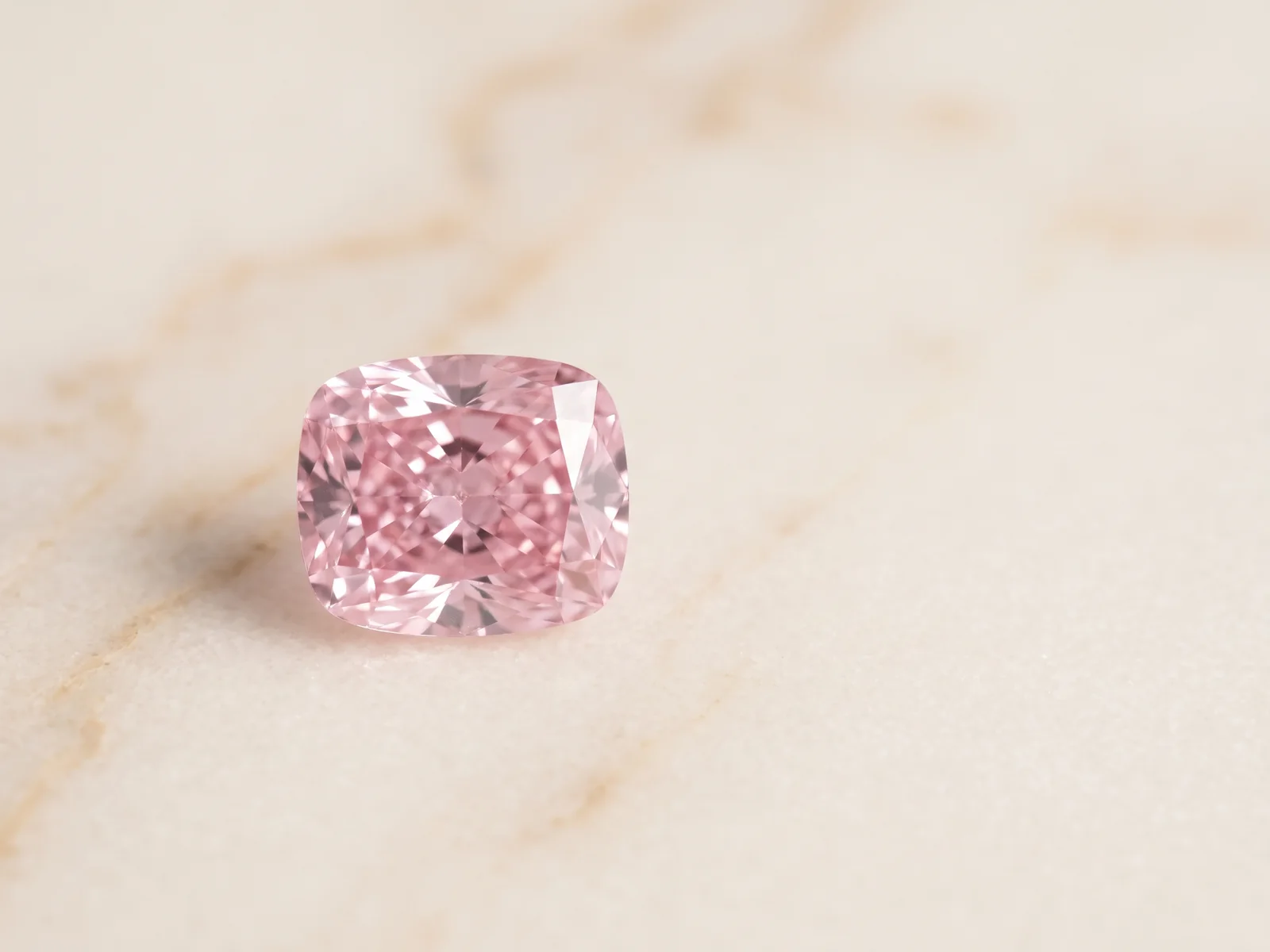
Pink diamonds are natural or laboratory-grown diamonds with a pink body colour, from a faint blush to a deep rose. Chemically they are the same as any diamond: pure carbon, 10 on the Mohs hardness scale and a refractive index of 2.42, so they wear and sparkle like a white diamond. Only the colour is different.
They belong to the fancy colour diamond family, alongside yellow and canary diamonds, blue diamonds and champagne and cognac stones. Unlike yellow and brown, which only count as fancy colours once they go past the Z end of the D–Z scale, pink is graded as a fancy colour at any strength. Even a faint pink is reported as a coloured diamond, not as a slightly tinted white one.
Natural pinks are among the rarest diamonds mined. Most are small: a natural pink over one carat is uncommon, and one over five carats belongs in an auction catalogue. That rarity, and the closure of the mine that produced most of them, is why the price gap between natural, treated and lab-grown pinks is so wide.
What causes pink diamonds to be pink?
Most coloured diamonds owe their colour to a trace element. Nitrogen makes yellow diamonds yellow and boron makes blue diamonds blue. Natural pinks are different. Their colour is linked to plastic deformation, which means the crystal was squeezed and slightly bent deep in the earth after it formed, without breaking.
That stress slides layers of carbon atoms along planes in the crystal, called glide planes. Defects along those planes absorb light in the green-yellow part of the spectrum, centred around 550 nanometres, and the light that is left reaches your eye as pink. Gemmologists still debate the exact defect responsible, but the link with deformation is well established.
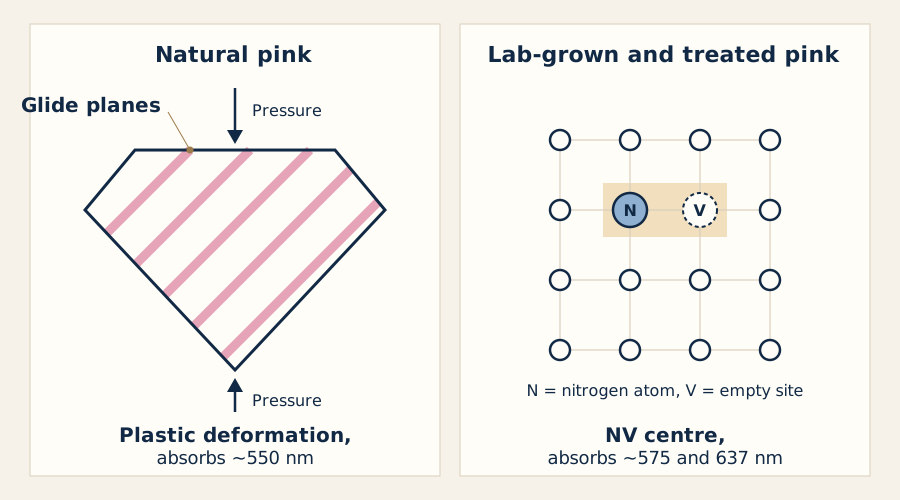
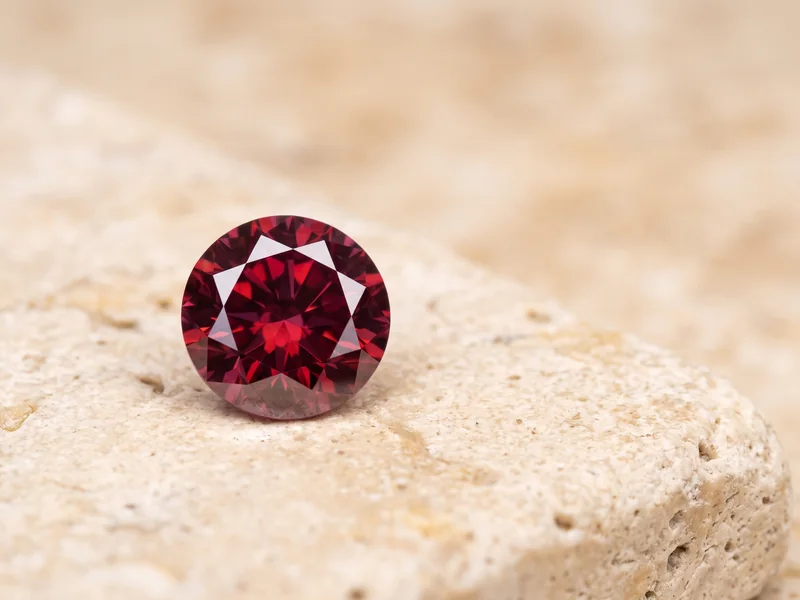
Because the colour forms along those planes, it is often uneven. Under magnification many natural pinks show pink graining: fine parallel lines or bands of colour against paler areas. It is a useful sign of natural origin, though a lab confirms origin with spectroscopy, not by eye. The same process, pushed further, produces the rare red diamond and many purple and purplish pink stones. Many brown diamonds have a related cause, which is why pinks and browns came out of the same mines.
Lab-grown and treated pinks get their colour another way. It usually comes from a nitrogen-vacancy (NV) centre: a nitrogen atom sitting next to a missing carbon atom, created by irradiating and then heating the stone. NV centres absorb light at about 575 and 637 nanometres, a different fingerprint from natural pink, and that is one of the main ways labs tell them apart.
How are pink diamond colour grades decided?
GIA grades a pink diamond on three things: hue (the colour itself), tone (how light or dark it is) and saturation (how strong it is). These combine into a single intensity grade, judged face-up under controlled lighting against reference stones.
| GIA intensity grade | How it looks | Notes |
|---|---|---|
| Faint Pink | A hint of pink, often clearest next to a white diamond | The entry point for natural pink |
| Very Light Pink | Soft blush, visible face-up | Common in pavé and side stones |
| Light Pink | Clear pale pink | Reads as pink across a table |
| Fancy Light Pink | Gentle, even pink | Where many buyers start for a centre stone |
| Fancy Pink | Definite, mid-strength pink | Clearly a coloured diamond |
| Fancy Intense Pink | Rich, saturated pink | Very rare in natural stones over 1 ct |
| Fancy Vivid Pink | The strongest, purest saturation | The top of the scale and of the price range |
| Fancy Deep Pink | Strong colour with a darker tone | Deep rose; prized in Argyle stones |
| Fancy Dark Pink | Dark tone, lower saturation | Often brownish; usually priced lower |
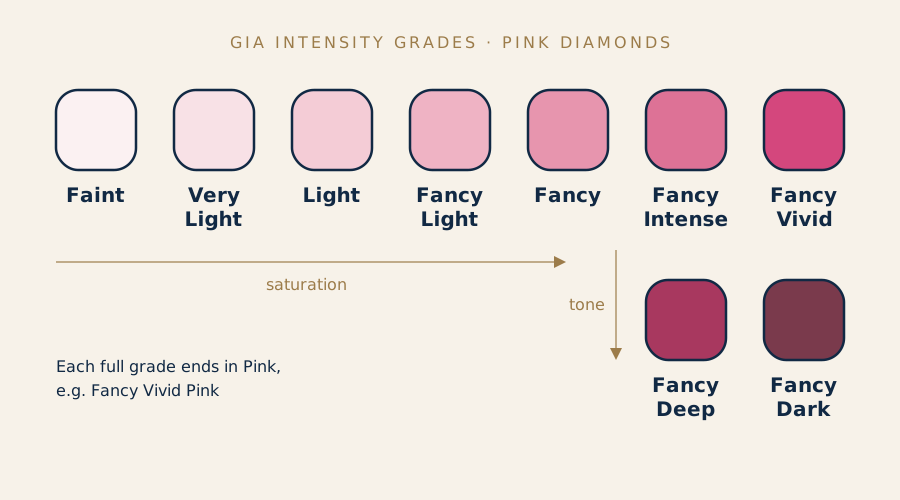
Then come the modifiers. A stone might be graded Fancy Purplish Pink, Fancy Orangy Pink or Fancy Brownish Pink. The last word is the main colour; anything before it is a secondary tint. Purplish pink is generally the most sought after and brownish pink the least, so two stones of the same intensity can be priced very differently. If the brown is strong enough to lead, the stone is graded as a pinkish brown and moves toward the brown and champagne range. For how the top grade is defined, see what Fancy Vivid actually means.
Cut matters more than it does for white diamonds. Cutters often choose radiant, cushion, oval and pear shapes for pinks because their facet patterns keep light travelling inside the stone for longer, which deepens the colour. A round brilliant is designed for white sparkle and can make a pink look a grade paler. Clarity matters less: colour drives the price, and many fine natural pinks are SI or even I clarity.
What made Argyle pink diamonds so special?
Australia's part in the pink diamond story is hard to overstate. The Argyle mine in the East Kimberley of Western Australia, operated by Rio Tinto, began mining in 1983 and closed in November 2020. Over those 37 years it produced the large majority of the world's natural pink diamonds, often quoted as more than 90 per cent.
Even at Argyle, pinks were a tiny fraction of output. Most of the mine's hundreds of millions of carats were brown and champagne diamonds, and pinks made up well under one per cent. Most polished Argyle pinks are small, typically under half a carat, which is why so many are used as accent stones around a white centre.
The finest stones went to the annual Argyle Pink Diamonds Tender, an invitation-only sale of usually 50 to 70 stones. Argyle graded these with its own system alongside GIA's:
- Hue codes: PP (purplish pink), P (pink), PR (pink rosé, a softer pink), PC (pink champagne, pink with brown), plus BL for blue-violet stones and Red for the rarest.
- Intensity numbers: 1 to 9, where 1 is the most intense. A 3PP is a strong purplish pink; an 8P is a pale pink.
- Paperwork: certified Argyle stones above a set size came with an Argyle certificate and a laser-inscribed number on the girdle (the thin outer edge of the stone).
Since the closure, no single mine has replaced Argyle's supply. Natural pinks still come in small numbers from Russia, South Africa, Brazil, Tanzania and elsewhere, but certified Argyle stones are now a finite pool. That is part of their appeal. It does not make them an investment: retail and resale prices are very different things, and a pink diamond is best bought because you love it.
Not sure which one is right?
Send us the stones you are looking at and our gemologist will tell you which to choose and why.
Natural, lab-grown or treated pink diamonds: what's the difference?
All three are real diamond, with the same hardness and sparkle. The difference is how the pink got there, and that decides the price and what the grading report says.
| Natural pink | Treated natural pink | Lab-grown pink | |
|---|---|---|---|
| Origin | Mined; colour formed in the earth | Mined diamond; colour added by HPHT, irradiation and annealing | Grown in a laboratory (usually CVD); colour usually added after growth |
| Colour cause | Plastic deformation | Mostly NV centres | Mostly NV centres |
| Typical look | Often softer; can be uneven or grained | Even, often strong pink | Even, often strong, sometimes slightly purplish |
| Report says | Colour origin: Natural | Colour origin: Treated | Laboratory-grown, with treatment noted |
| Availability | Very rare, mostly small sizes | Moderate | Widely available, including 1–3 ct |
| Relative price | By far the highest | Far below natural | Usually the lowest |
Lab-grown pink diamonds are laboratory-grown diamonds: identical in chemistry and hardness to mined diamonds, but made in weeks rather than formed over billions of years. Most are grown by CVD (chemical vapour deposition, where carbon from a gas builds up layer by layer on a seed) as a near-colourless or brownish crystal, then irradiated and heated to create the pink. The colour is stable in normal wear. They suit anyone who wants a strong pink at a realistic size and budget.
Treated pink diamonds are natural diamonds whose colour has been changed. The permanent methods, HPHT (high pressure, high temperature) processing combined with irradiation and annealing, are stable but must always be disclosed. A cheaper method is a thin pink surface coating, which can scratch or wear off and can be damaged by a jeweller's torch during repairs; we steer people away from coated stones. Our guide to HPHT and irradiation treatments covers each method in detail.
Browse natural and lab-grown pink diamonds in our stock
How do you read the colour origin on a GIA report?
For a pink, the most important line on the report is not clarity: it is colour origin. You cannot tell natural from treated or lab-grown pink by eye, so this line is what you are really paying for. Here is how the key entries typically read. These show the wording, not specific stones.
| What you see on the report | What it means |
|---|---|
| Coloured diamond report; Colour: Fancy Intense Purplish Pink; Colour origin: Natural | Mined diamond with naturally formed colour. The top category for price |
| Colour: Fancy Pink; Colour origin: Treated | Natural diamond with artificially changed colour; comments may mention HPHT or irradiation |
| Colour: Fancy Light Pink; Colour origin: Undetermined | The lab could not confirm the origin, more common in very small stones; treat with caution |
| Laboratory-grown diamond report; Colour: Fancy Vivid Pink; comments: CVD grown, post-growth treatment | Laboratory-grown diamond with colour created after growth; the girdle inscription reads 'Laboratory-Grown' |
| Argyle certificate plus a GIA report | Natural Argyle stone; check the inscription number matches both documents |
Also check that the report number and laser inscription match and that the report is recent. IGI also grades lab-grown pinks, and its reports state laboratory-grown origin and any treatment clearly. For a natural pink at any serious price, a GIA colour-origin determination is the standard to ask for.
How much are pink diamonds worth?
Price depends first on origin, then intensity, then size, modifier and cut. Clarity comes last. The ranges below are rough guides for a stone of about half a carat and move with the market, so treat them as orders of magnitude rather than quotes.
| Type and grade (about 0.50 ct) | Approximate price (AUD) |
|---|---|
| Lab-grown pink, Fancy Intense to Fancy Vivid | about $500–$2,500 |
| Treated natural pink, Fancy to Fancy Intense | about $1,500–$6,000 |
| Natural Faint to Light Pink | about $8,000–$40,000 |
| Natural Fancy Light to Fancy Pink | about $40,000–$200,000 |
| Natural Fancy Intense, Vivid or Deep Pink | from about $150,000 to well over $1,000,000 |
Natural price per carat climbs steeply with size, because larger natural pinks are so scarce. A purplish modifier adds value; a brownish one can lower the price considerably. At the very top, the 59.60 carat Pink Star sold at auction in 2017 for about US$71 million, at the time the highest price paid for any gem at auction.
Lab-grown prices have fallen as production has grown, and lab-grown diamonds generally resell for a small fraction of their purchase price. Natural pinks hold their rarity, but resale through a dealer or auction house is always below retail. Neither should be bought as a financial plan.
What are the best settings and metals for a pink diamond engagement ring?
Metal colour changes how pink a diamond looks, much more than with a white diamond. The usual choices:
- Rose gold: reflects warm pink light into the stone and makes a paler pink look stronger. A good match for Faint to Fancy Light pinks.
- Platinum or white gold: gives crisp contrast and keeps a strong pink looking pure, but can make a very pale pink look almost white.
- Yellow gold: warms the stone and can push pink toward peach; it suits orangy pinks better than purplish ones.
- Split metals: a white band with rose gold claws or a rose gold setting head, so only the metal touching the stone tints it.
A halo of white diamonds makes a small pink look larger and its colour more obvious by contrast, which is why classic Argyle rings so often pair a small pink centre with white diamonds. Pink pavé or side stones are another way to use small natural pinks. Because diamond rates 10 on the Mohs scale, a pink diamond engagement ring is fine for everyday wear in a secure claw or bezel setting. Our guide to settings and metals for coloured diamonds shows side-by-side examples.
Pink diamonds vs pink sapphire and morganite: which suits you?
If you want pink without a natural pink diamond's price, two gemstones come up most. Natural pink sapphire is corundum, 9 on the Mohs scale with a refractive index of about 1.76–1.77. It is tough enough for daily wear and comes in strong, saturated pinks, usually for a few hundred to a few thousand dollars per carat.
Morganite is a pink to peach variety of beryl, 7.5–8 on the Mohs scale with a refractive index of about 1.57–1.60. It is softer and paler than sapphire and needs more care in an everyday ring. Our morganite and pink sapphire comparison sets the two side by side. Lab-created pink sapphire also exists, and it must always be sold as lab-created or synthetic.
Within diamonds, pink is one colour among many, and prices vary enormously. Orange diamonds and naturally green diamonds are rare in their own right, while black diamonds and grey and salt-and-pepper stones offer character at a much lower cost. If a term on this page is new, our jewellery glossary explains it.
How to choose a pink diamond: step by step
- Decide on origin first. Natural, treated or lab-grown sets your budget more than any other choice.
- Ask for the right report. For natural, a GIA report showing colour origin: Natural; for lab-grown, a GIA or IGI laboratory-grown report.
- Choose intensity and modifier. Compare grades side by side; purplish pink costs more than brownish pink at the same intensity.
- Look in different lights. View the stone face-up in daylight and warm light, and watch for brown undertones or uneven colour.
- Check the inscription. Match the girdle inscription to the report, and to the Argyle certificate if there is one.
- Match the metal. Try rose gold and white metal around the stone before you commit to a setting.
Free consultation
Talk to a gemologist
Compare stones in person or online with Raj Sood, Graduate Gemologist (GIA), AJP (GIA).
Book a consultationShop this shape
FAQ
Common questions
Are pink diamonds real diamonds?
Yes. Natural, treated and lab-grown pink diamonds are all real diamond: pure carbon, 10 on the Mohs scale, with the same sparkle. What differs is how the colour formed, which the grading report states.
Why are pink diamonds so expensive?
Natural pinks are extremely rare, most are small, and the Argyle mine that supplied most of them closed in 2020. Lab-grown and treated pinks cost far less because they can be produced to order.
What happened to the Argyle mine?
The Argyle mine in Western Australia closed in November 2020 after 37 years of mining. Certified Argyle pinks already in circulation are now a finite supply.
Are lab-grown pink diamonds worth it?
If you want a strong pink at a larger size for a modest budget, yes. They are laboratory-grown diamond with stable colour, but they resell for much less than they cost, so choose one to wear, not to sell.
How can I tell if a pink diamond is treated?
Not by eye. A lab report from GIA or IGI states the colour origin as natural, treated or laboratory-grown, so always buy a pink with a recent report whose number matches the girdle inscription.
Do pink diamonds fade?
Natural pinks and properly HPHT- or irradiation-treated pinks keep their colour in normal wear. Surface coatings can wear off, and treated stones should always be disclosed to your jeweller before any repair that involves heat.

Ask a gemologist
Not sure which diamond to choose?
Raj Sood is a Graduate Gemologist (GIA) and master jeweller. Bring the stones you are considering, or send the reports, and he will tell you honestly which one is better and why.
Keep learning
Related guides
 Fancy Colour DiamondsRed Diamonds
 Fancy Colour DiamondsTreated Colour Diamonds (HPHT and Irradiation)
 Fancy Colour DiamondsBest Settings and Metals for Coloured Diamonds
 GemstonesPink Sapphire
 GemstonesMorganite vs Pink Sapphire
 Fancy Colour DiamondsGrey and Salt-and-Pepper Diamonds
 Fancy Colour DiamondsGreen Diamonds
Explore more
More guides on this topic
Education