
- Education
- Natural Diamonds
- How Are Natural Diamonds Formed? From the Mantle to Argyle
Natural diamonds
How Are Natural Diamonds Formed? From the Mantle to Argyle
Knowing how natural diamonds are formed explains why they are rare, why they come in different colours and how a laboratory can tell one from a lab-grown diamond. Here is the whole journey, from deep in the mantle to the ring, with Australia's own diamond story along the way.
 Reviewed by Raj Sood, Graduate Gemologist (GIA), AJP (GIA)Master jeweller and Graduate Gemologist (GIA) · reviewed 4 November 2026
Quick answer
Natural diamonds formed about 140–200 km below the surface, in the Earth's mantle, where carbon crystallised under pressures of roughly 45,000–60,000 atmospheres and temperatures of about 900–1,300°C. Most are 1–3.5 billion years old. Deep volcanic eruptions of kimberlite or lamproite carried them to the surface, where they are mined from pipes or river gravels.
How are natural diamonds formed deep in the Earth?
A natural diamond is pure carbon that crystallised deep in the Earth's mantle, the hot, slowly moving layer of rock beneath the crust. Under enormous pressure, carbon atoms lock into a tight cubic lattice, with every atom bonded to four neighbours. That arrangement is why diamond is 10 on the Mohs hardness scale and has a refractive index of about 2.42, which gives a well-cut stone its strong brilliance. Our complete guide to natural diamonds covers grading and choosing a stone; this page is about where the stone itself came from.
Pressure is the deciding factor. The same carbon at lower pressure forms graphite, the soft grey material in a pencil. Diamond only becomes the stable form of carbon from roughly 140 km down, and only where the rock is not too hot. Those conditions are met beneath the oldest, thickest parts of the continents, called cratons. Their deep roots of cool, rigid mantle rock act like a vault, where diamonds can sit for billions of years without turning back into graphite.
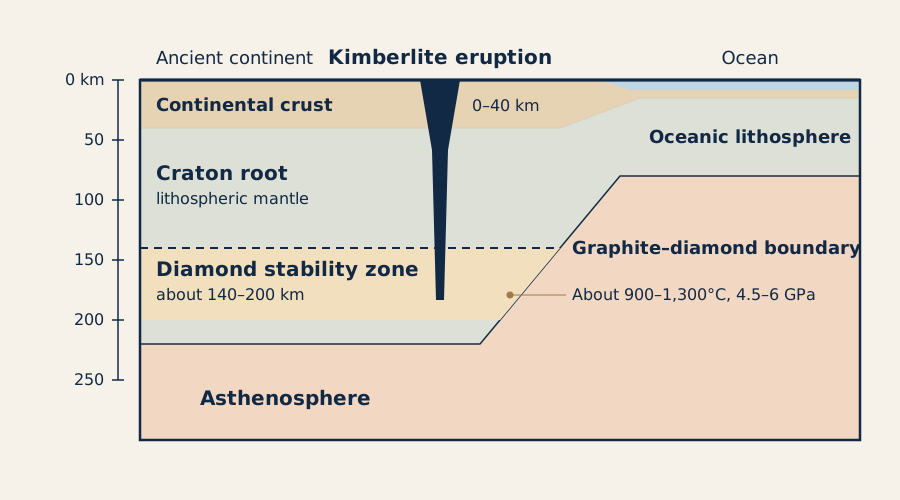
Diamonds do not form in an instant. They grow slowly from carbon-rich fluids and melts seeping through mantle rock, and many show growth in several episodes, sometimes separated by long periods of time. Along the way they can trap tiny crystals of the surrounding rock, which become the inclusions gemmologists study today. If any term here is new to you, our plain-English jewellery glossary explains it.
How deep, how hot and how long does it take for a diamond to form?
Here are the typical conditions for the gem diamonds you see in jewellery. The figures are ranges because each diamond had its own history, and scientists are still refining them.
| Condition | Typical range | What it means |
|---|---|---|
| Depth | About 140–200 km | Most gem diamonds; deeper than any mine or drill hole |
| Superdeep origin | About 300–800 km | A small minority, including some very large diamonds |
| Temperature | About 900–1,300°C | Hot, but cool for that depth, thanks to the craton root |
| Pressure | About 4.5–6 GPa (45,000–60,000 atmospheres) | Enough to force carbon into the diamond lattice |
| Age of the diamond | Mostly 1–3.5 billion years | Dated from mineral inclusions trapped inside |
| Journey to the surface | Hours to days | A fast volcanic eruption, far younger than the diamond |
Nobody can watch a natural diamond grow, so the exact growth time is unknown. What we can measure is age. Scientists date the tiny garnet and sulfide inclusions locked inside diamonds using radioactive decay, and the results show that many diamonds are older than complex life on Earth. The volcanic rock that carried them up is usually much younger, often only tens to a few hundred million years old. In other words, most diamonds waited in the mantle for a very long time before a passing eruption picked them up.
A small group of superdeep diamonds grew far lower, between about 300 and 800 km. Some of the largest diamonds ever found, including the 3,106 ct Cullinan found in South Africa in 1905, belong to a superdeep type that is very pure and contains tiny specks of metallic iron. These stones are a window into parts of the Earth no one can sample directly.
Tiny diamonds can also form when meteorites strike the Earth, and microscopic diamonds occur in some meteorites themselves. These are usually far too small to cut and play no part in the jewellery trade.
Are diamonds made from coal?
No, and this is one of the most common myths. Coal forms in the crust, usually only a few kilometres down, from buried plant material. Diamonds formed well over 100 km deeper, and most are older than the first land plants, which appeared around 470 million years ago. The carbon in diamonds came mainly from two places:
- Mantle carbon: carbon that has been in the deep Earth since the planet formed. Diamonds grown in mantle rock called peridotite are known as peridotitic diamonds.
- Recycled surface carbon: carbon from ocean floor rock and sediments carried down into the mantle where one tectonic plate slides beneath another. Diamonds grown in this transformed rock, called eclogite, are eclogitic diamonds.
Gemmologists can often tell the two apart from the inclusions. Peridotitic diamonds may trap purple-red chromium-rich garnet, green olivine or bright green chrome diopside; eclogitic diamonds tend to hold orange garnet and pale green clinopyroxene. The red pyrope you might know from our guide to natural garnet gemstones is a close cousin of the garnets found inside diamonds, and the same garnets are a key clue for diamond prospectors.
How do diamonds get to the surface?
Diamonds reach the surface inside rare, gas-rich volcanic rocks called kimberlite and lamproite. These magmas start deep in the mantle and punch upwards at speed, often estimated at tens of kilometres per hour, ripping off chunks of mantle rock (called xenoliths) along the way. Diamonds ride along in those chunks or loose in the magma.
Speed matters. If the magma rose slowly, the diamonds would spend too long in hot, low-pressure conditions and would begin to dissolve or turn to graphite. Many natural diamonds do show some rounding and etching from the trip, a process called resorption, but a fast eruption delivered them mostly intact.
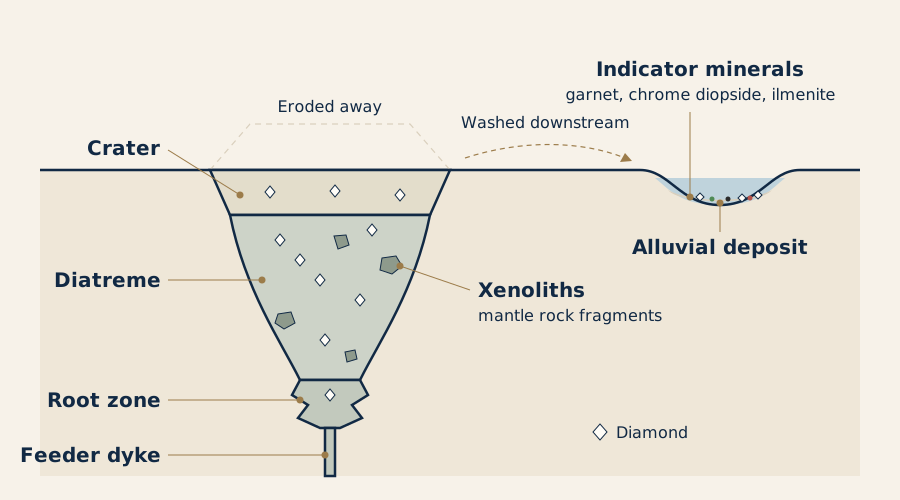
Near the surface, the gas-charged magma blasts out a carrot-shaped pipe, topped by a crater. Over millions of years, rain and rivers wear the top of the pipe away. Diamonds, being very hard and heavy, survive the trip downstream and collect in gravels, sometimes hundreds of kilometres away, even on beaches, as along the coast of Namibia. These are alluvial deposits. Because weaker, fractured stones break up along the way, alluvial diamonds tend to be of better quality on average.
Only a small share of kimberlite and lamproite pipes carry diamonds at all, and only a few dozen in history have been rich enough to mine. Even in a working mine, a tonne of rock may hold well under a carat, and only part of that is gem quality. That chain of chances is also why large rough crystals are so scarce.
Not sure which one is right?
Send us the stones you are looking at and our gemologist will tell you which to choose and why.
Where do Australian diamonds come from?
Australia has a rich diamond story, and it changed the world's understanding of where diamonds can come from. Until the 1970s, geologists looked almost only at kimberlite. Then, in 1979, explorers following indicator minerals up a creek in the East Kimberley of Western Australia found the Argyle pipe, which is a lamproite. Argyle went on to become one of the largest diamond producers by volume in the world.
| Deposit | Location | Host rock | Main production | Known for |
|---|---|---|---|---|
| Argyle | East Kimberley, WA | Lamproite | About 1983–2020 | Huge volumes of brown diamonds and most of the world's pinks |
| Ellendale | West Kimberley, WA | Lamproite | About 2002–2015 | Fancy yellow diamonds |
| Merlin | Northern Territory | Kimberlite | About 1999–2003 | Australia's largest diamond, about 104.73 ct |
| Copeton and Bingara | New England, NSW | Alluvial gravels | Small-scale from the late 1800s | Small, very hard diamonds found by gold miners |
Most of Argyle's output was brown, from pale champagne to deep cognac. Only a tiny fraction was pink, yet that fraction supplied around 90% of the world's pink diamonds. The colour comes from the way Argyle's diamonds were squeezed and twisted in the mantle (more on that below). When the mine closed in late 2020 after producing more than 800 million carats, the supply of new Argyle pinks ended, which is why they are so sought after today.
Diamonds were first reported in Australia in the 1850s, turned up by gold miners in New South Wales. Those alluvial stones were small, but they are a reminder that diamonds have been part of this country's mining history for well over a century.
Why are natural diamonds different colours?
A perfectly pure diamond lattice is colourless. Colour comes from what else got into the crystal as it formed, or what happened to it afterwards. The conditions deep in the mantle decide a diamond's colour long before any cutter sees it.
| Colour | Cause | How common |
|---|---|---|
| Near-colourless to light yellow | Nitrogen atoms in the lattice | By far the most common |
| Strong yellow (canary) | Isolated or clustered nitrogen | Uncommon |
| Brown | Plastic deformation (squeezing) in the mantle | Common; most of Argyle's output |
| Pink to red | Plastic deformation that distorts the lattice | Very rare |
| Blue | Traces of boron | Very rare |
| Green | Natural radiation exposure, often only on the skin | Rare |
Gemmologists also sort diamonds into types by their impurities. Type Ia contains clustered nitrogen and makes up roughly 98% of natural diamonds. Type IIa has almost no nitrogen, is often exceptionally white and accounts for only about 1–2%. Type IIb contains boron and can be blue. Some brown type IIa diamonds are later heated under high pressure in a laboratory to remove the brown; they are still natural diamonds, but the treatment must be disclosed. Our page on natural diamonds with HPHT colour treatment explains how this is detected.
What signs of formation can you see in a natural diamond?
A natural diamond carries a record of its life. With a 10× loupe or a microscope, a gemmologist may see:
- Mineral inclusions: tiny crystals of garnet, olivine or other mantle minerals trapped during growth.
- Graining: faint lines or a hazy texture from deformation, common in brown and pink stones.
- Trigons: small triangular pits on the original crystal faces, etched by hot fluids on the way up.
- Naturals: a patch of the original rough surface left unpolished, usually on the girdle (the thin outer edge).
- Indented naturals: a natural that dips below the polished surface into the stone.
Naturals are worth understanding because they show up on grading reports. Our guide to unpolished naturals on the girdle covers when they matter, and the page on indented naturals and how they affect clarity explains the version that reaches into the stone.
How are natural diamonds formed compared with lab-grown diamonds?
Lab-grown diamonds are real diamond, with the same carbon lattice, hardness and refractive index as natural diamond. The difference is how and where they grew, and that difference leaves evidence a laboratory can read.
| Natural diamond | Lab-grown diamond | |
|---|---|---|
| Where it grew | Earth's mantle, about 140–200 km down | A laboratory press or gas chamber |
| Growth time | Unknown; diamonds are mostly 1–3.5 billion years old | Usually weeks |
| Method | Carbon fluids crystallising under mantle pressure | HPHT (high pressure, high temperature) or CVD (chemical vapour deposition) |
| Typical rough shape | Octahedron (two pyramids base to base), often etched | Cube-octahedron (HPHT) or flat square plates (CVD) |
| Typical diamond type | Mostly type Ia (clustered nitrogen) | Mostly type IIa, or type Ib/IIb |
| Typical inclusions | Mantle minerals such as garnet and olivine | Metallic flux (HPHT) or dark graphite specks (CVD) |
| Grading report | States natural origin | Must state lab-grown or laboratory-grown |
Neither is better in a general sense: they suit different priorities. Lab-grown costs much less, while natural carries the geological history this page describes. Our full side-by-side of lab-grown and natural diamonds covers price, appearance and durability, and the guide to natural or lab-grown stones for an engagement ring widens the choice to sapphires and other gems.
The word natural means the same thing right across gemmology: formed by nature, without human help. It applies to coloured gemstones and even to pearls that grew without a farmer's nucleus. A simulant, such as cubic zirconia or moissanite, is different again, because it only imitates diamond. Our page on natural, synthetic and simulant gems sets out the three categories clearly.
Browse natural diamonds
Why are natural diamonds rare?
Every natural diamond needed a long run of luck: the right carbon, the right depth and temperature beneath an old continent, billions of years of stable storage, a fast eruption at the right moment, and then discovery in one of the few pipes or gravel beds worth mining. Most mined diamonds are small, included or brown, and only a minority are suitable for gem use.
Size makes the rarity sharper. Large, clean crystals are far less common than small ones, so a natural diamond does not just double in rarity as it doubles in weight; it climbs much faster. Our guide to how rarity climbs with carat weight puts this into numbers. If you are curious about how prices for natural diamonds have moved over the decades, see the history of natural diamond prices; it is useful background, but a diamond is best chosen as something to wear and enjoy, not as a financial plan.
How can you confirm a diamond is natural? Step by step
Because natural and lab-grown diamonds are the same material, you cannot tell them apart by eye. Here is how to be sure of origin before you buy.
- Ask for an independent grading report. A report from a lab such as GIA or IGI states whether the diamond is natural or laboratory-grown. Our walk-through of an IGI natural diamond report shows where to look.
- Check the origin wording. Lab-grown reports use different wording and often a different colour or layout; see how natural and lab-grown reports differ.
- Match the inscription. Many graded diamonds have a report number laser-inscribed on the girdle. Ask your jeweller to show it under magnification and compare it with the report.
- Do not rely on a handheld tester. A basic thermal tester cannot tell natural from lab-grown, and some cannot separate moissanite; read what a diamond tester can and cannot detect.
- Ask about treatments. Check whether the colour is natural or HPHT-treated; the report should say.
- For an unreported stone, send it to a lab. Laboratories use UV imaging and spectroscopy to read growth patterns; our page on the tests labs use to confirm diamond origin explains each one.
Free consultation
Talk to a gemologist
Compare stones in person or online with Raj Sood, Graduate Gemologist (GIA), AJP (GIA).
Book a consultationShop this shape
FAQ
Common questions
How long does it take for a natural diamond to form?
Nobody knows the exact growth time, because no one can watch it happen. What we do know is that most natural diamonds are between about 1 and 3.5 billion years old, dated from the minerals trapped inside them.
How deep are natural diamonds formed?
Most gem diamonds formed about 140–200 km below the surface, in the mantle beneath old continents. A small number of superdeep diamonds formed between about 300 and 800 km down.
Are diamonds made from coal?
No. Coal forms only a few kilometres down from plant material, while diamonds formed well over 100 km deeper, and most are older than land plants. Their carbon came from the mantle or from ocean floor rock carried down by tectonic plates.
Are there still diamond mines in Australia?
Australia's major diamond mines, including Argyle, Ellendale and Merlin, have closed, with Argyle ending production in 2020. Exploration continues, but large-scale production has stopped for now.
Why were Argyle diamonds pink?
Argyle's diamonds were heavily squeezed and deformed in the mantle, which distorted the carbon lattice and created pink, red and brown colours. Pinks were a tiny fraction of the mine's output but supplied most of the world's pink diamonds.
Can you tell a natural diamond from a lab-grown diamond by looking at it?
No. They are the same material and look identical to the eye. A grading report or a laboratory test using UV imaging and spectroscopy is needed to confirm origin.
Terms in this guide

Ask a gemologist
Not sure which diamond to choose?
Raj Sood is a Graduate Gemologist (GIA) and master jeweller. Bring the stones you are considering, or send the reports, and he will tell you honestly which one is better and why.
Keep learning
Related guides
 Lab-Grown DiamondsLab-Grown Diamonds vs Natural Diamonds
 Lab-Grown DiamondsHow Laboratories Identify Natural vs Lab-Grown Diamonds
 Natural DiamondsNatural Diamond Rarity by SizeNatural DiamondsNatural Diamond Value Over Time
 Natural DiamondsHPHT Natural DiamondsDiamond 4Cs & GradingIndented Naturals in Diamonds
 Lab-Grown DiamondsCan a Diamond Tester Tell Natural From Lab-Grown?
Explore more
More guides on this topic
Education