
- Education
- Gemstones
- Natural vs Synthetic vs Simulant Gemstones: What Each Means and How to Tell Them Apart
Gemstones
Natural vs Synthetic vs Simulant Gemstones: What Each Means and How to Tell Them Apart
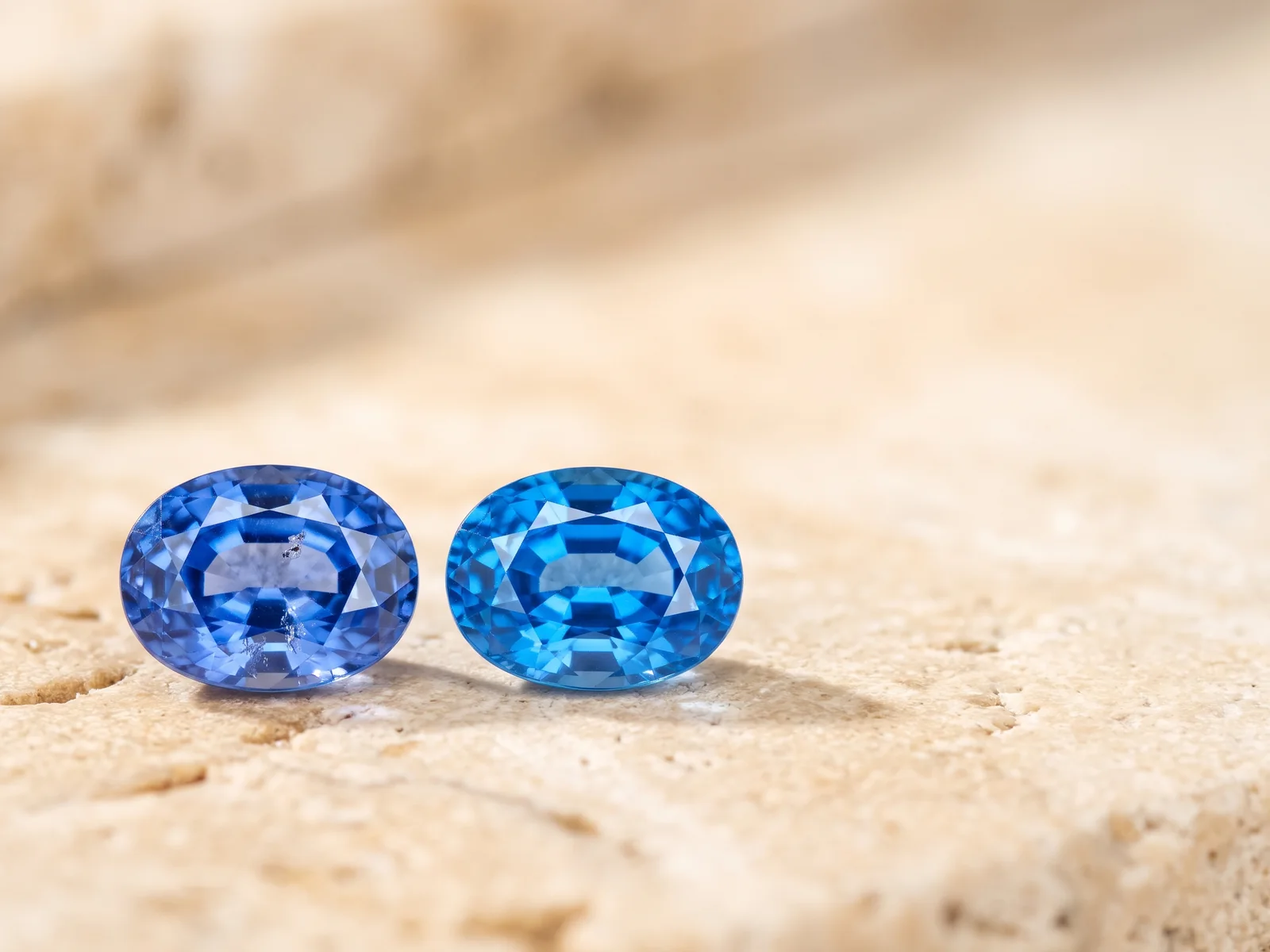
Three stones can look identical across the counter and be completely different things. Knowing the difference between natural vs synthetic vs simulant gemstones tells you what you are paying for, how the stone will wear and what the seller must disclose.
 Reviewed by Raj Sood, Graduate Gemologist (GIA), AJP (GIA)Master jeweller and Graduate Gemologist (GIA) · reviewed 4 November 2026
Quick answer
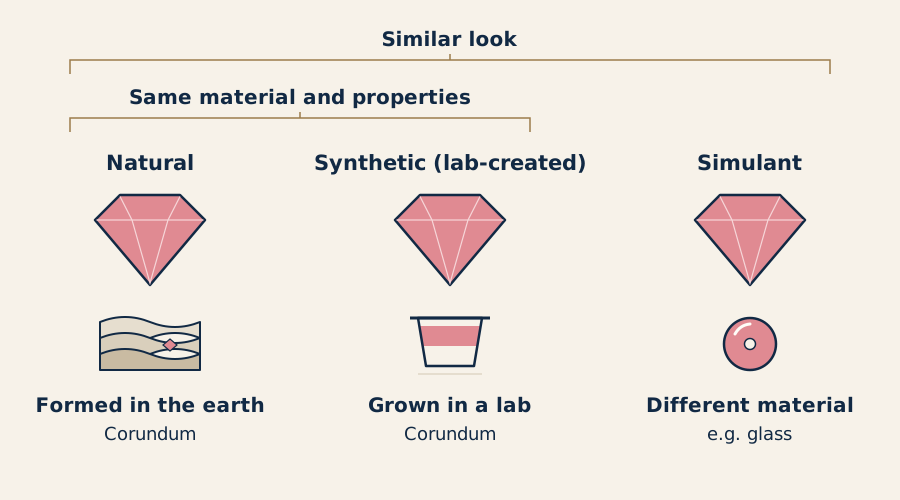
A natural gemstone formed in the earth. A synthetic (lab-created) gemstone has the same chemistry, crystal structure and properties as the natural gem but was grown in a laboratory. A simulant only imitates the look, using a different material, such as cubic zirconia imitating diamond or glass imitating emerald. Labs separate them by inclusions, refractive index and spectroscopy.
What is the difference between natural vs synthetic vs simulant gemstones?
Every gemstone falls into one of three origin groups, and the group matters more to price and disclosure than colour or size. A natural gemstone formed through geological processes, without human help, and was then mined, cut and polished. A synthetic gemstone (also called lab-created, lab-grown or laboratory-grown) has essentially the same chemical composition, crystal structure and physical properties as its natural counterpart, but it was grown in a laboratory. A simulant (or imitation) only looks like the gem it copies; it is a different material with different properties.
So a lab-created ruby is genuine corundum, the same aluminium oxide (Al2O3) as a ruby from Myanmar, and it scratches no more easily. Red glass cut to look like a ruby is a simulant: softer, lighter and optically different. The same three groups apply to diamond, to the stones across our coloured gemstones and birthstones pages and, with a twist, to pearls.
| Natural | Synthetic (lab-created) | Simulant | |
|---|---|---|---|
| Where it comes from | Formed in the earth over thousands to millions of years | Grown in a laboratory in hours to months | Made or chosen to imitate another gem |
| Chemistry and crystal structure | The gem's own | Same as the natural gem | Different from the gem it imitates |
| Hardness and refractive index | The gem's own | Same as the natural gem | Different, often lower |
| Typical inclusions | Mineral crystals, silk, fluid fingerprints | Gas bubbles, curved lines, flux, metallic particles | Gas bubbles, swirls, or almost none |
| Example | Natural ruby | Lab-created ruby | Red glass or a garnet-and-glass doublet |
| Relative price | Highest | Much lower | Usually lowest |
Gemologists add one more label. An artificial product is a lab-made material with no natural counterpart, such as cubic zirconia (CZ) or YAG. These are not synthetic versions of anything, because nothing in nature matches them, so they are used only as simulants. Any unfamiliar term here is also in our plain-English jewellery glossary.
What counts as a natural gemstone?
Natural means geology did the growing. Sapphire and ruby crystallise in metamorphic and some igneous rocks, and some are carried to the surface in volcanic basalts, which is the source of the sapphires found in New England in New South Wales and around Anakie in central Queensland. Diamonds formed far deeper, roughly 150–200 km down in the mantle, under heat and pressure no rock near the surface ever sees; our guide to how natural diamonds form deep in the mantle explains the journey up.
Natural does not mean untreated. Most natural sapphires and rubies on the market have been heated to improve colour or clarity. Many emeralds have their surface-reaching fractures filled with oil or resin. Some natural diamonds have their colour changed under high pressure and temperature, covered in our page on natural diamonds whose colour has been changed by HPHT. A treated stone is still natural in origin, but the treatment must be disclosed because it affects price and care.
The proof of natural origin is usually written inside the stone or on its surface. In coloured gems it is the inclusions (internal features): fine rutile needles called silk, tiny mineral crystals, healed fractures that look like fingerprints. In diamonds, a cutter sometimes leaves a patch of the original crystal skin. Our pages on naturals left on a diamond's girdle and indented naturals that dip below the polished surface show what these look like and why they are a reassuring sign.
Rarity drives natural prices, and it climbs steeply with size; the pattern is clearest in diamond, set out in how rarity climbs with size in natural diamonds. Economics also decides which gems get synthesised at all. Natural garnet (almandine, pyrope, spessartine, tsavorite and others) is plentiful and affordable in most colours, so there is little commercial reason to grow it. A garnet you buy is almost always natural, while ruby, sapphire and emerald, where natural material is costly, are grown in large quantities.
How are lab-created gemstones made?
Lab-created gemstones are grown by recreating the conditions a crystal needs: the right ingredients, heat and, for some gems, pressure, controlled far more tightly than in nature. The method leaves its own fingerprint inside the stone, which is how gemologists identify it later.
| Method | How it works | Gems commonly grown | Tell-tale signs |
|---|---|---|---|
| Flame fusion (Verneuil) | Powdered chemicals melted in a flame and dropped onto a rotating rod, building a pear-shaped crystal (a boule) in hours | Ruby, sapphire, spinel | Curved growth lines (curved striae), round gas bubbles |
| Czochralski (crystal pulling) | A seed crystal slowly pulled upward from a crucible of melt | Ruby, sapphire, alexandrite, YAG | Very clean; sometimes gas bubbles or faint curved lines |
| Flux growth | Ingredients dissolved in a molten flux and cooled slowly over weeks to months | Emerald, ruby, sapphire, alexandrite, spinel | Wispy flux fingerprints, triangular or hexagonal platinum platelets from the crucible |
| Hydrothermal | Crystals grown from a hot, pressurised water solution in a steel vessel | Emerald, quartz (amethyst, citrine) | Chevron or zigzag growth lines, nail-head spicules |
| HPHT | Carbon crystallised from a metal solvent at high pressure and temperature | Diamond | Metallic flux inclusions, distinct growth sectors |
| CVD | Carbon deposited layer by layer from a gas onto a diamond seed plate | Diamond | Layered growth striations, distinctive strain patterns |
Flame fusion is the oldest commercial method; Auguste Verneuil published it in 1902, and it is still the reason lab-created ruby and sapphire are inexpensive. A 1 carat flame-fusion sapphire can cost less than a dinner out. Flux and hydrothermal growth are slower and costlier, and they produce inclusions that look more like nature's, so those stones take more skill to separate from natural ones.
Lab-grown diamond follows the same rule as other synthetics: it is crystalline carbon, 10 on the Mohs scale, with a refractive index of about 2.42, identical to natural diamond in everyday wear. Our page on lab-grown and natural diamonds compared covers price, grading and how each holds up.
Moissanite is a useful oddity. Natural moissanite (silicon carbide) exists only as tiny grains, first identified in material from a meteorite impact site, so every moissanite in jewellery is lab-made. It is a synthetic moissanite and, when used in place of diamond, a diamond simulant at the same time.
Browse lab-created gemstones
What is a simulant gemstone, and what are common examples?
A simulant is defined by what it pretends to be, not by what it is made of. It can be an artificial product such as CZ, a synthetic of a different gem, or even a natural stone standing in for a rarer one. Synthetic spinel coloured blue to imitate sapphire is both things at once: a synthetic (of spinel) and a simulant (of sapphire). That is the heart of the synthetic vs simulant question: a synthetic matches the gem's material, a simulant only matches its look.
| Simulant | What it is | Usually imitates | Mohs | Refractive index |
|---|---|---|---|---|
| Cubic zirconia (CZ) | Artificial zirconium oxide | Diamond | 8–8.5 | about 2.15–2.18 |
| Synthetic moissanite | Lab-made silicon carbide | Diamond | 9.25 | about 2.65–2.69, doubly refractive |
| YAG | Artificial yttrium aluminium garnet | Diamond, coloured stones | about 8–8.5 | about 1.83 |
| GGG | Artificial gadolinium gallium garnet | Diamond | about 6.5 | about 1.97 |
| Glass | Non-crystalline (amorphous) silica-based material | Almost any gem | about 5–6 | about 1.50–1.70 |
| Synthetic spinel | Lab-created magnesium aluminium oxide | Aquamarine, sapphire, diamond | 8 | about 1.73 |
| Doublet or triplet | Two or three materials glued or fused together | Opal, emerald, sapphire, ruby | Depends on the top layer | Depends on the top layer |
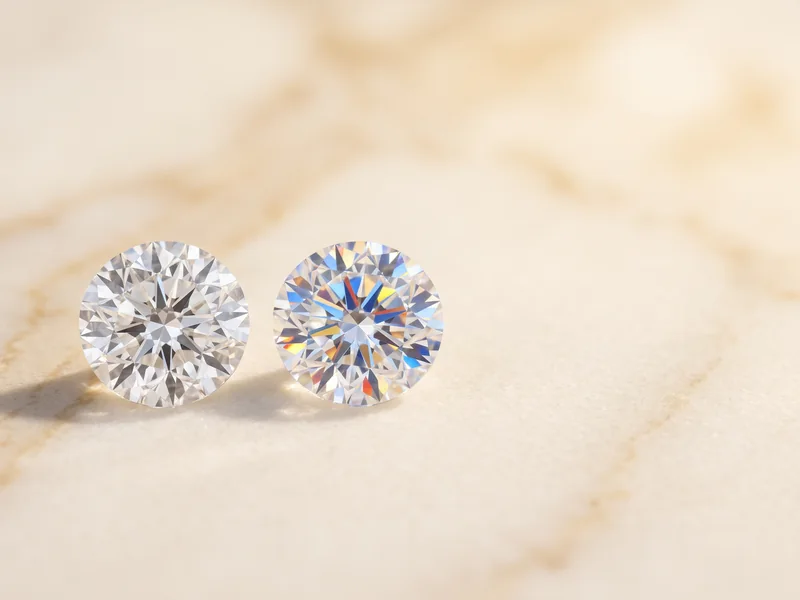
Compare those numbers with the real thing: diamond is Mohs 10 with a refractive index of about 2.42, and corundum (ruby and sapphire) is Mohs 9 at about 1.76–1.77. Refractive index is how strongly a material bends light, and it is one of the quickest ways to tell materials apart. Our page on CZ, YAG, GGG and glass as diamond imitations goes through each one in detail.
Composite stones deserve a special mention. A doublet is two pieces joined together; a triplet is three. The garnet-and-glass doublet was common in jewellery from the late 1800s into the early 1900s: a thin slice of natural red garnet fused onto coloured glass, so the top had garnet's hardness and lustre while the glass supplied the colour. Place one table-down on white paper and you will often see a faint red ring at the edge, a giveaway in antique pieces. Opal doublets and triplets, with a thin layer of opal on a dark backing, are still made today and need protecting from water.
Related guideDiamond Simulants: CZ, YAG, GGG and GlassNot sure which one is right?
Send us the stones you are looking at and our gemologist will tell you which to choose and why.
Natural vs synthetic vs simulant gemstones: which holds up best in wear?
A synthetic wears exactly like the natural gem, because it is the same material. A simulant wears like whatever it is actually made of, which can be very different. That matters most in rings, which knock against benches, car doors and tap fittings every day. For a ring worn daily, most gemologists suggest 8 or above on the Mohs scale; our Mohs hardness of common gems page lists where each stone sits.
| Natural blue sapphire | Lab-created blue sapphire | Blue glass | Blue synthetic spinel | |
|---|---|---|---|---|
| Material | Corundum | Corundum | Glass | Spinel |
| Mohs hardness | 9 | 9 | about 5–6 | 8 |
| Refractive index | 1.762–1.770 | 1.762–1.770 | about 1.50–1.70 | about 1.73 |
| Specific gravity | about 4.00 | about 4.00 | about 2.3–4.5 | about 3.64 |
| Typical inclusions | Silk, crystals, straight colour bands | Curved striae, gas bubbles (flame fusion) | Round bubbles, swirls | Often clean, sometimes bubbles |
| Suits a daily-wear ring? | Yes | Yes | Not recommended | Yes, with some care |
Specific gravity (SG) is how heavy a material is compared with the same volume of water. It explains why a CZ feels surprisingly heavy in the hand (SG about 5.6–6.0, against diamond's 3.52), and it is a simple check a gemologist can run on a loose stone.
Glass is where simulants fail first. At Mohs 5–6 it is softer than the quartz in ordinary dust (Mohs 7), so its facet edges round off and the table scuffs within a few years of daily wear. Lab-created sapphire, by contrast, will look the same after twenty years as a natural sapphire treated the same way. Synthetic colour also tends to be more even: natural sapphire usually shows straight, angular colour bands, while flame-fusion stones show curved ones.
How do gemologists tell natural from synthetic gemstones?
Separating a simulant from the real gem is usually quick: a refractometer reading, an SG test or a look at the hardness of the facet edges will do it. Separating natural from synthetic is harder, because the material is the same. It comes down to growth evidence, and there is a clear order of tools:
- 10x loupe and microscope: inclusions and growth lines, the first and often the deciding test.
- Refractometer: measures refractive index and whether the stone is singly or doubly refractive (splits light into two rays).
- Specific gravity: weighing a loose stone in air and in water.
- Polariscope and UV lamp: strain patterns and fluorescence (glow under ultraviolet light), which can differ between natural and lab-grown material.
- Laboratory spectroscopy: FTIR, Raman, UV-Vis-NIR and photoluminescence read the stone's atomic make-up; trace-element analysis can even point to a geographic origin.
What the microscope looks for:
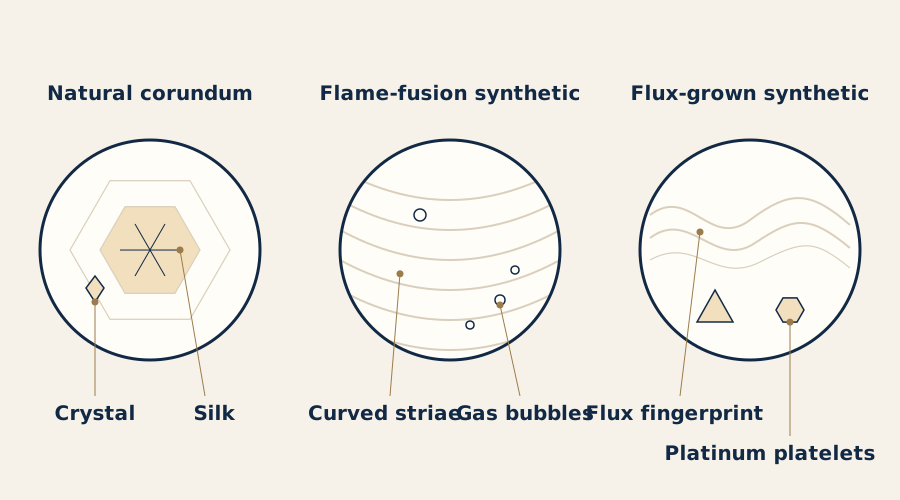
- Natural corundum: fine rutile silk, crystals, fingerprints and straight, angular colour zoning.
- Flame-fusion corundum: curved striae, like the grooves on a vinyl record, and round gas bubbles.
- Flux-grown stones: wispy flux veils and shiny platinum platelets from the crucible.
- Hydrothermal emerald: chevron-shaped growth and nail-head spicules (a tiny crystal with a tail).
- Natural emerald: often jagged three-phase inclusions, a pocket holding liquid, gas and a crystal together.
Diamond needs more equipment, because natural and lab-grown diamond share every basic property. Our explainer on the instruments labs use to separate natural and lab-grown diamonds covers spectroscopy and fluorescence imaging. Handheld testers are a different story: a thermal tester will read lab-grown diamond as diamond and can be fooled by moissanite, as explained in what a handheld diamond tester can and cannot tell you.
Where do cultured pearls fit: natural, synthetic or simulant?
Pearls break the pattern. A natural pearl forms by chance inside a mollusc. A cultured pearl forms when a farmer implants a bead or piece of tissue, and the living mollusc then coats it in nacre (the layered mineral that gives pearls their lustre) over months or years. A cultured pearl is not synthetic, because an animal made it, and it is not a simulant, because it is real nacre. It sits in its own category, and most pearls sold today are cultured, including the South Sea pearls farmed off Western Australia.
Imitation pearls are the simulants: glass, plastic or shell beads coated with a pearly finish. Rub one gently against your front tooth and it usually feels smooth; real nacre feels slightly gritty. Our guide to natural and cultured pearls explained covers the X-ray tests labs use to separate them.
Are synthetic gemstones real, and are they worth buying?
Yes, synthetic gemstones are real gem material. A lab-created sapphire is real sapphire in every physical sense; what differs is origin and, therefore, rarity and price. Whether that makes one worth buying depends on what you value: the material and look, which lab-created stones match, or a stone the earth made, which only natural can offer.
| About 1 ct, good quality | Natural (AUD) | Lab-created (AUD) | Common simulant (AUD) |
|---|---|---|---|
| Blue sapphire | about $1,500–$6,000 (heated) | about $50–$400 | Glass or synthetic spinel, under about $50 |
| Ruby | about $2,000–$10,000+ | about $50–$400 | Red glass or a doublet, under about $50 |
| Emerald | about $1,500–$8,000 | about $150–$900 | Glass or a doublet, under about $50 |
| Diamond, round, G–H, VS | about $5,000–$15,000 | about $800–$2,500 (lab-grown) | CZ under about $50; moissanite about $300–$1,200 |
These are broad ranges only; prices move with colour, clarity, treatment and the market. Within lab-created stones, flux and hydrothermal material costs more than flame-fusion because it takes longer to grow. Resale is the other difference. Lab-created stones have little secondhand value, while natural gems keep some, though natural stones should be bought for their beauty and meaning, not as a financial plan; our page on how natural diamond prices have moved over the years gives the honest picture.
For engagement rings in particular, the trade-offs are laid out in choosing natural or lab-grown stones for an engagement ring. Whichever you choose, the setting is built the same way.
What must a seller disclose in Australia?
The Australian Consumer Law prohibits misleading or deceptive conduct, so a gem's description has to make its origin clear before you buy. In practice the jewellery trade follows international naming guidelines such as those of CIBJO (the world jewellery confederation): a lab-made stone must carry a qualifying word directly with the gem name, in the same prominence.
- Clear: 'lab-created sapphire', 'synthetic ruby', 'laboratory-grown emerald', 'lab-grown diamond'.
- Clear: 'imitation emerald (glass)', 'cubic zirconia', 'moissanite'.
- Not acceptable on their own: the bare gem name for a lab-made stone, or vague words such as 'genuine created' or a trade name that hides the origin.
- Treatments: heating, fracture filling, HPHT colour change and coating should be stated, because they affect value and care.
An independent lab report states origin and known treatments. For coloured stones the report will say 'natural' or 'synthetic' and list treatment indications; for diamonds, labs such as GIA and IGI state clearly when a diamond is laboratory-grown and laser-inscribe many lab-grown stones on the girdle.
How to check whether a gemstone is natural, synthetic or a simulant: step by step
- Read the description. Look for the origin word beside the gem name: natural, lab-created, synthetic, lab-grown or imitation.
- Ask about treatments. For natural stones, ask whether the gem is heated, filled or otherwise treated.
- Ask for a report on important stones. An independent lab report should state natural or synthetic origin and any treatment.
- Check the price against the claim. A 'natural ruby' at a lab-created price deserves a second look.
- Look under a loupe. Note natural-looking inclusions, curved lines or gas bubbles, and whether facet edges are crisp or worn.
- Get the origin in writing. Make sure the invoice repeats exactly what you were told about origin and treatment.
Free consultation
Talk to a gemologist
Compare stones in person or online with Raj Sood, Graduate Gemologist (GIA), AJP (GIA).
Book a consultationShop this shape
FAQ
Common questions
Are synthetic gemstones real?
Yes. A synthetic (lab-created) gemstone has the same chemistry, crystal structure and hardness as the natural gem. Only its origin differs, which is why it must always be described as lab-created or synthetic.
What is the difference between synthetic and simulant?
A synthetic is the same material as the gem it is named after, just grown in a lab. A simulant only imitates the look and is a different material, such as cubic zirconia imitating diamond.
Is lab-created sapphire the same as natural sapphire?
Physically, yes: both are corundum at Mohs 9 with the same refractive index. A gemologist separates them by inclusions and growth lines, and the natural stone costs far more because it is rarer.
Is moissanite a synthetic or a simulant?
Both. All jewellery moissanite is lab-made silicon carbide, so it is synthetic moissanite, and when it is used in place of diamond it is a diamond simulant.
Can a jeweller tell if a gemstone is natural just by looking?
Often a trained gemologist can with a loupe and microscope, especially for flame-fusion stones with curved lines and bubbles. Flux-grown, hydrothermal and lab-grown diamond can need laboratory spectroscopy for a firm answer.
Do lab-created gemstones hold their value?
Lab-created stones have little resale value because they can be produced in quantity. They are a good choice for the look and durability of a gem at a lower price, not for resale.

Ask a gemologist
Not sure which diamond to choose?
Raj Sood is a Graduate Gemologist (GIA) and master jeweller. Bring the stones you are considering, or send the reports, and he will tell you honestly which one is better and why.
Keep learning
Related guides
 GemstonesDiamond Simulants: CZ, YAG, GGG and Glass
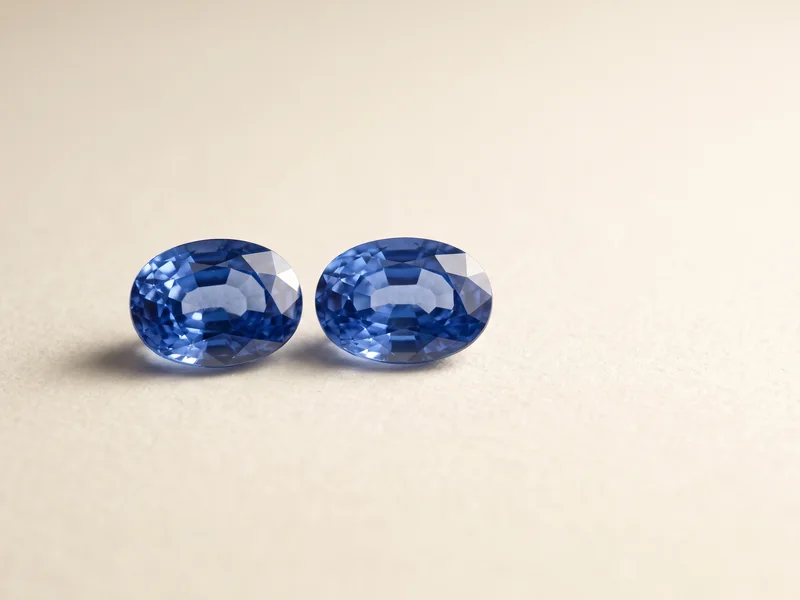 GemstonesNatural vs Lab-Grown Gemstones for Engagement Rings
 Lab-Grown DiamondsHow Laboratories Identify Natural vs Lab-Grown Diamonds
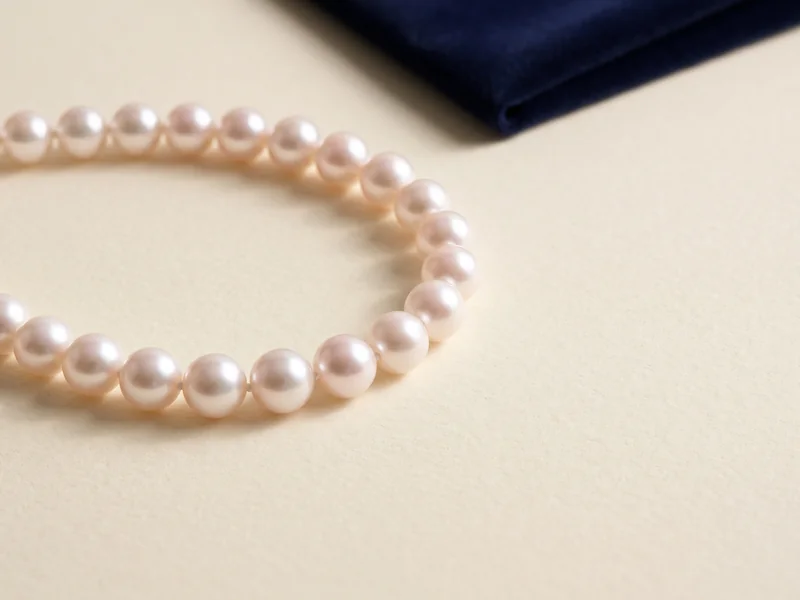 PearlsNatural vs Cultured PearlsGemstonesGemstones | Coloured Gemstones, Birthstones and Custom Jewellery
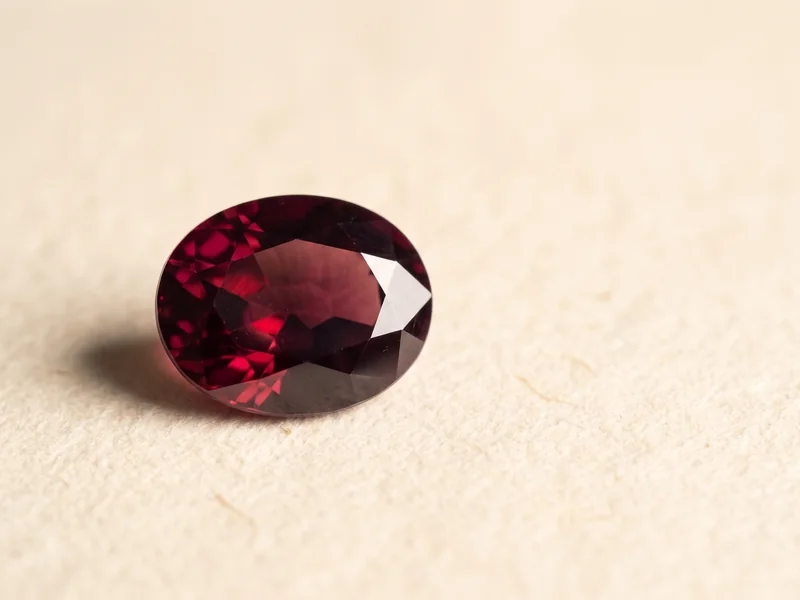 GemstonesNatural Garnet Gemstones and Custom Garnet JewelleryDiamond 4Cs & GradingIndented Naturals in Diamonds
 Natural DiamondsHow Are Natural Diamonds Formed?
Explore more
More guides on this topic
Education