
Gemstones
Emerald Gemstone: The Complete Australian Guide
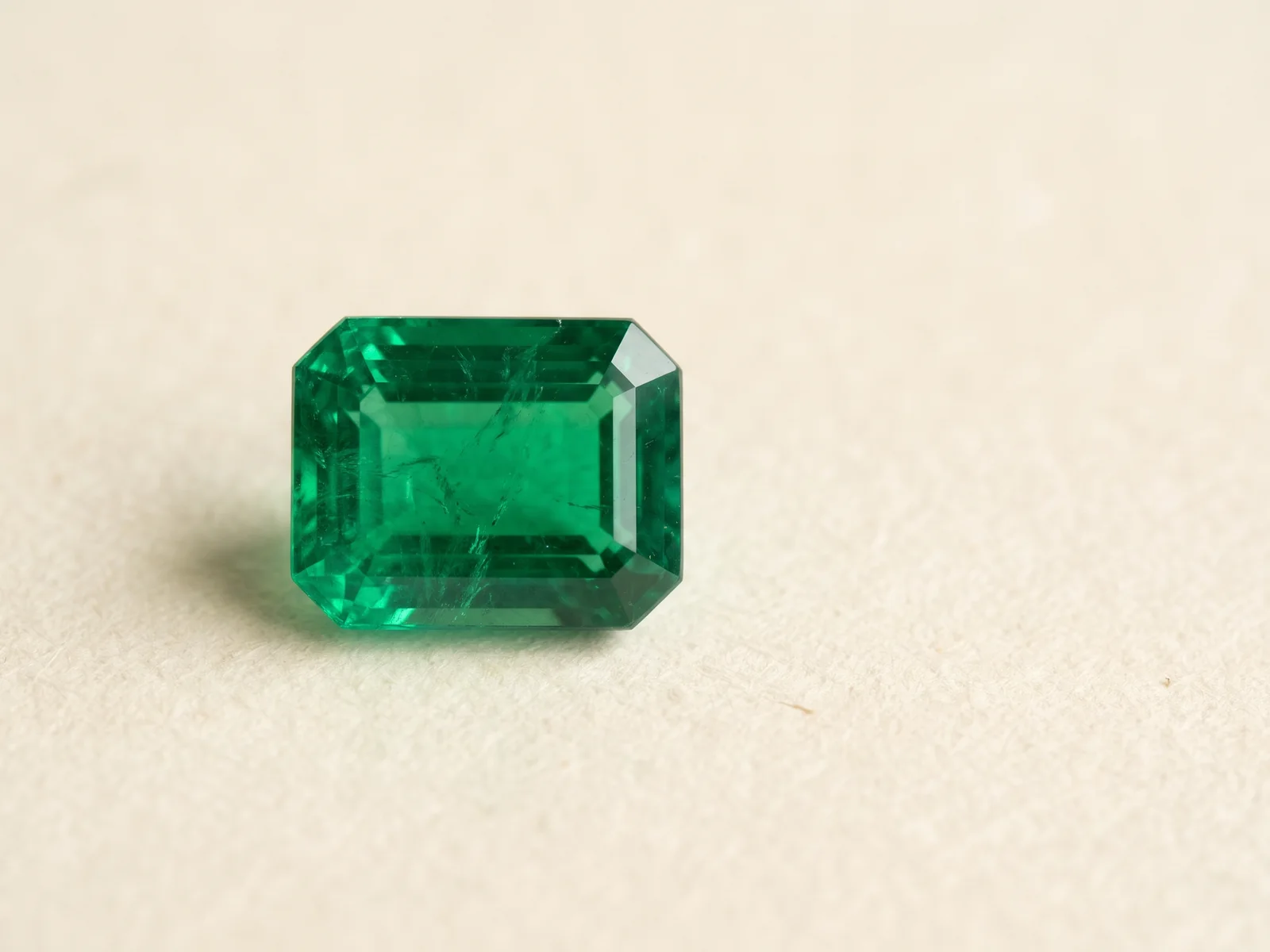
The emerald gemstone is the most famous green gem in the world, and one of the most misunderstood. Here is how colour, inclusions, treatments and toughness really work, so you can judge a stone with confidence.
 Reviewed by Raj Sood, Graduate Gemologist (GIA), AJP (GIA)Master jeweller and Graduate Gemologist (GIA) · reviewed 4 November 2026
Quick answer
An emerald gemstone is the green variety of the mineral beryl, coloured by chromium and vanadium. It rates 7.5–8 on the Mohs scale but is brittle, and almost every emerald contains inclusions and is clarity-treated with oil or resin. Choose a vivid, medium-dark green, an eye-clean appearance, disclosed treatment and a protective setting.
What is an emerald gemstone?
An emerald is the green variety of beryl, a beryllium aluminium silicate with the formula Be3Al2Si6O18. Beryl on its own is colourless. Tiny traces of chromium and vanadium replace some of the aluminium and turn it green; a little iron can add a bluish or yellowish note. The same mineral gives us aquamarine (blue), morganite (pink) and heliodor (yellow). Our page on the chemical composition of the major gemstones puts emerald alongside diamond, sapphire, ruby and opal.
Emerald grows in the hexagonal crystal system, usually as six-sided prisms. It is doubly refractive, which means light splits into two rays as it passes through, but the difference (the birefringence, about 0.005–0.009) is too small to see without instruments. Its refractive index, the measure of how much it bends light, sits around 1.57–1.59, much lower than diamond's 2.42. That is why emerald glows with deep colour rather than flashing with sparkle.
Emerald is the May birthstone and one of the four traditional precious gems, with diamond, ruby and sapphire. For the full family of coloured stones, start at our coloured gemstones hub.
What colour is the best emerald?
Colour drives most of an emerald's value. Gemmologists describe it in three parts: hue (the basic colour), tone (how light or dark) and saturation (how strong or pure). The most valued emeralds are a pure green to slightly bluish green, medium to medium-dark in tone, with vivid saturation and no grey or brown masking.
| Colour trait | What to look for | What lowers value |
|---|---|---|
| Hue | Pure green to slightly bluish green | Strong yellow or strong blue overtones |
| Tone | Medium to medium-dark | Very pale (light green) or so dark it looks black |
| Saturation | Vivid, even colour | Greyish or brownish, dull colour |
| Distribution | Even across the face | Colour zoning or pale patches visible face-up |
There is one grey area worth knowing. A very pale green beryl is not an emerald; it is green beryl, and it is worth far less. Where the line falls depends on the lab. Some labs call a vanadium-coloured stone emerald if the green is saturated enough; others require chromium. If a price looks too good, check the report actually says emerald, not green beryl.
Colour also shifts with light. Emeralds tend to look their richest in daylight and can look slightly yellower under warm indoor lighting. Always view a stone in more than one light before deciding.
Why do emeralds have inclusions (the jardin)?
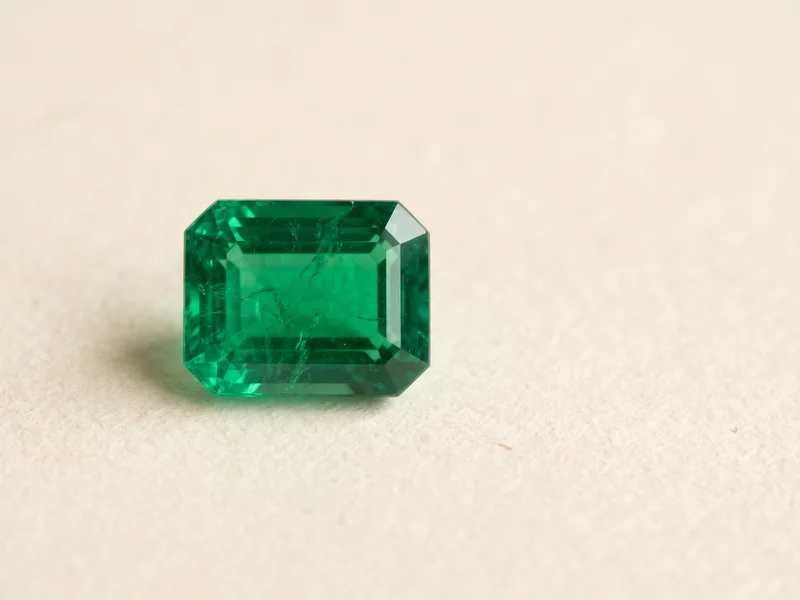
Emeralds form in hot, mineral-rich fluids under great pressure, and those conditions leave their mark. Almost every natural emerald contains inclusions: tiny fractures, crystals of other minerals and pockets of trapped fluid. The French call this inner landscape the jardin, or garden, and in emerald it is accepted in a way it never would be in a diamond.
Coloured gems are graded by eye rather than on the diamond clarity scale. Emerald is classed as a Type III gem, meaning inclusions are expected. The practical goal is a stone that looks clean and bright face-up at arm's length, with no large fracture reaching the surface.
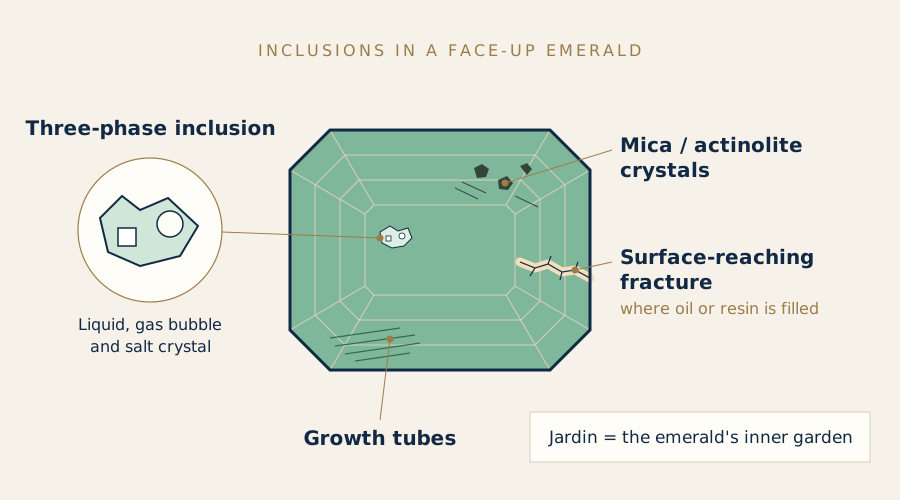
- Three-phase inclusions: jagged cavities holding liquid, a gas bubble and a salt crystal. Classic in Colombian emeralds.
- Mica and actinolite crystals: dark flakes or fine needles, common in Zambian, Brazilian and African stones.
- Fractures (feathers): small cracks. Internal ones are fine; ones that reach the surface are where treatments go in and where damage can start.
- Growth tubes and colour zoning: fine parallel lines and bands of uneven colour along the crystal's length.
At the bench, inclusions are also how we identify an emerald. Under the microscope, natural inclusions look very different from the veils, platinum flakes and zigzag growth lines found in lab-created stones, which is why a microscope tells a gemmologist far more than a single instrument reading.
Are emeralds treated? Oil, resin and what the report means
Yes, the great majority are. The standard treatment is clarity enhancement: filling surface-reaching fractures with a colourless substance that has a similar refractive index to emerald, so the cracks become much less visible. It has been done for centuries with cedarwood oil, and today also with synthetic oils and epoxy-type resins. It improves appearance; it does not repair the fracture or make the stone stronger.
Emerald oil treatment is accepted in the trade, but it must be disclosed. Independent labs grade how much filler is present, usually on a scale like this:
| Report wording | What it means | What to expect |
|---|---|---|
| None | No clarity enhancement detected | Rare and priced at a large premium |
| Insignificant / minor | Small amount of filler in a few fine fissures | Common in good stones; little change over time |
| Moderate | Filler in several fissures that affect appearance | Value noticeably lower; care matters more |
| Significant | Extensive filling; fractures would be obvious without it | Lowest value; appearance can change if filler degrades |
Oils can slowly dry out or be drawn out by heat, solvents and ultrasonic cleaners, letting fractures reappear. A jeweller can usually clean and re-oil a stone. Hardened resins are more stable but harder to remove. Green-tinted oils and dyes, which add colour rather than just clarity, are a separate treatment and must always be disclosed. Words like fissure, filler and enhancement are defined in our jewellery terms glossary.
Not sure which one is right?
Send us the stones you are looking at and our gemologist will tell you which to choose and why.
Where do emeralds come from, including Australian emeralds?
Origin affects the look of an emerald more than people expect, and for fine stones it can affect price. A lab can often determine origin from the inclusions and trace chemistry, but an origin report is an expert opinion about where the stone formed; it says nothing on its own about quality.
| Origin | Typical look | Notes |
|---|---|---|
| Colombia (Muzo, Chivor, Coscuez) | Warm, pure to slightly bluish green, often glowing | Three-phase inclusions; the historic benchmark |
| Zambia (Kafubu area) | Cooler, bluish green, often very clean-looking | Higher iron; major modern source |
| Brazil | Lighter to medium green | Large volumes of commercial stones |
| Afghanistan (Panjshir) | Vivid green, often Colombian-like | Smaller supply |
| Ethiopia, Zimbabwe, Russia, Pakistan | Varies widely | Zimbabwe's Sandawana known for small, intense stones |
| Australia (NSW and WA) | Mostly pale to medium green, often included | Historic finds; specimens and collector stones |
Australian emeralds are a small but real part of the story. Emeralds were found at Emmaville and Torrington in northern New South Wales in the late 1800s, and at Poona in the Murchison region of Western Australia in the early 1900s. Neither has become a large commercial source, and most Australian material today is collector or specimen grade. Western Australia also has a history in lab-created hydrothermal emerald production.
On the colombian vs zambian emerald question, neither is simply better. Colombian stones are prized for warmth and glow; Zambian stones often show fewer fractures and a cooler, bluer green. Judge the stone in front of you, not the name on the report.
Is emerald good for an engagement ring? Hardness vs toughness
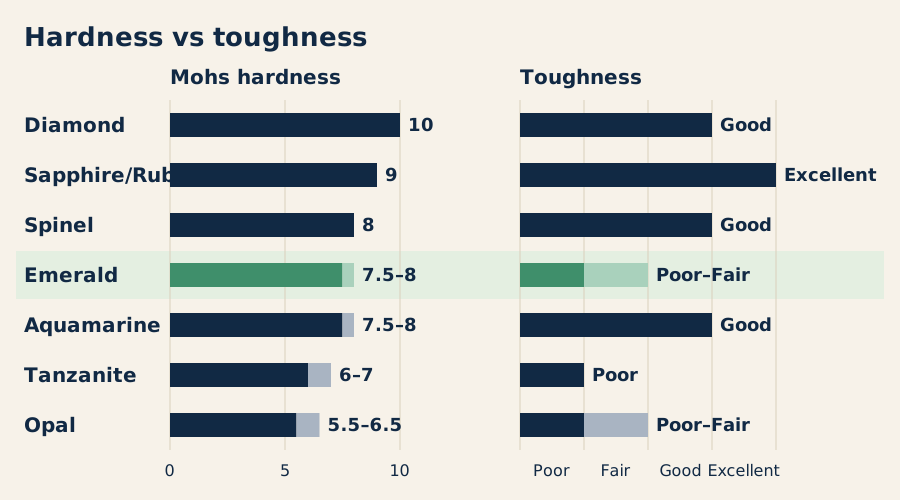
Emerald hardness is respectable: 7.5–8 on the Mohs scale, so it resists scratching from everyday dust (quartz, at 7). The weakness is toughness, the resistance to chipping and breaking. Because of its fractures and inclusions, emerald's toughness is generally rated poor to fair, and a hard knock on a corner or edge can chip it. Our guide to Mohs hardness and toughness explained covers why the two are different.
| Gem | Mohs hardness | Toughness | Everyday ring wear |
|---|---|---|---|
| Diamond | 10 | Good (can cleave) | Excellent |
| Sapphire / ruby | 9 | Excellent | Excellent |
| Spinel | 8 | Good | Very good |
| Emerald | 7.5–8 | Poor to fair | Good with a protective setting and care |
| Aquamarine | 7.5–8 | Good | Good |
| Tanzanite | 6–7 | Poor | Occasional wear |
| Opal | 5.5–6.5 | Poor to fair | Careful or occasional wear |
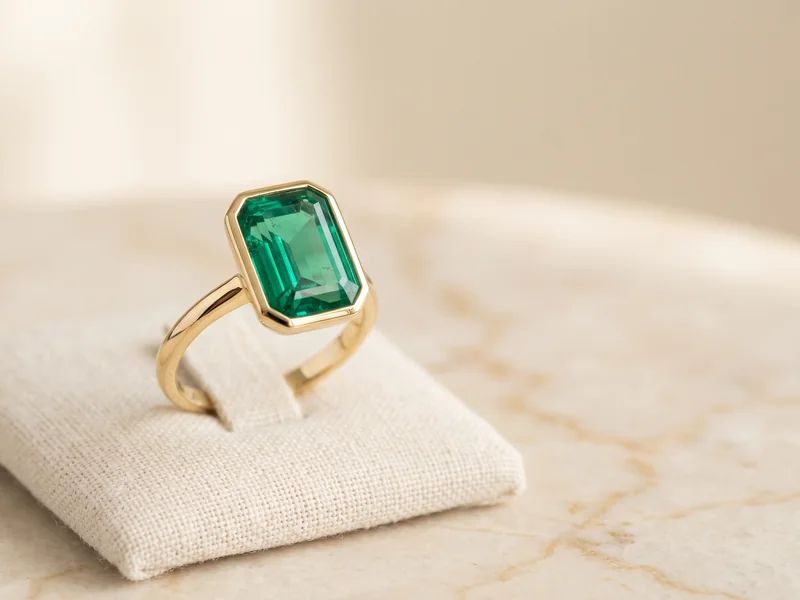
So yes, emerald can work for an engagement ring if you plan for it. A bezel or half-bezel guards the edges; claws at the corners of an emerald cut protect its weakest points; a halo adds a buffer. Lower profiles knock less. See emerald engagement ring designs for styles, and weigh up emerald or sapphire for an engagement ring if you want green or blue for daily wear. For a harder centre stone, read how emerald compares with diamond.
Our setting guide for diamonds and gemstones explains each style and how much protection it gives.
Emerald gemstone vs emerald cut: what's the difference?
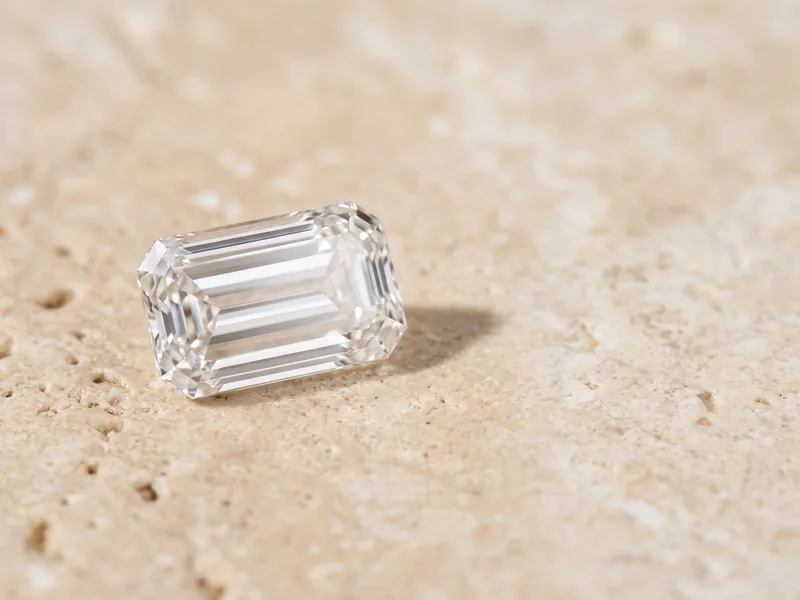
The emerald cut is a shape, not a stone. It is a rectangular step cut with long parallel facets and clipped corners, developed for emerald because cutting off the corners removes the points most likely to chip and the step facets put as little stress on the crystal as possible. Most emerald gemstones are still cut this way, though ovals, pears, cushions and cabochons (smooth domed stones) are common for more included material.
Diamonds are cut in the same shape, which is where search results get confusing. If you are looking at emerald-cut diamonds, the priorities are different: clarity matters more because step cuts show inclusions, windowing (a washed-out see-through centre) is a risk, and the length-to-width ratio for emerald cuts usually sits around 1.30–1.50. Our ideal proportions chart gives depth and table figures, and emerald vs radiant cut compares it with its brilliant-faceted cousin.
Windowing applies to coloured emeralds too: a shallow stone can show a pale, lifeless centre. Look for even colour right across the face. Ring advice carries over as well: the settings that suit an emerald cut protect the clipped corners, and there are wedding bands that sit flush beside a rectangular centre.
Related guideEmerald vs DiamondNatural vs lab-created emerald: how can you tell?
A lab-created emerald (also called synthetic emerald) is real beryl with the same chemistry and crystal structure as a natural one, grown in a laboratory rather than mined. It is not a fake, but it must always be sold as lab-created. Two methods are used: flux growth, where beryl crystallises slowly from a molten solvent, and hydrothermal growth, which mimics nature with hot, pressurised water. Our gemstone chemistry guide explains why the formula is identical either way.
- Natural emerald: rarer, almost always included, usually clarity-treated, wide range of quality and price.
- Lab-created emerald: often cleaner and more evenly coloured, rarely treated, and costs much less than a natural stone of similar appearance.
- Simulants: not emerald at all. Green glass, green YAG and assembled doublets (a colourless top glued to a green layer) are the common ones.
Telling them apart usually needs a gemmologist. Lab-created stones show tell-tale features under magnification: wispy veils and flux residue, tiny platinum flakes from the crucible, or zigzag (chevron) growth patterns in hydrothermal material. Flux-grown stones can also read slightly lower on the refractometer. The Chelsea filter, an old screening tool that makes many chromium emeralds look red, is not reliable on its own. For any significant emerald, an independent lab report is the only sound basis for a natural claim.
Browse natural gemstones in our stock
How much does an emerald gemstone cost in Australia?
Emerald prices span an enormous range, because colour, treatment level, size and origin all compound. These are broad, approximate AUD ranges per carat for loose natural stones; actual prices vary widely.
| Quality | Typical look | Approx. AUD per carat |
|---|---|---|
| Commercial | Lighter or included, moderate to significant treatment | about $100–$1,000 |
| Good | Medium green, eye-clean to lightly included, minor to moderate | about $1,000–$5,000 |
| Fine | Vivid medium-dark green, minor treatment | about $5,000–$15,000 |
| Exceptional | Top colour, no or insignificant treatment, often with origin report | $15,000+ and well above for large stones |
| Lab-created | Even colour, usually untreated | about $50–$500 |
Price per carat also climbs sharply with size: a fine 3-carat emerald costs far more per carat than a fine 1-carat. Lab-created emeralds cost much less than natural ones. Treat any natural emerald as jewellery to wear and enjoy rather than as an investment. To see how emerald sits against sapphire, ruby and other stones, browse our guides to precious and coloured gemstones.
How to choose and care for an emerald: step by step
- Start with colour. Look for pure to slightly bluish green, medium to medium-dark, vivid and even. View it in daylight and indoor light.
- Read the lab report. Confirm it says emerald (not green beryl), whether it is natural or lab-created, and the clarity enhancement level.
- Check the inclusions. Accept the jardin, but avoid large surface-reaching fractures, especially near corners and the girdle.
- Look for windowing. Tilt the stone; the centre should stay coloured, not wash out pale.
- Plan a protective setting. Choose a bezel, corner claws or a halo, and a low profile for daily wear.
- Care for it gently. Clean with lukewarm soapy water and a soft brush. Never use ultrasonic or steam cleaners, avoid heat and solvents, take it off for gardening and the gym, and have it checked yearly.
Unfamiliar terms along the way are explained in our jewellery glossary.
Free consultation
Talk to a gemologist
Compare stones in person or online with Raj Sood, Graduate Gemologist (GIA), AJP (GIA).
Book a consultationShop this shape
FAQ
Common questions
Are all emeralds treated?
Most are. The great majority of natural emeralds have their fractures filled with oil or resin to improve clarity. Untreated emeralds exist but are rare and priced at a large premium, so always ask for the treatment level on the report.
Can I wear an emerald ring every day?
Yes, with care. Emerald is hard enough to resist scratches but can chip from knocks, so choose a protective setting such as a bezel or corner claws and take it off for heavy work and sport.
How should I clean an emerald?
Use lukewarm water, a drop of mild detergent and a soft brush, then dry it with a soft cloth. Avoid ultrasonic and steam cleaners, heat and solvents, which can remove the oil in the fractures.
Is a lab-created emerald a real emerald?
It is real beryl with the same chemistry and structure as a natural emerald, grown in a laboratory. It must always be described as lab-created or synthetic, and it costs much less than a natural stone.
Are there emeralds in Australia?
Yes. Emeralds have been found at Emmaville and Torrington in New South Wales and at Poona in Western Australia, but production has been small and most Australian material is collector or specimen grade.
What is the difference between an emerald and green beryl?
Both are green beryl, but an emerald has a strong enough green, usually from chromium or vanadium, to qualify. Pale green beryl does not meet that standard and is worth far less.

Ask a gemologist
Not sure which diamond to choose?
Raj Sood is a Graduate Gemologist (GIA) and master jeweller. Bring the stones you are considering, or send the reports, and he will tell you honestly which one is better and why.
Keep learning
Related guides
 GemstonesEmerald Engagement Rings
 GemstonesEmerald vs Sapphire Engagement Rings
 GemstonesMay Birthstone: Emerald
 GemstonesGemstone Hardness GuideGemstonesGemstones | Coloured Gemstones, Birthstones and Custom Jewellery
 GemstonesEmerald vs Diamond
 Engagement Rings & SettingsBest Settings for Emerald Cut Diamonds
 GemstonesChemical Composition of Diamonds, Sapphires, Rubies, Emeralds, Opals and Other Gemstones
Explore more
More guides on this topic
Education