
Metals
Tungsten Jewellery and Tungsten Rings: The Australian Guide
Tungsten jewellery has become a popular choice for wedding bands and everyday rings because it hardly scratches. Here is what it really is, where it beats gold and platinum, and the trade-offs to know before you choose one.
 Reviewed by Raj Sood, Graduate Gemologist (GIA), AJP (GIA)Master jeweller and Graduate Gemologist (GIA) · reviewed 4 November 2026
Quick answer
Tungsten jewellery is made from tungsten carbide, a very hard compound of tungsten and carbon bound with nickel or cobalt. At about 9 on the Mohs scale it resists scratches far better than gold, platinum or titanium, and it feels heavy. But it cannot be resized, and a hard knock can crack it. Most bands cost roughly AUD 60–400.
What is tungsten jewellery?
Almost all tungsten jewellery is made from tungsten carbide (chemical formula WC), not pure tungsten. Pure tungsten, the element with the symbol W from its old name wolfram, has the highest melting point of any metal at about 3,422°C, but on its own it is too brittle and awkward to shape into rings. Combining it with carbon makes a ceramic-like compound that is extraordinarily hard.
To hold the carbide grains together, makers add a binder: a small amount of metal, usually about 6–15% nickel or cobalt. The powder mix is pressed into a ring-shaped mould and sintered (heated until the particles fuse, without fully melting) at around 1,400–1,500°C. The ring is then ground and polished with diamond tools, because nothing softer will cut it.
That manufacturing method explains almost everything about tungsten. It is formed rather than cast, so a jeweller cannot melt, solder or stretch it the way they work gold jewellery. It is closer to a piece of engineering ceramic than a traditional precious metal, which is why it suits plain bands far better than detailed engagement settings. If you are comparing metals for a centre-stone ring, our guide to choosing an engagement ring metal is the better starting point.
How scratch-resistant are tungsten rings?
Very. Tungsten carbide sits at about 8.5–9 on the Mohs scale, the 1–10 scale that ranks materials by which can scratch which. Ordinary household dust and grit contain quartz, which is 7 on the scale. Quartz scratches gold, silver and platinum, which is why those rings slowly develop a soft, satin-like wear. It cannot scratch tungsten, so a polished tungsten band can still look close to new after years of daily wear.
| Material | Mohs hardness (approx.) | Vickers hardness (approx. HV) | What it means on the hand |
|---|---|---|---|
| Diamond | 10 | around 10,000 | One of the few materials that readily scratches tungsten |
| Tungsten carbide | 8.5–9 | about 1,600–2,200 | Resists everyday scratching almost completely |
| Quartz (dust, sand, grit) | 7 | about 1,100 | Scratches anything softer than itself |
| Titanium | about 6 | about 200–350 | Scratches, but shallowly; very light |
| Platinum 950 | about 4–4.5 | about 80–135 | Scratches into a patina; metal is moved, not lost |
| 18K gold | about 2.5–3 | about 125–220 | Scratches and slowly wears thinner over decades |
| Sterling silver | about 2.5–3 | about 75–100 | Scratches and dents easily |
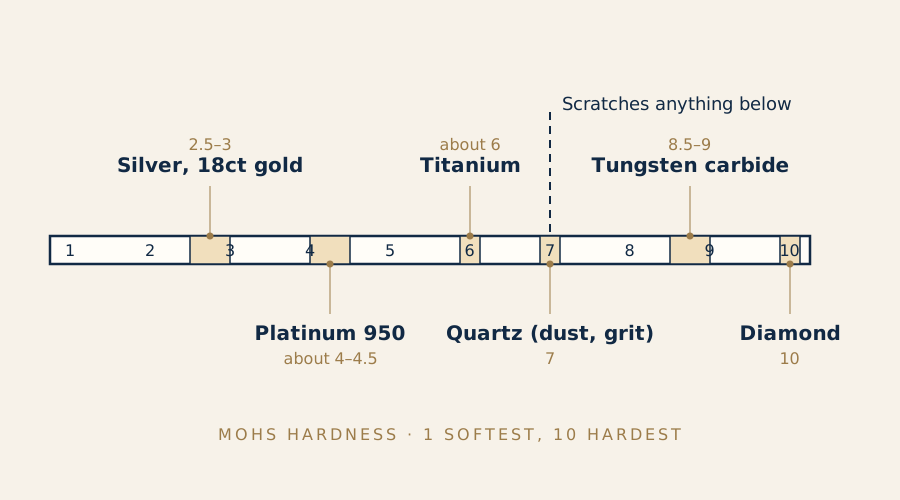
Hardness is not the same as toughness. Hardness is resistance to scratching; toughness is resistance to breaking. Gold is soft but tough: drop it and it dents. Tungsten carbide is hard but brittle: drop it on tiles or concrete, or strike it against something hard at the wrong angle, and it can chip or crack in two. Our article on why alloying makes yellow gold stronger shows how precious metals balance these properties differently, and why high-purity 22K and 24K gold sits at the very soft end.
Can tungsten rings be resized?
No. Because tungsten carbide is sintered rather than cast, it cannot be cut, soldered and rejoined like gold or platinum. Any attempt to stretch it would crack it. If your finger size changes, the only option is a new ring, which is why getting the size right at the start matters more than with any other metal.
- Size with the same width: an 8 mm band fits tighter than a 4 mm band of the same size, so try on a sizer close to the width you want.
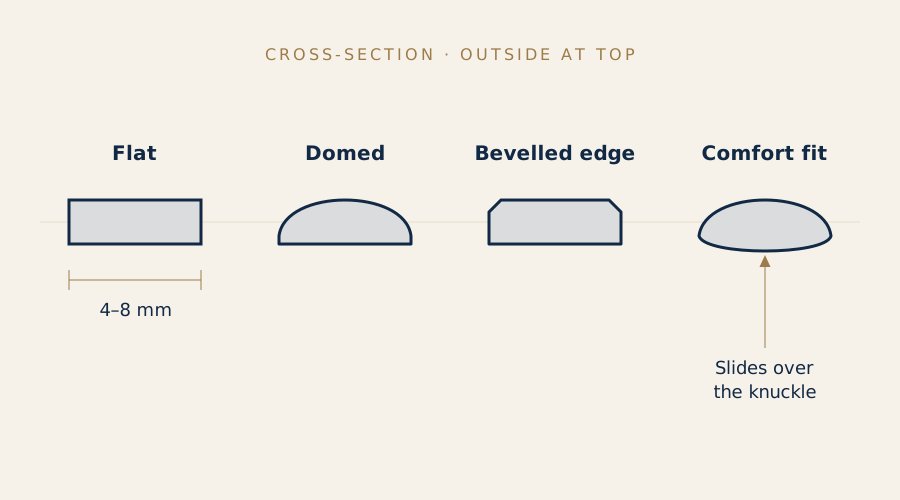
- Choose comfort fit: a domed inside edge slides over the knuckle more easily and is the norm for tungsten.
- Measure at the end of the day: fingers are larger when warm, so avoid sizing first thing on a cold Melbourne morning.
- Ask about exchange policies: many tungsten sellers swap sizes within a set period rather than resizing.
A common worry is removal in an emergency. A standard hospital ring cutter will not cut tungsten carbide, but because it is brittle, medical staff can usually crack it off with locking pliers. It is worth knowing, but in practice it is rarely a problem.
Is tungsten safe for sensitive skin?
It depends on the binder. Tungsten carbide itself is very stable and unlikely to irritate skin, but the small percentage of nickel or cobalt holding it together can matter.
- Cobalt binder: found in many low-cost rings. Cobalt can react with sweat, skin oils and household chemicals, leaving grey or dark marks on the skin and dull patches on the ring. It can also trigger cobalt allergies.
- Nickel binder: more chemically stable and less likely to discolour. Most people wear it without trouble, but people with a known nickel allergy can still react, because only a small amount of nickel needs to reach the skin.
- Binder not stated: treat it with caution. A reputable seller should be able to tell you which binder is used.
If you have a confirmed metal allergy, titanium and platinum are usually safer choices, and higher-carat gold is gentler than 9K, which contains more base metals. Our comparison of 9K and 18K gold explains how much alloy each carries.
Not sure which one is right?
Send us the stones you are looking at and our gemologist will tell you which to choose and why.
Tungsten vs titanium, gold and platinum: which ring metal suits you?
| Tungsten carbide | Titanium | 18K gold | Platinum 950 | Sterling silver | |
|---|---|---|---|---|---|
| Scratch resistance | Excellent | Fair | Low | Low to moderate | Low |
| Breaks if dropped? | Can crack or chip | No | No (dents) | No (dents) | No (dents) |
| Weight | Heavy (≈15 g/cm³) | Very light (≈4.5 g/cm³) | Heavy (≈15.5 g/cm³) | Very heavy (≈21 g/cm³) | Medium (≈10.4 g/cm³) |
| Resizable | No | Rarely | Yes | Yes | Yes |
| Can hold claw settings | No | Limited | Yes | Yes | Yes, softly |
| Precious metal value | None | None | Yes | Yes | Some |
| Typical band price | AUD 60–400 | AUD 80–500 | AUD 1,000–3,000 | AUD 1,500–4,000 | AUD 80–400 |
The short version: tungsten vs titanium rings is a choice between heavy and scratch-proof but brittle (tungsten) and feather-light, tough but more easily scratched (titanium). Tungsten vs gold wedding bands is a different decision altogether: gold can be resized, repaired, engraved by hand and eventually remade, and it carries real metal value, while tungsten will look polished for longer but can never be altered.
For more on the precious options, see our guides to platinum and how it wears and everyday sterling silver. Many couples match metals across a set, so it helps to decide whether the engagement ring and the wedding bands need to be the same before you settle on tungsten for one of them.
What colours and styles do tungsten rings come in?
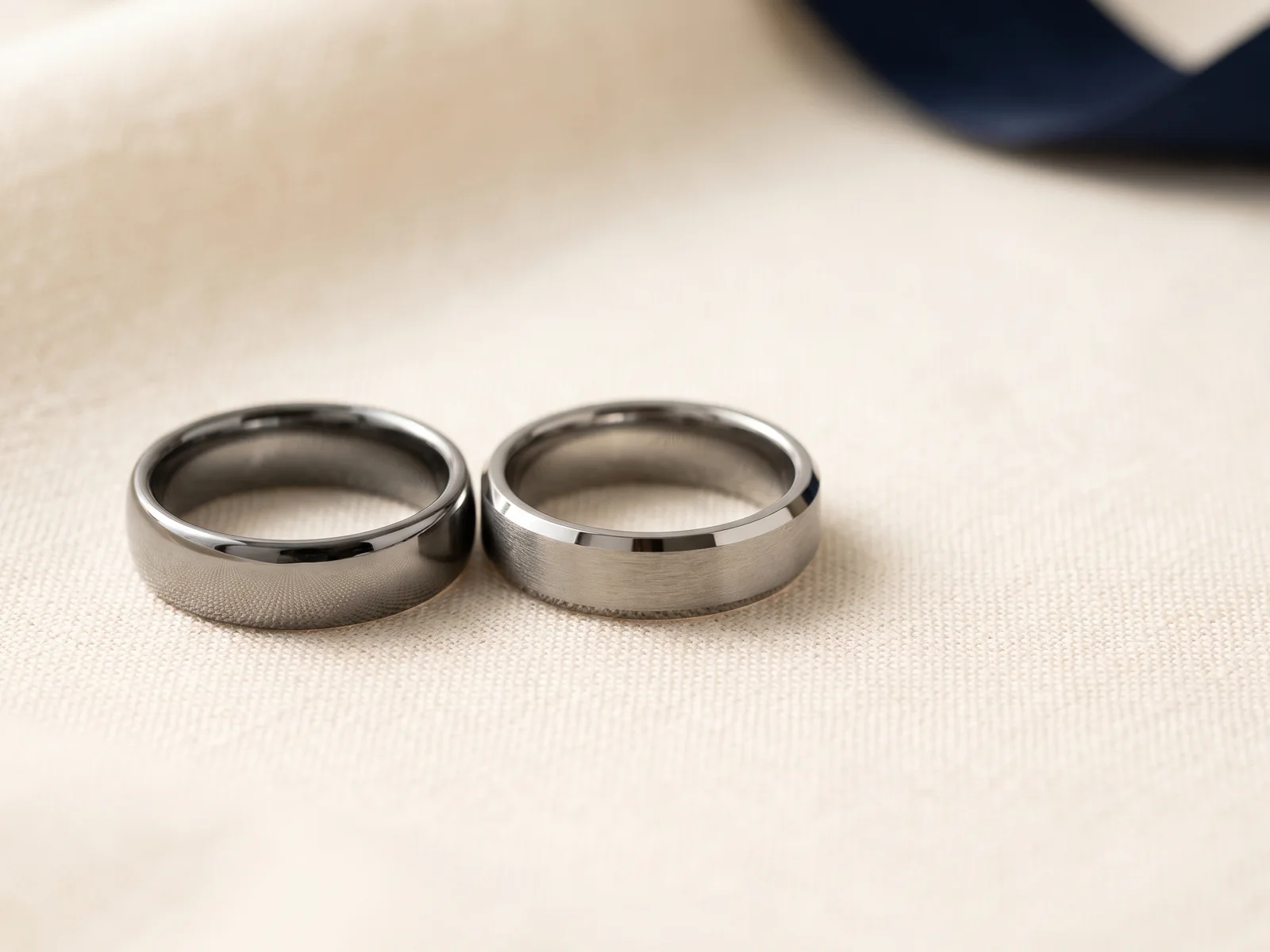
Natural tungsten carbide is a cool, gun-metal grey, slightly darker than white gold or platinum. It can be finished high-polish, brushed (fine parallel lines) or matte, and the finish lasts far longer than on softer metals.
- Black tungsten rings: usually a thin surface coating applied by PVD (physical vapour deposition) or ion plating. It is durable but can wear through at edges after a few years of hard use, showing grey underneath.
- Gold and rose tones: also coatings, not gold alloy. They look warm at first but are not the same as solid gold.
- Inlays: channels filled with wood, carbon fibre, opal, abalone shell or meteorite. The inlay is softer than the tungsten around it and needs more care.
- Stones: traditional claws cannot be formed in tungsten, so small diamonds are set flush into drilled seats or into an inserted channel. Larger centre stones are not practical.
Engraving is done by laser rather than by hand, because no engraving tool will bite into the carbide. Because claw work is impossible, people wanting a set stone should look at precious metals; our explanation of claw styles and how they hold a stone shows what each metal allows. If you want something non-traditional but still workable, our guide to engagement rings for people who dislike classic designs and the patterned layered metal in mokume gane bands are worth a look.
Related guideMokume Gane Rings MelbourneDo tungsten rings have hallmarks in Australia?
Not in the precious-metal sense. Australia has no compulsory government assay office, so marks on gold, platinum and silver are applied by manufacturers to show fineness: 375 for 9K gold, 585 for 14K, 750 for 18K, 950 or PT950 for platinum and 925 for sterling silver, usually beside a maker's mark. Our guide to reading Australian hallmarks and metal stamps lists them all.
| Mark inside the ring | What it tells you |
|---|---|
| TUNGSTEN, TUNGSTEN CARBIDE or TC | The band is tungsten carbide; no precious-metal content is implied |
| W | Sometimes used as shorthand for tungsten |
| 375, 585, 750 | Gold fineness; should not appear on a tungsten band |
| 950 / PT950 | Platinum fineness |
| 925 | Sterling silver fineness |
| Laser-engraved size | Common on tungsten, since the size can never change |
Because tungsten has no bullion value, its price does not move with the metals markets. A gold band's cost is partly tied to the spot price, as our explainer on how gold prices flow through to jewellery shows; a tungsten band is priced on manufacturing, finish and brand.
Is tungsten jewellery worth it?
Tungsten jewellery is worth it if you want a plain, heavy band that stays polished with no upkeep, at a modest price, and you accept that it is a ring for its own lifetime only. It is less suited if you expect your hands to change, want stones set in claws, or hope to pass the metal on.
- Strengths: near-scratch-proof finish, satisfying weight, low cost, good choice for tradespeople who are hard on rings (though see the cracking caveat).
- Limits: cannot be resized or repaired, can crack if dropped on hard surfaces, coatings wear, binder can cause skin reactions, and the material has no resale or melt value.
That last point matters more than people expect. Gold and platinum can be melted and remade; a grandparent's band can become part of a new ring. Our guides to which old jewellery can be reused in remodelling and turning an old ring into a modern engagement ring show what that looks like. A tungsten ring cannot be part of that story.
Browse ring settings by metal
How do you care for tungsten jewellery?
Care is simple, but it is different from softer metals. Clean it with warm water, a drop of mild dish soap and a soft brush, then dry it. Avoid bleach and strong chlorine, which can attack a cobalt binder, and take it off for pool and spa use. Inlaid rings need gentler handling: no soaking wood or opal inlays.
- Store it apart: tungsten is harder than gold, silver, platinum and most gemstones below 9 on the Mohs scale, so it will scratch them in a shared box. Our tips on storing jewellery so pieces don't damage each other apply doubly here.
- Protect it from hard drops: take it off over a towel or carpet, not tiles, and remove it for heavy lifting near steel.
- Travel sensibly: a tungsten band is a low-risk ring to wear away from home, but the usual precautions in our guide to reducing risk when travelling with jewellery still help.
- Silver pieces worn alongside: they tarnish and scratch, so clean them separately using our method for cleaning silver safely at home.
How to choose a tungsten ring: step by step
- Decide if tungsten fits your life. If you need resizing, claw-set stones or a ring to remake one day, choose gold or platinum instead.
- Ask which binder is used. Prefer a stated nickel binder, or avoid tungsten altogether if you have a known nickel or cobalt allergy.
- Pick the width and profile. 4–6 mm suits most hands; 7–8 mm reads bolder. Comfort fit makes wider bands easier to wear.
- Size carefully. Measure at the end of the day with a sizer of the same width, and check the seller's size-exchange policy.
- Check the finish. Natural grey will not wear; black, gold and rose tones are coatings that can wear at edges.
- Look inside. Expect a TUNGSTEN or TC mark, not a gold or platinum fineness stamp. Unfamiliar terms are explained in our jewellery glossary.
Free consultation
Talk to a gemologist
Compare stones in person or online with Raj Sood, Graduate Gemologist (GIA), AJP (GIA).
Book a consultationShop this shape
FAQ
Common questions
Can tungsten rings be resized?
No. Tungsten carbide is sintered rather than cast, so it cannot be cut and rejoined or stretched. If your size changes you will need a new ring, which is why many sellers offer size exchanges instead.
Do tungsten rings scratch?
Hardly ever in daily wear. At about 8.5–9 on the Mohs scale, tungsten carbide is harder than the quartz grit that scratches gold and platinum, though a diamond or another tungsten ring can still mark it.
Can a tungsten ring break?
Yes. It is hard but brittle, so a drop onto tiles or concrete, or a sharp blow against something hard, can chip or crack it. It does not bend or dent like gold.
Will a tungsten ring turn my finger green or grey?
Tungsten carbide does not turn skin green, but rings with a cobalt binder can leave grey marks and dull spots when they react with sweat or chemicals. Nickel-bound rings are less prone to this.
Is tungsten better than titanium for a wedding band?
Neither is better overall. Tungsten is heavier and far more scratch-resistant but can crack; titanium is very light and tough but scratches more easily. Neither can be easily resized.
Is tungsten a precious metal?
No. It has no precious-metal fineness mark in Australia and no melt or resale value, so its price reflects manufacturing and finish rather than metal markets.

Ask a gemologist
Not sure which diamond to choose?
Raj Sood is a Graduate Gemologist (GIA) and master jeweller. Bring the stones you are considering, or send the reports, and he will tell you honestly which one is better and why.
Keep learning
Related guides
 MetalsAustralian Hallmarks and Metal Stamps
 MetalsPlatinum Jewellery Melbourne
 MetalsMokume Gane Rings Melbourne
 MetalsSterling Silver Jewellery
 Care, Repairs & RemodellingHow to Redesign an Old Ring Into a Modern Engagement Ring
 MetalsWhat Gives Yellow Gold Its Colour and Strength?
 Care, Repairs & RemodellingHow to Store Jewellery
Explore more
More guides on this topic
Education