
- Education
- Diamond Shapes
- Emerald Cut Diamonds: The Complete Guide to the Emerald Cut Diamond
Diamond shapes
Emerald Cut Diamonds: The Complete Guide to the Emerald Cut Diamond
The emerald cut diamond trades sparkle for clean lines: long, mirror-like steps that show everything inside the stone. Here is how to judge one properly, from the 57-facet layout and ratio to windowing, clarity, settings and matching bands.
 Reviewed by Raj Sood, Graduate Gemologist (GIA), AJP (GIA)Master jeweller and Graduate Gemologist (GIA) · reviewed 4 November 2026
Quick answer
An emerald cut diamond is a rectangular step cut with cut corners and usually 57 or 58 long, parallel facets that create broad flashes of light rather than sparkle. Look for a length-to-width ratio of about 1.30–1.50, a depth near 61–68% to avoid windowing, VS2 clarity or better and a setting that protects the corners.
What is an emerald cut diamond?
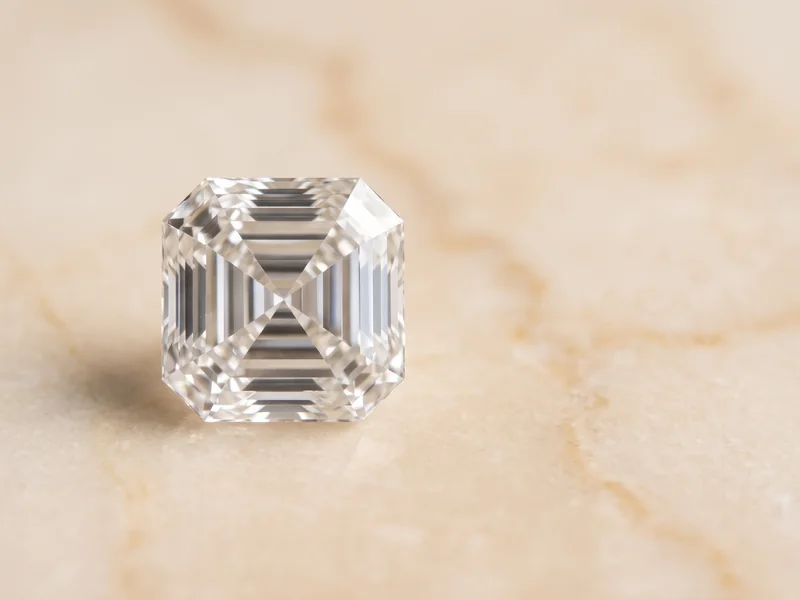
An emerald cut diamond is a step cut. Instead of the triangular and kite-shaped facets of a brilliant, it has long, flat facets arranged in rows that step down from the top of the stone like a staircase. The outline is a rectangle with the four corners cut off (bevelled), which gives it eight sides and helps protect the corners from chipping. It belongs to the wider family of step-cut diamonds, alongside its square sibling, the Asscher cut.
A traditional emerald cut has 57 facets, or 58 if the cutter adds a culet (a tiny flat facet at the very bottom). That is where the phrase '57 facet emerald cut diamond' comes from. Usually there are three rows of steps on the crown (the top part, above the girdle), three or four rows on the pavilion (the lower part, below the girdle) and the large, flat table on top. Some modern cutters add extra steps or split facets, so counts anywhere from about 50 to 65 turn up. None of these is wrong, as long as the steps are even and the light pattern is balanced.
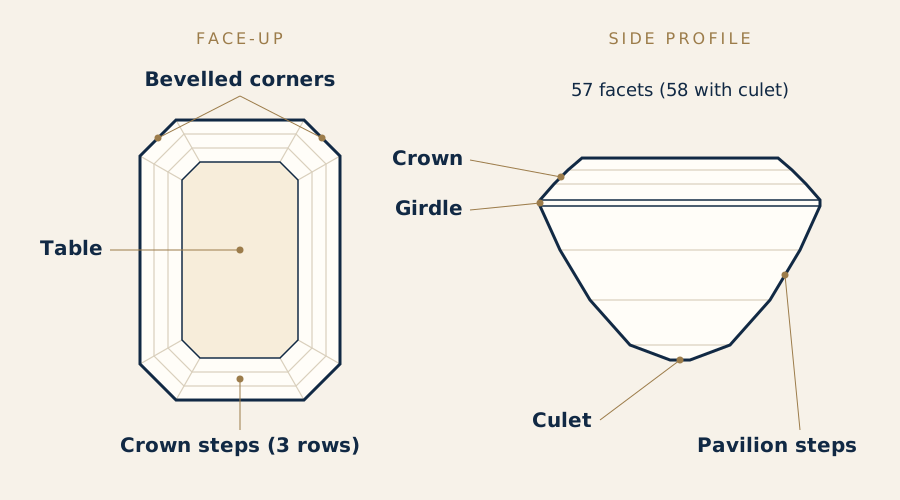
The look is unlike almost every other shape. Rather than lots of small sparkles, an emerald cut shows broad flashes of white light and dark contrast as it moves, a slower, more architectural effect. If you are still comparing outlines, our overview of diamond shapes and the guide to every diamond cut we work with put the emerald cut in context.
Is an emerald cut diamond the same as an emerald?
No, and the name trips up a lot of people searching for emerald gemstones. An emerald cut diamond is a diamond cut in this shape. An emerald is a different gem altogether: the green variety of the mineral beryl. The cut borrowed the gem's name because cutters developed the step layout for emerald crystals. Emerald is relatively brittle and usually included, and flat steps with bevelled corners reduce stress on the stone while it is cut and worn.
| Diamond | Emerald (gemstone) | |
|---|---|---|
| Mineral | Carbon | Beryl |
| Hardness (Mohs scale) | 10 | 7.5–8 |
| Refractive index | 2.42 | about 1.57–1.58 |
| Colour | Colourless to faint yellow; fancy colours are rare | Green, from traces of chromium and/or vanadium |
| Typical treatment | Natural diamonds are usually untreated | Most are oiled or resin-filled to make fissures less visible |
| Laboratory version | Lab-grown diamond | Lab-created (synthetic) emerald |
Today the emerald cut is used for diamonds, emeralds and many other coloured stones, such as sapphire, aquamarine and tourmaline. Diamond is much harder and bends light far more strongly (refractive index is a measure of how much a material bends light), so an emerald cut diamond looks brighter and crisper, and it handles daily wear in a way a softer, oiled emerald does not. Any unfamiliar term here is explained in our A to Z of jewellery terms.
What is the best ratio for an emerald cut diamond?
The length-to-width ratio is the stone's length divided by its width, taken from the measurements on the grading report. An emerald cut measuring 7.00 × 5.00 mm has a ratio of 1.40. That one number decides whether the stone looks squarish, classic or long and slender.
| Ratio | How it looks | Who tends to choose it |
|---|---|---|
| Below 1.25 | Nearly square, close to an Asscher outline | People who want a compact, chunky look |
| 1.25–1.35 | Short rectangle, bold and solid | Smaller hands and shorter fingers |
| 1.35–1.50 | The classic emerald proportion | Most engagement rings |
| 1.50–1.65 | Long and slim; looks larger face-up | Longer fingers and a more modern look |
| Above 1.65 | Very narrow, almost baguette-like | A strong personal preference |
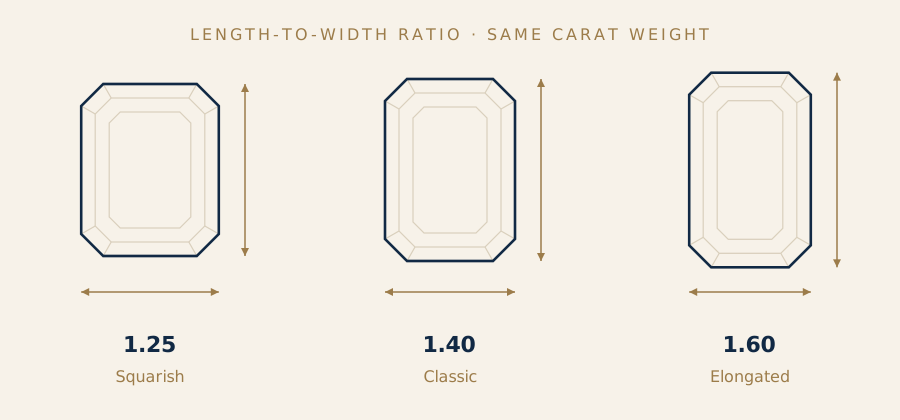
Most people end up between 1.30 and 1.50, and many settle near 1.40–1.45. A longer stone spreads its weight over more length, so a 1.60 stone often looks bigger on the finger than a 1.35 stone of the same weight. Our emerald cut ratio guide compares real examples, and our page on elongated emerald cuts covers the slimmer end of the range.
What is windowing in an emerald cut, and how do you spot it?
A step cut has a large table and fewer, bigger facets than a brilliant, so it hides less. Two effects decide whether an emerald cut looks lively or flat:
- Windowing: a washed-out, see-through patch in the centre of the stone, where light passes straight through instead of reflecting back to your eye. It usually comes from a pavilion that is too shallow. Our explainer on windowing in emerald-cut diamonds shows what to look for.
- The hall-of-mirrors effect: the pattern of nested rectangles, alternating bright and dark, that a well-cut emerald shows as it moves. Evenly spaced, clearly defined steps are a sign of good cutting. See how the hall-of-mirrors pattern forms.
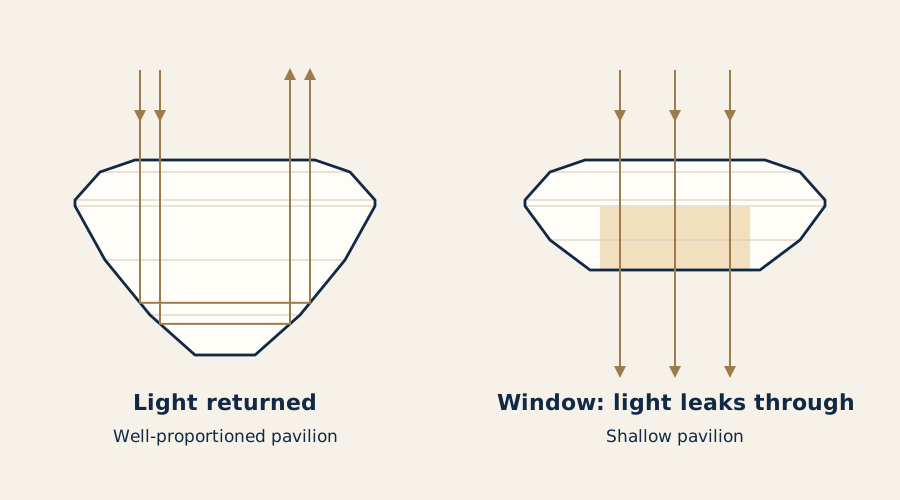
GIA does not give emerald cuts an overall cut grade (it only does that for round brilliants), so proportions are your guide. As a starting point, many cutters aim for a total depth of about 61–68% and a table of about 60–69% of the width, with a girdle from thin to slightly thick and no culet or a very small one. Very shallow stones, under about 60% depth, look large for their weight but often window. Very deep stones, over about 70%, hide weight underneath and look small face-up. Our proportions chart for emerald cuts sets out the full ranges.
Numbers only take you so far. The most reliable check is a 360° video against a patterned or dark background. If the centre turns glassy and you can see the background through it as the stone rocks, it windows.
Not sure which one is right?
Send us the stones you are looking at and our gemologist will tell you which to choose and why.
What clarity and colour should an emerald cut diamond be?
This is where emerald cuts differ most from brilliants. A round or radiant scatters light into many small flashes, which camouflages inclusions (the tiny internal features found in almost every diamond). An emerald cut's broad, open table works like a window into the stone, so a crystal or feather that would disappear in a round can be plain to see. Why inclusions show more in an emerald cut explains this with examples.
| Clarity grade | In an emerald cut | Practical advice |
|---|---|---|
| FL–IF | No inclusions visible under 10× magnification (IF may show minor surface blemishes) | Only needed if you want the top grade |
| VVS1–VVS2 | Minute inclusions, very hard to find at 10× | Clean to the eye with room to spare |
| VS1 | Small inclusions, almost always eye-clean | A comfortable choice for larger stones |
| VS2 | Usually eye-clean; check position | The sweet spot for many buyers; confirm on video |
| SI1 | Sometimes eye-clean in smaller stones | Only with a careful look at the stone itself |
| SI2 and below | Inclusions usually visible through the table | Generally not recommended for this shape |
Colour shows a little more too, because there is less sparkle to distract the eye, and any tint tends to gather at the corners and ends. In white gold or platinum, most people are comfortable at H colour or better, and G or better once the stone is above about 2 carats. In yellow or rose gold, I or J can look white, because the warm metal reflects into the stone. Some people deliberately choose a warmer K–M emerald cut for a vintage feel.
How big is a 1 carat emerald cut diamond?
Carat is a measure of weight, not size, so the face-up measurements depend on ratio and depth. These are typical figures for an emerald cut of about 1.40 ratio with normal depth:
| Carat weight | Typical size (length × width) |
|---|---|
| 0.50 ct | about 5.6 × 4.0 mm |
| 0.75 ct | about 6.3 × 4.5 mm |
| 1.00 ct | about 7.0 × 5.0 mm |
| 1.50 ct | about 8.0 × 5.7 mm |
| 2.00 ct | about 8.8 × 6.3 mm |
| 3.00 ct | about 10.0 × 7.2 mm |
An emerald cut covers roughly the same area face-up as a round of the same weight, and its length makes it read larger along the finger. A deep stone or one with a thick girdle can look noticeably smaller, so compare millimetres, not just carats. Emerald cuts under about 0.30 carat are mostly used as side stones and in bands.
Related guideEmerald vs Asscher Cut DiamondsEmerald cut vs radiant, Asscher and princess: what is the difference?
| Emerald | Radiant | Asscher | Princess | |
|---|---|---|---|---|
| Facet style | Step cut | Brilliant | Step cut | Brilliant |
| Outline | Rectangle, cut corners | Rectangle or square, cut corners | Square, cut corners | Square, sharp corners |
| Typical ratio | 1.30–1.50 | 1.00–1.50 | 1.00–1.05 | 1.00–1.05 |
| Look | Broad flashes, hall of mirrors | Lots of small sparkle | Concentric squares, windmill pattern | Bright, crisp sparkle |
| Hides inclusions | Poorly | Well | Poorly | Well |
| Corners | Protected by bevels | Protected by bevels | Protected by bevels | Pointed; need claws |
The most common decision is between an emerald and a radiant: the same outline with very different light. Our emerald versus radiant comparison works through clarity, price and sparkle side by side, and emerald compared with Asscher covers the square step-cut alternative. If you prefer a square brilliant, read about princess cut diamonds; for a square step cut without bevelled corners, the carré cut is the closer match. The octagonal cut is another close relative of the emerald.
What are the best settings and bands for an emerald cut diamond?
The bevelled corners make an emerald cut tougher than a princess, but the corners are still its most exposed points, so most settings place metal on each one. Our page on settings that suit emerald cut diamonds has side-by-side examples. The usual options:
- Four claws: one on each corner, the classic solitaire. Double claws (two per corner) add security and a slightly vintage look.
- Bezel or half-bezel: a thin rim of metal around the edge. Very secure and clean-lined, though it shows a little less of the outline.
- Halo or hidden halo: small diamonds around the stone or just under it, adding sparkle to balance the emerald's calmer light.
- Three-stone: an emerald centre flanked by tapered baguette diamonds or trapezoid side stones, which echo its straight step facets.
- East-west: the stone set sideways across the finger for a modern look.
Emerald cut diamond bands are a style of their own. An emerald-cut eternity band sets small emerald cuts end to end, usually about 0.10 to 0.50 carat each, either all the way round (full eternity) or across the top (half eternity). Claw settings let in more light; channel settings hold the stones between two metal walls, which is smoother and less likely to snag. Full eternity bands are difficult to resize, so confirm your ring size first.
If you are choosing an emerald cut engagement band to sit beside the ring, a straight band that sits flush, a fine row of small round brilliants or a matching emerald-cut band all work well. See wedding bands that pair with emerald cut rings for what fits beside each setting.
Should you choose a natural or lab-grown emerald cut diamond?
Both natural and laboratory-grown emerald cuts are widely available and look identical to the eye. They are the same material, carbon in a diamond crystal, and only laboratory testing tells them apart. Lab-grown emerald cuts cost much less and are easy to find above 2 carats in high colour and clarity, which suits a shape that rewards clean stones. Natural emerald cuts are rarer and are chosen by people who value that rarity and the stone's natural origin. Both should come with an independent grading report from a lab such as GIA or IGI, and a lab-grown report states clearly that the stone is laboratory-grown.
Shop emerald cut diamonds
As a rough guide in Australia, a 1 carat natural emerald cut in G–H colour and VS clarity sits around AUD 6,000–14,000, while a comparable lab-grown emerald cut is more like AUD 800–2,500. Emerald cuts usually cost less per carat than rounds of the same grade, partly because a step cut keeps more of the rough crystal. Prices move with the market, so treat these as ranges rather than quotes; carat, colour, clarity and how well the steps are cut move the price most.
How to choose an emerald cut diamond: step by step
- Read the report. Confirm the shape, measurements, colour, clarity, polish and symmetry, and whether the stone is natural or laboratory-grown.
- Work out the ratio. Divide length by width from the measurements; aim for about 1.30–1.50, depending on the look you want.
- Check the proportions. Look for a depth of roughly 61–68% and a table of roughly 60–69%; question anything far outside those ranges.
- Watch a 360° video. Look for even, clearly defined steps, and make sure the centre does not go glassy (a window).
- Find the inclusions. Aim for VS2 or better, and check that nothing sits directly under the table.
- Plan the setting and band. Choose claws or a bezel that protect the corners, and decide early whether a matching band needs to sit flush.
Free consultation
Talk to a gemologist
Compare stones in person or online with Raj Sood, Graduate Gemologist (GIA), AJP (GIA).
Book a consultationFAQ
Common questions
Is an emerald cut diamond a good choice for an engagement ring?
Yes, if you like its clean, step-cut look. Choose a ratio you like, VS2 clarity or better and a setting that protects the corners, and it is well suited to everyday wear.
What does a 57 facet emerald cut diamond mean?
It describes the traditional emerald cut layout: 57 facets in rows of steps on the crown and pavilion, or 58 if the stone has a culet. Some modern emerald cuts have a few more or fewer facets, which is normal.
Why are emerald cut diamonds cheaper than round diamonds?
An emerald cut usually costs less per carat than a round of the same grade, partly because cutting it keeps more of the rough crystal and partly because demand is lower. Very well-cut emerald cuts with high clarity still command strong prices.
What clarity do I need for an emerald cut diamond?
Most people aim for VS2 or better, because the large open table shows inclusions more than a brilliant does. Where the inclusion sits matters as much as the grade, so check a video before deciding.
Is an emerald cut diamond the same as an emerald stone?
No. An emerald is a green gemstone, a variety of beryl, while an emerald cut diamond is a diamond cut in the rectangular step shape first developed for emeralds.
Can you get emerald cut diamond bands?
Yes. Emerald-cut eternity and half-eternity bands set small emerald cuts end to end in claws or a channel, and they can be worn alone or beside an emerald cut engagement ring.

Ask a gemologist
Not sure which diamond to choose?
Raj Sood is a Graduate Gemologist (GIA) and master jeweller. Bring the stones you are considering, or send the reports, and he will tell you honestly which one is better and why.
Keep learning
Related guides
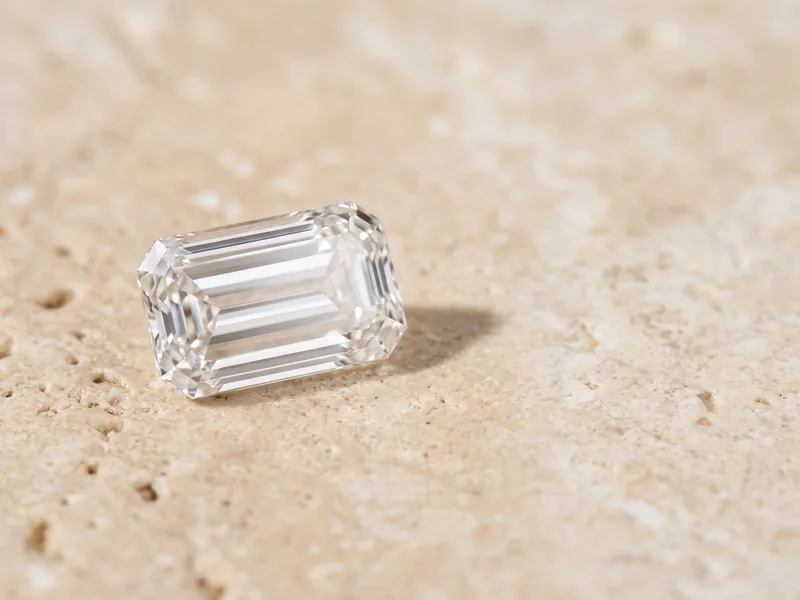 Engagement Rings & SettingsBest Settings for Emerald Cut DiamondsDiamond ShapesWhat Is Windowing in an Emerald-Cut Diamond?Diamond ShapesEmerald-Cut Diamond Length-to-Width Ratio
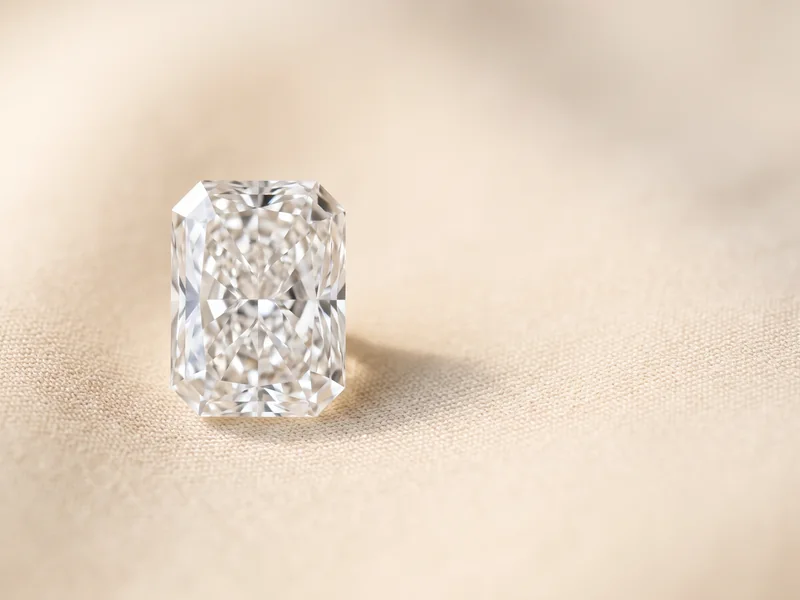 Diamond ShapesEmerald vs Radiant Cut DiamondsDiamond ShapesUnderstanding Diamond Shapes
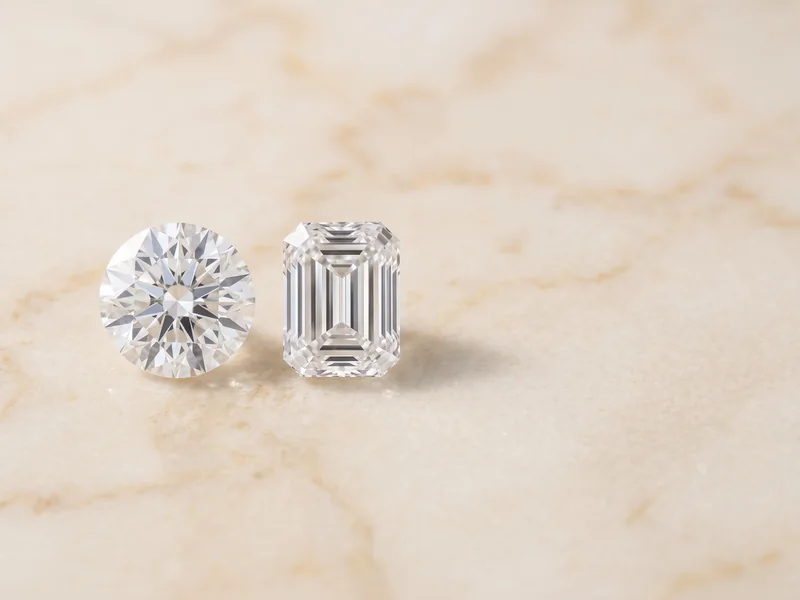 Diamond ShapesAll 34 Diamond Cuts: Every Shape Explained and Compared
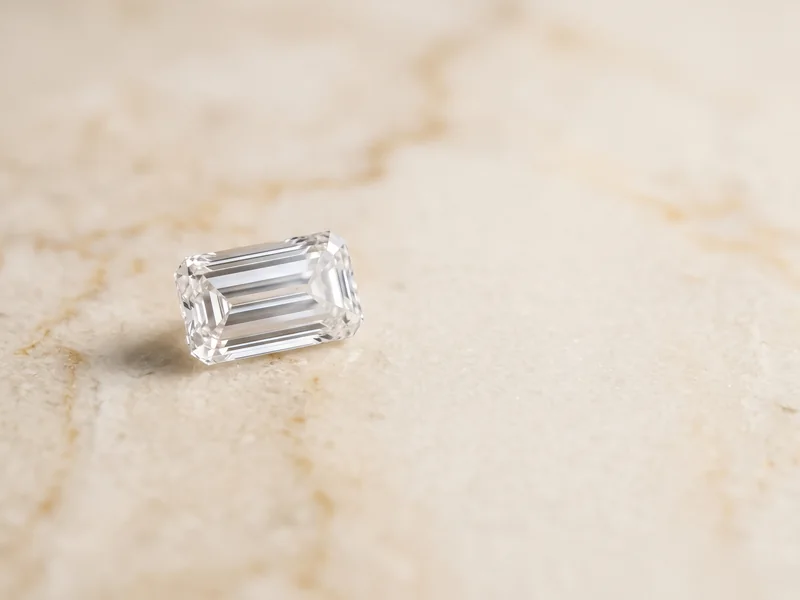 Diamond ShapesStep Cut Diamonds: Emerald, Asscher, Baguette, Carré and More
 Diamond ShapesAsscher Cut Diamonds
Explore more
More guides on this topic
Education