
- Education
- Engagement Rings & Settings
- Halo Engagement Rings: The Complete Australian Guide
Engagement Rings & Settings
Halo Engagement Rings: The Complete Australian Guide
A halo is the most common way to make a centre diamond look larger and brighter, but it also changes how a ring wears, sits beside a band and ages. Here is what a halo really adds, and what to check before you choose one.
 Reviewed by Raj Sood, Graduate Gemologist (GIA), AJP (GIA)Master jeweller and Graduate Gemologist (GIA) · reviewed 4 November 2026
Quick answer
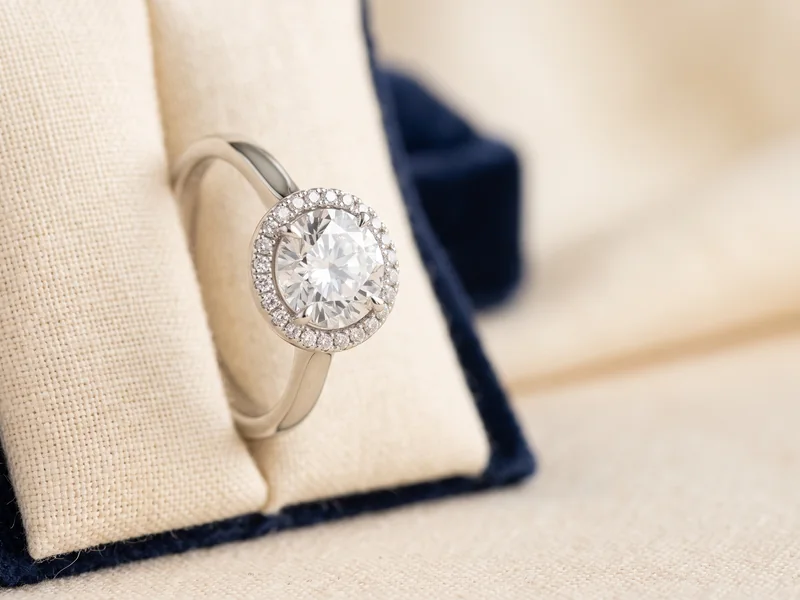
Halo engagement rings surround the centre stone with a ring of small diamonds, usually 1.0–1.5 mm each, set in micro-claws or pavé. A single halo adds roughly 2.5–3 mm to the face-up width, so a 1 carat round can look close to 9 mm across. Expect more upkeep: tiny claws need checking every year or two.
What are halo engagement rings?
A halo engagement ring has a centre stone surrounded by a continuous frame of small diamonds called melee (said 'mel-ay', the trade word for diamonds under about 0.18 carat). The halo sits around the centre's girdle, the widest edge of the stone, usually a little below its table so the centre stays the focus. It is one of the main styles in our guide to engagement ring setting styles, alongside the solitaire, three-stone and bezel.
The idea is old. Edwardian and Art Deco rings often framed a centre with small diamonds or coloured gems. The modern halo, with very fine claws and precise metalwork, became widespread over the last two decades as computer design and casting made thin frames practical.
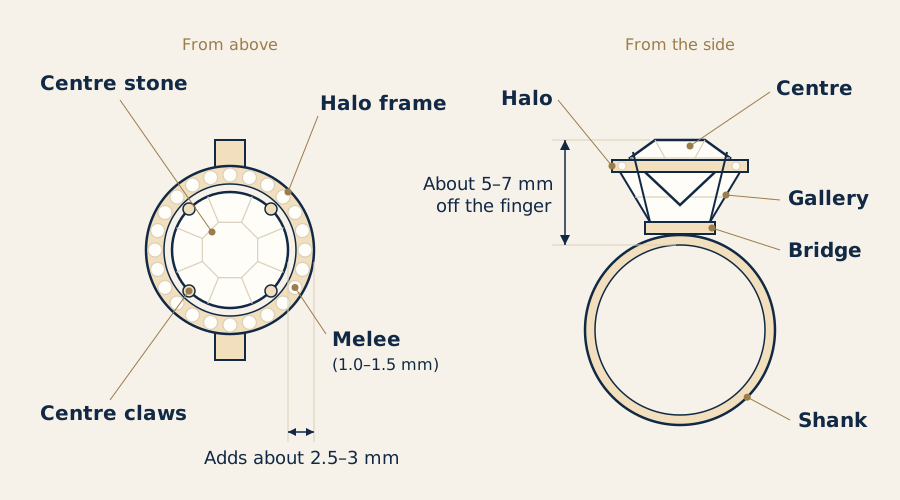
Every halo ring has the same basic parts: the centre stone in its own claws, the halo frame (a thin metal rim carrying the melee), the gallery (the metalwork under the head you see from the side) and the shank, which is the band itself. If any term is new, our jewellery glossary defines it.
How much bigger does a halo make a diamond look?
Each halo diamond is usually 1.0–1.5 mm across, and there is a thin line of metal between it and the centre. Add both sides together and a single halo widens the bright area by roughly 2.5–3 mm. From a metre or two away, the eye reads the centre and its halo as one shape.
| Centre round | Centre diameter | Face-up width with a single halo |
|---|---|---|
| 0.50 ct | about 5.1 mm | about 7.6–8.0 mm |
| 0.75 ct | about 5.8 mm | about 8.3–8.7 mm |
| 1.00 ct | about 6.4 mm | about 8.9–9.3 mm |
| 1.50 ct | about 7.4 mm | about 9.9–10.3 mm |
| 2.00 ct | about 8.1 mm | about 10.6–11.0 mm |
For comparison, a round solitaire about 9 mm across weighs roughly 2.7 carats. That does not mean a halo ring holds a bigger diamond: up close you can see the join between centre and halo, and the halo's total diamond weight is usually only 0.15–0.30 carat. What you gain is presence on the hand for far less than the cost of a much larger centre.
The effect is strongest on smaller centres. Around 0.50–1.00 carat, a halo makes a clear difference. Around 2 carats and above, the halo is thin compared with the stone, so it works more as a frame than an enlarger.
What types of halo setting are there?
The word 'halo' covers several quite different designs. The shape of the frame, how many rows it has and where it sits all change the look and the upkeep.
| Halo type | Seen from above | Adds face-up size | Upkeep |
|---|---|---|---|
| Classic halo | One row of melee around the centre | Yes, about 2.5–3 mm | Moderate: many small claws |
| Hidden halo | Plain top; melee only visible from the side | No | Lower: claws are less exposed |
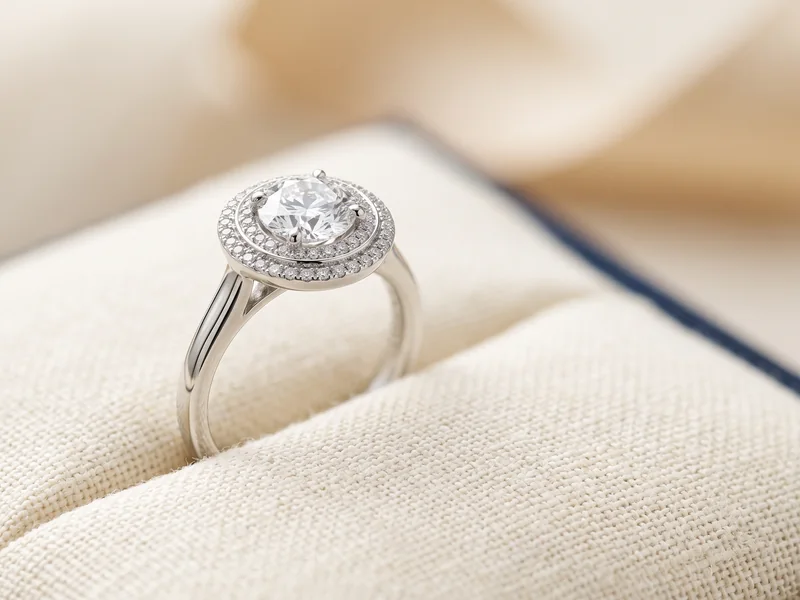
| Double halo | Two rows of melee | Yes, about 5–6 mm | Higher: twice the claws |
| Contrast-shape halo | Halo in a different outline, e.g. a cushion halo around a round | Yes | Moderate |
| Floral or scalloped halo | Larger petal-like stones or a scalloped edge | Yes | Moderate to higher |
| Coloured halo | Sapphire, ruby or other gems instead of diamonds | Yes | Depends on the gem's hardness |
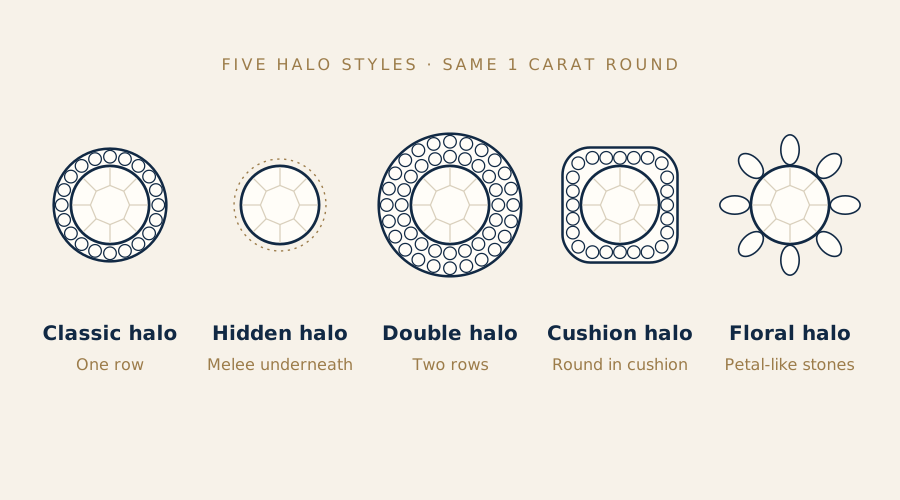
Most halos follow the outline of the centre, but you can change it. Our page on matching or contrasting halo outlines shows how a cushion halo makes a round centre read squarer, for example. If you want the side sparkle without the bigger look, a hidden halo set under the centre is the quieter option. For maximum presence, a double halo with two rows of melee adds the most width. Milgrain edges and scalloped frames suit vintage-inspired designs.
Coloured halos need one extra check: sapphire and ruby sit at 9 on the Mohs hardness scale and wear well, but softer gems such as emerald (7.5–8) or morganite (7.5–8) scratch and chip more easily in a ring worn every day.
Related guideHalo vs Hidden Halo Engagement RingsWhich diamond shapes suit a halo?
A halo works with almost any centre shape, but it does a different job for each one:
- Round: the most common halo centre. The halo continues the round's sparkle, and the circle is the easiest frame to make even.
- Oval: an oval halo engagement ring adds width to a slim oval and frames its length. It does not remove a bow-tie (the dark band across some elongated stones), but the bright frame makes it less noticeable.
- Cushion: a classic pairing, often with a cushion-shaped halo that exaggerates the soft square outline.
- Pear and heart: the halo shields the fragile point, which is a practical as well as a visual benefit.
- Princess: the halo protects the four sharp corners, though the centre still needs V-claws at each corner.
- Emerald and Asscher: these step cuts show broad, flat facets rather than sparkle, so a halo creates strong contrast. Some people love it; others feel it competes with the clean lines.
Our oval engagement ring guide covers ratios and settings for that shape in detail, and turning an elongated centre sideways in an east-west setting works with a halo too.
Colour matching matters more than most people expect. Halo melee is usually around F–H colour. Put a J or K centre inside very white melee and the contrast makes the centre look warmer than it would on its own. Either match the melee to the centre's colour, or choose yellow or rose gold, which warms everything evenly.
Not sure which one is right?
Send us the stones you are looking at and our gemologist will tell you which to choose and why.
How is a halo setting made, and how high does it sit?
A halo is fine engineering. The frame is often under 1.5 mm wide, and each melee is held by tiny shared claws or beads raised from the metal, a method called micro-pavé. On a well-made ring, the centre has its own claws, separate from the halo, so it can be re-tipped (having fresh metal added to worn claw tips) or reset without disturbing the small stones.
Metal choice changes how the halo wears. Platinum is dense and wears mostly by moving rather than losing metal, so claws hold their bulk longer. 18ct white gold is harder to the touch but is usually rhodium plated (coated in a bright white metal) and needs replating every year or so to stay white. 18ct yellow and rose gold need no plating and suit warmer centres.
A halo adds height, because the centre has to sit above the frame. Halo rings usually sit about 5–7 mm off the finger. If you work with your hands, our guide to low-profile and high-profile rings explains the trade-offs, and the side profile guide shows what the gallery and bridge look like from the side.
The band can be plain, pavé-set or split into two strands. A split shank that opens towards the halo widens the head visually and suits larger halos.
Are halo engagement rings durable enough for everyday wear?
Yes, with sensible care. A halo ring has many more small claws than a solitaire, and small claws wear faster. From the repair bench, these are the issues halo rings bring in most often:
- Worn melee claws: the outer edge of the halo takes knocks against desks, car doors and benchtops. As claws thin, a small stone can loosen and fall out.
- Missing melee: usually replaced with a matched stone and re-set, a routine repair if caught early.
- Worn centre claws: fixed by re-tipping or replacing claws.
- Pavé bands thinning underneath: the palm side of the band wears over the years, which can loosen stones set along the shank.
- Rhodium wearing off white gold: the yellow tone of the gold shows through, mostly on the band and halo edge.
Resizing is possible but more limited than with a plain band. Bending a pavé shank can stress the claws, so many halo rings can only move one or two sizes without re-setting stones. The same caution applies to rings with stones set in channels, explained in our page on channel-set diamonds and their repairs. If you want a rounded inner band for comfort, see what a comfort-fit band changes.
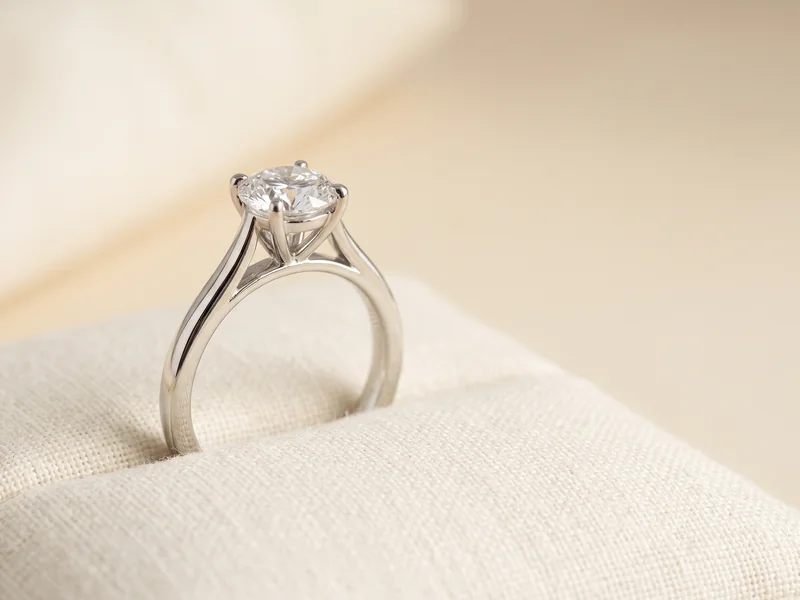
If you love the look but worry about upkeep, compare whether a hidden halo wears differently: its melee sits under the centre, away from most knocks.
Halo vs solitaire, three-stone and cluster: which suits you?
| Halo | Solitaire | Three-stone | Cluster | |
|---|---|---|---|---|
| Look | Bright frame around one centre | Single stone, clean lines | Centre with a side stone each side | Several stones forming one shape |
| Centre appears | Larger | True size | True size, wider overall | No single large centre |
| Upkeep | Higher: many small claws | Lowest | Moderate | Higher |
| Band sitting flush | Often needs a contoured band | Usually easy | Sometimes | Often needs a contoured band |
| Setting cost | Moderate to high | Lowest | Moderate to high | Moderate |
A halo is the choice when you want the centre to look larger and you enjoy a lot of sparkle. A solitaire is simplest to wear and maintain. Three-stone rings spread the width sideways along the finger rather than all around the centre. Cluster rings build the whole shape from smaller stones, which can suit a smaller budget for a big look. If you are drawn to two centre stones side by side, a toi et moi design can even give each stone its own small halo.
Which wedding band goes with a halo engagement ring?
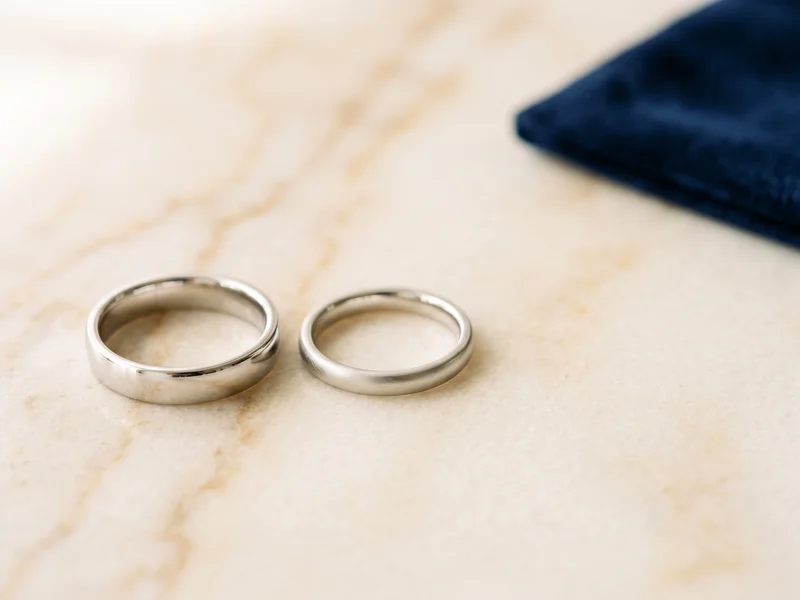
The halo is usually the widest part of the ring, so a straight wedding band often leaves a gap where it meets the halo. Whether that matters is personal. The common options:
- Straight band, with the halo raised: if the halo sits high enough on a bridge, a straight band can slide underneath and sit flush.
- Contoured or notched band: curves around the halo so the two sit together without a gap.
- Pavé band: choose melee of a similar size and colour to the halo so the two read as a set.
- Plain band in the same metal: rings rub together every day, so matching metals wear evenly. A platinum band worn beside an 18ct gold ring can slowly wear the gold one.
Our guide to the wedding bands that pair well with a halo shows each option side by side. Planning the band at the same time as the engagement ring is the easiest way to get a flush fit.
How much do halo engagement rings cost in Australia?
The centre stone is usually the largest part of the price. For the setting alone, excluding the centre, rough ranges in Australia are:
- Classic halo in 18ct gold with natural melee: about AUD 2,500–4,500.
- Hidden halo: about AUD 2,000–4,000.
- Double halo: about AUD 3,500–6,500.
- Platinum: usually about AUD 500–1,500 more than the same design in 18ct gold.
- Lab-grown melee instead of natural can lower the setting cost, depending on how many stones the design uses.
Both the centre and the halo can be natural or laboratory-grown diamond, and they look identical to the eye. Lab-grown diamonds cost much less than natural diamonds of the same size and grade; natural diamonds are rarer. Whichever you choose, the type should be disclosed for every stone in the ring, melee included. Our page on lab-grown melee in pavé and halo work explains how small lab-grown diamonds are graded and matched.
Design a halo ring with our settings
Because a halo makes a centre look larger, many people choose a slightly smaller centre than they would for a solitaire. Moving from 1.00 to 0.80 carat, for example, reduces the centre's price noticeably while the halo keeps the overall size on the hand.
How to choose a halo engagement ring: step by step
- Choose the centre first. Shape, carat, colour and clarity decide the size and outline of the halo.
- Pick the halo style. Classic, hidden, double or a contrast shape, depending on how much extra size and sparkle you want.
- Match the melee. Ask for melee colour close to the centre, and confirm whether it is natural or lab-grown.
- Check the build. Make sure the centre has its own claws, separate from the halo, and ask how high the ring sits.
- Plan the band. Decide on a straight, contoured or pavé wedding band before the design is finalised.
- Book regular checks. Have the claws inspected every one to two years, and replate white gold as needed.
Free consultation
Talk to a gemologist
Compare stones in person or online with Raj Sood, Graduate Gemologist (GIA), AJP (GIA).
Book a consultationShop this shape
FAQ
Common questions
Do halo engagement rings make a diamond look bigger?
Yes. A single halo adds about 2.5–3 mm to the face-up width, so a 1 carat round reads roughly 9 mm across. Up close you can still see the centre and halo as separate parts.
What is the difference between a hidden halo and a halo?
A classic halo sits around the centre and is visible from above. A hidden halo sits under the centre, so it only shows from the side and does not add face-up size.
Are halo rings hard to maintain?
They need more care than a solitaire because they have many small claws. Have them checked every one to two years and bring the ring in if a stone ever feels loose.
Can a halo engagement ring be resized?
Usually by one or two sizes. Larger changes can stress the claws on a pavé band and may mean re-setting some small stones.
Does a straight wedding band fit with a halo ring?
Sometimes. If the halo sits high on a bridge, a straight band can sit flush underneath; otherwise a contoured band closes the gap.
Can the halo diamonds be lab-grown?
Yes. Halo melee can be natural or laboratory-grown, and the type should be disclosed for every stone. Lab-grown melee costs less than natural melee of similar quality.
Terms in this guide

Ask a gemologist
Not sure which diamond to choose?
Raj Sood is a Graduate Gemologist (GIA) and master jeweller. Bring the stones you are considering, or send the reports, and he will tell you honestly which one is better and why.
Keep learning
Related guides
 Engagement Rings & SettingsHidden Halo Engagement Rings
 Engagement Rings & SettingsDouble Halo Engagement Rings
 Engagement Rings & SettingsHalo Shapes Explained
 Wedding Bands & EternityBest Wedding Band for Halo Engagement RingsEngagement Rings & SettingsEngagement Ring Setting Styles Guide
 Engagement Rings & SettingsHalo vs Hidden Halo Engagement Rings
 Lab-Grown DiamondsLab-Grown Diamond Melee in Pavé and Halo Settings
 Engagement Rings & SettingsOval Engagement Rings
Explore more
More guides on this topic
Education