
Pearls
Broome South Sea Pearls: Australia's Pearling Story, Farming, Grading and Price
Broome South Sea pearls are among the largest cultured pearls grown anywhere, and they come from Australia's own north-west coast. Here is how they are grown, how to judge one, and what a fair price range looks like before you buy.
 Reviewed by Raj Sood, Graduate Gemologist (GIA), AJP (GIA)Master jeweller and Graduate Gemologist (GIA) · reviewed 4 November 2026
Quick answer
Broome South Sea pearls are cultured pearls grown in the silver-lipped pearl oyster, Pinctada maxima, off Western Australia's north-west coast. They are typically 10–16 mm, mostly white or silver with satiny lustre and thick nacre from about two years' growth. Quality depends on lustre, surface, shape, size and matching, with prices from hundreds to tens of thousands of dollars.
What are Broome South Sea pearls?
Broome South Sea pearls are cultured pearls grown in Pinctada maxima, the silver-lipped pearl oyster, in the warm tidal waters off the Kimberley and Pilbara coasts of Western Australia. "South Sea" is a trade name for any pearl from this oyster, whether it was grown in Australia, Indonesia, the Philippines or Myanmar. Broome is the historic home of the Australian industry, so "Broome pearl" has become everyday shorthand for Australian South Sea pearls. For the wider family, including the deeper golden colours grown further north, see our guide to white and golden South Sea pearls.
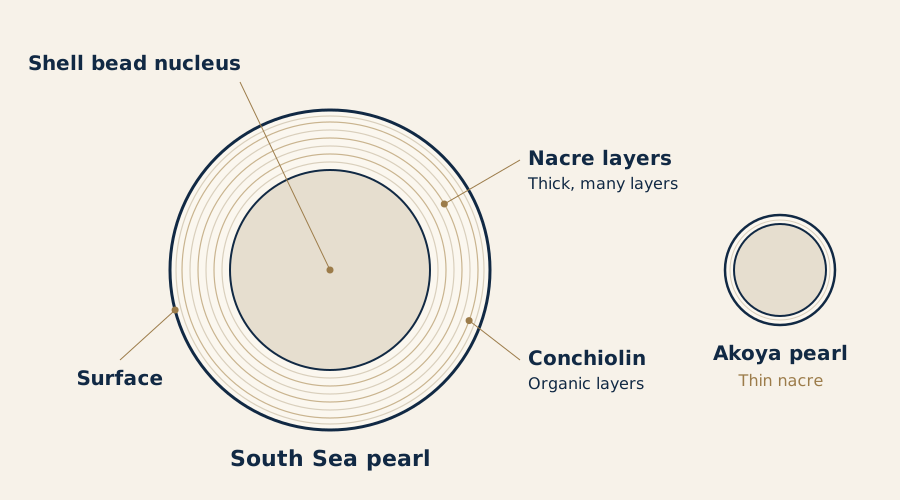
Cultured means a technician started the pearl by placing a small polished bead (the nucleus) and a sliver of mantle tissue inside the oyster. The oyster then coats the bead in nacre, the same iridescent material that lines its shell. Nacre is mostly aragonite, a crystal form of calcium carbonate, laid down in microscopically thin layers held together by an organic protein called conchiolin. To understand how labs separate these from pearls that formed with no human help, read our page on natural versus cultured pearls and how they are tested.
Pinctada maxima is the largest pearl oyster in the world, with a shell that can grow to around 30 cm across. A bigger oyster can accept a bigger nucleus and lay down nacre faster, which is why South Sea pearls are so much larger than most other cultured pearls. Pearl is soft compared with other gems, about 2.5–4.5 on the Mohs hardness scale, with a refractive index of roughly 1.52–1.66, so it needs gentler care than a sapphire or diamond.
Pearl is also the traditional June birthstone, which makes a Broome pearl a popular birthday or anniversary gift. Any unfamiliar word on this page is defined in our glossary of jewellery terms.
How did Broome become Australia's pearling town?
Broome sits on Yawuru country, and Aboriginal people of the Kimberley coast used pearl shell long before Europeans arrived. Broome's commercial industry began in the 1880s, and it was built on shell, not pearls. Mother-of-pearl from Pinctada maxima was cut into buttons, knife handles and inlay, and Broome became one of the world's main sources of it in the early 1900s. A pearl found inside a shell was a welcome bonus, not the business.
The work was hard and dangerous. In the early years Aboriginal people, including women, were forced into diving under conditions now recognised as exploitation. Later, divers came mainly from Japan, the Malay world, Timor (often called Koepangers) and the Philippines, working in heavy helmet-and-canvas diving suits from wooden luggers. Decompression sickness (the bends) and cyclones killed hundreds of men, and Broome's Japanese cemetery holds the graves of many of them. The town's multicultural character, and festivals such as Shinju Matsuri, grew from this history.
Plastic buttons collapsed the shell market after the Second World War. From the 1950s the industry turned to pearl culturing, drawing on Japanese technique, and the first Australian South Sea pearl farms were set up on the Kimberley coast. Today farms operate from the Pilbara and Kimberley across to the Northern Territory, and Australia is known for growing mostly white and silver South Sea pearls.
Pearls are one strand of Australia's gem story. If local stones interest you, see our guide to the sapphire fields of Inverell and Anakie and our page on chrysoprase, often called Australian jade.
How are Broome South Sea pearls farmed?
Australian pearling is regulated by state licences and quotas, and one feature sets it apart: much of the industry has traditionally relied on wild oysters collected from the seabed by divers, supplemented by hatchery-raised oysters. The growing cycle looks like this:
- Collecting: divers gather young wild oysters, or hatcheries raise them, and they rest on the farm before seeding.
- Seeding: a skilled technician opens the oyster slightly and inserts a shell bead nucleus and a small graft of mantle tissue from a donor oyster. The graft forms a pearl sac that lays down nacre.
- Growing: oysters hang in mesh panels on long lines in open water. Crews clean and turn them regularly, which helps the pearl grow round and keeps marine growth off the shells.
- Harvest: after about two years the pearl is removed. A healthy oyster that produced a good pearl can often be reseeded with a larger nucleus, so second and third pearls tend to be bigger.
- Sorting: pearls are cleaned and sorted by size, shape, colour, lustre and surface before they are matched into strands or set.
The long growing time is the key to quality. Akoya pearls are often harvested after a year or less with nacre well under 1 mm thick, while South Sea pearls commonly carry around 2 mm or more of nacre over the bead. Thick nacre gives depth to the glow and helps the pearl wear well over decades. The Kimberley's very large tides flush the farms with nutrient-rich water, which feeds the oysters.
Because a technician inserts the nucleus and graft, these are cultured pearls in every case, whether the oyster was wild-caught or hatchery-raised. Natural pearls from Australian waters are extremely rare today and must be identified by X-ray at a gemmological laboratory.
What colours and sizes do Australian South Sea pearls come in?
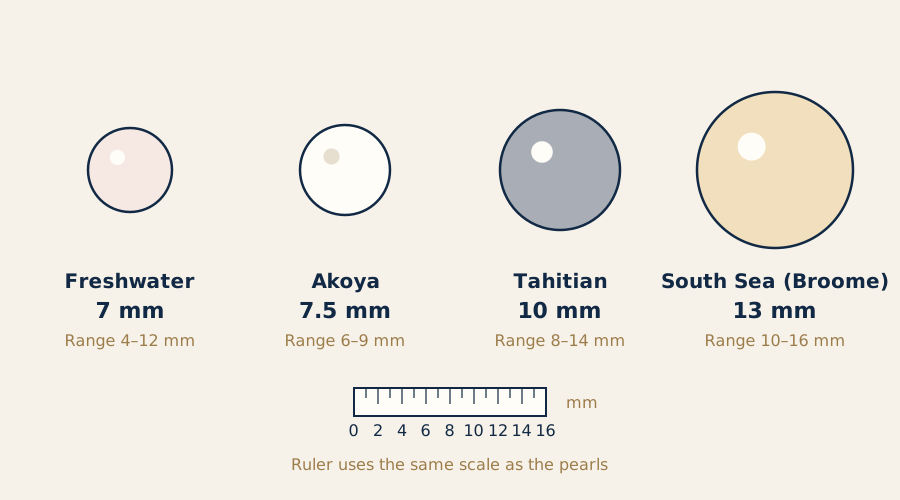
Australian South Sea pearls range from about 9 mm to 20 mm in diameter, with most falling between 10 and 16 mm. For comparison, a classic Akoya strand is usually 6.5–8 mm. Size is measured across the pearl in millimetres, and price climbs steeply with every extra millimetre because large, clean, round pearls are scarce.
| Size | How it looks | Common uses |
|---|---|---|
| 9–11 mm | Small for a South Sea pearl; still larger than most Akoya | Studs, everyday strands, graduated necklaces |
| 11–13 mm | The most common range; clearly substantial on the neck | Pendants, strands, drop earrings |
| 13–15 mm | Large and noticeable from across a room | Statement strands, rings, single-pearl pendants |
| 15–20 mm | Rare, especially in round shapes | Feature pendants and one-off pieces |
Colour has two parts. Body colour is the main colour you see, and overtone is a translucent tint that seems to float over the surface. Broome pearls are mostly white, silver-white and cream, often with a pink, silver or faint blue-green overtone. A white pearl with a soft pink overtone flatters many skin tones; a silver-white with a cool overtone reads crisp against white metal.
Deep golden South Sea pearls mostly come from gold-lipped oysters farmed in Indonesia and the Philippines. Australian farms produce occasional champagne and light gold pearls. Very strong gold colours on the market are sometimes dyed or treated, so ask whether the colour is natural to the pearl. Australian white South Sea pearls are generally sold after cleaning and polishing rather than bleaching or dyeing, but ask your seller to confirm any treatment in writing.
Shapes run from round and near-round through oval, drop and button to circled (with rings around the surface) and baroque, meaning irregular. Perfectly round pearls are a small fraction of each harvest. Drops and baroques cost far less for their size and often show stronger orient, the rainbow shimmer across uneven surfaces.
Not sure which one is right?
Send us the stones you are looking at and our gemologist will tell you which to choose and why.
How are South Sea pearls graded?
There is no single international grading system for pearls the way there is for diamonds. Producers and retailers use their own scales, such as A–AAA or A–D, and an "AAA" from one seller does not necessarily match another's. A more reliable approach is GIA's seven value factors, which our guide to grading lustre, nacre, surface, shape and size covers in full.
| Value factor | What to look for in a Broome pearl |
|---|---|
| Lustre | A bright, satiny glow with a clear reflection of a light source; not chalky or dull |
| Nacre quality | Thick nacre with no bead showing through at the drill hole |
| Surface | Few spots, pits or bumps; small marks hidden near the drill hole are acceptable |
| Shape | Round and near-round cost most; drop, button and baroque cost less for the size |
| Colour | Even body colour; a visible overtone adds appeal |
| Size | Measured in millimetres; each extra millimetre raises the price noticeably |
| Matching | In strands and pairs, pearls should match in colour, lustre and size |
Lustre in a South Sea pearl looks different from the sharp, mirror-like shine of a top Akoya. It is softer and deeper, sometimes described as satiny, because the nacre platelets are larger and laid down in warmer water. Judge it against other South Sea pearls, not against Akoya.
Not sure what type of pearl you have? Our pearl identification guide shows how size, colour, drill-hole appearance and lustre point to the oyster a pearl came from.
South Sea pearl vs Akoya, Tahitian and freshwater: what is the difference?
| South Sea (Broome) | Akoya | Tahitian | Freshwater | |
|---|---|---|---|---|
| Mollusc | Pinctada maxima | Pinctada fucata | Pinctada margaritifera | Freshwater mussels (mainly Hyriopsis) |
| Main sources | Australia, Indonesia, Philippines | Japan, China | French Polynesia | China |
| Typical size | 10–16 mm | 6–9 mm | 8–14 mm | 4–12 mm, some larger |
| Colours | White, silver, cream, gold | White with pink or silver overtone | Grey to black, peacock green | White, pastel, often dyed |
| Nacre | Thick, often around 2 mm+ | Thin, often below 0.5 mm | Moderate to thick | Usually solid nacre, no bead |
| Lustre | Soft, satiny, deep | Sharp, mirror-like | Metallic to satiny | Softer, varies widely |
| Relative price | Highest | Moderate | Moderate to high | Lowest |
If you love a classic white strand at a smaller size, compare our Akoya pearl guide. For dark colours from the black-lipped oyster, see Tahitian pearls from French Polynesia. If budget matters most, freshwater pearls give the most size per dollar, though their lustre and roundness rarely match a good South Sea pearl.
What are keshi and mabe pearls from South Sea oysters?
South Sea farms produce two by-products that many buyers never hear about. Keshi pearls form when the oyster rejects or loses its nucleus but the pearl sac keeps producing nacre. The result is a pearl of solid nacre with no bead, usually small and baroque, with very high lustre. Our keshi pearl guide explains why they glow so brightly and how they are priced.
Mabe pearls are grown against the inside of the shell rather than inside the oyster's body. A half-dome is glued to the shell, the oyster coats it in nacre, and the dome is cut out, backfilled and backed with mother-of-pearl. Mabe gives a large, flat-backed pearl face for earrings and rings at a fraction of the price of a whole South Sea pearl, though it is less durable on its edges. See how mabe blister pearls are made for care and setting advice.
Related guideSouth Sea Pearls (White and Golden)How much do Broome South Sea pearls cost?
Broome pearls price ranges are wide because the gap between a baroque 10 mm pearl and a round, clean 15 mm pearl is enormous. The figures below are broad guides only, for pearls of good commercial quality in a simple gold setting or on a knotted silk strand.
| Piece | Approximate price range (AUD) |
|---|---|
| Single pearl pendant, 10–12 mm, near-round | about $500–$2,500 |
| Pair of studs, 10–11 mm, matched | about $800–$3,000 |
| Strand, 10–13 mm, about 45 cm | about $4,000–$20,000 |
| Strand, 13–16 mm, round, well matched | about $20,000–$60,000 or more |
| Baroque or keshi strand | about $1,500–$10,000 |
What moves the price most is shape and size, then surface, lustre and matching. A round pearl can cost several times as much as a drop of the same size and quality. For strands, matching dozens of pearls in colour and lustre takes time, which is reflected in the price. Pearls are priced as jewellery to enjoy and wear; resale values vary and should not be assumed.
Browse natural gemstones
How do you care for and restring South Sea pearls?
Nacre is soft and sensitive to acids, so pearls need a few simple habits. Our pearl care and restringing guide goes into detail, but the basics are:
- Last on, first off: put pearls on after perfume, hairspray and make-up, and take them off before the gym, pool or beach.
- Wipe after wearing: use a soft, slightly damp cloth to remove skin oils and sweat.
- Store flat and separately: in a soft pouch, away from diamonds and other hard gems that can scratch them. Do not hang strands, which stretches the silk.
- No ultrasonic or steam cleaners: heat and vibration can damage nacre and loosen drill holes.
- Restring regularly: silk thread stretches and weakens. Strands worn often usually need restringing every one to two years; check sooner if gaps appear between the knots.
GemTrove restrings pearls in-house, with a knot between each pearl so that if the thread ever breaks you lose at most one pearl. Inherited strands can also be remodelled: a long strand might become a shorter necklace plus a pair of earrings, or a single Broome pearl can be set into a pendant or paired with a stone from our Australian sapphire ring designs for an all-Australian piece.
For ideas on strands, pendants and made-to-order designs, see our pearl jewellery and custom pearl designs page.
How to tell real South Sea pearls and choose one: step by step
- Ask what it is. Confirm the pearl is cultured South Sea from Pinctada maxima, where it was grown, and whether the colour has been treated.
- Check the size in millimetres. Australian South Sea pearls are usually 10 mm or more; a "South Sea" pearl under 9 mm deserves a second look.
- Judge the lustre. Look for a clear reflection and a soft, deep glow, not a chalky or glassy surface.
- Rub gently against a tooth. Real pearls feel slightly gritty; imitation glass or plastic pearls feel smooth.
- Look at the drill hole. The edge should be clean, and the nacre should not look thin or chipped around it.
- Inspect surface and matching. Roll strands to check for spots and for pearls that differ in colour or lustre.
- Plan care and restringing. Ask how the strand is knotted and budget for restringing every year or two if you wear it often.
Free consultation
Talk to a gemologist
Compare stones in person or online with Raj Sood, Graduate Gemologist (GIA), AJP (GIA).
Book a consultationShop this shape
FAQ
Common questions
Are Broome pearls real pearls?
Yes. Broome South Sea pearls are real cultured pearls grown by the Pinctada maxima oyster, which coats a shell bead in genuine nacre. They are not imitations, but they are cultured rather than natural.
Why are South Sea pearls so expensive?
Each oyster produces one pearl at a time over about two years, many pearls come out baroque or blemished, and large round pearls are scarce. Thick nacre and big sizes add further to the cost.
What is the difference between Australian and other South Sea pearls?
They come from the same species of oyster. Australian farms are known mainly for white and silver pearls, while Indonesia and the Philippines produce more of the deep golden colours.
How often should a pearl necklace be restrung?
If you wear it often, every one to two years. Strands worn only occasionally can go longer, but have them checked if the knots look loose or the silk looks grubby.
Can you wear South Sea pearls every day?
Yes, with care. Put them on after cosmetics, wipe them after wearing and keep them away from chlorine, sweat and harder gems that can scratch the nacre.
Are there natural pearls from Broome?
Natural pearls do still occur in Australian oysters, but they are extremely rare and must be confirmed by X-ray at a gemmological laboratory. Almost all Broome pearls sold today are cultured.
Terms in this guide

Ask a gemologist
Not sure which diamond to choose?
Raj Sood is a Graduate Gemologist (GIA) and master jeweller. Bring the stones you are considering, or send the reports, and he will tell you honestly which one is better and why.
Keep learning
Related guides
 PearlsSouth Sea Pearls (White and Golden)
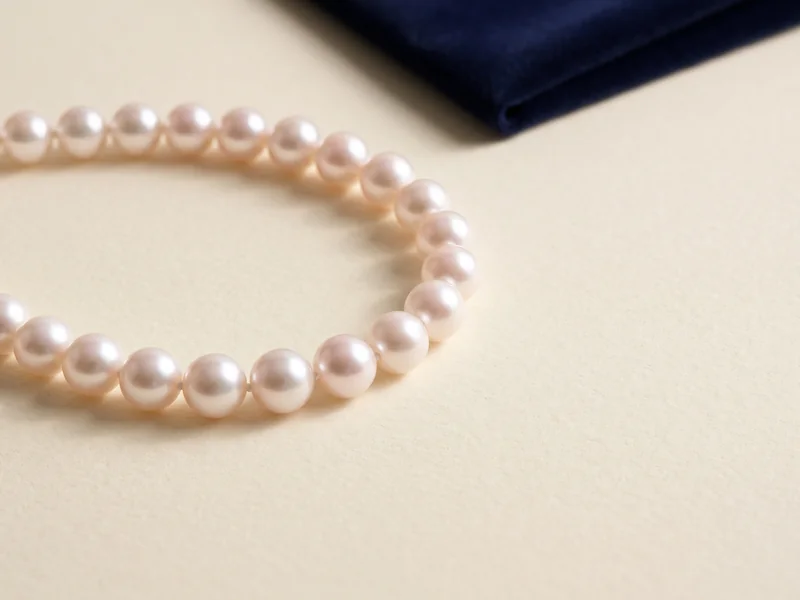 PearlsPearl Care and RestringingPearlsPearl Grading: Lustre, Nacre, Surface, Shape, SizePearlsNatural vs Cultured Pearls
 PearlsPearl Jewellery, Pearl Strands and Custom Pearl DesignsPearlsTypes of Pearls and Pearl Identification GuidePearlsAkoya Pearls
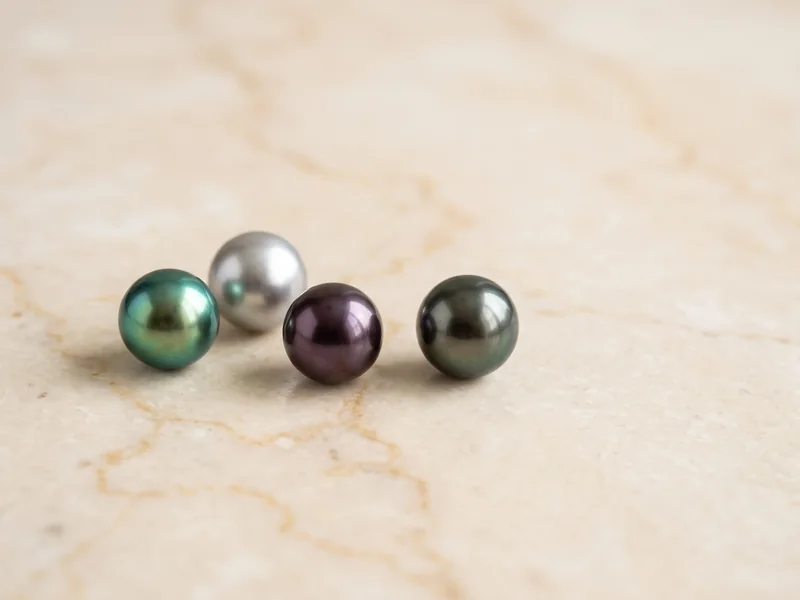 PearlsTahitian Pearls
Explore more
More guides on this topic
Education