
Metals
Gold Jewellery: 9ct, 18ct, Colours, Hallmarks and Lasting Value
Almost no gold jewellery is pure gold, and the small number stamped inside a piece tells you how much gold you actually own. Here is how carat, colour, alloys and hallmarks change the way gold looks, wears and costs.
 Reviewed by Raj Sood, Graduate Gemologist (GIA), AJP (GIA)Master jeweller and Graduate Gemologist (GIA) · reviewed 4 November 2026
Quick answer
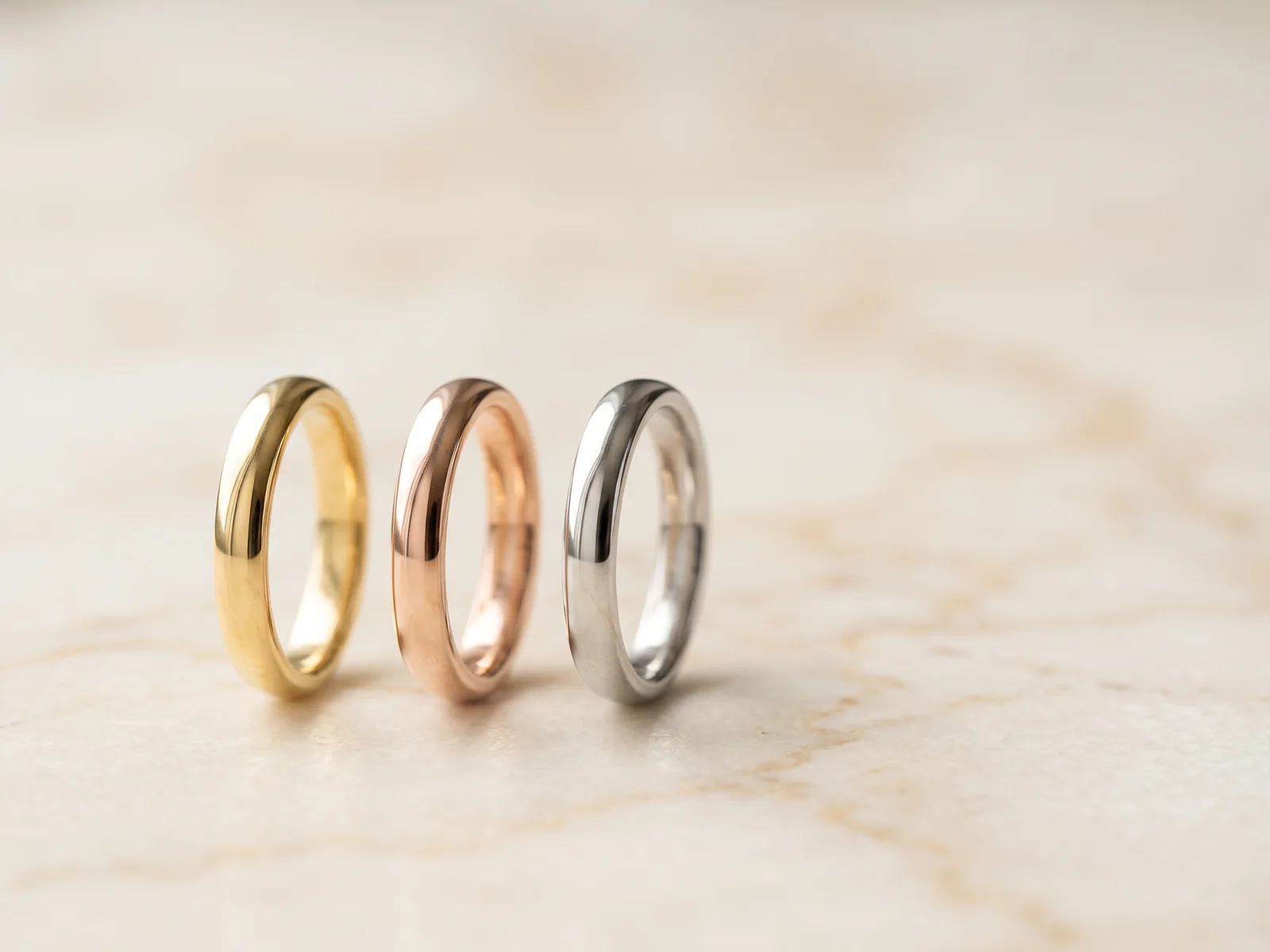
Gold jewellery is made from gold alloyed with other metals for strength and colour. In Australia, 9ct (37.5% gold, stamped 375) and 18ct (75%, stamped 750) are most common. 18ct is richer in colour, kinder to sensitive skin and costs more; 9ct is more affordable but can tarnish. Yellow, white and rose come from the alloy mix.
What is gold jewellery made of?
Pure gold is a soft, heavy, rich-yellow metal. It sits at about 2.5–3 on the Mohs scale (the 1–10 scratch-hardness scale on which diamond is 10), so on its own it bends and scratches too easily for most rings. Almost all gold jewellery is therefore an alloy: gold melted together with other metals, usually silver, copper and zinc, and for white gold palladium or nickel.
Those added metals do two jobs. They make the gold harder and springier, so claws grip a stone and a band keeps its shape, and they set the colour. More copper pushes the gold pink, more silver makes it paler or slightly green, and palladium or nickel bleach it towards white. Our guide to why yellow gold is both warm in colour and strong covers the metallurgy, and the jewellery glossary defines every term on this page.
What never changes is the gold itself. Gold does not rust or corrode in everyday wear, which is why a ring made a hundred years ago can still be resized, repaired or melted and remade today. The alloy metals around it are what tarnish, wear thin or react with skin, and how much of them a piece contains is exactly what the carat number tells you.
What do 9ct, 14ct, 18ct, 22ct and 24ct gold mean?
Gold purity is measured in carats, out of 24. Pure gold is 24 carat, so 18 carat is 18 parts gold in 24, or 75%. This is a different measure from a diamond's carat, which is a weight (one carat = 0.2 grams). In the USA it is spelt karat and written 18K; in Australia you will usually see 18ct. The fineness number stamped on a piece is simply the gold content in parts per thousand.
| Carat | Gold content | Fineness stamp | Where you usually see it |
|---|---|---|---|
| 9ct | 37.5% | 375 | The most common carat in Australia and the UK |
| 10ct | 41.7% | 417 | Common in the USA; rarely sold new here |
| 14ct | 58.5% | 585 | Common in the USA and Europe; increasingly offered in Australia |
| 15ct | 62.5% | 625 | Older Australian and British jewellery; little made today |
| 18ct | 75% | 750 | Fine jewellery and engagement rings in Australia and Europe |
| 22ct | 91.6% | 916 or 917 | Traditional jewellery from India, the Middle East and South-East Asia |
| 24ct | 99.9% | 999 | Bullion and some traditional pieces; too soft for most rings |
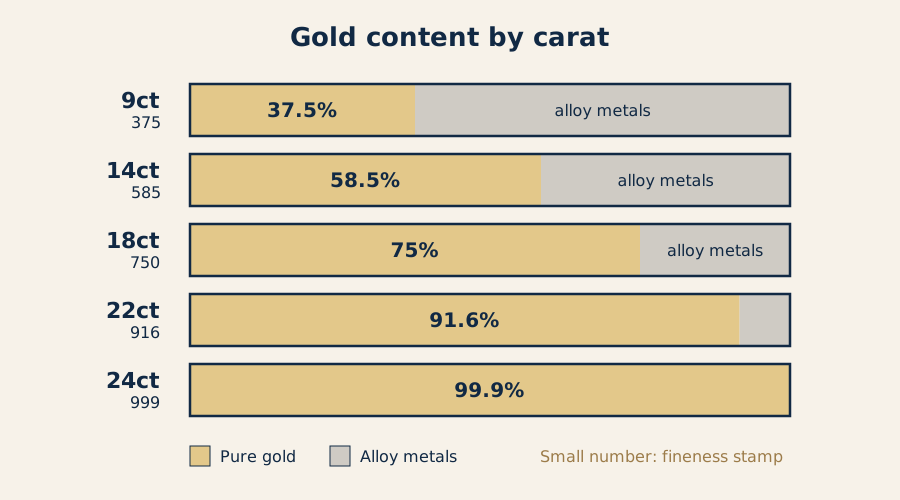
14ct sits between the two Australian favourites, with a little more gold than half; our page on 14 carat gold in detail explains when it makes sense. At the other end, high-carat 22ct and 24ct gold has a deep, almost orange yellow that many families treasure, but it dents and wears quickly and is rarely used to hold a diamond.
Is 9ct or 18ct gold better for everyday wear?
Both are solid gold and both suit daily wear. The difference is less about strength than people expect, and more about colour, weight, how the metal ages and how your skin responds.
| 9ct gold | 18ct gold | |
|---|---|---|
| Gold content | 37.5% | 75% |
| Yellow colour | Paler, slightly brassy | Rich and warm |
| Weight of the same design | Lighter | Roughly a third heavier |
| Tarnish | Can darken over years, faster in chlorine or with some skin chemistry | Very little |
| Sensitive skin | More alloy metal, so more likely to react | Less likely to react |
| Scratching and wear | Scratches like any gold; hardness depends on the alloy | Scratches like any gold; hardness depends on the alloy |
| Price | Lower, mainly because it holds less gold | Higher, mainly because it holds more gold |
| Often chosen for | Pendants, earrings, fashion rings, tighter budgets | Engagement rings, wedding bands, sensitive skin |
For a ring worn every day for decades, most Australians choose 18ct: the colour stays truer next to a diamond and it is gentler on skin. 9ct is a sensible choice for pieces worn less often or where budget matters most. Our full 9ct vs 18ct comparison goes further, and if the piece is a bridal ring, read choosing a metal for an engagement ring, which weighs gold against platinum too.
Related guide9K vs 18K Gold: Which Gold Is Better for Jewellery?How are yellow, white and rose gold made?
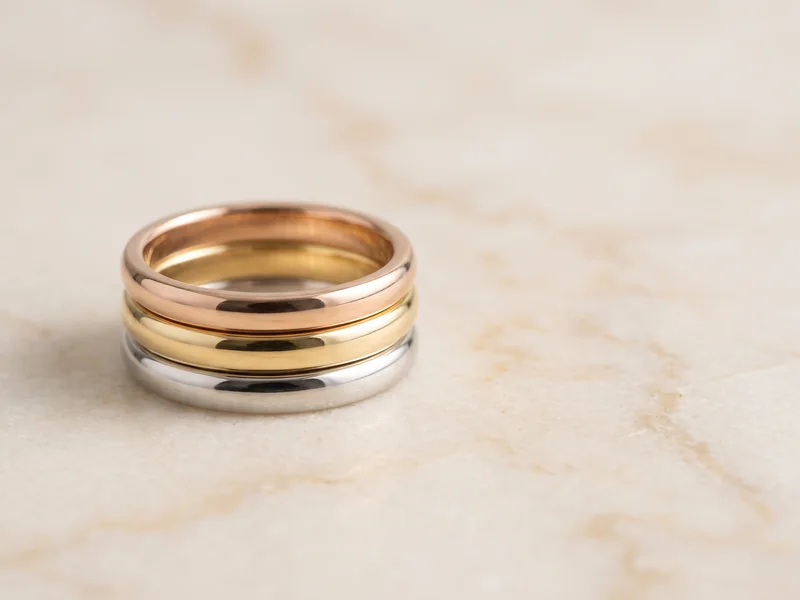
All three colours can be made at any carat. The gold content stays the same; only the other 25% (in 18ct) or 62.5% (in 9ct) changes. Typical 18ct mixes look like this, though every refiner's recipe differs slightly:
| Colour | Typical 18ct mix | Look | Worth knowing |
|---|---|---|---|
| Yellow | 75% gold, roughly 12–16% silver, 9–13% copper | Warm, classic yellow | No plating needed; wears evenly |
| Rose | 75% gold, roughly 20–22% copper, 3–5% silver | Soft pink to coppery | Copper makes it a little harder; colour deepens slightly with age |
| Red | 75% gold, about 25% copper | Strong copper-red | Uncommon; harder to work |
| White (palladium) | 75% gold, palladium plus silver or copper | Pale grey-white | Nickel-free; usually rhodium plated |
| White (nickel) | 75% gold, nickel plus copper and zinc | Whiter base colour | Hard and bright, but can trigger nickel allergy |
| Green | 75% gold, about 25% silver | Pale yellow-green | Rare in modern jewellery |
Lower carats show the alloy more. 9ct rose gold is usually a stronger pink than 18ct rose, and 9ct yellow is visibly paler. To compare the three main colours on skin and next to stones, see yellow, white and rose gold side by side, and for the chemistry behind the blush, what gives rose gold its pink tone.
Colour also changes how a stone looks. Rose gold flatters morganite, pink sapphire and warm-toned diamonds; our guide to pairing stones with rose gold gives combinations. If you want more than one colour, mixing gold colours in a bridal set shows how to make it look deliberate.
Not sure which one is right?
Send us the stones you are looking at and our gemologist will tell you which to choose and why.
Why is white gold rhodium plated?
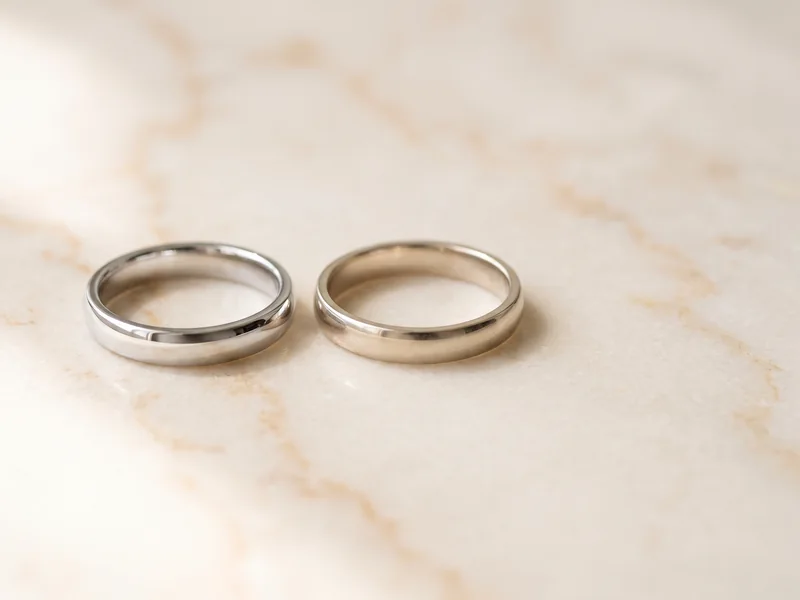
No gold alloy is truly white. Even good white gold has a faint grey or straw tint, because gold's yellow is only partly masked by palladium or nickel. To make it bright and white, most white gold jewellery is electroplated with rhodium, a hard, very white metal from the platinum family. The layer is thin, usually well under one micron (a thousandth of a millimetre).
Rhodium wears away where the metal rubs, so on a ring the underside of the band and the edges fade first, often within one to three years depending on how hard the hands work. Earrings and pendants keep their plating far longer. Re-plating is a routine workshop job: the piece is cleaned, polished and dipped again, and for a plain ring it typically costs somewhere around A$80–A$150. Our page on why white gold is rhodium plated explains the process in full.
If you would rather never re-plate, platinum is naturally white all the way through, usually 95% pure (stamped 950) and heavier than gold. It scratches too, but the metal moves rather than wearing away. White gold versus platinum compares cost, weight and upkeep.
How do you read hallmarks on gold jewellery?
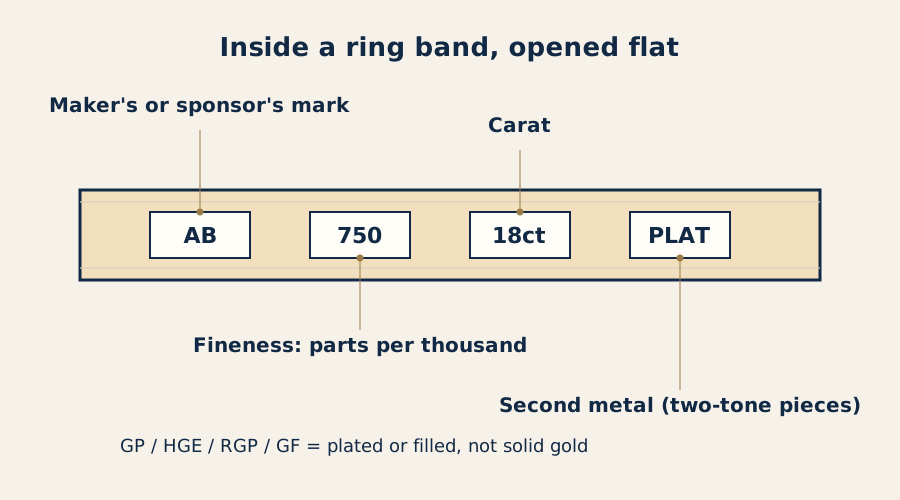
A hallmark is the set of small stamps, usually inside a ring band or on a clasp, that tells you what a piece is made of. Australia, unlike the UK, has no compulsory government hallmarking or official assay office. Marks are stamped by the maker or importer, and stating the wrong purity would be misleading under Australian Consumer Law, so reputable makers stamp accurately. The marks you are most likely to find:
- Fineness number: 375, 585, 750, 916 or 999, the gold content in parts per thousand.
- Carat mark: 9ct, 14ct or 18ct, or 9K, 14K and 18K on imported pieces. Some pieces carry both.
- Maker's or sponsor's mark: initials or a symbol identifying the workshop or business that takes responsibility for the piece.
- Metal mark for two-tone pieces: for example 18ct with PLAT where a platinum head sits on a gold band.
- Plated or filled marks: GP or GEP (gold plated or gold electroplated), HGE (hard gold electroplate), RGP (rolled gold plate) and GF (gold filled). These mean the piece is not solid gold.
Older Australian pieces are often stamped 15ct or 9ct with a maker's name, sometimes with a small pictorial mark. A missing stamp does not mean a piece is fake; marks wear off and resized bands lose them. A jeweller can confirm the carat with an acid test or, more precisely, an XRF (X-ray fluorescence) analyser that reads the alloy without damaging it. A magnet is not a reliable test.
Can gold jewellery cause an allergy?
Gold itself almost never causes a reaction. The usual cause is nickel, one of the most common contact allergies, which is used in some white gold alloys and occasionally in lower-carat yellow gold. The rhodium plating on white gold acts as a barrier, but once it wears through on the inside of a band, skin is in direct contact with the alloy underneath.
- Choose a higher carat: 18ct holds twice the gold of 9ct, so there is far less of everything else.
- Ask for nickel-free white gold: palladium white gold is the usual alternative.
- Keep plating fresh: re-plating before the base metal shows reduces contact.
- Consider platinum: see platinum, a naturally white nickel-free option, if reactions are severe.
A grey or green mark on skin under a ring is a different issue. It usually comes from copper or silver in the alloy reacting with sweat, sunscreen or cosmetics, and is more common with 9ct. It is not harmful and normally washes off; cleaning the ring and keeping lotions off it usually stops it.
What is the difference between solid gold, gold plated and vermeil?
Only solid gold is gold all the way through. The others put a thin gold layer over a cheaper base metal, which is why they cost so much less and eventually wear.
| Type | What it is | Typical gold layer | How long the colour lasts |
|---|---|---|---|
| Solid gold | Gold alloy throughout (9ct, 14ct, 18ct and up) | Not a layer; the whole piece | Indefinitely; can be polished and repaired |
| Gold filled | Thick gold sheet bonded to brass or copper | Often about 5% of the item's weight | Years with care |
| Gold vermeil | Sterling silver electroplated with gold | Commonly 2.5 microns or more | Months to a few years, depending on wear |
| Gold plated | Thin electroplated layer over brass or other base metal | Often under 1 micron to about 2.5 microns | Weeks to months on rings and bracelets |
Plated and vermeil pieces are fine for fashion jewellery, but they cannot be resized easily, re-polished or reliably repaired. Solid, filled and plated gold compared covers each in depth, and how gold vermeil is made explains what the label should and should not mean.
How does the gold price affect what gold jewellery costs?
Gold is traded per troy ounce (31.1 grams), and in Australia the price is quoted in AUD. The metal is only part of a piece's price: design, labour, finishing, stones and setting often matter as much. Because 18ct is also denser than 9ct, the same design weighs more in 18ct, so the difference in gold content is bigger than the carat numbers alone suggest.
| Same ring design in… | Approximate ring weight | Pure gold contained |
|---|---|---|
| 9ct yellow | 5.0 g | about 1.9 g |
| 14ct yellow | about 6.0 g | about 3.5 g |
| 18ct yellow | about 6.8 g | about 5.1 g |
| 22ct yellow | about 8.0 g | about 7.3 g |
Those figures are approximate and vary with the alloy, but they show why an 18ct band typically contains well over double the gold of the same band in 9ct. When the gold price moves, plain bands and heavy chains move most; diamond rings move less, because the stone carries most of the cost. How the gold price flows through to jewellery explains this, including what happens to quotes when the market swings.
The lasting value of gold jewellery is mainly in its durability and the fact that the gold can always be reused. A well-made piece can be resized, re-tipped, re-plated or remodelled for generations. Its scrap value is only its pure gold content, less refining costs, which is usually far below the retail price of a finished piece.
How to choose gold jewellery: step by step
Browse ring settings by metal
- Decide how often it will be worn. Daily rings take the most wear; pendants and earrings take very little.
- Pick the carat. 18ct for everyday rings and sensitive skin, 9ct or 14ct where budget or lightness matters more.
- Choose the colour. Hold yellow, white and rose against your skin, and against the stone. A yellow gold setting with a colourless diamond often works better than people expect, with white claws if you want the diamond to look whiter.
- Ask about the alloy. For white gold, ask whether it is palladium or nickel based, and how often it will need rhodium.
- Check the hallmark. Look for the fineness stamp and a maker's mark, and make sure it matches the paperwork.
- Ask about weight and finish. A heavier band lasts longer; ask the weight in grams and whether it is cast, handmade or die-struck.
- Plan the upkeep. Ask what cleaning, re-plating and claw checks the piece will need, and roughly how often.
For care, wash gold in warm water with a drop of mild detergent and a soft brush, then dry it. Take rings off in chlorinated pools and spas, at the gym and when gardening; chlorine can weaken lower-carat alloys over time, and hard knocks scratch every carat. Have claws checked about once a year.
Free consultation
Talk to a gemologist
Compare stones in person or online with Raj Sood, Graduate Gemologist (GIA), AJP (GIA).
Book a consultationShop this shape
FAQ
Common questions
Is 9ct gold real gold?
Yes. 9ct is a solid gold alloy containing 37.5% pure gold, stamped 375. It is less pure than 18ct, so it is paler and can tarnish slightly over time, but it is genuine gold, not plating.
What does 750 mean on gold jewellery?
750 means the metal is 750 parts per thousand pure gold, which is 18 carat. 375 is 9ct, 585 is 14ct and 916 or 917 is 22ct.
Does Australia have official gold hallmarking?
No. Australia has no compulsory government hallmarking system, so purity marks are stamped by the maker or importer. Misstating the purity would be misleading under Australian Consumer Law, and a jeweller can test a piece if you are unsure.
Does 18ct gold tarnish?
Very little. With three-quarters pure gold, 18ct yellow and rose hold their colour well; any dulling is usually dirt or skin oils and cleans off. White gold's rhodium plating wears rather than tarnishes.
Can I wear gold jewellery in the shower or pool?
A shower will not harm solid gold, though soap film dulls it. Avoid chlorinated pools and spas, which can discolour and, over years, weaken lower-carat alloys.
Is white gold or yellow gold more durable?
At the same carat both are durable enough for daily wear. Nickel white gold is often slightly harder, but white gold needs re-plating, while yellow gold simply polishes back.

Ask a gemologist
Not sure which diamond to choose?
Raj Sood is a Graduate Gemologist (GIA) and master jeweller. Bring the stones you are considering, or send the reports, and he will tell you honestly which one is better and why.
Keep learning
Related guides
 Metals9K vs 18K Gold: Which Gold Is Better for Jewellery?
 MetalsYellow Gold vs White Gold vs Rose Gold
 MetalsWhy White Gold Is Rhodium PlatedMetalsGold Plated vs Gold Filled vs Solid GoldMetalsBest Metal for Engagement Rings
 MetalsGold Vermeil ExplainedMetals22K and 24K Gold JewelleryMetalsWhat Gives Rose Gold Its Colour?
Explore more
More guides on this topic
Education