
- Education
- Natural Diamonds
- HPHT Natural Diamonds: How the Treatment Works, How It Is Detected and What It Means for Price
Natural diamonds
HPHT Natural Diamonds: How the Treatment Works, How It Is Detected and What It Means for Price
Some HPHT natural diamonds left the mine brown and came out of a press colourless, and you cannot see the difference by eye. Here is how the treatment works, how laboratories find it, how it appears on a report and what it means for price in Australia.
 Reviewed by Raj Sood, Graduate Gemologist (GIA), AJP (GIA)Master jeweller and Graduate Gemologist (GIA) · reviewed 4 November 2026
Quick answer
HPHT natural diamonds are mined diamonds whose colour has been changed after mining using high pressure and high temperature, similar to conditions deep in the Earth. The treatment can turn brownish stones colourless or create yellow, green, blue or pink. It is permanent, but must be disclosed, and treated stones usually sell below untreated natural diamonds.
What are HPHT natural diamonds?
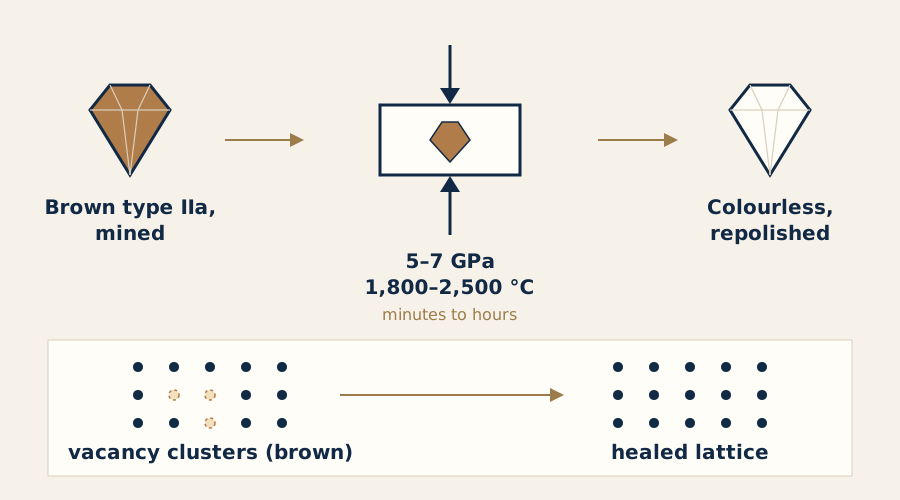
HPHT stands for high pressure, high temperature. An HPHT natural diamond is a diamond that formed naturally in the Earth, was mined, and was then placed in a large press and heated under enormous pressure to change its colour. The diamond is still entirely natural in origin. What has changed is the arrangement of a few atoms and defects inside the crystal, and with it the colour you see.
It helps to know that natural diamonds were born in similar conditions. They crystallised roughly 150–200 km down in the mantle, at around 1,000–1,300 °C, and many spent millions or billions of years there. Our explainer on how diamonds form under heat and pressure in the mantle covers that story. HPHT treatment briefly recreates, and pushes past, those conditions in a factory for minutes to hours rather than geological time.
Do not confuse this with an HPHT lab-grown diamond. That is a laboratory-grown diamond grown from scratch in a similar press. A treated natural diamond was mined; a lab-grown diamond was not. Both can carry the letters HPHT on a report, so the wording matters, and we explain how to read it further down. For the wider picture on mined stones, start with our complete guide to natural diamonds, and if any term here is new, our plain-English jewellery glossary defines it.
HPHT is a colour treatment. It does not improve clarity, does not change the cut and does not change the weight, except for the small loss when the stone is repolished afterwards. The diamond keeps its hardness (10 on the Mohs scale) and refractive index (about 2.42).
How does HPHT treatment change a diamond's colour?
Most brown natural diamonds are brown because the crystal was squeezed and bent while it was still in the Earth. Gemmologists call this plastic deformation: layers of atoms slip against each other and leave behind tiny clusters of missing atoms (vacancy clusters) that absorb light and look brown. Under HPHT conditions those clusters break up and the crystal partly heals, so the brown fades.
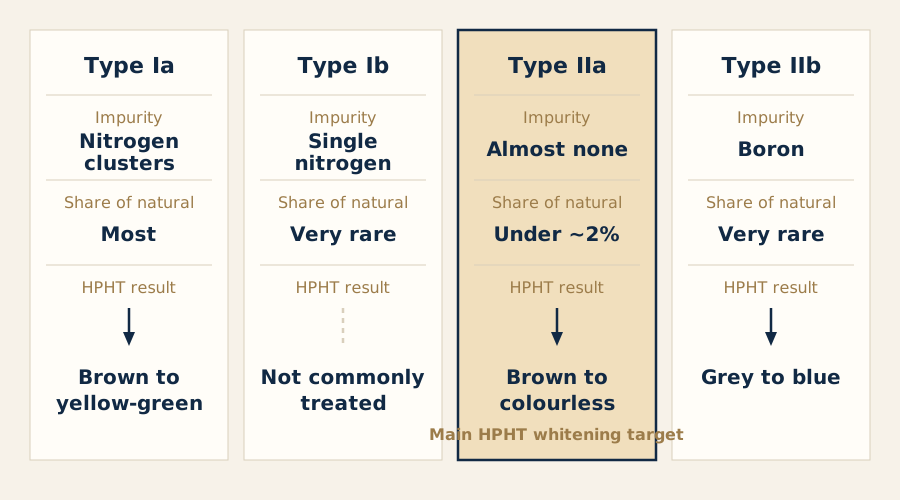
What colour you end up with depends on the diamond's type, a classification based on how much nitrogen or boron the crystal holds. Nitrogen is the most common impurity in natural diamond, and how it is arranged decides whether removing the brown leaves the stone white or turns it yellow or green.
| Starting diamond | What it contains | Typical result after HPHT |
|---|---|---|
| Brown type IIa | Almost no measurable nitrogen; under about 2% of natural diamonds | Colourless or near-colourless, often D–H colour; occasionally faint pink |
| Brown type Ia | Nitrogen in clusters; most natural diamonds | Yellow, greenish-yellow or yellow-green |
| Grey type IIb | Traces of boron | Blue or greyish blue |
| Brownish type IIa with pink tint | Very low nitrogen, deformation bands | Pink (rare) |
| Type Ia after HPHT plus irradiation and annealing | Nitrogen, with new defects added in later steps | Pink, red or purple (a multi-step treatment) |
Type IIa stones are the prize for treaters because brown type IIa can become a high white, and type IIa is the purest chemical type. That is also why some of the most famous large colourless diamonds are type IIa. In nitrogen-rich type Ia stones, the heat breaks the nitrogen clusters apart and creates new colour centres (such as the H3 centre) that absorb blue light, so the stone turns yellow to green instead of white.
HPHT is one of several ways colour can be altered. Irradiation, coatings and combinations of steps are explained in our guide to HPHT and irradiation colour treatments.
When did HPHT treatment start, and what about Argyle brown diamonds?
General Electric had used HPHT presses to grow diamonds since the 1950s, and in 1999 GE and Pegasus Overseas, a company linked to the diamond firm Lazare Kaplan, began selling natural diamonds whitened by HPHT. The trade nicknamed them GE POL diamonds, later sold under the name Bellataire. The release caused alarm because the stones could not be identified by a standard gemmological examination, and laboratories such as GIA spent the following years developing detection methods. Early GE POL stones were laser-inscribed on the girdle so they could be traced.
Australia has a particular connection. The Argyle mine in the East Kimberley, Western Australia, produced from the mid-1980s until it closed in 2020 and was for years one of the largest diamond producers in the world by volume. The large majority of its output was brown. Rio Tinto marketed these as champagne and cognac diamonds on a C1 to C7 colour scale, and the famous Argyle pinks were well under 1% of production.
Argyle diamonds are mostly nitrogen-bearing type Ia with heavy plastic deformation, which is the same deformation that gives Argyle pinks their colour. Because they contain nitrogen, HPHT does not turn Argyle browns white. Instead it tends to push them towards yellow and greenish-yellow. Treaters have experimented with brown Australian rough for exactly this reason, which is one more reason to rely on the report rather than assume an attractive yellow or green stone is untreated.
Natural untreated colour becomes harder to find as stones get larger, and large type IIa diamonds are rare at any colour. Our page on how rarity climbs with carat weight shows the pattern.
Are HPHT natural diamonds the same as HPHT lab-grown diamonds?
No. They share a machine, not an origin. An HPHT natural diamond grew in the Earth and only had its colour adjusted. An HPHT lab-grown diamond was grown in a press over days or weeks, from carbon dissolved in a molten metal mix (usually iron, nickel or cobalt), onto a small diamond seed. Laboratory-grown diamonds made by chemical vapour deposition (CVD) are different again, and many CVD stones are also HPHT-treated after growth to remove brown. Our comparison of the two ways lab-grown diamonds are made explains both.
| Untreated natural | HPHT-treated natural | HPHT lab-grown | |
|---|---|---|---|
| Origin | Mined | Mined | Grown in a laboratory press |
| Colour | As it came from the Earth | Changed after mining | Set during growth, sometimes treated after |
| Typical type | Mostly type Ia | Mostly type IIa (when whitened) | Usually type IIa or IIb |
| Telltale features | Natural growth and strain patterns | Natural strain, sometimes graphitised fractures or etched naturals | Cuboctahedral growth sectors, possible metallic inclusions |
| Report wording | Natural, no treatment noted | Natural, with HPHT processing disclosed | Laboratory-grown, growth method often stated |
| Price for the same grades | Highest | Usually below untreated | Much lower |
HPHT lab-grown stones have their own clues, such as metallic inclusions left by the growth press and, in some stones, the faint blue tint some press-grown stones show from traces of boron. None of those apply to a treated natural diamond. For how the two origins compare on look, durability and cost, read lab-grown versus natural diamonds compared.
Related guideLab-Grown Diamonds vs Natural DiamondsNot sure which one is right?
Send us the stones you are looking at and our gemologist will tell you which to choose and why.
How do you tell if a diamond is HPHT treated?
You cannot tell by eye, and neither can most jewellers with a loupe. A treated colourless type IIa diamond looks exactly like an untreated one. Detection is a laboratory job, and it usually happens in stages.
- Screening by type: infrared spectroscopy (FTIR) shows how much nitrogen the stone contains. Most colourless natural diamonds are type Ia, so a type IIa result flags the stone for closer testing.
- Photoluminescence (PL): a laser excites the diamond, often cooled in liquid nitrogen to about −196 °C, and the light it gives back reveals tiny defect signatures that change during HPHT treatment.
- UV fluorescence imaging: instruments such as the DiamondView show growth patterns, separating natural from laboratory-grown at the same time.
- Microscope clues: graphitised inclusions or fractures with dark halos, and etched or frosted surfaces on unpolished areas, can point to heat treatment, though many treated stones show none of these.
The unpolished patches matter more than you might think. A natural is a small area of the original crystal surface left on a cut diamond, and under HPHT conditions that skin can etch or frost. Look at our pages on indented naturals and on original crystal skin left on the girdle to see what normal untreated naturals look like.
A handheld diamond tester will simply say diamond, because the treated stone is diamond. Our guide on what a handheld diamond tester can and cannot tell explains the limits, and the instruments laboratories use to confirm origin goes deeper into spectroscopy.
How is an HPHT processed diamond shown on a report?
A reputable laboratory that detects HPHT treatment says so in writing. On a GIA or IGI report for a natural diamond, expect a comment noting that the colour has been changed by HPHT processing, and usually a laser inscription on the girdle (the thin outer edge) reading something like HPHT PROCESSED alongside the report number. For treated fancy colours, the colour origin may be listed as treated.
Read three lines carefully: the origin (natural or laboratory-grown), the colour origin or comments, and the inscription. If a report says natural but the comments mention processing, you have an HPHT natural diamond. If it says laboratory-grown and mentions HPHT, the stone was grown in a press. The layout differences are explained in how natural and lab-grown reports differ, and our walk-through of reading an IGI natural diamond report line by line shows where each comment sits.
Under the Australian Consumer Law, a seller must not mislead you about the goods, and leaving out a treatment that affects a diamond's value can be misleading. Industry nomenclature standards also require treated diamonds to be described as treated. In practice, an older stone with a basic report, or no report, is where an undisclosed treatment is most likely to slip through.
Are HPHT natural diamonds worth buying?
It depends on what you value. An HPHT natural diamond is a real, mined diamond with the same hardness, sparkle and durability as an untreated one. If you want a natural origin and a high colour grade at a lower price, a disclosed treated stone can make sense. If what matters to you is that the stone is exactly as nature made it, an untreated natural is the only choice.
| 1 ct round, G–H, VS2 | Approximate price range (AUD) |
|---|---|
| Untreated natural | about $7,000–$14,000 |
| HPHT-treated natural | about $4,000–$9,000 |
| Lab-grown | about $800–$2,000 |
These are broad ranges only and move with the market. Treated natural stones usually sell below untreated stones of the same grades, and the gap tends to be wider at resale, because many buyers and dealers prefer untreated colour. Natural diamonds should never be thought of as an investment, treated or not; our page on how natural diamond prices have moved over time gives the history without the hype.
Treated fancy colours are a separate case. An HPHT yellow, green or blue costs a small fraction of a natural-colour stone of similar appearance, because natural fancy colours are rare. That is fine for a fashion piece as long as it is described as treated.
Browse natural diamonds with full grading reports
Is HPHT treatment permanent?
Yes. HPHT treatment changes the defects inside the crystal itself, so the colour is stable under normal wear, cleaning, sunlight and the heat of an ultrasonic cleaner. It does not wear off and does not need to be redone. This is different from coatings, which sit on the surface and can scratch or wear.
A few practical points for a jeweller working on the stone:
- Strength: the diamond is as hard as before. Stones with fractures may have been repolished after treatment, so check the report's clarity plot.
- Repairs: a jeweller's torch heats the stone only briefly and without the enormous pressure of an HPHT press, so normal resizing and retipping will not change the colour. Tell your jeweller if a stone is treated, as you would for any treated gem.
- Multi-step treatments: pinks and reds made by HPHT plus irradiation and annealing are also stable in normal wear, but should not be exposed to very high heat.
How do you check an HPHT treated diamond before you buy? Step by step
- Ask for the report. Choose a stone graded by a laboratory that tests for treatment, such as GIA or IGI, and check the report number online.
- Confirm the origin. Find the line stating natural or laboratory-grown before you look at the grades.
- Read the comments. Look for wording that mentions HPHT processing, treated colour or colour origin.
- Check the inscription. Under a 10x loupe, match the girdle inscription to the report, including any HPHT PROCESSED wording.
- Compare like with like. Compare treated stones with treated stones, and untreated with untreated, at the same colour, clarity, cut and carat.
- Get it in writing. Make sure the invoice describes the diamond exactly as the report does, including any treatment.
Free consultation
Talk to a gemologist
Compare stones in person or online with Raj Sood, Graduate Gemologist (GIA), AJP (GIA).
Book a consultationShop this shape
FAQ
Common questions
What does HPHT mean on a diamond?
HPHT means high pressure, high temperature. On a natural diamond report it means the colour was changed after mining; on a laboratory-grown report it usually describes how the diamond was grown.
Is an HPHT treated diamond still a real natural diamond?
Yes. It formed in the Earth and was mined; only its colour was altered afterwards. It must be described as treated, and reports note the HPHT processing.
Is HPHT treatment permanent?
Yes. The treatment changes defects inside the crystal, so the colour is stable through normal wear, cleaning and jewellery repairs.
Can a jeweller tell if a diamond is HPHT treated?
Usually not by eye or with a loupe. Detection needs laboratory spectroscopy, so rely on a report from a lab that tests for treatment.
Are HPHT treated diamonds cheaper than untreated natural diamonds?
Usually, yes. A disclosed HPHT-treated natural diamond generally sells below an untreated natural of the same grades, and lab-grown diamonds cost much less than both.
Were Argyle diamonds HPHT treated?
Argyle pinks sold through Argyle's own channels were natural colour. Some brown Australian diamonds have been HPHT-treated to yellow or green by others, so always check the report for any individual stone.

Ask a gemologist
Not sure which diamond to choose?
Raj Sood is a Graduate Gemologist (GIA) and master jeweller. Bring the stones you are considering, or send the reports, and he will tell you honestly which one is better and why.
Keep learning
Related guides
 Fancy Colour DiamondsTreated Colour Diamonds (HPHT and Irradiation)
 Lab-Grown DiamondsHow Laboratories Identify Natural vs Lab-Grown DiamondsLab-Grown DiamondsHPHT vs CVD Lab-Grown Diamonds
 Certificates & ValuationsNatural vs Lab-Grown Diamond ReportsNatural DiamondsNatural Diamonds Guide
 Natural DiamondsHow Are Natural Diamonds Formed?
 Natural DiamondsNatural Diamond Rarity by SizeNatural DiamondsNatural Diamond Value Over Time
Explore more
More guides on this topic
Education