
- Education
- Engagement Rings & Settings
- Channel Set Diamonds: Pros, Cons, Long-Term Wear and Repairs
Engagement Rings & Settings
Channel Set Diamonds: Pros, Cons, Long-Term Wear and Repairs
Channel set diamonds sit in a smooth metal groove with no claws to snag, which makes them a favourite for wedding bands and engagement ring shoulders. Here is how the setting works, where it shines, where it struggles, and what a jeweller sees when these rings come back for repair.
 Reviewed by Raj Sood, Graduate Gemologist (GIA), AJP (GIA)Master jeweller and Graduate Gemologist (GIA) · reviewed 4 November 2026
Quick answer
Channel set diamonds sit side by side in a groove between two metal walls, held by a thin lip along each edge. The setting is smooth, protects the stones' edges and suits active hands. The trade-offs are slightly less side light, dirt build-up under the stones, limited resizing and more complex repairs when walls wear.
What are channel set diamonds?
In a channel setting, a row of diamonds sits in a groove running along the ring, between two parallel walls of metal called rails. The jeweller cuts a small ledge, called a seat, into the inside of each rail. Each diamond's girdle (its thin outer edge) slides into those seats, and the top edge of each rail is then gently pressed over the stones to lock them in. Nothing sits on top of the diamonds, so the surface of the ring is smooth from one end of the channel to the other.
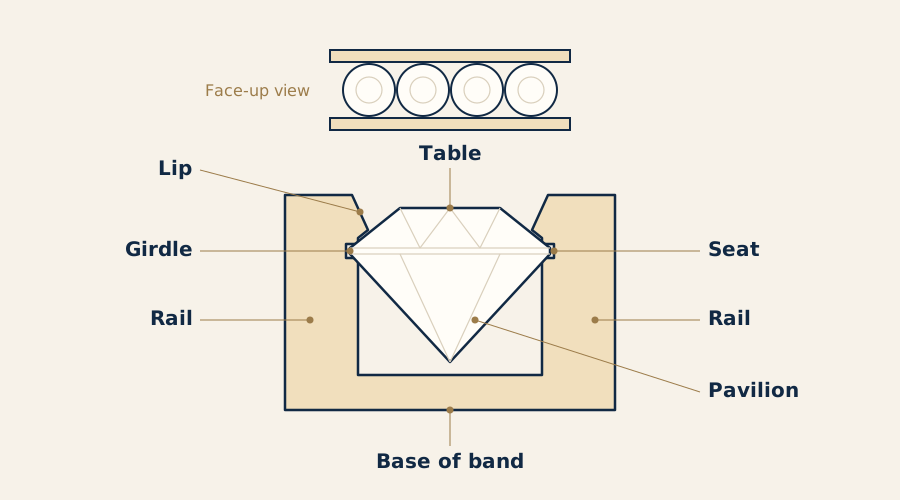
Channel set diamonds are most common in wedding bands, half-eternity rings (stones across the top half of the band) and full eternity rings (stones all the way around). You will also see channels on the shoulders of engagement rings, leading the eye towards a claw-set or bezel-set centre stone. To see where the channel fits among other options, our overview of every main engagement ring setting style lays them out side by side, and any unfamiliar word here is in our jewellery glossary.
One naming note: the setting has nothing to do with etch channels, a natural feature inside some diamonds. An etch channel is a tiny tunnel-shaped inclusion formed in the earth; a channel setting is purely about how the metal holds the stone.
A close cousin is the bar setting, where short metal bars separate each stone and the sides stay open. Another is the invisible setting, where princess-cut stones have grooves cut into their pavilions and slide onto a hidden metal grid, so no metal shows on top at all. Invisible settings look seamless but are more delicate than a true channel, and lost stones are a common repair.
Which diamond shapes and sizes work in a channel setting?
Channels need stones that sit snugly edge to edge, so shapes with straight sides or consistent round outlines work well. Round brilliants are the most common because they are easy to match. Princess, square step cuts and straight and tapered baguettes (long rectangular step cuts) butt together with almost no gap, giving an unbroken line of diamond. Pear, marquise and other pointed shapes rarely suit a channel because their points leave gaps and are fragile under the rail. For how each outline behaves, see our overview of diamond shapes or browse the full list of 34 diamond cuts.
| Stone | Typical size | Approximate weight each | Stones in a half-eternity (size N) |
|---|---|---|---|
| Round brilliant | 1.5 mm | about 0.015 ct | about 20–22 |
| Round brilliant | 2.0 mm | about 0.03 ct | about 15–17 |
| Round brilliant | 2.5 mm | about 0.06 ct | about 12–14 |
| Round brilliant | 3.0 mm | about 0.10 ct | about 10–11 |
| Princess | 2.0 mm | about 0.05–0.06 ct | about 15–17 |
| Baguette | 3.0 × 1.5 mm | about 0.03–0.04 ct | about 20–24 (set across the band) |
These are typical figures; exact weights depend on each stone's depth and the stone count depends on finger size and how far around the band the channel runs. The stone width and the band width are linked: the rails need roughly 0.6–1.0 mm of metal each side, so a 2.5 mm stone usually needs a band of at least 3.5–4 mm across the top. Our guide to how band width changes comfort and strength shows how that feels on the finger.
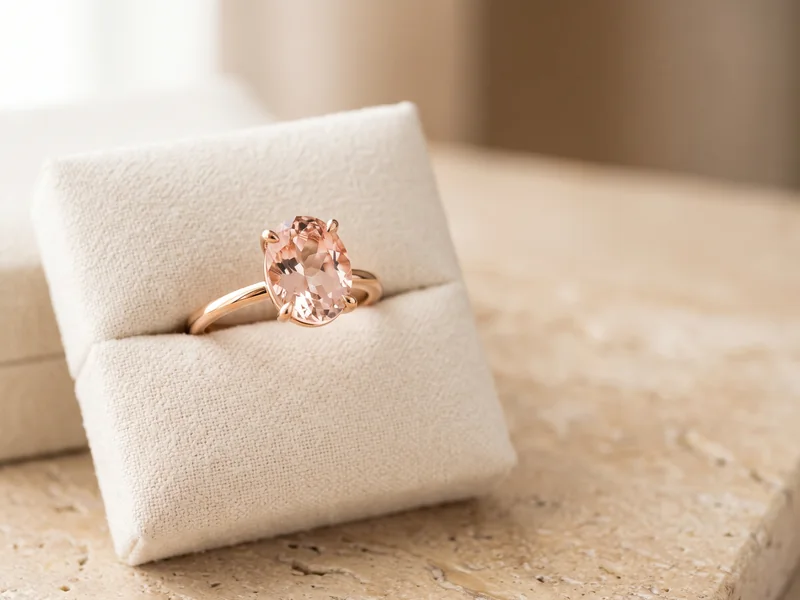
Channels suit hard stones best because tightening involves pressing metal against the girdle. Diamond (10 on the Mohs scale) and sapphire or ruby (9) cope well. Softer gems need more care: see why morganite needs a gentler setting at 7.5–8 on the Mohs scale, and treat emeralds, opals and tanzanite as poor channel candidates.
What are the pros of channel set diamonds?
- Nothing to snag. With no claws, the ring does not catch on knitwear, hair or gloves. This is the main reason people choose it.
- Protected edges. The girdle is the most chip-prone part of a diamond, and in a channel it is tucked inside metal on two sides.
- Secure for active hands. Gardeners, nurses, gym-goers and tradespeople often prefer channels because a knock lands on metal first.
- A clean, continuous line. The row of stones reads as one band of light, which looks tidy beside an engagement ring.
- Lower profile. Stones sit within the band rather than above it, so the ring sits closer to the finger and pairs neatly with other rings.
- Long-lasting when built well. Solid rails of good thickness can hold stones for decades with only occasional tightening.
Compared with claw-set or pavé bands, a channel band also needs fewer small metal points re-tipped over time. There are simply fewer tiny parts to wear out.
What are the cons of a channel setting?
- Less side light. The rails cover the sides of each stone, so less light enters from the side. Channel set diamonds usually look a little less sparkly than the same stones in claws or shared prongs, though face-up the difference is modest.
- Dirt collects underneath. Soap, hand cream and skin oils build up beneath the stones, where a brush cannot easily reach, and dull the sparkle.
- Limited resizing. Stretching or compressing the band flexes the rails and can loosen stones. Full eternity channel bands generally cannot be resized at all.
- Harder repairs. Replacing one stone can mean opening a section of rail and loosening its neighbours, which takes more skill and time than re-tipping a claw.
- Rail wear from other rings. Two rings worn together rub along the rail tops; over years this thins the lip that holds the stones.
- Heavier and wider. To hold stones safely, the band must be wide and deep enough, so a channel band is rarely as fine as a pavé band.
If maximum sparkle matters more to you than a snag-free surface, look at how a shared-prong band compares on sparkle. If you love the channel but worry about worn rails, factor in a thicker band and a professional check every year.
Not sure which one is right?
Send us the stones you are looking at and our gemologist will tell you which to choose and why.
Channel set vs shared prong, bezel and pavé: which suits you?
| Channel | Shared prong | Bezel | Pavé | Bar | |
|---|---|---|---|---|---|
| How stones are held | Between two rails | Tiny claws shared by neighbours | Metal rim around each stone | Tiny beads raised from metal | Short bars between stones |
| Sparkle | Good face-up, less side light | Very high | Lower, metal frames each stone | High, lots of small stones | High, sides open |
| Snag risk | Very low | Moderate | Very low | Moderate | Low |
| Edge protection | High | Low to moderate | Very high | Low | Moderate |
| Cleaning | Harder underneath | Easy | Moderate | Moderate | Easy |
| Resizing | Limited | Limited | Limited | Limited | Limited |
| Typical repair | Close rails, replace stone | Re-tip claws | Re-close rim | Rebuild beads | Re-close bars |
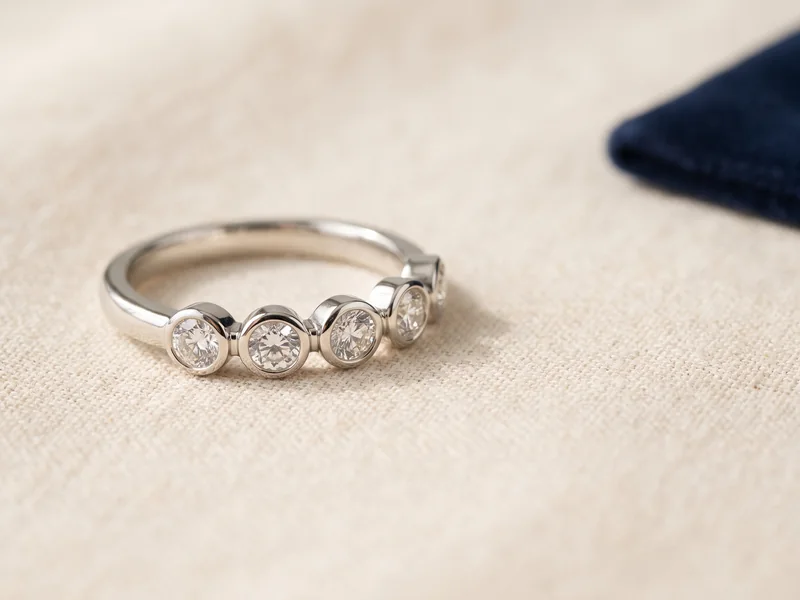
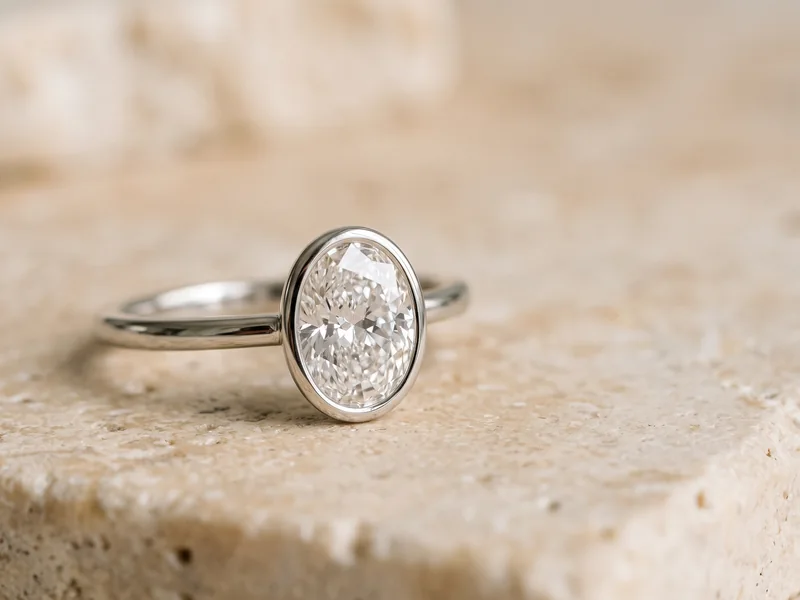
A channel and a bezel share the same strength: metal on the stone's edge. The difference is that a bezel wraps each stone fully, while a channel only holds two sides. Our guides to bezel-set diamond wedding bands and bezel set engagement rings cover that style in depth. Pavé, by contrast, uses many tiny beads that each wear down and may need rebuilding, while a channel's two solid rails wear more slowly.
Related guideShared-Prong vs Channel-Set Wedding BandsMixing styles works well too. A common design pairs a claw-set centre with channel set shoulders, or a bezel centre framed by a channel band for someone who wants every stone edge protected.
Which metal and band width suit a channel set engagement ring or band?
The rails do all the work in a channel setting, so the metal's behaviour over time matters more here than in most rings.
| Metal | How it behaves in a channel | Long-term care |
|---|---|---|
| Platinum (950) | Dense and tough; metal moves rather than wears away, so rails can often be pushed back over stones | Develops a soft satin patina; repolish every few years |
| 18ct white gold | Harder than platinum but loses metal slowly through wear | Rhodium plating usually refreshed every 1–2 years |
| 18ct yellow or rose gold | Rich colour, no plating needed; wears similarly to white gold | Polish and check rails yearly |
| 9ct or 14ct gold | Harder and more affordable, but can be more brittle when re-worked | Check for hairline cracks at the shoulders |
For width, most channel bands sit between 2.5 and 4 mm across the top, and the depth from the top of the rails to the inside of the band should be generous enough for the stone's pavilion plus a solid base, often around 1.8–2.2 mm. A very thin channel band looks delicate but has little metal to rework later. Compare engagement ring band widths from 1.8 to 4 mm before you settle on a profile.
Shape matters too. A channel needs flat-topped rails, so it does not suit a knife-edge band, where the shank rises to a sharp ridge. You can, however, pair a channel wedding band with a knife-edge engagement ring if the two are shaped to sit together.
How do channel set diamonds wear over the years?
Seen from the repair bench, channel rings age in a predictable order. Knowing it helps you catch problems early, while a quick tightening still solves them.
| Years of daily wear | What usually happens | What to do |
|---|---|---|
| 0–2 | Surface scratches; white gold plating starts to thin; dirt builds under stones | Clean regularly; replate white gold as needed |
| 2–5 | Rail tops round off slightly where they rub another ring; the odd stone may start to click | Annual check; close rails where stones move |
| 5–15 | Rails visibly thinner on the side facing the engagement ring; small dents from knocks; possible stone loss | Tighten, polish, replace any missing stones |
| 15+ | Lips may be too thin to close safely; hairline cracks where the channel meets plain shank | Rebuild rails or remake the band |
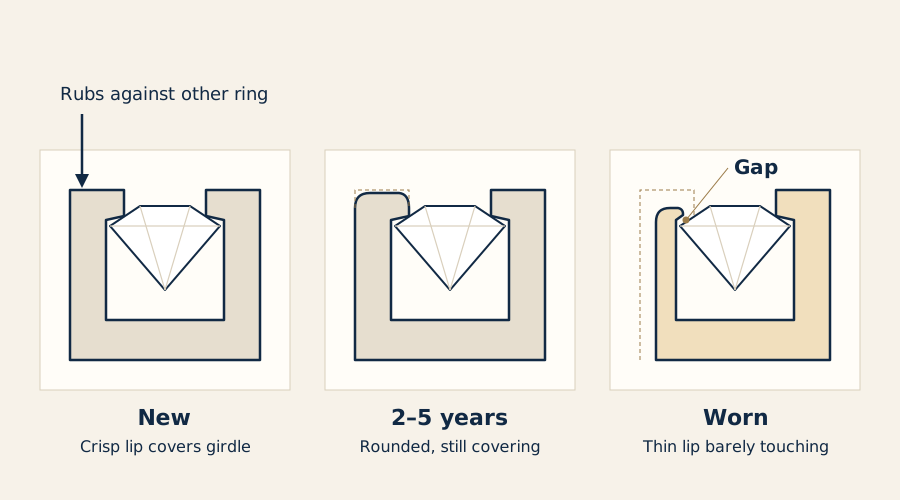
The biggest single cause of wear is two rings rubbing. If you wear a channel band against an engagement ring, the rail on the touching side wears first. A slightly wider gap, a contoured band or a harder alloy all slow this. Knocks are the second cause: a hard hit on a door frame can bow a rail outward just enough to free a stone, even if nothing looks bent.
Patina is not damage. Platinum takes on a soft grey satin look, and that is normal. What matters is whether each lip still covers the girdle, which needs a loupe (a 10× magnifier) to judge properly. A tapered knife-edge engagement shank worn beside a channel band rubs less than a flat band, because the contact area is smaller.
Can a channel set ring be repaired or resized?
Yes, most channel set rings can be repaired, and many can be resized a little. The work is precise, so it helps to know what is involved.
- Tightening: the jeweller pushes the rail lips back down over loose stones. Quick when the metal is sound.
- Replacing a stone: a section of rail is opened, a matched diamond is fitted into the seat and the rail is closed again. Matching colour and size to 0.05 mm keeps the line even.
- Rebuilding rails: worn lips are built up with new metal, often by laser welding, which puts heat in a tiny spot so stones can stay in place.
- Resizing: a half-eternity band with plain metal at the back can often go up or down about one size. Larger changes, or any full eternity band, usually mean remaking the ring.
- Refinishing: polishing and, for white gold, rhodium plating.
| Repair | Approximate cost (AUD) |
|---|---|
| Tighten loose channel stones | about $80–$250 |
| Replace one small diamond (1.5–2.5 mm) | about $100–$400 per stone |
| Rebuild worn rails | about $300–$1,000+ |
| Resize a half-eternity channel band | about $100–$300 |
| Rhodium plating (white gold) | about $60–$150 |
These are broad ranges only and depend on the metal, stone sizes and how much of the channel needs work. Replacement stones can be natural or lab-grown; a lab-grown stone costs much less, and both should be matched carefully in colour so the row looks even. If the rails are badly worn, read when to repair a worn band and when to replace it before you decide.
How much do channel set diamonds cost in Australia?
Price depends mostly on total diamond weight, whether the stones are natural or laboratory-grown, their colour and clarity, and the metal. Small melee diamonds (tiny accent stones) are usually around G–H colour and VS–SI clarity in quality bands. Lab-grown diamonds are real diamond grown in a laboratory; they look the same and cost much less than natural.
| Half-eternity, 18ct gold, about 0.50 ct total | Approximate price range (AUD) |
|---|---|
| Lab-grown diamonds | about $1,200–$2,800 |
| Natural diamonds | about $2,000–$4,500 |
| Same in platinum | add roughly $500–$1,500 |
A full eternity band holds roughly twice the stones, so expect close to double the diamond cost, plus more labour. Channels typically cost a little more in labour than shared prong bands of the same weight, because cutting accurate seats along two rails takes time.
Explore ring settings, create your ring or book a jewellery repair
How do you check and care for a channel set ring? Step by step
- Look along the row. Under good light, sight down the channel. Every stone should sit level, with no tilt and no gap between stone and rail.
- Do the tap test. Tap each stone gently with a fingernail near your ear; any click or rattle means it needs tightening.
- Clean underneath weekly. Soak in warm water with a drop of dishwashing liquid for 15 minutes, then brush the sides and underside with a soft toothbrush. Rinse and pat dry.
- Go easy on ultrasonic cleaners. They are fine for diamonds in a sound setting, but vibration can shake a loose stone free, so check first.
- Take it off for heavy work. Weights, gardening and moving furniture are the usual causes of bent rails.
- Book a yearly check. A jeweller checks each lip under a loupe, tightens as needed and polishes. If the rails are past saving, weigh up whether to rebuild the band or start fresh.
- Plan any change of style early. If you are thinking of a new look, compare the channel with claw, halo and bezel styles and check unfamiliar words against setting terms defined in plain English.
Free consultation
Talk to a gemologist
Compare stones in person or online with Raj Sood, Graduate Gemologist (GIA), AJP (GIA).
Book a consultationShop this shape
FAQ
Common questions
Are channel set diamonds secure?
Yes, when the rails are thick enough and the stones are seated properly, channel settings are among the more secure options because metal protects the stones' edges. Stones can still loosen after knocks or years of rubbing, so a yearly check is wise.
Can you resize a channel set ring?
A half-eternity channel band with plain metal at the back can often be resized about one size up or down. Full eternity channel bands generally cannot be resized and are made to size instead.
Do channel set diamonds sparkle less?
Slightly. The rails block some light from entering the sides, so they usually look a little less lively than the same stones in shared prongs. Keeping the underside clean makes the biggest difference to sparkle.
What do I do if a stone falls out of a channel setting?
Stop wearing the ring and bring it in, because neighbouring stones are often loose too. A jeweller can fit a matched natural or lab-grown replacement and close the channel.
Is channel or pavé better for everyday wear?
For snag-free daily wear, a channel is usually more practical because there are no beads or claws to catch. Pavé gives more sparkle but has many tiny beads that wear and may need rebuilding over time.
Which metal is best for a channel set band?
Platinum is a strong choice for channels because its metal tends to move rather than wear away, so rails can often be reworked. 18ct gold also works well with yearly checks, and white gold needs periodic rhodium plating.

Ask a gemologist
Not sure which diamond to choose?
Raj Sood is a Graduate Gemologist (GIA) and master jeweller. Bring the stones you are considering, or send the reports, and he will tell you honestly which one is better and why.
Keep learning
Related guides
 Wedding Bands & EternityShared-Prong vs Channel-Set Wedding Bands
 Wedding Bands & EternityBezel-Set Diamond Wedding Bands
 Care, Repairs & RemodellingWhen to Repair vs Replace a Band
 Engagement Rings & SettingsEngagement Ring Band Widths: 1.8 to 4 mmEngagement Rings & SettingsEngagement Ring Setting Styles Guide
 Diamond 4Cs & GradingEtch Channels in Diamonds
 GemstonesMorganite for Engagement Rings: Pros and Cons
 Engagement Rings & SettingsBezel Set Engagement Rings
Explore more
More guides on this topic
Education