
Pearls
Freshwater Pearls Guide: Origin, Size, Colour, Quality and Care
Freshwater pearls are the pearls most Australians own first, and the difference between an ordinary strand and a fine one is enormous. Here is how they are grown, what sets one pearl apart from another, and how to look after them for decades.
 Reviewed by Raj Sood, Graduate Gemologist (GIA), AJP (GIA)Master jeweller and Graduate Gemologist (GIA) · reviewed 4 November 2026
Quick answer
Freshwater pearls are cultured pearls grown mainly in mussels in Chinese lakes and ponds. Most are nucleated with tissue rather than a bead, so they are almost solid nacre. They range from 2 to 12 mm, or 15 mm and more for bead-nucleated types, in natural white, peach, pink and lavender, and cost much less than saltwater pearls.
What are freshwater pearls?
Freshwater pearls are pearls grown in mussels that live in lakes, rivers and ponds rather than in the sea. Almost every freshwater pearl sold today is cultured: a pearl farmer starts the process by hand, and the living mussel does the rest, coating the graft in layer after layer of nacre (say NAY-ker), the iridescent material also called mother-of-pearl. Natural freshwater pearls, formed with no human help, do exist but are rare; our guide to the difference between natural and cultured pearls explains how each one forms.
China grows the great majority of the world's freshwater pearls, mainly in the triangle shell mussel, Hyriopsis cumingii, and hybrids of it. Japan's Lake Biwa was the famous early source, which is why some older strands are still called Biwa pearls, but production there fell away decades ago as the lake's water quality declined.
Nacre is made of microscopic plates of aragonite (a crystal form of calcium carbonate) stacked like bricks and held together by conchiolin, an organic protein. Light reflecting off those thin layers gives a pearl its lustre (the glow and sharpness of reflections) and, in fine pearls, orient, a soft rainbow shimmer just under the surface. Pearls are soft, about 2.5–4.5 on the Mohs scale, compared with 7 for quartz and 10 for diamond, and have a refractive index of about 1.52–1.66. They are organic gems, like amber and coral, rather than minerals, which shapes how you wear and care for them.
Pearl is the traditional June birthstone, alongside moonstone and alexandrite, and freshwater pearls are the most affordable way into it. To see how they sit against the other pearl families, read how to tell the main pearl types apart, or look through our pearl jewellery and custom pearl designs.
How are freshwater pearls cultured?
Most freshwater pearls are tissue-nucleated. A technician cuts small squares of mantle tissue (the organ that makes nacre) from a donor mussel and slips them into small incisions in the mantle of a host mussel. Each piece of tissue forms a pearl sac, and the sac builds a pearl. Because one mussel can take many grafts on each side of its shell, a single mussel can produce a few dozen pearls at once, often quoted at up to 30–50. That is the main reason freshwater pearls cost so much less than saltwater pearls, where an oyster usually grows one or two at a time.
The result is a pearl that is nacre almost all the way through, sometimes with a tiny hollow or a speck of organic material at the centre. That makes freshwater pearls very durable for their price: there is no bead to show through if the surface wears, and no thin coating of nacre to rub away. Culturing usually takes about two to six years. Longer growth gives larger pearls but also more irregular shapes, which is why truly round freshwater pearls are the minority of any harvest.
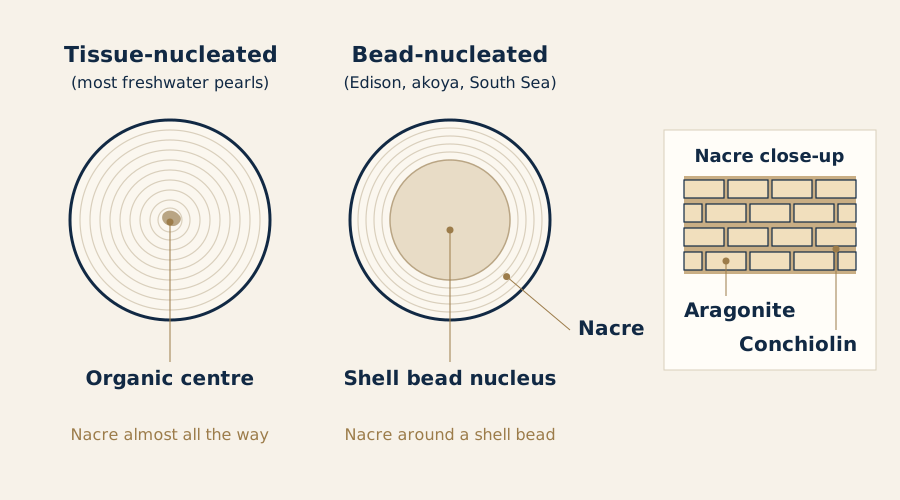
Some Chinese farms also bead-nucleate freshwater mussels, inserting a polished shell bead with the tissue, the same method used for saltwater pearls. These pearls are often sold under trade names such as Edison pearls. The bead gives a round starting shape, so they grow larger and rounder, commonly 10–15 mm and sometimes more, with a bright, almost metallic lustre and strong colours. A related type, the soufflé pearl, is nucleated with a ball of mud that is later drained, leaving a light, hollow baroque pearl.
Culturing also produces by-products sold in their own right. When a pearl sac keeps making nacre without a nucleus, for example after a harvest, it can form small free-form pearls; see keshi pearls, the nucleus-free by-products of culturing. Pearls grown deliberately against the inside of the shell, as flat-backed domes, are covered in our guide to half-dome mabe pearls grown against the shell.
What sizes and shapes do freshwater pearls come in?
Pearls are measured across their diameter in millimetres, usually in half-millimetre ranges such as 7.0–7.5 mm. Tissue-nucleated freshwater pearls are typically 2–12 mm; 6–8 mm is the classic everyday strand and stud size. Bead-nucleated types start around 9–10 mm and go up to 15 mm or more. Each half-millimetre step up in a matched strand is noticeable on the neck and in the price, because larger pearls take longer to grow and fewer reach size with good shape and surface.
| Shape | What it looks like | Common uses | Price relative to round |
|---|---|---|---|
| Round | Rolls straight on a flat surface; less than about 2–3% variation in diameter | Classic strands, studs | Highest |
| Near-round | Very slightly off-round; hard to tell once worn | Strands, studs | A little below round |
| Oval and drop | Elongated or teardrop | Drop earrings, pendants | Moderate |
| Button | Flattened on one side, domed on the other | Studs, where the flat back sits on the ear | Moderate |
| Baroque | Irregular, free-form shapes | Statement strands, artistic designs | Lower, except large fine baroques |
| Coin and stick | Flat discs or long slender shapes | Fashion necklaces and earrings | Lower |
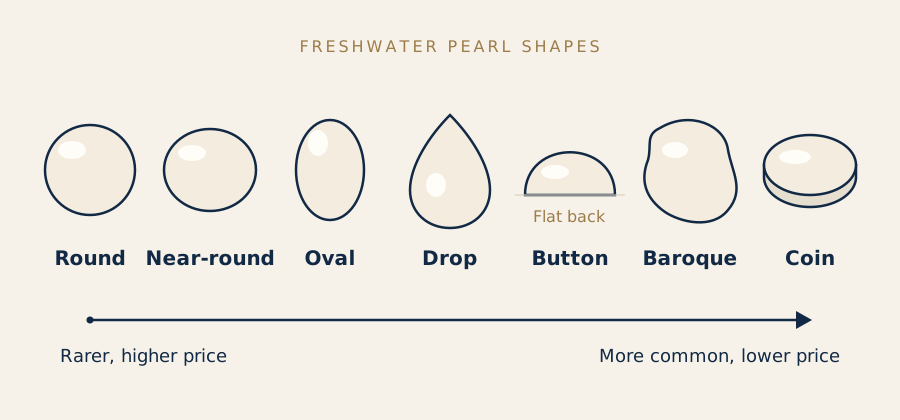
Do not dismiss off-round shapes. A drop or button pearl with high lustre often looks better in an earring than a round pearl with dull skin, and baroque strands have become a favourite for people who want something less formal. Any shape term you have not met before is in our glossary of pearl and jewellery terms.
What colours do freshwater pearls come in naturally?
Freshwater pearls grow in a wider range of natural colours than akoya pearls. The body colour (the main colour) is usually white, cream, peach, apricot, pink or lavender, and the mussel and the position of the graft both influence it. Many pearls also show an overtone, a second colour that seems to float over the surface, such as a rose overtone on a white pearl or a green-blue overtone on a lavender one.
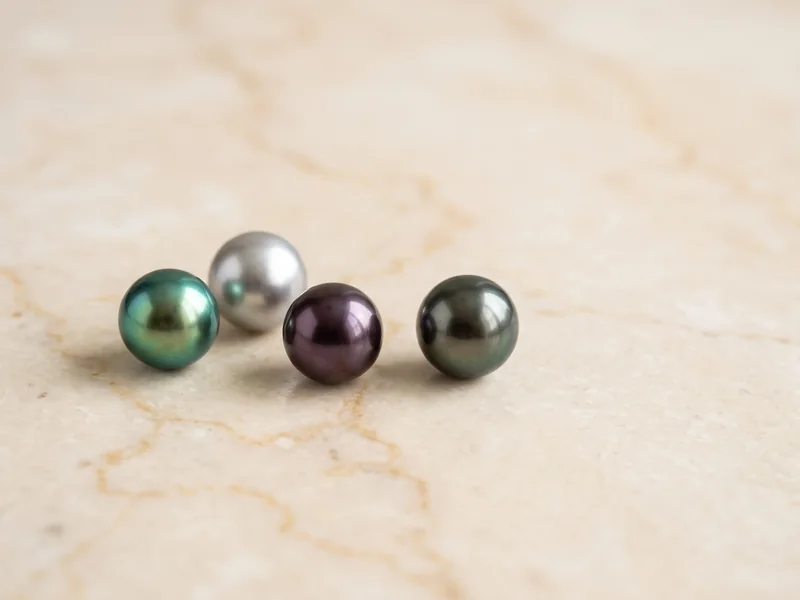
Treatments are very common and must be disclosed. White freshwater pearls are routinely bleached and polished to even out colour. Dark colours, such as black, deep purple, bronze and bright blue, are almost always dyed or irradiated, because freshwater mussels do not grow them naturally in those shades. A dyed pearl is still a real pearl, but its value is lower than a naturally coloured one, and dye can sometimes be seen concentrated around the drill hole.
Natural pastel pearls pair well with other soft-coloured gems. Peach and pink freshwater pearls sit naturally beside pink-peach morganite, and lavender or pink strands are often combined with multicoloured tourmaline in custom pieces. If you want white, match the pearl's overtone to your skin tone: rose overtones flatter fairer skin, while cream and silver suit warmer and darker complexions.
Not sure which one is right?
Send us the stones you are looking at and our gemologist will tell you which to choose and why.
How is freshwater pearl quality graded?
There is no single worldwide grading standard for pearls the way there is for diamonds. Many sellers use A to AAA or AAAA scales, but each company defines these differently, so a letter grade alone tells you very little. The gemmological approach is to judge the same seven value factors for every pearl: size, shape, colour, lustre, surface, nacre quality and, for strands and pairs, matching.
- Lustre: the most important factor. Fine pearls show sharp, bright reflections; poor pearls look chalky or milky.
- Surface: the fewer spots, pits, bumps and wrinkles, the higher the value. A pearl with no visible marks is called clean.
- Shape: round is rarest; the closer to round, the higher the price.
- Nacre quality: in tissue-nucleated freshwater pearls this is rarely a problem, because the pearl is solid nacre; it matters more for bead-nucleated types.
- Colour: even body colour with an attractive overtone; natural colour is valued over dyed.
- Size: larger pearls of the same quality cost more, sharply so above about 9 mm for tissue-nucleated pearls.
- Matching: in a strand, pearls should be even in size, colour and lustre from end to end.
For a fuller explanation of each factor, with examples of what each grade looks like, see the seven pearl value factors in full.
Freshwater vs akoya pearls: how do they compare with saltwater pearls?
The four main cultured pearl types differ in the mollusc, the water and the nucleus, and that drives their look and price. Here is how they compare side by side.
| Freshwater | Akoya | Tahitian | South Sea | |
|---|---|---|---|---|
| Mollusc | Mussel (Hyriopsis) | Oyster (Pinctada fucata) | Black-lip oyster (Pinctada margaritifera) | Silver- or gold-lip oyster (Pinctada maxima) |
| Main sources | China | Japan, China | French Polynesia | Australia, Indonesia, Philippines |
| Typical size | 2–12 mm (bead-nucleated to 15 mm+) | 2–10 mm, mostly 6–9 mm | 8–16 mm | 9–20 mm |
| Natural colours | White, cream, peach, pink, lavender | White, cream, rose and silver overtones | Grey, black, green, peacock | White, silver, cream, golden |
| Nucleus | Usually tissue, solid nacre | Shell bead, thinner nacre | Shell bead | Shell bead, thick nacre |
| Lustre | Soft to bright | Very sharp, mirror-like | Metallic | Satiny, deep |
| Relative price | Lowest | Moderate | Higher | Highest |
Freshwater vs akoya pearls is the comparison most people make. A fine freshwater strand can look very close to an akoya at a glance, but akoyas are usually rounder and sharper in lustre, while freshwater pearls are more durable and come in more natural pastel colours. Read about Japanese and Chinese akoya pearls or the deep colours of dark Tahitian pearls from French Polynesia.
At the top of the range are white and golden South Sea pearls. Australia is one of the world's main producers, with large silver-white pearls farmed off the Kimberley coast; our page on Australian South Sea pearls from Broome explains why they are the largest cultured saltwater pearls in regular production.
Are freshwater pearls real, and what are they worth?
Yes, freshwater pearls are real pearls, grown by a living mussel. Cultured does not mean imitation: a cultured pearl is made of the same nacre as a natural one, the only difference being that a person started the process. Imitation pearls, by contrast, are glass, plastic or shell beads coated with a pearly lacquer. A simple check is to rub a pearl gently against the edge of your front tooth: real pearls feel slightly gritty, imitations feel smooth. Do it gently, and never on a pearl you do not own.
Freshwater pearl value depends on the seven factors above, and the spread is wide. A small, slightly off-round strand can cost less than a dinner out, while a matched strand of large, round, high-lustre pearls costs many times more. As broad guides only:
| Freshwater pearl jewellery | Approximate price range (AUD) |
|---|---|
| Stud earrings, 6–7 mm, good quality | about $50–$300 |
| 45 cm strand, 6–7 mm, good quality | about $150–$600 |
| 45 cm strand, 8–9 mm, fine round, high lustre | about $800–$2,500 |
| Bead-nucleated (Edison-type) strand, 11–13 mm | about $1,500–$5,000 |
Prices vary with the metal and clasp, the knotting and the exact quality. Freshwater pearls are jewellery to be worn and enjoyed rather than something to buy for resale value. If you are weighing pearls against a coloured gemstone for a gift or a custom design, our natural gemstones are a useful comparison.
Browse natural gemstones
How are freshwater pearl necklaces and earrings made?
A good freshwater pearl necklace is strung on silk or a strong synthetic thread with a small knot between every pearl. The knots stop the pearls rubbing against each other, and if the strand ever breaks you lose one pearl, not the lot. Strand length changes the whole look:
- Collar: about 30–33 cm, sits high on the neck.
- Choker: about 35–40 cm, rests at the base of the neck.
- Princess: about 43–48 cm, the most popular length, falling just below the collarbone.
- Matinee: about 50–60 cm, sits above the neckline of most tops.
- Opera: about 70–90 cm, can be worn long or doubled.
- Rope: 100 cm or more, often knotted or wrapped.
Freshwater pearl earrings are usually set on a post with a small cup and a short peg, the pearl being half-drilled and glued onto the peg. Button and near-round pearls suit studs; drops and ovals suit hooks and dangles. Pendants and rings use the same half-drilled method, so the setting should protect the pearl's sides, because nacre wears far faster than most gemstones.
Clasps matter more than people expect. A box clasp with a safety catch or a secure fish-hook clasp keeps a strand on the neck; you can learn how silk knotting and restringing work before choosing one.
How do you care for freshwater pearls?
Because pearls are soft, porous and organic, they need gentler care than diamonds or sapphires. Acids, sweat, chlorine and cosmetics slowly dull nacre, and harder gems scratch it. The basic rules:
- Last on, first off: put pearls on after perfume, hairspray, sunscreen and make-up, and take them off before exercise, swimming or cleaning.
- Wipe after wearing: use a soft, slightly damp cloth, then let them dry flat.
- Never use ultrasonic or steam cleaners: heat and vibration can crack nacre and loosen glued earrings.
- Store separately: in a soft pouch or a lined compartment, away from diamonds and other hard gems.
- Store flat: hanging a strand stretches the silk over time.
- Let them breathe: avoid airtight plastic bags for long periods, because nacre can dry out.
Silk stretches and soaks up oils, so a strand worn often needs restringing about every one to two years. Signs it is due: small gaps between the pearls and knots, grey or darkened knots, or a strand that hangs more loosely than it used to. At GemTrove we restring pearls in our own workshop, and you can follow a full pearl care routine to stretch the time between visits.
Related guidePearl Grading: Lustre, Nacre, Surface, Shape, SizeHow to check freshwater pearls before you buy: step by step
- Ask what you are looking at. Confirm the pearls are freshwater cultured, whether tissue- or bead-nucleated, and whether the colour is natural, bleached or dyed.
- Check lustre first. Look for sharp reflections in daylight; avoid chalky or milky pearls.
- Roll the strand. On a flat surface, round pearls roll straight; wobbling pearls are off-round.
- Inspect the surface. Turn each pearl and look for pits, spots and wrinkles, especially on the front of studs.
- Check the matching. Lay the strand flat and look for even size, colour and lustre from clasp to centre.
- Look at the finishing. Knots should be tight and even, drill holes centred and clean, and the clasp secure.
- Confirm size and length. Note the millimetre range and strand length, and ask how restringing will be handled.
Free consultation
Talk to a gemologist
Compare stones in person or online with Raj Sood, Graduate Gemologist (GIA), AJP (GIA).
Book a consultationShop this shape
FAQ
Common questions
Are freshwater pearls real pearls?
Yes. Freshwater pearls are real cultured pearls grown by living mussels, made of the same nacre as natural pearls. Imitation pearls are coated glass or plastic beads.
Are freshwater pearls worth anything?
Freshwater pearl value ranges widely, from tens of dollars for small studs to several thousand dollars for large, round, high-lustre strands. Lustre, shape, surface, size and matching decide the price.
What is the difference between freshwater and akoya pearls?
Freshwater pearls grow in mussels, are usually solid nacre and come in natural pastel colours. Akoya pearls grow in saltwater oysters around a shell bead, are usually rounder with sharper lustre and cost more.
What are Edison pearls?
Edison is a trade name for bead-nucleated freshwater pearls from China. They grow larger and rounder than most freshwater pearls, commonly 10–15 mm, with bright lustre and strong colours.
Can you wear freshwater pearls every day?
Yes, with care. Put them on after cosmetics, wipe them after wearing and have strands restrung about every one to two years if worn often.
Can freshwater pearls get wet?
A quick wipe with a damp cloth is fine, but avoid swimming, showering and chlorine. Wet silk stretches and weakens, so let a strand dry flat before storing it.

Ask a gemologist
Not sure which diamond to choose?
Raj Sood is a Graduate Gemologist (GIA) and master jeweller. Bring the stones you are considering, or send the reports, and he will tell you honestly which one is better and why.
Keep learning
Related guides
Explore more
More guides on this topic
Education