
- Education
- Wedding Bands & Eternity
- Plain or Diamond? Choosing a Plain Wedding Band with a Diamond Engagement Ring
Wedding Bands & Eternity
Plain or Diamond? Choosing a Plain Wedding Band with a Diamond Engagement Ring
The band you wear every day beside your engagement ring changes how both rings look, how they wear and what you can change later. Here is how plain and diamond bands compare, and how to choose.
 Reviewed by Raj Sood, Graduate Gemologist (GIA), AJP (GIA)Master jeweller and Graduate Gemologist (GIA) · reviewed 4 November 2026
Quick answer
Yes, a plain wedding band with a diamond engagement ring is a classic, practical pairing: it lets the centre stone stand out, costs less, resizes easily and needs little upkeep. Choose a diamond band if you want more sparkle and an even look across both rings, but check it sits flush and matches the centre diamond's colour.
What is the difference between a plain and a diamond wedding band?
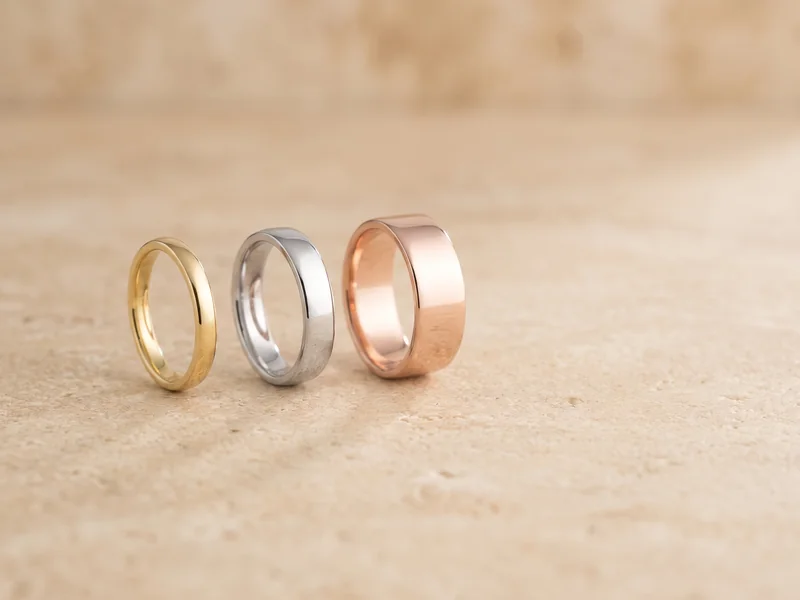
A plain wedding band is a ring of metal with no stones, usually in 18ct gold or platinum, sometimes 9ct or 14ct gold. A diamond wedding band has a row of small diamonds set across the top, either part of the way round (a half-eternity, usually covering the visible top third to half) or all the way round (a full eternity). If the terms are new, our page on the difference between a wedding ring and a wedding band clears them up, and the jewellery glossary defines every setting word used here.
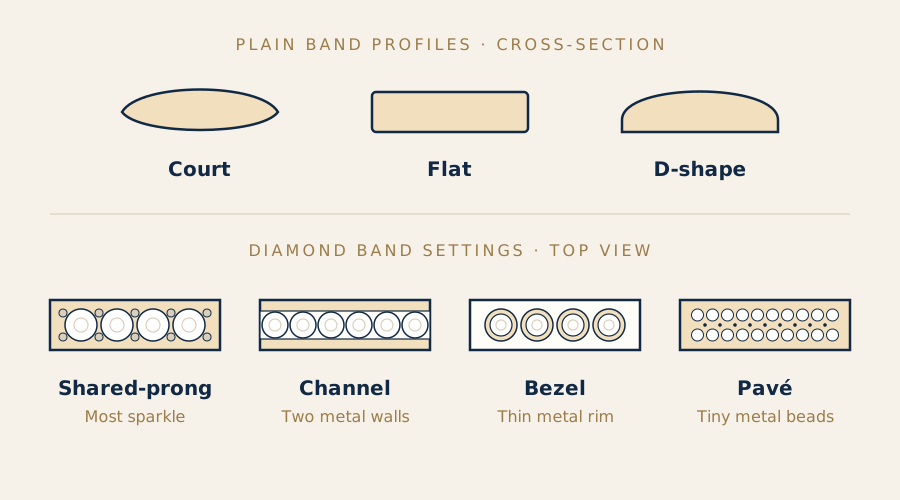
Plain bands differ mainly in width and profile, which is the shape of the band in cross-section. A court profile is rounded inside and out and slides on easily; a flat profile looks crisp and sits neatly against a straight engagement ring shank; a D-shape is flat inside and domed on top. Our guide to band profiles such as court, flat and D-shape shows how each one feels on the finger.
Diamond bands differ in how the stones are held. Claw or shared-prong settings show the most diamond and sparkle; channel settings hold the stones between two walls of metal; bezel settings wrap each stone in a thin rim; pavé and grain settings use tiny beads of metal over many small stones. Each choice changes the sparkle, the comfort and how easily the band catches on clothing.
Should you wear a plain wedding band with a diamond engagement ring?
For many people, yes. A plain band frames the centre diamond without competing with it, so the eye goes straight to the stone. The clean metal line also shows off the shape of the engagement ring, which matters with fancy shapes and detailed settings. It is the pairing jewellers see most often with solitaires.
- The centre stone stays the focus. Nothing else on the hand sparkles, so the diamond reads larger by contrast.
- Easy to resize. With no stones in the way, a plain band can usually go up or down one to two Australian sizes (for example from L to N).
- Easy to shape. A plain band can be curved or notched to sit tight against an awkward engagement ring.
- Low upkeep. There are no claws to check and no stones to lose. Scratches can be polished out when the band is refinished.
- Lower cost. You pay for metal and labour only, so the money can go towards the centre stone instead.
The trade-offs are mostly about look. Next to an engagement ring with pavé shoulders or a halo, a plain band can read as a break in the sparkle; some people like that contrast, others find it unfinished. A high-polish band also shows fine scratches within weeks, while a brushed or satin finish hides them but needs re-brushing over time. Our complete wedding ring buying guide covers metal and finish choices in more depth.
When does a diamond wedding band with an engagement ring make more sense?
A diamond band suits you if your engagement ring already carries small diamonds on the shoulders or in a halo, if you want an even line of sparkle across both rings, or if you plan to wear the band on its own at work, at the gym or when travelling. A smaller centre stone can also gain presence from a diamond band beside it.
- Shared-prong (claw): neighbouring stones share small claws, so more diamond shows and more light gets in. It needs the most checking.
- Channel-set: stones sit between two rails of metal. Smoother and less likely to snag, with a little less sparkle. See shared-prong and channel settings compared.
- Bezel-set: each stone sits in its own rim. Very secure and modern. Our page on bezel-set diamond bands explains the look.
- Pavé or micro-pavé: many tiny stones held by beads of metal. Fine and delicate, but the beads wear down over years.
Band diamonds are usually between about 1.3 and 2.5 mm across, which is roughly 0.01 to 0.06 carat each. A good starting point is to match the band's stones to any shoulder diamonds on the engagement ring so the two rings read as one. Our guide on how big band diamonds should be works through the sizes for different widths.
Colour matters more than people expect. Small band stones are graded in ranges such as F–G or G–H. If your centre diamond is G colour and the band stones are I–J, the band can look slightly yellow beside it, especially in white gold or platinum. Ask for band stones within one grade of the centre.
Plain vs diamond wedding band: how do they compare?
| Plain band | Half-eternity diamond band | Full eternity diamond band | |
|---|---|---|---|
| Look beside a solitaire | Frames the centre; clean contrast | Adds sparkle across the top | Sparkle all the way round |
| Resizing | Usually 1–2 sizes | Usually about 1 size | Very limited; often a remake |
| Shaping to fit (curve or notch) | Easy | Possible, more complex | Difficult |
| Maintenance | Polish every few years | Claw checks every 6–12 months | Claw checks every 6–12 months |
| Comfort between fingers | Smooth all round | Smooth underneath | Stones underneath can press |
| Risk of rubbing the engagement ring | Low if metals match | Higher; diamonds can wear softer metal | Higher; diamonds can wear softer metal |
| Relative cost | Lowest | Moderate | Highest |
The table shows the pattern: a plain band is the flexible, low-maintenance choice, and a diamond band trades some of that flexibility for sparkle. A half-eternity keeps a plain metal section underneath, which is why it can be resized and is more comfortable than a full eternity for most people.
Related guideHow to Match a Wedding Band to an Engagement RingNot sure which one is right?
Send us the stones you are looking at and our gemologist will tell you which to choose and why.
How does a plain wedding band sit with a diamond engagement ring?
Whether a band sits flush (touching the engagement ring all along its length) or leaves a gap depends mainly on the engagement ring, though the band's shape can change it. If the setting holding the centre stone sits lower than the line of the shank, or a halo or basket hangs below it, a straight band will touch the engagement ring only at the setting and leave a small space either side.
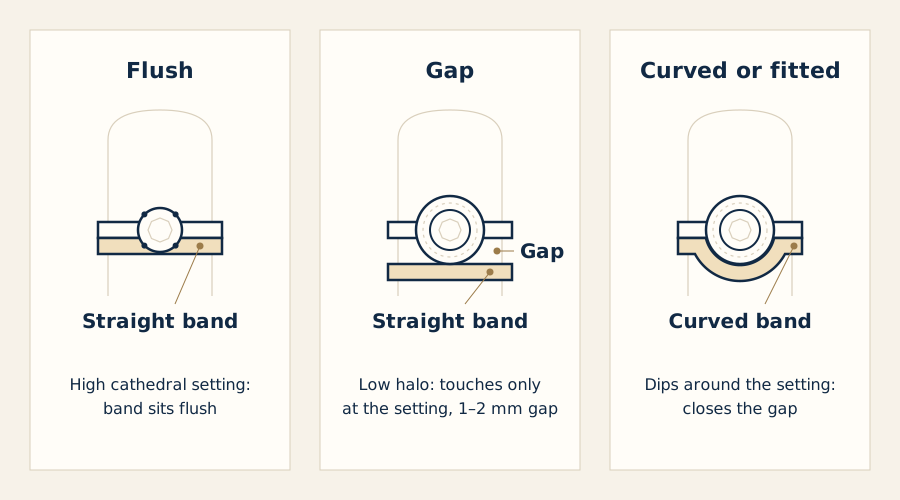
A gap of 1–2 mm is common and many people are happy with it; it can even stop the rings rubbing. If you want them tight together, you have four options:
- Choose a higher setting at the engagement ring stage, so a straight band slides underneath.
- A curved or contour band that dips around the setting. Our page on whether to choose a curved or straight band weighs up both.
- A notched band with a small cut-out where the setting sits.
- A fitted band made to follow the exact outline of your engagement ring. See fitted (custom-curved) bands for how they are made.
This is where a plain band has a real advantage: metal can be bent, carved and fitted far more easily than a row of set diamonds. If your engagement ring sits very close to the finger, read our page on bands for low-set engagement rings before you choose.
Which wedding band suits your engagement ring shape?
| Engagement ring | Plain band | Diamond band | Watch for |
|---|---|---|---|
| Round solitaire, high setting | Sits flush; any profile | Half-eternity in matching stone size | Very little; the most flexible pairing |
| Princess or square | Flat profile echoes the straight edges | Channel-set or square stones | Sharp corners pressing on the band |
| Cushion | Court or D-shape softens the line | Shared-prong rounds | Halo cushions often need a curve |
| Oval, pear or marquise | Thin 1.5–2 mm band keeps it elegant | Fine pavé or shared-prong | A point that overhangs the band |
| Halo or hidden halo | Often needs a curve or fitted band | Must match halo stone size and colour | Halo sitting below the shank line |
| Low-set or bezel | Fitted or notched band | Usually needs a custom fit | Gap or metal-on-metal rubbing |
Every shape has its own quirks. For a deeper look at the most common ones, see bands that suit a round solitaire, our notes on pairing a band with a princess cut, and bands for cushion engagement rings.
As a rule of thumb, match the band's width to the engagement ring's shank, usually 1.8 to 2.5 mm. A band much wider than the shank can make the centre stone look smaller; a band much thinner can look like an afterthought.
Which lasts better day to day, plain or diamond?
Diamond is the hardest natural material, 10 on the Mohs scale. Gold and platinum are far softer, roughly 2.5 to 4.5 depending on the alloy. That difference matters when two rings touch: the diamonds in a band, or the claws holding them, can slowly wear a groove into the side of an engagement ring, and the reverse happens too. Our guide to stopping two rings rubbing covers the fixes, from matching metals to small spacers.
- Match metals where you can. Platinum beside 18ct white gold can make one ring wear faster than the other; two rings in the same metal wear more evenly.
- Plain bands age gracefully. They pick up a soft surface texture that can be polished back. Over decades the band thins slightly, mainly underneath.
- Diamond bands need checks. Claws thin with wear and stones can loosen. Have a claw-set band looked at every 6–12 months.
- Resizing is easier on plain bands. Fingers change with age, pregnancy and climate; a full eternity often cannot be resized and may need remaking.
Whichever you choose, a regular look-over saves trouble. Our wedding band maintenance checklist lists what to check at home and what to leave to a jeweller.
How much do plain and diamond wedding bands cost in Australia?
Prices move with the gold and platinum price, band width and weight, and for diamond bands the number, size and quality of the stones. The ranges below are approximate guides for a 2 mm women's band, not quotes.
| Band (about 2 mm) | Approximate price (AUD) |
|---|---|
| Plain 9ct gold | about $300–$700 |
| Plain 18ct gold | about $600–$1,500 |
| Plain platinum | about $900–$2,000 |
| Half-eternity, lab-grown diamonds, 18ct gold | about $900–$2,500 |
| Half-eternity, natural diamonds, 18ct gold | about $1,500–$4,500 |
| Full eternity, natural diamonds, 18ct gold | about $2,500–$7,000 |
Band diamonds can be natural or laboratory-grown. They look the same to the eye; lab-grown diamonds cost much less, and natural diamonds are rarer. Many people match the band to the engagement ring, natural with natural or lab-grown with lab-grown, but mixing is fine as long as you know which is which. Either way, the band stones should be disclosed and described on your paperwork.
Design your wedding band or eternity ring
How to choose between a plain and a diamond wedding band: step by step
- Look at your engagement ring from the side. Note how high the setting sits and whether a halo or claws hang below the shank.
- Decide how much sparkle you want. A centre-stone focus points to plain; an even line of sparkle points to a diamond band.
- Match width and metal. Aim for a band close to your shank width and in the same metal to limit rubbing.
- Check the fit. Try a straight band first; if there is a gap you dislike, consider a curved, notched or fitted band. If you have not bought the engagement ring yet, think about designing both rings together.
- Match the diamonds. For a diamond band, keep stone size close to any shoulder stones and colour within one grade of the centre.
- Think ahead. If your size may change, a plain band or half-eternity is easier to adjust than a full eternity. For an older ring, a band made around an heirloom ring avoids altering the original.
Partners' bands are a separate choice. Our men's wedding band guide covers wider widths and alternative metals, and our page on whether couples' bands need to match looks at pairing styles without making them identical.
Free consultation
Talk to a gemologist
Compare stones in person or online with Raj Sood, Graduate Gemologist (GIA), AJP (GIA).
Book a consultationShop this shape
FAQ
Common questions
Does a plain wedding band look good with a diamond engagement ring?
Yes. A plain band frames the centre stone and keeps attention on it, which is why it is such a common pairing with solitaires. Match the width and metal to the engagement ring shank for a clean look.
Is a diamond wedding band too much with a diamond engagement ring?
Not if the diamonds are in proportion. Keep the band stones small, close in size to any shoulder stones, and within one colour grade of the centre so the two rings look like a set.
Can you resize a diamond wedding band?
A half-eternity can usually be resized by about one size through its plain lower section. A full eternity has diamonds all the way round, so it often cannot be resized and may need to be remade.
Why won't my wedding band sit flush against my engagement ring?
Usually the engagement ring's setting, halo or claws sit below the line of the shank and push a straight band away. A curved, notched or fitted band can close the gap.
Will a diamond wedding band damage my engagement ring?
It can wear the metal over time, because diamond is much harder than gold or platinum. Matching metals, choosing a smooth setting such as channel or bezel and regular checks reduce the risk.
Should the wedding band be the same metal as the engagement ring?
It is the safest choice. Different metals wear at different rates, so a harder band can slowly wear a softer engagement ring where they touch, and colours can also drift apart over time.

Ask a gemologist
Not sure which diamond to choose?
Raj Sood is a Graduate Gemologist (GIA) and master jeweller. Bring the stones you are considering, or send the reports, and he will tell you honestly which one is better and why.
Keep learning
Related guides
 Wedding Bands & EternityHow to Match a Wedding Band to an Engagement Ring
 Wedding Bands & EternityFitted Wedding Bands Explained | Custom Curved Bands
 Wedding Bands & EternityHow Big Should Diamonds Be in a Wedding Band?Wedding Bands & EternityCurved vs Straight Wedding BandsWedding Bands & EternityWedding Ring Buying Guide
 Wedding Bands & EternityWedding Ring vs Wedding Band
 Wedding Bands & EternityMen’s Wedding Band Guide
 Wedding Bands & EternityWedding Band Profiles Explained
Explore more
More guides on this topic
Education