
- Education
- Fancy Colour Diamonds
- Brown Diamonds Guide: Champagne, Cognac, Grades and Colour Origin
Fancy Colour Diamonds
Brown Diamonds Guide: Champagne, Cognac, Grades and Colour Origin
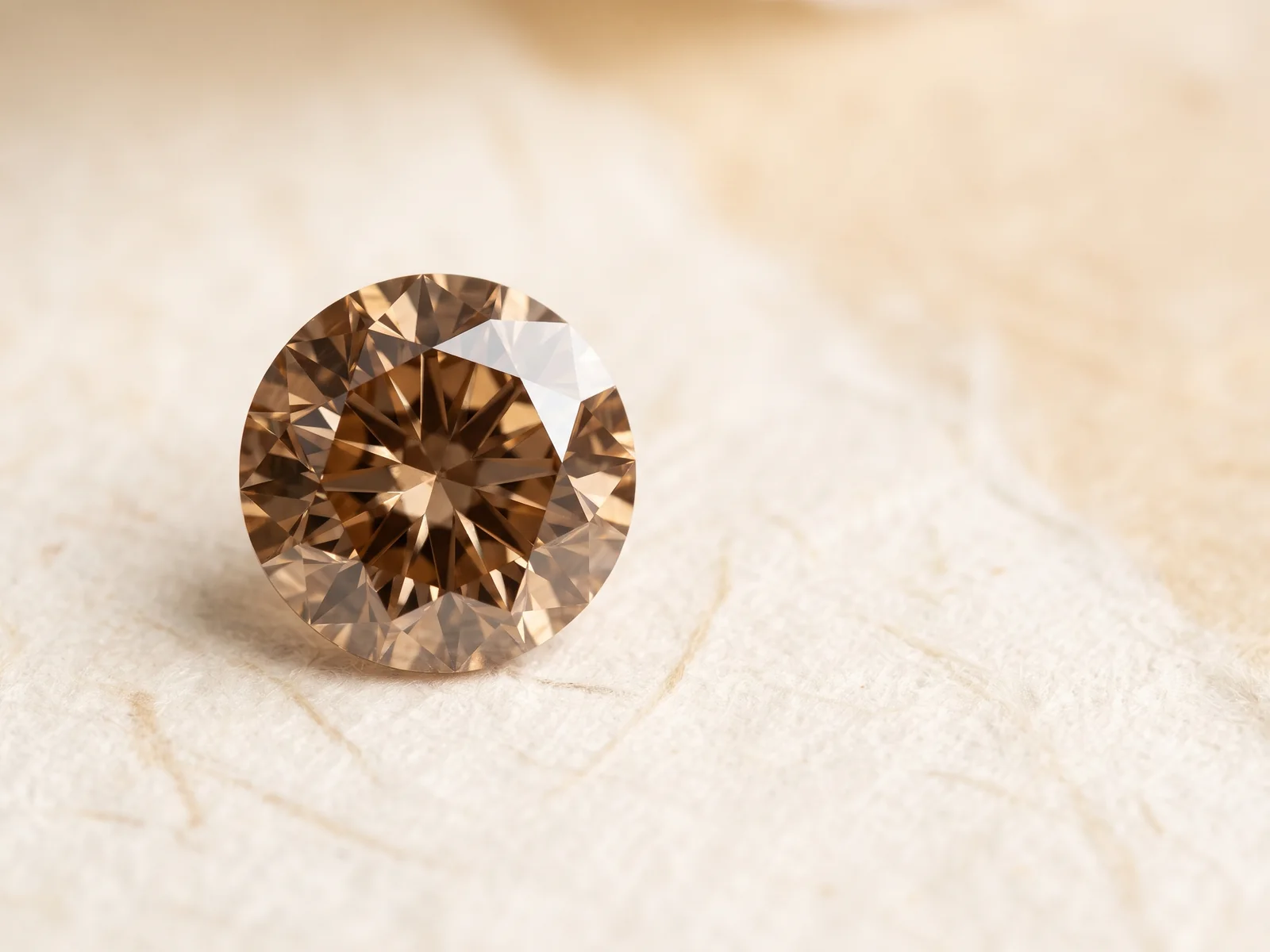
Brown diamonds are the most common fancy colour, and Australia's Argyle mine taught the world to call them champagne and cognac. Here is what causes the colour, how it is graded and how to tell natural, lab-grown and treated stones apart.
 Reviewed by Raj Sood, Graduate Gemologist (GIA), AJP (GIA)Master jeweller and Graduate Gemologist (GIA) · reviewed 4 November 2026
Quick answer
Brown diamonds are natural or lab-grown diamonds whose colour usually comes from distortion in the crystal lattice. Champagne and cognac are trade names: champagne for light to medium browns, cognac for deep, rich browns. They are the most common fancy colour, usually cost less than colourless or pink diamonds, and suit yellow and rose gold especially well.
What are brown diamonds?
Brown diamonds are diamonds with a brown body colour strong enough to be graded as a fancy colour, meaning the colour is distinct enough to be valued for itself rather than graded on the D-to-Z scale used for near-colourless stones. They range from a pale straw or tea tint to a deep coffee brown, and many carry a second colour such as pink, orange, yellow or green. They belong to the wider family covered in our full guide to fancy colour diamonds.
In the trade you will hear several names for them. Champagne usually describes light to medium browns. Cognac describes deep, rich browns, often with an orange or reddish warmth. Chocolate is a trademark one overseas jewellery brand uses for its dark brown diamonds. None of these are grading terms. A laboratory such as GIA writes the colour as, for example, Fancy Light Pinkish Brown or Fancy Dark Orangy Brown, and the trade name is simply a description layered on top.
Physically, a brown diamond is the same material as any other diamond: 10 on the Mohs hardness scale, a refractive index of about 2.42 and the same toughness for daily wear. Only the colour differs, so a champagne diamond engagement ring is just as practical as a white one. Any term here you have not met before is explained in our plain-English jewellery glossary.
What causes the colour in brown diamonds?
Most diamond colours come from a trace element: nitrogen makes yellow, boron makes blue. Brown is different. In most natural brown diamonds the colour comes from plastic deformation. After the crystal formed, it was squeezed and sheared deep in the earth, and layers of carbon atoms slipped slightly out of line. That damage leaves clusters of missing atoms (called vacancy clusters) that absorb light across the spectrum, more strongly towards the blue end, so the stone looks brown.
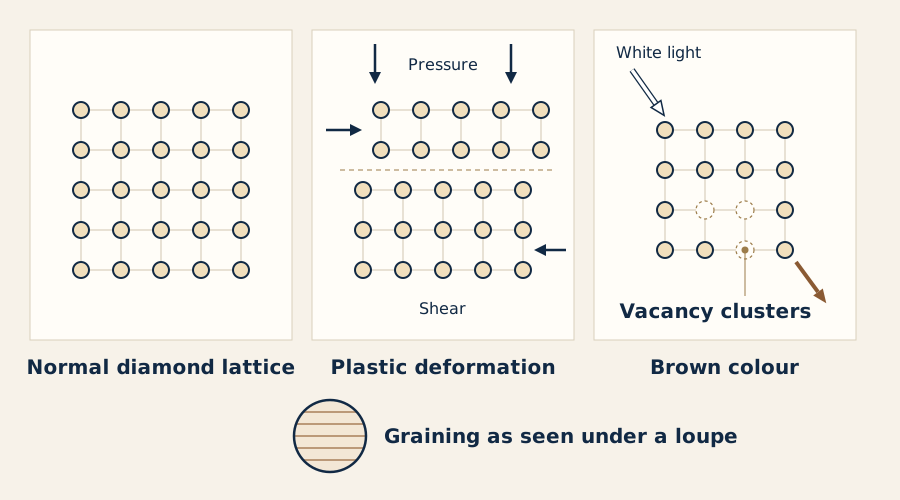
Under magnification you can often see this as graining: fine parallel lines or bands of colour running through the stone. Light graining is harmless and invisible to the eye. Heavy internal graining can make a diamond look slightly hazy and, if it is visible, can lower the clarity grade.
- Deformation alone: the classic neutral or pinkish brown, typical of many Argyle champagnes.
- Deformation plus nitrogen: the nitrogen adds yellow, giving yellowish, orangy and golden browns, which is where many cognac tones come from.
- Growth defects in lab-grown diamond: CVD-grown crystals often come out brownish, for different reasons from natural stones.
- Treatment: heating, irradiation or coatings can create, lighten or change a brown colour, and this must be disclosed.
The same kind of deformation is what gives natural pink and red diamonds their colour. Whether a deformed diamond ends up brown or pink depends on the exact defects that formed, and brown is far more common. A trace of the same brown can also hide in stones that grade as near-colourless; our page on faint brown nuance in diamonds that face up colourless explains how that affects a white diamond.
What is the difference between champagne and cognac diamonds?
The names came from Australia. In the late 1980s the Argyle mine in Western Australia was producing huge volumes of brown diamonds, and Argyle created a seven-step scale to describe and market them. It runs from C1, the palest champagne, to C7, the deepest cognac. Retailers around the world still use these C-grades as shorthand.
| Argyle grade | Trade name | What it looks like | Rough GIA equivalent |
|---|---|---|---|
| C1–C2 | Light champagne | Pale straw to light tea | Light brown on the D-to-Z scale, up to Fancy Light Brown |
| C3–C4 | Medium champagne | Warm honey-brown | Fancy Light Brown to Fancy Brown |
| C5–C6 | Dark champagne | Rich caramel brown | Fancy Brown to Fancy Dark Brown |
| C7 | Cognac | Deep brown, often orange or red undertone | Fancy Dark to Fancy Deep Brown |
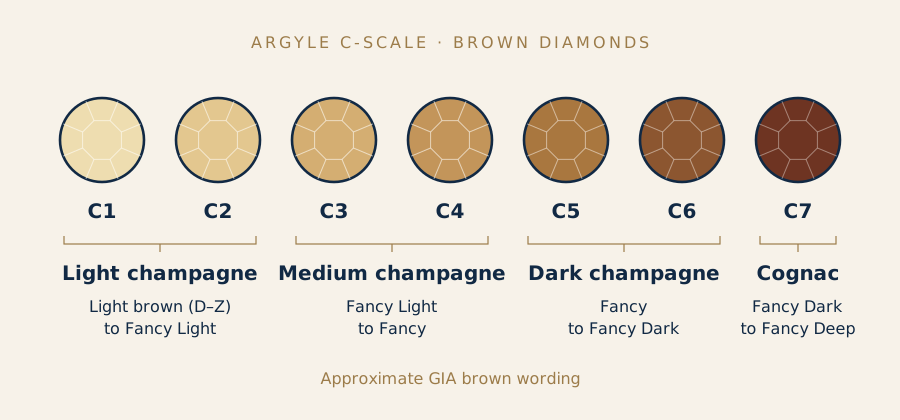
Keep in mind that the Argyle scale was a trading and marketing tool, not an independent laboratory grade, and two sellers may call the same stone C3 and C4. Use C-grades to talk about the look you like, then rely on the laboratory report for the actual colour description.
How does GIA grade brown diamond colour?
GIA describes a fancy colour with three parts: hue (the colour itself), tone (how light or dark it is) and saturation (how strong it is). For brown, the intensity grades you will see most often are Fancy Light, Fancy, Fancy Dark and Fancy Deep. Brown is by nature a low-saturation colour, so Fancy Intense and Fancy Vivid are rarely, if ever, used for a pure brown. Our explainer on what Fancy Vivid actually means shows why those grades belong to strongly saturated colours, and the full ladder is set out in how the Faint-to-Vivid intensity scale works.
Very lightly brown diamonds are not given a fancy grade at all. They are graded on the D-to-Z scale, so a faint champagne tint may simply appear as a letter grade such as K or M, sometimes with a short description such as Faint Brown. Only once the brown is strong enough does the report switch to fancy colour wording.
The words in front of brown are modifiers, and the order matters. The last word is the main colour. A Fancy Pinkish Brown is a brown with a rosy glow; a Fancy Brownish Pink is mainly pink and is priced as a pink, which is a very different amount of money. Our guide to modifiers and overtones such as pinkish or orangy covers how they shift both look and price.
| Example report colour | What you see | Price effect (relative) |
|---|---|---|
| Fancy Light Brown | Light champagne | Lowest |
| Fancy Light Yellowish Brown | Champagne with golden warmth | Low |
| Fancy Dark Orangy Brown | Classic cognac | Low to moderate |
| Fancy Dark Greenish Brown | Olive or khaki brown | Low to moderate |
| Fancy Pinkish Brown | Brown with a rosy glow | Noticeably higher |
| Fancy Brownish Pink | Mainly pink | Much higher, priced as a pink |
Not sure which one is right?
Send us the stones you are looking at and our gemologist will tell you which to choose and why.
Why are Australian champagne diamonds linked to the Argyle mine?
The Argyle mine in the east Kimberley of Western Australia began full-scale production in the mid-1980s and closed in November 2020. Over its life it produced more than 800 million carats of rough diamond, which made it one of the largest diamond producers in the world by volume. Most of that output was brown. Pinks, which made Argyle famous, were well under one per cent of production.
Before Argyle, brown diamonds were mostly sold for industrial use or at low prices. Argyle's champagne and cognac campaign changed that, giving warm browns a jewellery identity of their own. Many Argyle browns were small, often under 0.50 carat, and many carried visible inclusions, so they were widely used as pavé and accent stones as well as centre stones.
The same mine supplied most of the world's Argyle's famous pink diamonds and a handful of the even rarer red diamonds, which share the deformation-based cause of colour described above. Since the closure, interest in documented Argyle stones has grown. Argyle pinks were sold with their own certificates, but most browns were not individually certified, so if Australian origin matters to you, ask what documentation comes with the stone.
Are brown diamonds natural, lab-grown or treated, and how can you tell?
A brown diamond can reach you by three routes: natural colour formed in the earth, natural diamond with treated colour, or lab-grown diamond, which is real diamond grown in a laboratory rather than mined. They can look the same to the eye. Only laboratory testing, shown on the grading report, separates them reliably.
Brown natural diamonds are the raw material for many treatments. Since the late 1990s, HPHT (high pressure, high temperature) processing has been used to remove brown from certain diamonds and make them colourless, or to turn them yellow or greenish yellow. Irradiation, sometimes followed by heating, can turn browns into pink, red, purple, blue or green. That is why the reports for green diamonds and their treated look-alikes and for yellow and canary colours always state colour origin. Thin surface coatings are also used occasionally; they are not permanent and laboratories detect them.
Lab-grown brown diamonds are common too. CVD (chemical vapour deposition) crystals often grow with a brownish tint, which producers usually remove by HPHT treatment; our page on why CVD lab-grown diamonds often grow with a brown or grey tint explains the process. Lab-grown champagne and cognac stones are made by controlling the growth or by post-growth treatment, and the report states both the lab-grown origin and any treatment.
| Report situation | Example wording | What it means |
|---|---|---|
| Natural colour | Fancy Light Pinkish Brown. Colour origin: Natural | Mined diamond, colour formed in the earth and not altered |
| Natural diamond, treated colour | Fancy Intense Yellow. Colour origin: Treated, with a comment such as HPHT processed | Mined diamond whose colour was changed; it may have started out brown |
| Origin not concluded | Colour origin: Undetermined | The laboratory could not reach a conclusion; uncommon, ask for further testing |
| Lab-grown | Laboratory-Grown Diamond, Fancy Brown, with a note on any post-growth treatment | Grown in a laboratory; colour may have been modified after growth |
Most reports also record a laser inscription on the girdle (the thin outer edge). Check that the inscribed number matches the report, and for a lab-grown stone, that the inscription identifies it as laboratory-grown.
Are brown diamonds rare, and how much do they cost in Australia?
Only a small fraction of all diamonds have enough colour to be graded fancy, and among those, brown is the most common. So brown diamonds are rare compared with diamonds in general, but plentiful compared with other fancy colours. That is reflected in the price: a natural brown usually costs less per carat than a colourless diamond of the same size and clarity, and far less than a pink or green.
| 1 ct, eye-clean | Approximate price range (AUD) |
|---|---|
| Lab-grown champagne or brown | about $600–$2,000 |
| Natural light to medium champagne (Fancy Light Brown) | about $2,500–$6,000 |
| Natural cognac (Fancy Dark Orangy Brown) | about $2,500–$7,000 |
| Natural Fancy Pinkish Brown | about $5,000–$15,000 |
| For comparison: natural colourless round, G colour, VS | about $9,000–$16,000 |
These are broad ranges only, and they move with the market and the exact grades. Within natural browns, the price rises most with a pink or orange modifier, good transparency, a lively cut and larger size. Orangy browns sit on a spectrum that runs towards true orange diamonds, which are far rarer and priced accordingly. Documented Argyle origin may also add a premium. Lab-grown browns cost much less than natural browns and suit anyone who wants the colour in a larger size.
Shop brown diamonds: natural and lab-grown
What is the best setting and metal for a champagne diamond?
Because brown is a warm colour, the metal around it changes how it reads more than it does with a white diamond. The common pairings:
- Rose gold: picks up pinkish and cognac tones and makes the whole ring look warmer and richer.
- Yellow gold: suits golden and yellowish browns; 18 ct yellow gold keeps the look soft and even.
- White gold or platinum: gives the strongest contrast, so a light champagne stands out clearly as a colour rather than blending in.
- Black rhodium plating: a dark, modern frame for cognac stones, often paired with grey or black accents. It wears over time and needs re-plating.
For settings, a halo of white diamonds frames a champagne centre and makes its colour read more clearly; pavé bands of small champagne diamonds give a tone-on-tone look. Dark cognac stones benefit from open claws that let light in from the sides, while a full bezel (a rim of metal around the edge) can make a deep brown look darker. Two-stone designs pairing a champagne with a white diamond, or with grey and salt-and-pepper diamonds, are popular for a less traditional ring. Our guide to settings and metals that suit coloured diamonds compares the options side by side.
How do brown diamonds compare with other fancy colour diamonds?
| Colour | Main cause of colour | Natural rarity | Relative price per carat |
|---|---|---|---|
| Brown | Lattice deformation | Most common fancy colour | Lowest of the natural fancy colours |
| Yellow | Nitrogen | Common | Low to moderate |
| Grey and salt-and-pepper | Hydrogen-related defects or many small inclusions | Fairly common | Low to moderate |
| Black | Dense dark inclusions such as graphite | Natural black uncommon; most sold are treated | Low |
| Orange | Nitrogen-related defects | Rare | High |
| Green | Natural radiation exposure | Rare | High to very high |
| Pink | Lattice deformation | Very rare | Very high |
| Purple | Lattice deformation, often with hydrogen | Very rare | Very high |
| Red | Lattice deformation | Rarest | Highest |
The interesting pattern is that brown, pink, purple and red all trace back to the same physical event, a crystal deformed under pressure, yet sit at opposite ends of the price scale. If you like a darker, moodier stone, compare cognac with black diamonds, natural and treated; if you are drawn to the rosy end of brown, the guide to purple diamonds and their pink-to-violet range shows how far the deformation colours can go.
How do you choose a brown or champagne diamond? Step by step
- Decide on the look. Light champagne (C1–C4), dark champagne (C5–C6) or cognac (C7), and whether you want a pink, orange or golden warmth.
- Read the report. Check the full colour wording, the modifier order, the colour origin and whether the diamond is natural or lab-grown.
- Check transparency. Watch a 360° video and, if you can, see the stone in daylight and warm light. Avoid stones that look hazy or flat.
- Check clarity by eye. Aim for eye-clean; ask whether any graining or inclusion is visible face-up.
- Compare like with like. Price stones of the same intensity, modifier and size against each other, not against a different colour.
- Plan the metal and setting. Choose rose, yellow or white metal to suit the tone, and open claws for darker stones.
Free consultation
Talk to a gemologist
Compare stones in person or online with Raj Sood, Graduate Gemologist (GIA), AJP (GIA).
Book a consultationShop this shape
FAQ
Common questions
Are champagne diamonds real diamonds?
Yes. Champagne is a trade name for light to medium brown diamonds, which can be natural or lab-grown. Both are real diamond with the same hardness and refractive index as a colourless stone.
Are brown diamonds cheaper than white diamonds?
Usually, yes. A natural brown typically costs less per carat than a colourless diamond of similar size and clarity. Browns with a pink modifier or documented Argyle origin cost more.
What is the difference between champagne and cognac diamonds?
Champagne describes light to medium browns, roughly C1 to C6 on Argyle's scale. Cognac describes the deepest, richest browns, C7, often with an orange or reddish undertone.
Are chocolate diamonds the same as brown diamonds?
Chocolate is a trademark one jewellery brand uses for its dark brown diamonds. Gemmologically they are brown diamonds, and a laboratory report would describe them with GIA-style brown colour grades.
Are brown diamonds good for engagement rings?
Yes. They are 10 on the Mohs scale like any diamond, so they handle everyday wear well. Choose a setting that protects the edges and a metal that suits the warmth of the colour.
Can lab-grown diamonds be champagne or cognac coloured?
Yes. Lab-grown brown diamonds are widely available, and their colour is often controlled during growth or adjusted afterwards. The report will state that the diamond is laboratory-grown and note any treatment.

Ask a gemologist
Not sure which diamond to choose?
Raj Sood is a Graduate Gemologist (GIA) and master jeweller. Bring the stones you are considering, or send the reports, and he will tell you honestly which one is better and why.
Keep learning
Related guides
 Fancy Colour DiamondsFancy Colour Intensity Scale: Faint to Vivid
 Fancy Colour DiamondsBest Settings and Metals for Coloured Diamonds
 Fancy Colour DiamondsPink Diamonds
 Diamond 4Cs & GradingBrown, Grey and Blue Nuance in Colourless-Looking Diamonds
 Lab-Grown DiamondsBrown or Grey Tint in CVD Lab-Grown Diamonds
 Fancy Colour DiamondsYellow and Canary Diamonds
 Fancy Colour DiamondsRed Diamonds
Explore more
More guides on this topic
Education