
- Education
- Wedding Bands & Eternity
- Wedding Bands for Oval Engagement Rings: The Complete Guide
Wedding Bands & Eternity
Wedding Bands for Oval Engagement Rings: The Complete Guide
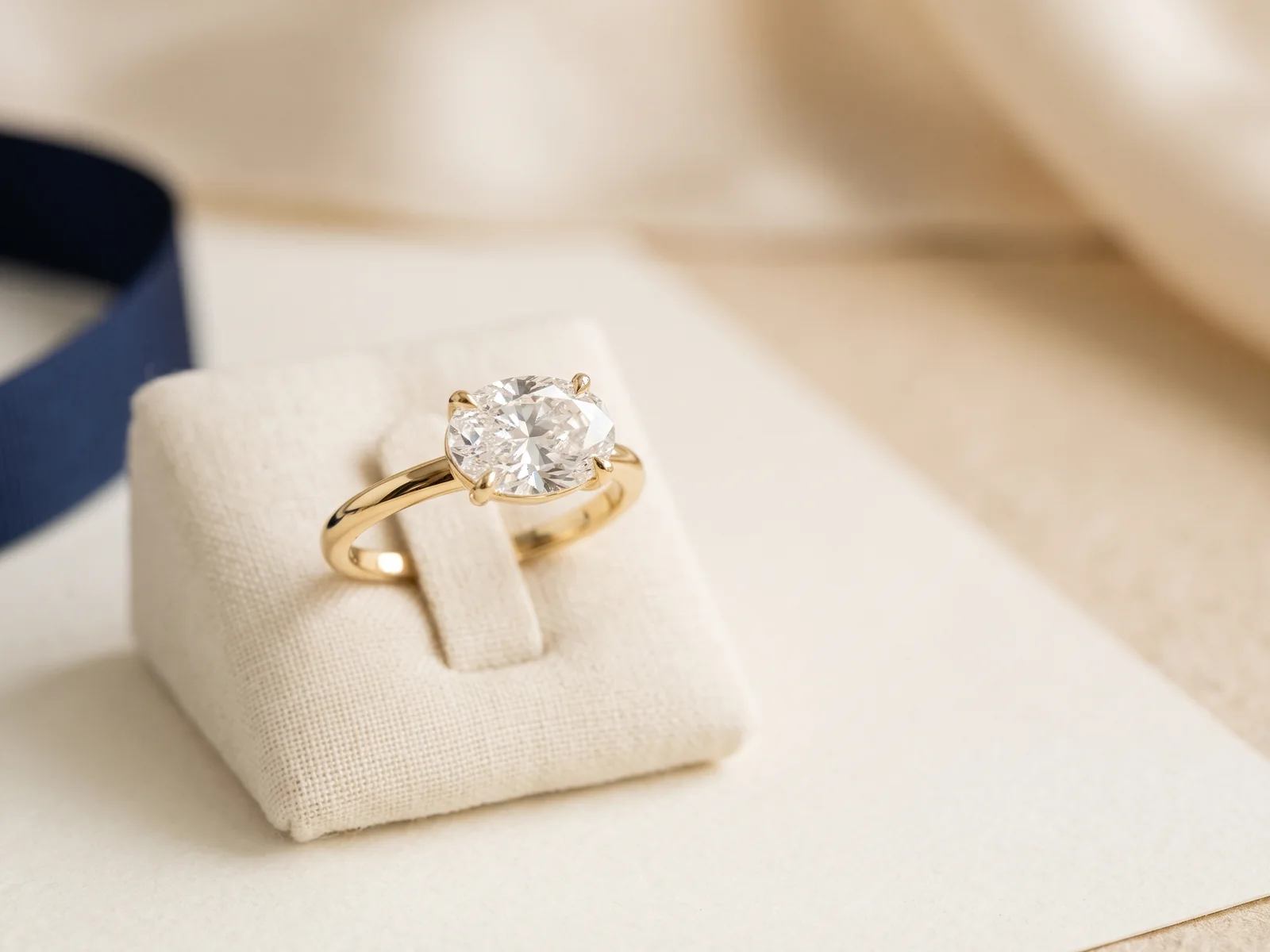
An oval sits long on the finger, and its belly, claws or halo often reach out over the space a wedding band needs. Here is how to choose a band that sits flush, or with a deliberate gap, and still looks right years from now.
 Reviewed by Raj Sood, Graduate Gemologist (GIA), AJP (GIA)Master jeweller and Graduate Gemologist (GIA) · reviewed 4 November 2026
Quick answer
Most wedding bands for oval engagement rings are thin (1.5–2.5 mm) and either straight or gently curved. A straight band sits flush only if the oval's setting is raised high enough to clear it; otherwise choose a fitted, contoured band. Match the metal, keep band diamonds small, and try both rings together.
What wedding bands suit oval engagement rings?
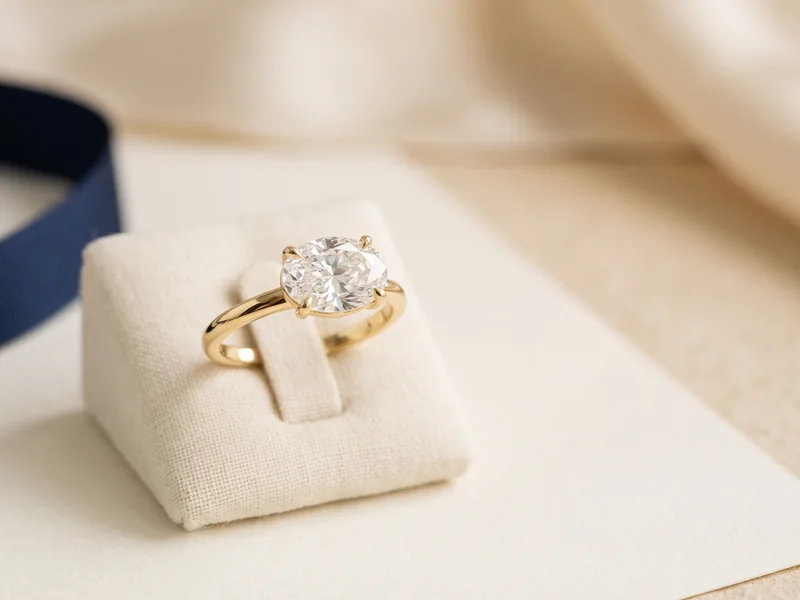
A wedding band for an oval engagement ring has a job most bands do not: it has to share space with a stone that is longer than it is wide. An oval diamond is a brilliant cut (faceted to return light up through the top of the stone) with a smooth, elongated outline. It is usually set north-south, meaning the long axis runs along the finger towards the knuckle.
That length is the whole story. A 1 carat oval measures about 7.7 × 5.7 mm, against about 6.4 mm across for a 1 carat round. So the oval, its claws and any halo reach further along the finger and often overhang the shank (the band part of the engagement ring). Whatever sits next to it has to slip underneath, curve around it, or sit slightly away from it.
In practice, almost every oval pairing falls into one of three groups:
- A straight band that sits flush: plain or diamond-set, touching the engagement ring along its whole length. Only possible when the setting is raised high enough for the band to pass under the stone.
- A curved or contoured band: shaped to follow the outline of the oval, so the two rings meet with no gap even when the setting sits low.
- A straight band with a deliberate gap: the rings touch at the back of the finger but a small space shows under the stone. Some people like this look; others find it untidy.
If you are still sorting out the language, our explainer on wedding ring versus wedding band clears up what each term means in Australia. For principles that apply to any centre stone, see matching a band to any engagement ring. This guide stays on ovals and the specific problems their shape creates.
Do straight wedding bands sit flush with oval engagement rings?
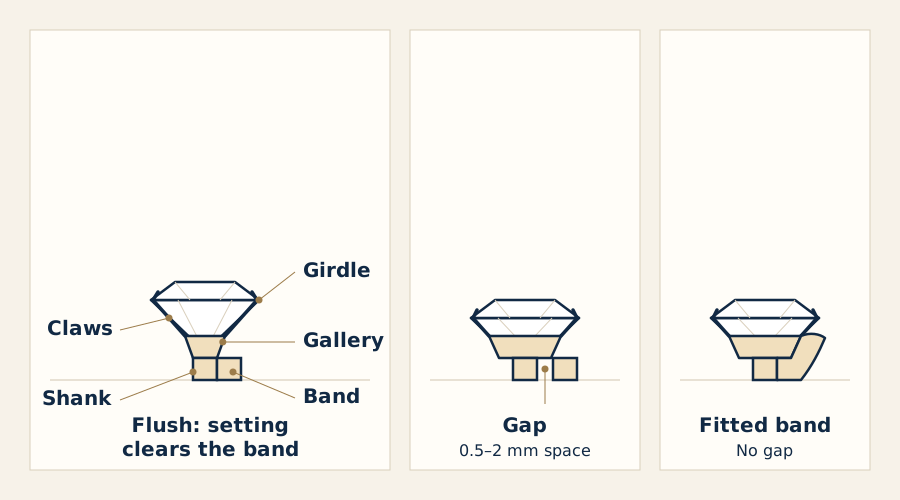
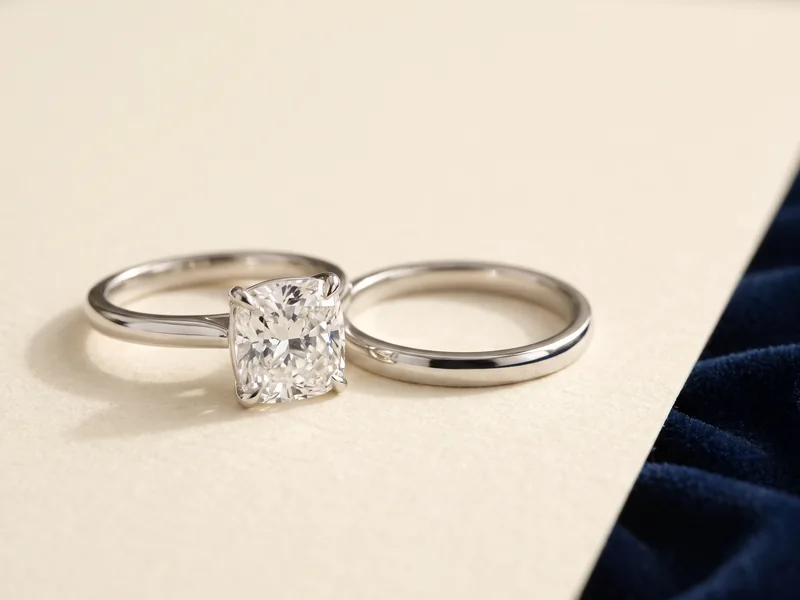
Sometimes. It depends on how high the oval sits and what is underneath it. For a straight band to sit flush (touching along its full length with no visible space), the lowest parts of the setting, usually the girdle of the stone (its widest edge) and the base of the claws, must clear the top of the wedding band.
Most wedding bands stand about 1.5–2.0 mm tall from the finger. So, as a rough guide, the underside of the oval and its claws need to sit a little more than that above the top of the engagement ring's shank. Settings designed for this are often called flush-fit or band-friendly: the gallery (the metal basket under the stone) is lifted or cut back so a band can tuck beneath it.
| Fit | How it looks | When it happens | Watch for |
|---|---|---|---|
| Flush, straight band | Two rings touching end to end, a neat solid line | Oval set high, gallery cut back, no halo overhang | A tall setting catches more on clothes and gloves |
| Gap, straight band | Rings touch at the back, a 0.5–2 mm space under the stone | Oval set low, a wide basket or a halo | Rings can twist and rub; some people like the airy look |
| Fitted, curved band | Band bends around the oval and meets it with no gap | Any setting height; made to the exact ring | Only fits that engagement ring; harder to wear on its own |
A gap is not a fault. It is a style choice, and many Australians wear a straight band with a small gap for decades. The catch is movement: with nothing locking them together, the rings can turn on the finger and wear against each other. Our guide to stopping two rings from rubbing explains the options, including having them soldered together.
If you want no gap and your setting sits low, a fitted band is the answer. Custom fitted and contoured bands are shaped to the exact profile of your engagement ring, usually from a CAD model built around it.
Which wedding band styles work with an oval diamond?
An oval has no corners and no point, so it is more forgiving than a pear or marquise. Its soft curve pairs naturally with round edges and gentle arcs. Here is how the main band styles behave beside it:
| Band style | How it sits with an oval | Suits | Watch for |
|---|---|---|---|
| Plain straight | Clean line; lets the oval lead | Raised settings, minimal look | Gap if the setting is low |
| Diamond-set straight (claw, pavé, channel) | Adds a line of sparkle under the stone | Raised settings, solitaires, hidden halos | Band diamonds can compete if too large |
| Gentle curve (contour) | Follows the oval's belly; no gap | Low settings, halos, larger ovals | Choose a curve that matches the stone's width |
| Notched | Straight band with a small dip for the setting | Medium-height settings with a slight overhang | Notch must line up with the claws |
| V or chevron | Sharp point under the stone | Very elongated ovals (above about 1.50) | A sharp V can look fussy against a soft oval |
| Full eternity | Diamonds all the way round | Even sparkle; stacking | Hard to resize; must clear the setting |
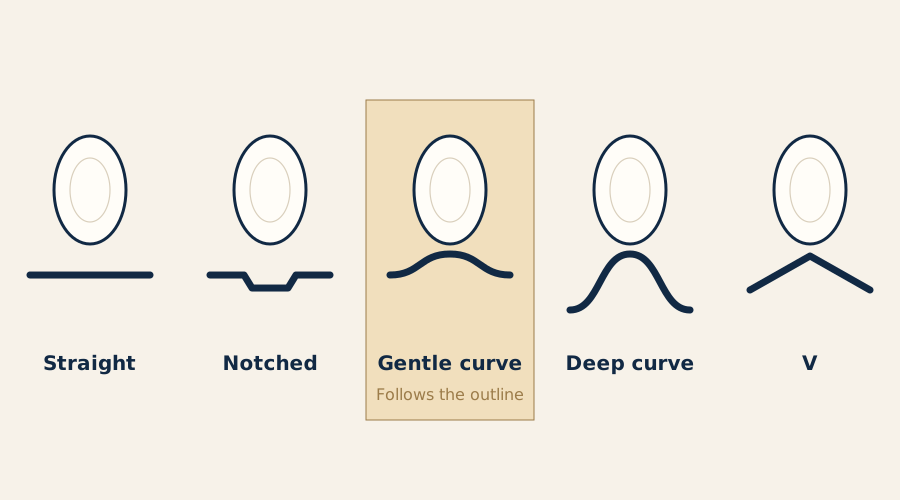
A gentle curve is the shape most often chosen for ovals because it echoes the stone's outline rather than fighting it. A V band, which works well with a pear's pointed tip, can look too sharp against an oval's rounded end unless the oval is long and slim.
Think ahead too. If you might add a band for a later anniversary, a curved first band can make it harder to add a straight one on the other side. Our guide to building an anniversary ring stack shows how people plan two or three bands around one centre stone.
How wide should a wedding band be for an oval?
Width is measured across the top of the band, from one edge to the other. Most engagement ring shanks for ovals are 1.8–2.5 mm wide, and a wedding band usually looks balanced when it is within about 0.3 mm of the shank. A band much wider than the shank makes the engagement ring look thin; a much narrower one can look lost.
| Oval carat | Typical size (length × width) | Common shank width | Band width that usually balances |
|---|---|---|---|
| 0.70 ct | about 7.0 × 5.0 mm | 1.6–1.8 mm | 1.5–1.8 mm |
| 1.00 ct | about 7.7 × 5.7 mm | 1.8–2.0 mm | 1.8–2.2 mm |
| 1.50 ct | about 8.7 × 6.3 mm | 2.0–2.2 mm | 2.0–2.4 mm |
| 2.00 ct | about 9.5 × 7.0 mm | 2.0–2.5 mm | 2.0–2.5 mm |
| 3.00 ct | about 11.0 × 8.0 mm | 2.3–2.8 mm | 2.2–2.8 mm |
These sizes assume a ratio around 1.35. A slimmer oval at 1.50 is longer and narrower for the same weight, which pushes it even further along the finger and makes a flush straight band less likely.
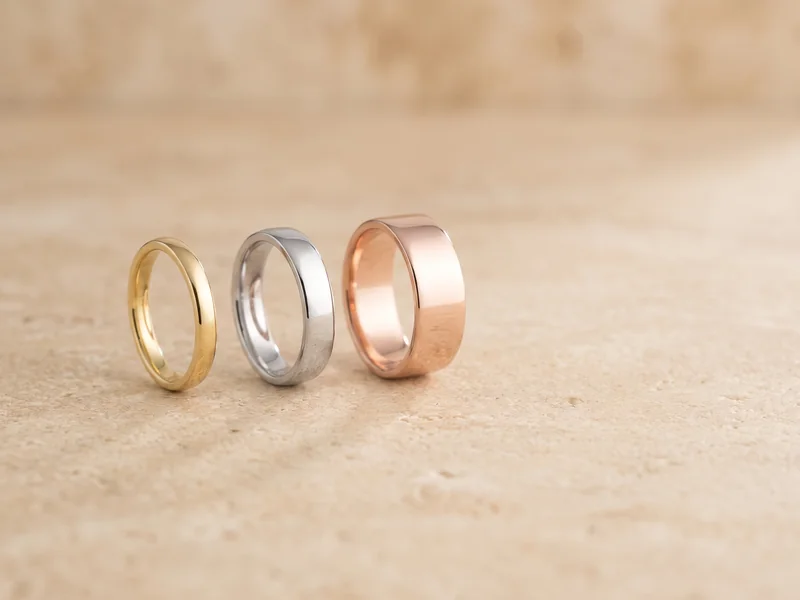
Height (how thick the band is from finger to top) matters as much as width. A band of 1.5–1.8 mm height slips more easily under a raised setting than a chunky 2.2 mm one. The shape of the band's cross-section changes comfort and how the two rings meet: our explainer on court, flat, D-shape and knife-edge profiles shows each one. A band with flat sides sits more snugly against a flat-sided engagement ring; a court (rounded inside and out) profile is the most comfortable for everyday wear.
Not sure which one is right?
Send us the stones you are looking at and our gemologist will tell you which to choose and why.
Should a wedding band for an oval be plain or diamond-set?
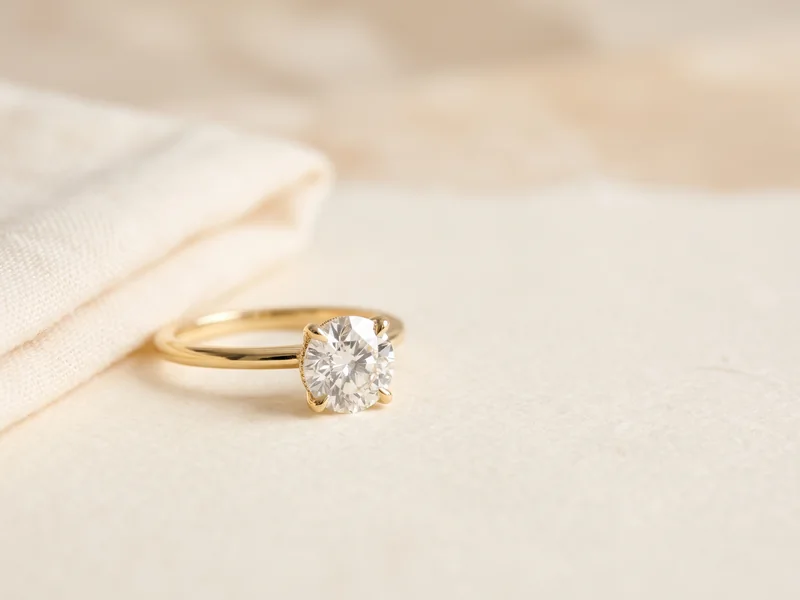
Both work. A plain band lets the oval do all the talking and suits a solitaire with plain shoulders. A diamond band adds a line of light beneath the stone and suits a pavé or hidden-halo engagement ring. Our side-by-side look at plain and diamond bands covers wear, cost and maintenance.
If you choose diamonds, keep them small enough that the oval stays the clear centre. Beside a 1 carat oval, most people choose round brilliants of 1.3–2.0 mm. As a guide, a 1.5 mm round weighs about 0.015 ct, a 1.8 mm about 0.025 ct and a 2.0 mm about 0.03 ct. Match the band diamonds to the shoulder stones if your engagement ring has them, so both rings read as one set. See how big the diamonds in a band should be for a fuller sizing chart.
- Claw set: each diamond held by small metal claws. Lets the most light in, but claws can catch and need checking.
- Pavé: tiny diamonds set close together with beads of metal. Fine and sparkly; suits pavé engagement rings.
- Channel set: diamonds held between two walls of metal. Smooth, secure and good for active hands.
- Half eternity: diamonds across the top third to half of the band. Easy to resize and comfortable.
- Full eternity: diamonds all the way round. Even sparkle from every angle, but sizing is difficult.
Before committing to a full eternity, read whether a full-eternity ring can be resized; the short answer is rarely, so the size needs to be right from the start. Also match colour: if your oval is G colour, band diamonds of G–H keep the set even. Band diamonds that are noticeably warmer than the centre stand out against a white oval.
Should the wedding band match the engagement ring's metal?
Ideally, yes, and not just the colour. Two rings worn together rub every day. If one is platinum and the other 18 carat gold, or one is 9 carat and the other 18 carat, the softer or more abrasive metal wears at a different rate and the rings can mark each other. Matching the metal and its purity keeps wear even.
- Platinum (usually 950): dense and naturally white. It scratches into a soft patina rather than wearing away, and holds claws well.
- 18 carat white gold: 75% gold, usually plated with rhodium for a bright white finish that needs re-plating every year or two with daily wear.
- 18 carat yellow or rose gold: warm tones that make slightly warmer diamond colours look whiter.
- 9 carat gold: 37.5% gold; harder-wearing but paler in colour and a different tone next to 18 carat.
Mixed metals are a valid choice, such as a platinum oval with a yellow gold band, as long as you accept some uneven wear. Many people keep the claws white for the diamond and choose a warm band.
If both partners are choosing bands together, our guide to choosing a men's wedding band covers widths, profiles and finishes that complement, rather than copy, an oval bridal set.
How does the oval's setting change the band you need?
The same oval can need a completely different band depending on how it is set. Look at your engagement ring from the side before you shop:
- Four-claw solitaire: claws at the four diagonal positions. If the setting is raised, a straight band usually sits flush or close to it.
- Six-claw solitaire: adds claws at the ends of the oval. The lower end claw often sits where the band wants to go, so check the overhang.
- Halo: a ring of small diamonds around the oval adds roughly 1.5–2 mm on each side. That extra footprint usually means a curved band or a gap.
- Hidden halo: small diamonds under the oval, out of sight from above. Often designed to leave room for a band, but confirm on your ring.
- Cathedral shoulders: metal arches rising to the setting. They lift the stone, which helps a straight band slide beneath.
- Bezel: a rim of metal around the stone. Usually low-set, so expect a gap or a fitted band.
- East-west oval: set with the long axis across the finger. Only the oval's width (about 5.7 mm at 1 carat) runs along the finger, so straight bands sit flush more often.
Three-stone rings with an oval centre and side stones behave much like a halo: the combined width leaves little room for a straight band. A gentle curve, or a band made to fit, is the usual solution.
Related guideHow to Match a Wedding Band to an Engagement RingHow do ovals compare with other shapes for wedding band pairing?
Each shape creates its own fitting problem. The oval sits in the middle: easier than shapes with points or corners, harder than a low round solitaire.
| Centre shape | Usual band choice | Straight band flush? | Main issue |
|---|---|---|---|
| Oval | Straight or gentle curve | Often, if set high | Length overhangs the shank |
| Round | Straight | Usually | Few; the simplest to pair |
| Pear | Curve or V | Sometimes | Pointed tip needs space or a matching V |
| Marquise | V or deep curve | Rarely | Two points and a long outline |
| Emerald cut | Straight, often channel or claw | Usually | Straight sides suit straight lines |
| Cushion | Straight or gentle curve | Often | Wide shoulders and halos |
| Princess | Straight | Usually | Corners need protection |
| Asscher | Straight | Usually | Square outline and high crown |
If you are still deciding on a centre stone, compare the fit with our guides to bands for round engagement rings, marquise engagement rings, emerald-cut settings, cushion-cut rings, princess-cut solitaires and Asscher-cut rings.
Natural and lab-grown ovals in a bridal set
Ovals are cut from both natural and laboratory-grown diamond, and the two look identical to the eye. Lab-grown ovals cost much less than natural ones of the same size and grade, so many couples choose a larger lab-grown centre; natural ovals are rarer and come from the earth. Both should come with an independent grading report from a lab such as GIA or IGI.
The band diamonds can be natural or lab-grown regardless of the centre. What matters for the look is that their colour and brightness match. If you mix types, the paperwork should say so clearly, so you always know which stones are which.
Shop oval diamonds and wedding bands
As a rough guide only, a plain 2 mm band in 18 carat gold typically sits around AUD 900–1,800, and a natural diamond half eternity of about 0.25–0.50 ct total around AUD 1,800–4,500, with lab-grown diamond bands costing considerably less. Platinum, fitted bands and full eternities sit higher. Prices depend on metal weight, diamond quality and labour, so get a quote for your exact design.
How to choose wedding bands for oval engagement rings: step by step
- Look at your ring from the side. Note how high the oval sits, whether the gallery or a halo overhangs the shank, and where the claws land.
- Decide on flush, gap or fitted. If a straight band touches cleanly, you have the widest choice. If not, choose between accepting a gap and a curved or fitted band.
- Match the width and height. Stay within about 0.3 mm of the shank width, and choose a band low enough to slide under a raised setting.
- Match the metal. Same metal and purity as the engagement ring, so both wear evenly.
- Choose plain or diamond-set. Keep band diamonds close in size to any shoulder stones and close in colour to the oval.
- Try them together. Wear both rings for a few minutes, make a fist, and check they do not twist or catch. For the wider process, see our wedding ring buying guide, and look up any unfamiliar word in the jewellery glossary.
Free consultation
Talk to a gemologist
Compare stones in person or online with Raj Sood, Graduate Gemologist (GIA), AJP (GIA).
Book a consultationFAQ
Common questions
Do wedding bands sit flush with oval engagement rings?
A straight band sits flush only when the oval is set high enough for the band to pass beneath the stone and claws. With low settings, halos or bezels, you will see a small gap unless you choose a curved or fitted band.
Should I get a curved or straight wedding band for an oval ring?
Choose straight if your setting is raised and you want a clean line or plan to stack more bands later. Choose a gentle curve if the oval sits low or has a halo and you want no gap.
How wide should a wedding band be next to an oval engagement ring?
Most people choose 1.5–2.5 mm, staying within about 0.3 mm of the engagement ring's shank. Larger ovals of 2 carats and above can carry a slightly wider band.
Can I wear a wider wedding band with an oval diamond?
Yes, but a band much wider than the shank can make the engagement ring look thin and push the oval forward. Bands over about 3 mm usually suit being worn alone or with a large centre stone.
Does my wedding band need to be the same metal as my oval engagement ring?
It is recommended, because two different metals worn side by side wear at different rates and can mark each other. Mixed metals still work if you accept some uneven wear over time.
Is a gap between my oval engagement ring and wedding band a problem?
Not structurally. It is a look some people like, but the rings can twist and rub, so check them for wear or consider having them soldered together.

Ask a gemologist
Not sure which diamond to choose?
Raj Sood is a Graduate Gemologist (GIA) and master jeweller. Bring the stones you are considering, or send the reports, and he will tell you honestly which one is better and why.
Keep learning
Related guides
 Wedding Bands & EternityFitted Wedding Bands Explained | Custom Curved Bands
 Wedding Bands & EternityHow to Match a Wedding Band to an Engagement Ring
 Wedding Bands & EternityWedding Band Profiles Explained
 Wedding Bands & EternityPlain vs Diamond Wedding BandsWedding Bands & EternityWedding Ring Buying Guide
 Wedding Bands & EternityBest Wedding Band for Princess Engagement Rings
 Wedding Bands & EternityWedding Ring vs Wedding Band
 Wedding Bands & EternityMen’s Wedding Band Guide
Explore more
More guides on this topic
Education