
- Education
- Diamond 4Cs & Grading
- Diamond Colour Grading: The Complete D-to-Z Guide
Diamond 4Cs & Grading
Diamond Colour Grading: The Complete D-to-Z Guide
Colour is the C you notice first in a white diamond, and the one where paying for a higher grade often buys a difference only a grader can see. Here is how the scale works and where it actually matters.
 Reviewed by Raj Sood, Graduate Gemologist (GIA), AJP (GIA)Master jeweller and Graduate Gemologist (GIA) · reviewed 4 November 2026
Quick answer
Diamond colour grading measures how little body colour a white diamond has, on GIA's scale from D (colourless) to Z (light yellow or brown). D–F are colourless, G–J near-colourless, K–M faint. Most people can't tell neighbouring grades apart face-up; in white metal, G–H looks white to most eyes, and I–J sits well in yellow or rose gold.
What is diamond colour grading?
Diamond colour grading is the measurement of body colour: the faint yellow, brown or grey tint that most white diamonds carry. The less colour a diamond has, the higher its grade. It is one of the four Cs of diamond quality, alongside cut, clarity and carat weight.
The tint comes mostly from nitrogen atoms trapped in the crystal as it grew. A few nitrogen atoms per million carbon atoms is enough to absorb a little blue light, which leaves the stone looking slightly yellow. Brown tints usually come from distortion in the crystal lattice. Truly colourless diamonds, with almost no nitrogen, are rare in nature.
The grading applies to white, or 'colourless range', diamonds only. Once a diamond's colour is strong enough to be attractive in its own right (a vivid yellow, pink or blue), it moves onto a separate fancy colour scale, where more colour means a higher grade rather than a lower one. Terms such as body colour and fancy colour are defined in our jewellery glossary.
What do the diamond colour grades D to Z mean?
GIA (the Gemological Institute of America) introduced the D-to-Z scale in the early 1950s, starting at D deliberately so it would not be confused with the older A, B, C and 'AAA' systems that meant different things at different shops. Today almost every lab and retailer worldwide uses the same letters.
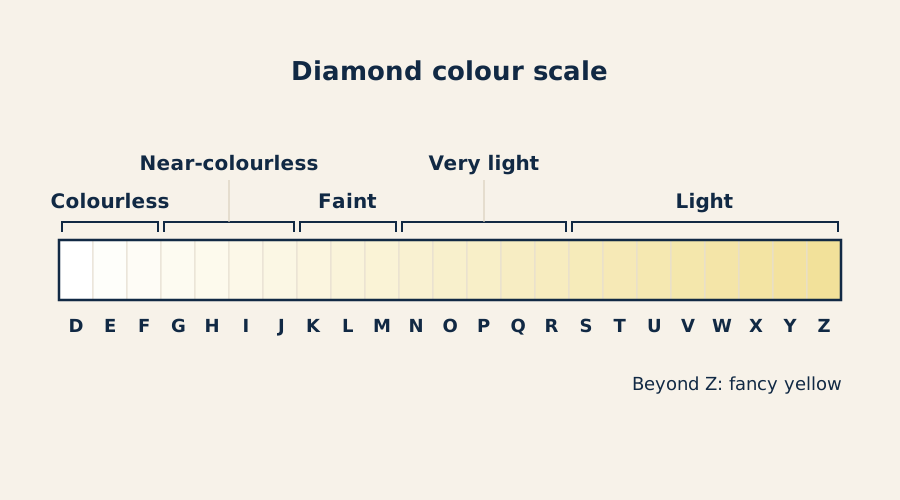
| Grades | GIA group | What you see face-up | Typical use |
|---|---|---|---|
| D, E, F | Colourless | No colour visible, even to most trained eyes face-up | Platinum and white gold rings where you want icy white |
| G, H | Near-colourless (upper) | Looks white in almost any setting; a grader sees faint warmth side-on | The most popular range for engagement rings |
| I, J | Near-colourless (lower) | Slight warmth side by side with a D; looks white alone in warm metal | Yellow and rose gold; value-focused white metal rings |
| K, L, M | Faint | A gentle, visible warmth | Vintage-style and yellow gold settings |
| N–R | Very light | Clear yellow or brown tint | Rarely used in fine jewellery today |
| S–Z | Light | Obvious yellow or brown | Mostly industrial or very warm styles |
Each grade has its own guide with real examples: D colour diamonds, E colour and F colour stones at the top; G colour diamonds, H colour, I colour diamonds and J colour in the near-colourless range; and K colour and the faint range beyond it.
How does diamond colour grading work in the lab?
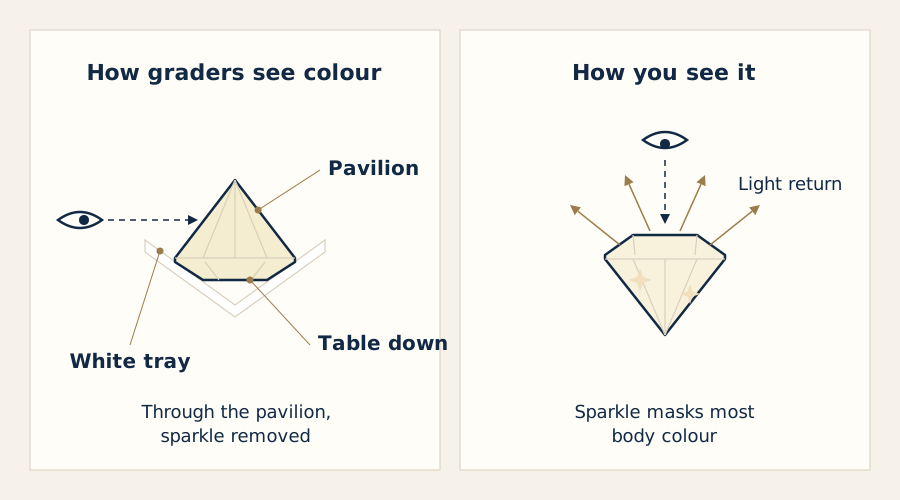
Colour is graded with the diamond upside down. The grader places the stone table-down in a white, V-shaped grading tray and looks through the side of the pavilion (the cone-shaped underside). Viewing it this way strips out most of the sparkle, which would otherwise mask the body colour.
- Controlled light: a daylight-equivalent lamp in a neutral grey booth, so room lighting cannot warm or cool the stone.
- Master stones: a set of diamonds of known colour. The grader slides the stone between them to find where it sits; each master marks the most colour a grade can have.
- More than one opinion: at major labs, several graders and often an instrument that measures colour check each stone before the grade is final.
- A range, not a point: each letter covers a band of colour. A 'high H' and a 'low H' can differ more than a low G and a high H.
Not every lab grades to exactly the same standard. GIA and AGS are widely regarded as consistent; other labs can be a grade softer on some stones. Our guide to how the major grading labs compare explains what that means when you compare two reports side by side.
Can you see the difference between diamond colour grades?
Honestly, between neighbouring grades, most people cannot once the stone is set and face-up. The steps on the scale are designed to be detected by trained graders under ideal conditions, side by side, through the pavilion. On a hand, in normal light, a well-cut G and a well-cut H look the same to nearly everyone.
Differences become visible when you jump three or more grades, compare stones side by side, or look at a large stone. A D next to a J shows the J's warmth clearly; a J on its own, in yellow gold, simply looks white. If you are torn between two neighbours, our guides to how D, E and F compare and to choosing between G and H go through real photos.
Related guideG vs H Diamond Colour for Engagement RingsNot sure which one is right?
Send us the stones you are looking at and our gemologist will tell you which to choose and why.
Which diamond colour looks white in each metal?
The metal around a diamond reflects into it. Cool metals make any warmth easier to notice; warm metals hide it. This is the single biggest practical factor in choosing a grade, and our guide to how ring metal changes the way colour looks shows the same stones in each metal.
| Metal | Colour that usually looks white | Why |
|---|---|---|
| Platinum | G or better (F or better if you want icy white) | Bright, cool grey-white metal; shows warmth in lower grades |
| White gold (rhodium plated) | G–H for most people | Cool white finish; once rhodium wears, the warmer gold underneath can blend with I–J |
| Yellow gold (18ct) | H–J, and K can work | Warm reflections mask the stone's own tint; a D can even pick up a yellow glow |
| Rose gold | H–J | Pink warmth complements slight body colour |
| Two-tone (white head, yellow band) | G–I | The white claws or head sit closest to the stone and decide how it reads |
A practical point many people miss: you can set the diamond in a white gold or platinum head on a yellow gold band. The stone sits against cool metal while the band stays warm, which lets a G or H look crisp in an otherwise yellow ring.
Do shape and carat size change how colour shows?
Yes, both do. A round brilliant hides colour well because its facets return so much white light. Fancy shapes such as ovals, pears, marquises, cushions, radiants and emerald cuts tend to show colour more, especially at the ends and corners where the stone is deeper, or through the large open table of a step cut.
- Round: hides colour well; H–I often looks white in white metal.
- Oval, pear, marquise: colour gathers in the points; consider one grade higher than you would for a round.
- Cushion and radiant: deeper stones can hold warmth; many people pick one grade higher, or embrace a warmer look in yellow gold.
- Emerald and Asscher: step cuts show body colour clearly through the open table; G or better suits white metal.
Size matters too. Under about 0.50 carat, a J can look white in almost any metal. Above 2 carats, there is simply more diamond for light to travel through, so colour becomes easier to see and many people move up a grade. Our guide to colour and clarity pairings for every shape gives a starting point for each.
Does fluorescence affect diamond colour?
Fluorescence is a glow some diamonds give off under ultraviolet light, usually blue. Roughly a quarter to a third of natural diamonds show some. Reports grade it as None, Faint, Medium, Strong or Very Strong. It is a separate line on the report, not part of the colour grade.
In daylight, which contains UV, medium to strong blue fluorescence can cancel out a little yellow, so an I, J or K can look whiter face-up than its grade suggests. In higher colours (D–F), very strong fluorescence occasionally gives a slightly hazy or oily look, though most fluorescent stones look perfectly normal. Always judge the stone itself, ideally in daylight as well as shop light.
| Fluorescence | Effect in D–F | Effect in G–H | Effect in I–K |
|---|---|---|---|
| None / Faint | No effect | No effect | No effect |
| Medium blue | Rarely noticeable | Rarely noticeable | Can look slightly whiter |
| Strong / Very strong blue | Occasionally hazy; check by eye | Usually fine; check by eye | Often looks whiter in daylight |
How much does colour change a diamond's price?
Colour moves the price of a natural diamond noticeably, and the steps are steepest at the top of the scale, where truly colourless stones are rarest. The figures below are rough guides for a 1 carat natural round with excellent cut and VS2 clarity, with an independent report. Real prices vary with cut quality, fluorescence, lab and the market, so treat them as a sense of the step, not a quote.
| Colour (1 ct natural round, VS2, excellent cut) | Approximate price (AUD) |
|---|---|
| D | about $11,000–16,000 |
| E | about $10,000–14,000 |
| F | about $9,000–13,000 |
| G | about $8,000–12,000 |
| H | about $7,000–10,500 |
| I | about $6,000–9,000 |
| J | about $5,000–7,500 |
| K | about $4,000–6,500 |
Because neighbouring grades look so alike face-up, colour is often the easiest C to trade down for a bigger or better-cut stone. The same logic applies to clarity: VS1 and VS2 side by side often look identical, and there are times when an SI1 makes sense too. If you have to choose, read our guide on whether to put colour or clarity first.
How is lab-grown diamond colour graded?
Laboratory-grown diamonds are graded on the same D-to-Z idea, and most lab-grown stones sold for jewellery fall between D and H. Growers can keep nitrogen out more easily than nature does, so high colours are common. Some CVD-grown stones start with a brownish tint and are then treated with heat and pressure to improve their colour; some HPHT-grown stones carry a faint blue or grey from boron. A reputable report discloses that the stone is laboratory-grown and notes any post-growth treatment.
Labs differ in how they describe lab-grown colour, and GIA has moved towards broader descriptions for lab-grown stones rather than the full letter-by-letter detail it gives natural diamonds. Our guide to how lab-grown diamonds are colour graded explains each lab's approach.
Price works differently too. A lab-grown diamond costs much less than a natural one of the same grade, and the price gap between colour grades is far smaller, so many people choose a higher colour in lab-grown simply because the step costs little. Natural diamonds remain rarer, especially in the colourless range. Neither is better; they are different choices, and both should come with an independent report.
Browse natural and lab-grown diamonds by colour
How to choose a diamond colour grade: step by step
- Choose the metal first. Platinum or white gold points to G–H (or higher for icy white); yellow or rose gold opens up H–K.
- Factor in shape. Rounds hide colour well; for ovals, pears, cushions and step cuts, consider one grade higher in white metal.
- Factor in size. Over about 2 carats, colour shows more; under about 0.50 carat, a lower grade rarely shows.
- Check the report. Confirm the colour grade, the lab and the fluorescence, and for lab-grown stones, any post-growth treatment.
- Look face-up in mixed light. Compare the stone on a white card and on your hand, in daylight and indoors.
- Spend the savings wisely. If you cannot see the difference between two grades, put the money into cut quality or carat weight instead.
Colour is only one part of the picture. Before you decide, also check the stone for surface issues covered in our guide to diamond cavities and chips, and weigh colour against the other Cs rather than chasing the top letter for its own sake.
Free consultation
Talk to a gemologist
Compare stones in person or online with Raj Sood, Graduate Gemologist (GIA), AJP (GIA).
Book a consultationShop this shape
FAQ
Common questions
What is the best diamond colour grade?
D is the highest grade, but it is not automatically the right choice. For most people, G or H looks white in white metal and costs noticeably less, while I or J looks white in yellow or rose gold.
Is an H colour diamond good?
Yes. H sits in the near-colourless range and looks white face-up to almost everyone, especially in a well-cut round. It is one of the most popular grades for engagement rings.
Can you see the difference between G and H colour?
Not face-up once the stone is set, for nearly everyone. A trained grader can separate them side by side through the pavilion under controlled light.
What colour diamond should I choose for yellow gold?
H to J usually looks white in yellow gold, and K can work for a warmer look. A D or E can actually pick up a yellow glow from the metal, so the extra cost is often wasted.
Does fluorescence make a diamond look yellow?
No, blue fluorescence tends to do the opposite, making lower grades such as I–K look slightly whiter in daylight. In rare cases very strong fluorescence can make a high-colour stone look hazy, so judge the stone by eye.
Are lab-grown diamonds graded for colour the same way?
Labs such as IGI grade them on the same D-to-Z idea, while GIA now describes lab-grown colour more broadly rather than giving a full letter grade. Most lab-grown diamonds sold for jewellery fall between D and H.

Ask a gemologist
Not sure which diamond to choose?
Raj Sood is a Graduate Gemologist (GIA) and master jeweller. Bring the stones you are considering, or send the reports, and he will tell you honestly which one is better and why.
Keep learning
Related guides
 Diamond 4Cs & GradingG vs H Diamond Colour for Engagement Rings
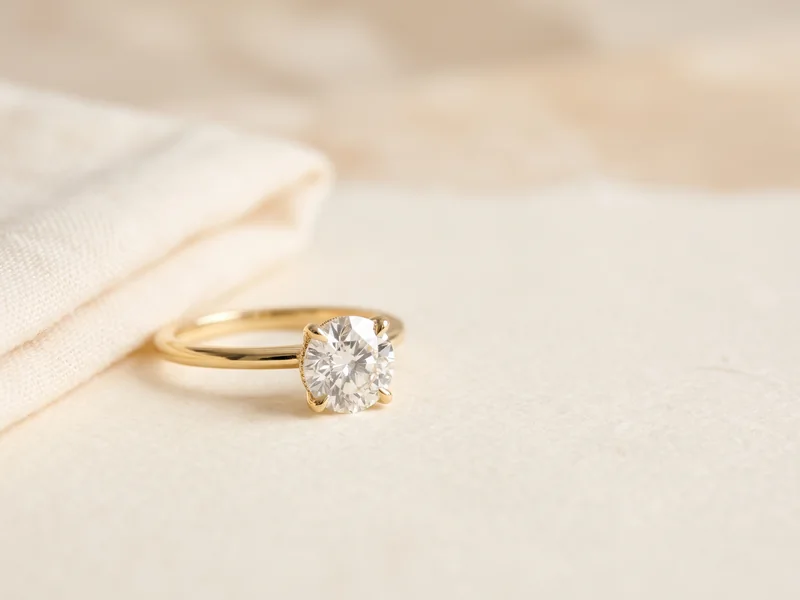 Diamond 4Cs & GradingHow Ring Metal Changes the Way Diamond Colour LooksDiamond 4Cs & GradingColour vs Clarity: Which to Prioritise
 Lab-Grown DiamondsLab-Grown Diamond Colour GradesDiamond 4Cs & GradingDiamond 4CsDiamond 4Cs & GradingI Colour Diamonds
 Diamond 4Cs & GradingH Colour DiamondsDiamond 4Cs & GradingG Colour Diamonds
Explore more
More guides on this topic
Education