
Gemstones
Australian Sapphire Engagement Rings: The Complete Guide
Australian sapphire engagement rings carry a stone dug from basalt country in New South Wales and Queensland, with colours you rarely see from anywhere else. Here is how to judge the colour, check the origin and choose a setting that will last.
 Reviewed by Raj Sood, Graduate Gemologist (GIA), AJP (GIA)Master jeweller and Graduate Gemologist (GIA) · reviewed 4 November 2026
Quick answer
Australian sapphire engagement rings use natural corundum mined mainly around Inverell in NSW and Anakie in central Queensland. The stones are known for deep blue, teal, green, yellow and parti colours. At 9 on the Mohs scale with excellent toughness, sapphire suits daily wear. Choose a lively, not inky, colour, confirmed treatment status and a secure setting.
What makes Australian sapphire engagement rings different?
Sapphire is corundum, crystallised aluminium oxide (Al2O3). Every colour except red is called sapphire; red corundum is ruby. Our sapphire gemstone guide covers the mineral in full. What sets Australian stones apart is their geology. Most of them formed deep underground and were carried to the surface by volcanic basalt, then weathered out into creeks and gravels where miners find them today.
Basalt-related sapphires are rich in iron. Iron, together with titanium, gives the blue colour, and in Australian stones there is often enough iron to push the blue dark and add a green or teal undertone. That is why an Australian sapphire usually looks deeper and moodier than a bright Sri Lankan stone, and why Australian fields produce so many teal, green, yellow and multi-coloured sapphires.
For an engagement ring this means two things. You get a stone that is hard and tough enough for daily wear, and a colour range with a strong local story. If you are still weighing up gem types, browse our wider coloured gemstone collection or see how we approach sapphire engagement rings in Melbourne in general.
Where are Australian sapphires mined?
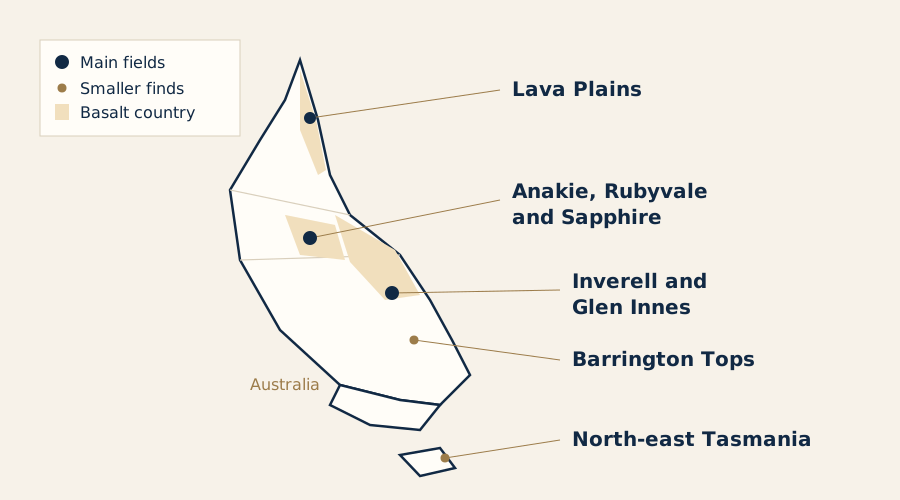
Australian sapphire comes from a belt of old volcanic country along the east coast. The main sources are:
- New England, NSW: the Inverell and Glen Innes district, historically the largest commercial source, known for dark blue, teal and parti stones.
- Central Queensland gemfields: Anakie, Rubyvale, Sapphire and nearby fields west of Emerald, known for blue, green, yellow and parti stones, and still worked by small miners and fossickers.
- The Lava Plains, far north Queensland: a smaller basalt field producing blue and green stones.
- Smaller finds: Barrington Tops in NSW and north-east Tasmania have produced sapphire too, though in much smaller quantities.
Australia was one of the world's major sapphire producers in the second half of the twentieth century. Much of that rough was sent to Thailand for cutting and heat treatment and sold without its Australian origin attached. Today production is far smaller, which is part of the appeal: a well-cut Australian stone is not common. Our guide to the Inverell, Anakie and Lava Plains fields goes through each region's geology and history.
Related guideAustralian Sapphire Fields: Inverell, Anakie and the Lava PlainsWhat colours do Australian sapphires come in?
Blue is still the classic, but the Australian fields are most admired for the colours in between. The table shows what you are likely to see:
| Colour | What it looks like | Notes for a ring |
|---|---|---|
| Blue | Medium-dark to very dark, often with a slight green undertone | Aim for medium-dark; very dark stones can look black indoors |
| Teal | Blend of blue and green, often shifting with the light | One of the most requested Australian colours |
| Green | Olive to forest green, sometimes with blue flashes | Usually less per carat than fine blue |
| Yellow | Lemon to golden, especially from central Queensland | Bright and cheerful; reads well in yellow gold |
| Parti | Two or more colours in zones, such as blue, green and yellow | Every stone is different; the cut decides how the zones show |
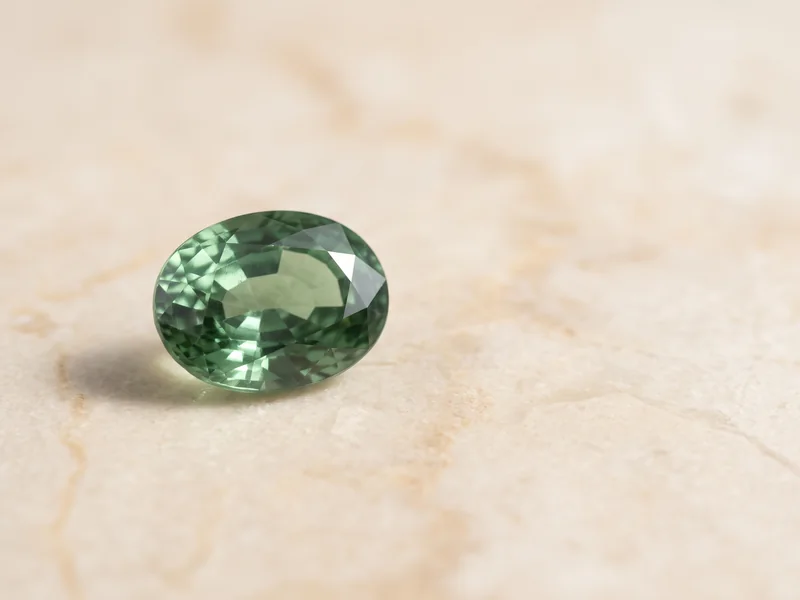
Teal stones are the ones most people ask about. Our guide to teal sapphire rings explains how the blue-green balance is judged, and comparing teal with classic blue helps if you are torn between them. Australian parti sapphires (from "particoloured") are a speciality of the New England and Queensland fields; see parti sapphire engagement rings for how the colour zones are cut and set. Pure greens are covered in our green sapphire page.
Some colours are rarely found in Australian fields. If you love purple sapphire, a warm orange sapphire, the pink-orange padparadscha or a colour-change stone that shifts between daylight and lamplight, those usually come from Sri Lanka, Madagascar or East Africa instead.
Are sapphires hard enough for an engagement ring?
Yes. Two properties matter for a ring you wear every day. Hardness is resistance to scratching, measured on the Mohs scale from 1 to 10. Toughness is resistance to chipping and breaking when knocked. Sapphire scores well on both: 9 on the Mohs scale and excellent toughness, because it has no cleavage (a natural plane of weakness along which a crystal can split).
| Gem | Mohs hardness | Toughness | Everyday engagement ring? |
|---|---|---|---|
| Diamond | 10 | Good (can cleave) | Yes |
| Sapphire | 9 | Excellent | Yes |
| Spinel | 8 | Good | Yes, with care |
| Aquamarine | 7.5–8 | Good | Yes, with care |
| Emerald | 7.5–8 | Poor to fair | Protective setting needed |
| Tanzanite | 6–6.5 | Fair | Occasional wear or protective setting |
| Opal | 5.5–6.5 | Poor to fair | Protective setting, gentle wear |
Household dust contains quartz, which sits at 7 on the Mohs scale. Anything softer than 7 will slowly lose its polish; sapphire will not. It can still chip if struck hard on a sharp edge, and some stones show parting (a weakness along twinning planes), so a good setting still matters. For a side-by-side look at durability and price, read how sapphire compares with diamond, or emerald versus sapphire if you like green.
Not sure which one is right?
Send us the stones you are looking at and our gemologist will tell you which to choose and why.
How can you tell if a sapphire is Australian?
You cannot tell by eye alone. Origin is an opinion from a gemmological laboratory, based on inclusions, colour zoning and trace-element chemistry. Still, basalt-related Australian stones have a recognisable profile that a trained gemmologist looks for:
- Refractive index: 1.762–1.770 on the refractometer, confirming corundum.
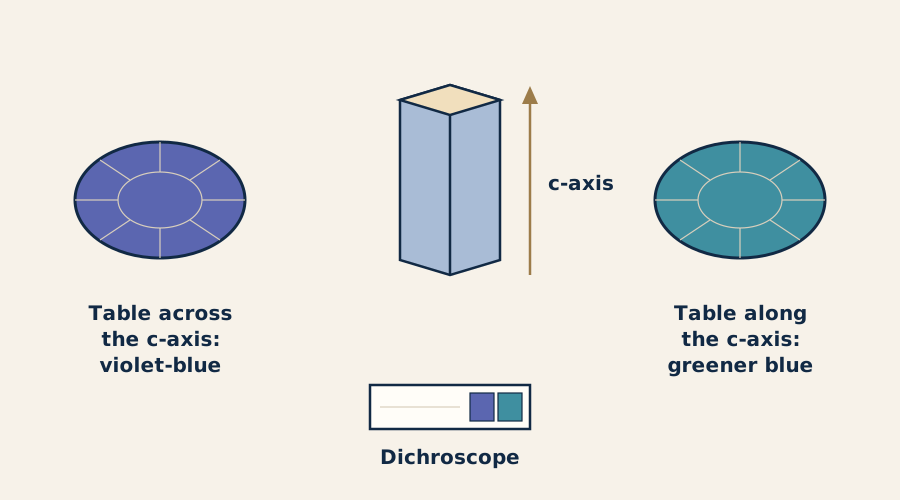
- Pleochroism: strong. Viewed through a dichroscope, an Australian blue shows a violet-blue and a greenish-blue colour in different directions.
- Spectroscope: a strong iron absorption band around 450 nm, often with lines near 460 and 470 nm.
- UV fluorescence: usually inert, because iron suppresses the glow.
- Inclusions: sharp, straight hexagonal colour zoning, fingerprints and small mineral crystals typical of basaltic corundum.
| Australian | Sri Lankan (Ceylon) | Lab-created sapphire | |
|---|---|---|---|
| How it formed | Basalt-related, mined from alluvial gravels | Metamorphic, mined from gem gravels | Grown in a laboratory (flame fusion or flux) |
| Typical blue | Deep, often with a green undertone | Lighter, bright cornflower blue | Any shade the maker chooses |
| Other colours | Teal, green, yellow, parti | Pink, yellow, purple, padparadscha | Most colours |
| Iron content | High | Low | Varies by method |
| Clues to a gemmologist | Straight hexagonal zoning, iron spectrum | Fine silk, low iron | Curved growth lines or flux inclusions |
| Relative price | Moderate | Higher for fine blue | Much lower |
Sri Lanka is the main contrast for blue sapphire; our explainer on what Ceylon origin means shows the difference. If any of these terms are new, the jewellery and gem glossary defines them in plain English. For an important stone, an independent origin report adds confidence, but it remains an expert opinion, not proof of exactly where a stone was dug.
Are Australian sapphires heat-treated?
Many are. Heat treatment means heating the sapphire to a high temperature to improve colour and clarity. It is a long-established, stable treatment that does not fade. With Australian blue it is often used to lighten an overly dark stone, or to reduce the green so the blue reads more clearly.
Unheated Australian stones exist, particularly among parti, teal and green sapphires, where the natural colour is the point. They usually cost more than comparable heated stones. Other treatments to ask about include beryllium diffusion (which adds colour from outside the crystal and is mostly seen in orange and yellow corundum) and fracture filling. These change value considerably and should always be disclosed.
The practical rule: ask whether the stone is heated, unheated or otherwise treated, and get the answer in writing. A laboratory report can confirm it for higher-value stones.
Which settings suit Australian sapphire engagement rings?
Because Australian blue sapphires tend to be deep, the setting has a real job: letting light in and showing the colour off. Some points to weigh:
- Open claw settings: four or six claws let light into the pavilion, which brightens a darker stone.
- Bezel settings: a rim of metal around the edge is very secure and suits active hands, but lets in less side light, so pair it with a medium-toned stone.
- Diamond halo: a ring of small diamonds adds sparkle around a dark blue and makes the colour look richer by contrast.
- Three-stone: an Australian sapphire between two diamonds, or two smaller parti stones either side of a diamond.
- Metal: white gold or platinum keeps blue looking cool; yellow or rose gold warms teal, green, yellow and parti stones.
Shape matters too. Ovals and cushions are the most common Australian cuts, because they keep weight from rough that is often flat and tabular. Emerald cuts show off parti zoning in neat bands. Rounds give the most brilliance but lose more rough in cutting, so they cost more per carat.
How much do Australian sapphire engagement rings cost?
Price depends on colour, size, clarity, cut and treatment. Fine, bright blue and attractive unheated parti or teal stones sit at the top. Very dark or heavily zoned stones sit at the bottom. These are approximate ranges for loose stones only; the ring adds the cost of metal, any diamonds and the work.
| Stone (about 1 carat, eye-clean) | Approximate price, loose (AUD) |
|---|---|
| Australian blue, heated, good colour | about $600–$2,500 |
| Australian blue, unheated, fine colour | about $2,500–$6,000+ |
| Australian teal or green | about $800–$3,000 |
| Australian parti | about $800–$3,500 |
| Lab-created sapphire | about $50–$300 |
A finished Australian sapphire engagement ring in 18 carat gold typically ends up roughly in the AUD 3,000–10,000 range, depending on the stone, metal weight and how many diamonds are added. Lab-created sapphire has the same hardness and chemistry as natural sapphire at a fraction of the price, but it is not Australian and must always be sold as lab-created. Natural Australian sapphire is valued for rarity and origin, not as an investment.
If you prefer a colourless look, white sapphire is another natural option, though it shows less sparkle than diamond.
Browse natural gemstones in our stock
How to choose an Australian sapphire engagement ring: step by step
- Pick your colour family. Decide between blue, teal, green, yellow or parti, then look at several stones of that colour side by side.
- Check the tone. Choose medium to medium-dark. Look in both daylight and indoor light; reject stones that go inky indoors.
- Ask about origin and treatment. Get the origin, and whether it is heated, unheated or otherwise treated, in writing. For higher-value stones, ask for a laboratory report.
- Judge clarity by eye. Coloured stones are graded by eye, not under 10× magnification. Aim for no inclusions that are obvious face-up or near the edges.
- Watch it move. In a video or in hand, look for even colour across the face, lively flashes and no washed-out see-through centre (a window) or dead, dark patches (extinction).
- Plan the setting. Match metal to colour and choose claws, bezel or halo for your lifestyle. Have the claws checked every year or two.
Free consultation
Talk to a gemologist
Compare stones in person or online with Raj Sood, Graduate Gemologist (GIA), AJP (GIA).
Book a consultationShop this shape
FAQ
Common questions
Are Australian sapphires good quality?
They range from commercial to very fine, like sapphire from anywhere. Well-cut Australian stones with a medium-dark blue, teal or clean parti colour are highly regarded; the weaker ones are simply too dark.
Why are Australian sapphires so dark?
They formed in basalt-related geology and contain a lot of iron, which deepens the blue and adds green. Heat treatment and careful cutting can lighten them.
What is an Australian parti sapphire?
A parti sapphire shows two or more colours in distinct zones, usually blue, green and yellow. The New England fields in NSW and the central Queensland gemfields are well known for them.
Can I wear an Australian sapphire engagement ring every day?
Yes. Sapphire is 9 on the Mohs scale with excellent toughness, so it handles daily wear well. Take it off for heavy work and have the claws checked regularly.
Is a lab-created sapphire the same as an Australian sapphire?
Lab-created sapphire has the same chemistry and hardness, but it is grown in a laboratory, not mined in Australia. It costs much less and must always be sold as lab-created or synthetic.
Can I still fossick for sapphires in Australia?
Yes. The central Queensland gemfields and parts of New England have fossicking areas. You need a fossicking licence in Queensland and should check local NSW rules first.

Ask a gemologist
Not sure which diamond to choose?
Raj Sood is a Graduate Gemologist (GIA) and master jeweller. Bring the stones you are considering, or send the reports, and he will tell you honestly which one is better and why.
Keep learning
Related guides
 GemstonesAustralian Sapphire Fields: Inverell, Anakie and the Lava Plains
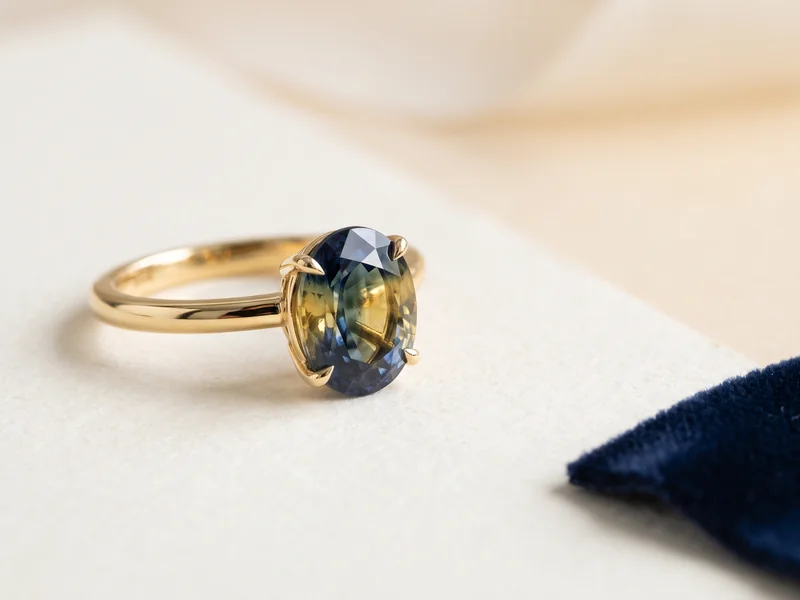 GemstonesParti Sapphire Engagement Rings
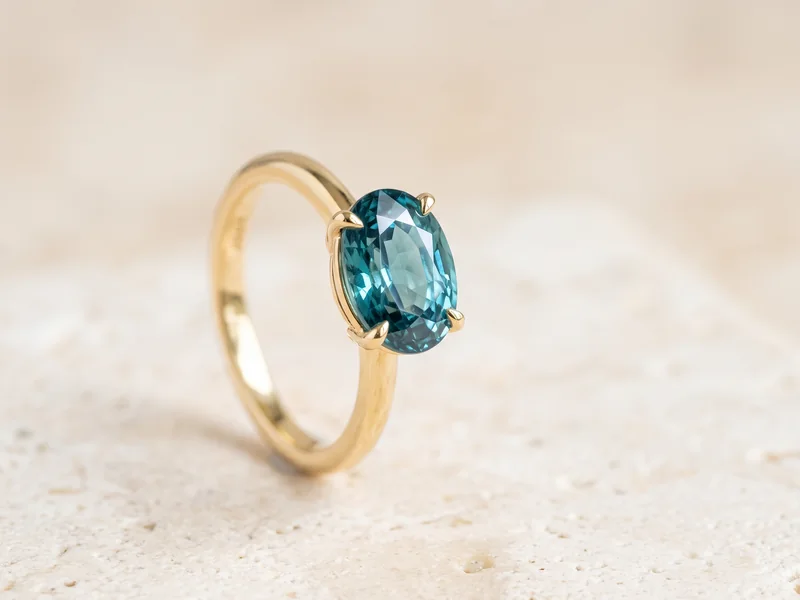 GemstonesTeal Sapphire Engagement Rings
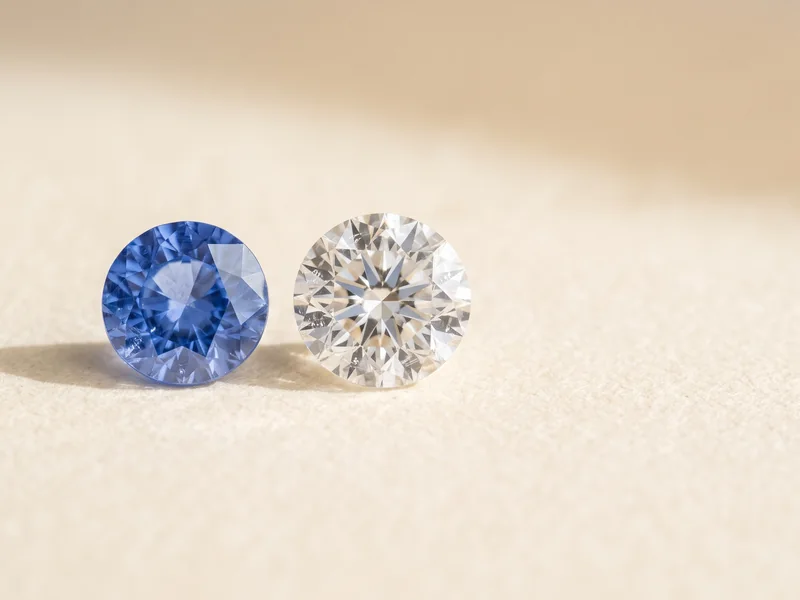 GemstonesDiamond vs Sapphire Engagement RingsGemstonesGemstones | Coloured Gemstones, Birthstones and Custom Jewellery
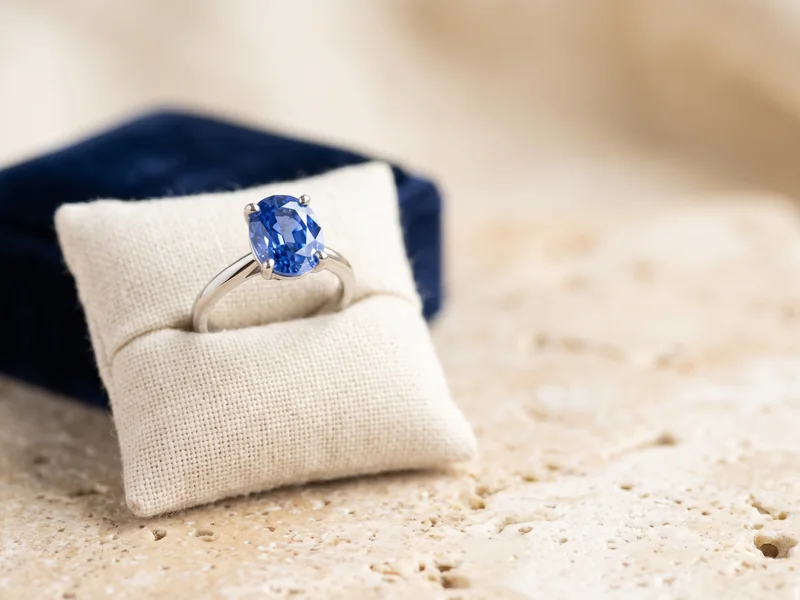 GemstonesSapphire Engagement Rings in MelbourneGemstonesSapphire Gemstones
 GemstonesGreen Sapphire
Explore more
More guides on this topic
Education