
- Education
- Diamond 4Cs & Grading
- Carat Diamond Guide: What Diamond Carats Are and How Big They Look
Diamond 4Cs & grading
Carat Diamond Guide: What Diamond Carats Are and How Big They Look
Carat is the most talked-about of the 4Cs and the most misunderstood part of choosing a carat diamond. It measures weight, not size, and knowing the difference changes how you compare stones and spend your budget.
 Reviewed by Raj Sood, Graduate Gemologist (GIA), AJP (GIA)Master jeweller and Graduate Gemologist (GIA) · reviewed 4 November 2026
Quick answer
Carat is a unit of weight, not size: one carat equals 0.2 grams, split into 100 points. Heavier diamonds are usually larger, and a well-cut 1 carat diamond (round) measures about 6.4–6.5 mm across. Price per carat rises with weight and jumps at popular sizes such as 0.50, 1.00 and 2.00 carats.
What does carat mean for a diamond?
A carat (written ct) is the unit gemstones are weighed in. One metric carat is exactly 0.2 grams, or 200 milligrams, so a 1 carat diamond weighs about as much as a fifth of a standard paperclip. Carat is one of the four Cs of diamond quality, alongside cut, colour and clarity, and it is the one most people think of first.
Each carat is split into 100 points. The trade often talks in points for smaller stones: a 50-pointer is half a carat, a 75-pointer is three-quarters. On a grading report the weight is shown to two decimal places, such as 1.02 ct, because even a few points can change the price. If any of these terms are new, our jewellery terms glossary defines them in plain English.
| Carat weight | Points | Grams |
|---|---|---|
| 0.25 ct | 25 points | 0.05 g |
| 0.50 ct | 50 points | 0.10 g |
| 0.75 ct | 75 points | 0.15 g |
| 1.00 ct | 100 points | 0.20 g |
| 2.00 ct | 200 points | 0.40 g |
Don't confuse diamond carat with the carat used for gold purity, as in 9ct or 18ct gold. The two words share a history (both trace back to the carob seed once used to balance scales), but gold purity is a proportion of gold in the alloy, while diamond carat is a plain weight.
Is carat weight the same as diamond size?
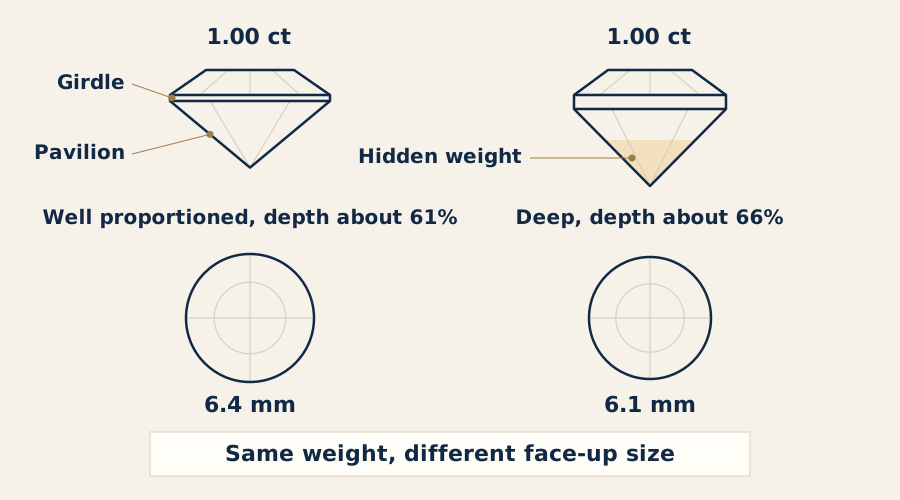
No. Carat tells you how much a diamond weighs, not how big it looks. Two diamonds of the same weight can face up at noticeably different sizes, because some of the weight can sit hidden in a deep pavilion (the cone-shaped underside) or a thick girdle (the narrow rim around the widest part).
What you see from above is the face-up size, also called the spread, measured in millimetres. That is why the measurements on the report matter as much as the carat figure. A round brilliant with a total depth around 59–62.5% usually shows its weight well; one at 65% or more carries extra weight underneath and can look the size of a stone several points lighter.
Shape matters too. Elongated shapes such as the oval, pear and marquise usually look larger per carat than a round, because more of their weight is spread across the top. Cushions and princess cuts often look slightly smaller than a round of the same weight, as they carry more depth. Our millimetre-to-carat chart for every shape lists typical sizes side by side.
Diamond carat size chart: how big is each weight?
For a well-cut round brilliant, these are the typical diameters. Real stones vary by a few tenths of a millimetre either way depending on their proportions, so always check the measurements on the report.
| Carat weight | Typical round diameter | Detailed guide |
|---|---|---|
| 0.50 ct | about 5.0–5.2 mm | Half-carat diamond guide |
| 0.75 ct | about 5.7–5.9 mm | Three-quarter carat guide |
| 1.00 ct | about 6.4–6.5 mm | 1 carat diamond guide |
| 1.25 ct | about 6.8–7.0 mm | 1.25 carat diamonds explained |
| 1.50 ct | about 7.3–7.4 mm | One-and-a-half carat guide |
| 2.00 ct | about 8.0–8.2 mm | 2 carat diamond guide |
| 3.00 ct | about 9.2–9.4 mm | What to know about 3 carat stones |
| 5.00 ct | about 10.9–11.1 mm | 5 carat diamond buying notes |
Notice that doubling the weight does not double the width. A 2 carat round is only about a quarter wider than a 1 carat, not twice as wide, because the extra weight spreads in three dimensions: width, length and depth. Going from 1 to 1.5 carats adds less than a millimetre across, which is why many people are surprised how similar those two sizes look on the hand.
What are carats of diamonds people usually compare?
Most people shopping for an engagement ring or pendant end up weighing up neighbouring sizes. Each band has its own character, and the jump in price is rarely the same as the jump in what you see.
| Weight band | What it looks like | Common use |
|---|---|---|
| 0.30–0.70 ct | Delicate; clearly a diamond but understated | Pendants, studs, petite solitaires |
| 0.90–1.50 ct | The classic engagement ring centre | Solitaires, halos, three-stone centres |
| 2.00–3.00 ct | Noticeably large on most fingers | Statement solitaires |
| 4.00–5.00 ct | Very large; cut quality is on full display | Statement rings, often lab-grown |
| 6.00 ct and up | Rare in natural; shows every flaw in proportion | Collector pieces, special commissions |
Between the main sizes there are useful in-between weights. Our guide to 2.5 carat diamonds covers the step between two and three carats, the 4 carat diamond guide looks at very large solitaires, and 6 to 10 carat diamonds explains what changes at the top end, where colour and clarity become far easier to see.
Not sure which one is right?
Send us the stones you are looking at and our gemologist will tell you which to choose and why.
How does carat affect diamond price?
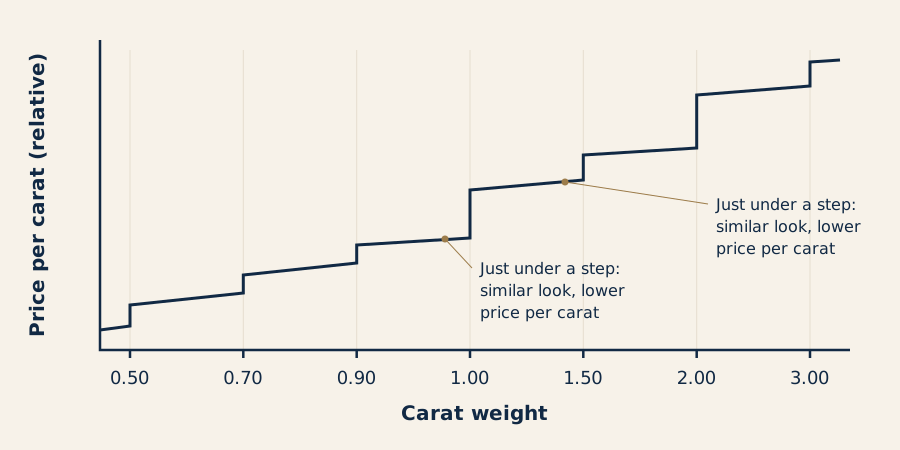
Carat has the biggest single effect on price, and the relationship is not a straight line. Larger rough diamonds are much rarer than small ones, so the price per carat goes up as the weight goes up. A 2 carat natural diamond usually costs well over twice as much as a 1 carat of the same colour, clarity and cut.
Prices also step up at popular weights, often called magic sizes: 0.50, 0.70, 0.90, 1.00, 1.50, 2.00 and 3.00 carats. Demand clusters at these round numbers, so a 1.00 ct stone typically costs noticeably more per carat than a 0.95 ct, even though the size difference is only a fraction of a millimetre and impossible to see once set.
Within any weight, the other Cs still move the price a long way. Two 1 carat diamonds can be thousands of dollars apart because of colour, clarity, cut grade and fluorescence. Lab-grown diamonds follow a similar pattern of rising price with weight, but the steps are gentler and the overall figures are much lower.
What do ct, ctw and tcw mean?
ct describes a single stone. ctw (carat total weight) and tcw (total carat weight) mean the same thing: the combined weight of every diamond in a piece. A halo ring labelled 1.20 ctw might have a 0.90 ct centre and 0.30 ct of small diamonds around it.
Many small diamonds can weigh the same as one larger diamond but cost far less, because small stones are much more plentiful. So a 1 ctw cluster or three-stone ring is a very different purchase from a 1 ct solitaire, even though the label reads the same. Our guide to reading ct, ctw and tcw labels goes through real examples.
Is a lab-grown carat diamond the same size as a natural one?
Yes. A carat is a carat, and a laboratory-grown diamond and a natural diamond of the same weight and proportions are the same size, because they are the same material with the same density (about 3.52 g/cm³). What differs is the price: lab-grown diamonds cost much less than natural diamonds of the same weight and grades, so many people choose a larger lab-grown stone for the same budget.
Natural diamonds are formed in the earth over very long periods and are rarer, especially above 2 carats. Lab-grown diamonds are grown in a laboratory by CVD or HPHT methods and are physically, chemically and optically diamond. Both should come with an independent grading report that states the exact weight. Our look at lab-grown diamond carat sizes from 1 to 5 carats shows how size choices change when the budget stretches further.
Browse natural and lab-grown diamonds by carat weight
How big will the diamond look on the hand?
The same diamond looks larger on a slim finger and smaller on a wide one, so there is no single right carat weight. A 1 carat round covers roughly a third of the width of an average adult finger, while a 2 carat covers closer to half. The setting also changes the impression:
- Halo: a ring of small diamonds around the centre can add a millimetre or two of visual width.
- Fine band: a band around 1.8–2.2 mm wide makes the centre stone look larger by contrast.
- Elongated shape: an oval or pear covers more finger than a round of the same weight.
- Good cut: a well-proportioned diamond shows its full spread and returns more light, which reads as size.
If you can, try a few sizes on in person. Photos and size charts are useful, but the difference between 0.90 and 1.10 carats on your own hand is often smaller than people expect.
How should you balance carat against cut, colour and clarity?
Carat sets the size, but cut decides how much the diamond sparkles, and a poorly cut large stone can look duller and even smaller than a well-cut lighter one. Most gemmologists suggest securing a good cut first, then choosing colour and clarity that look clean to the eye, and letting carat be whatever the budget allows after that.
Larger stones show more. At 2 carats and above, inclusions are bigger and easier to spot, and a faint body colour is more noticeable, so the grades that worked at 1 carat may not hold up. Our comparison of whether VS1 and VS2 look different helps here, and hidden brown, grey and blue tints explains why two stones with the same colour grade can look different at larger sizes. Check the report for chips too; cavities and chips matter more on bigger stones with more exposed edge.
Related guideWhen Can an SI1 Diamond Be a Smart Choice?How to choose the right diamond carat weight: step by step
- Set a budget first. Carat is the biggest price lever, so decide what you are comfortable spending before you fall in love with a size.
- Choose the shape. Shape changes how big a given weight looks, so pick it before comparing carat weights.
- Compare millimetres, not just carats. Check the measurements on the report and compare face-up size between stones.
- Look just under the magic sizes. A 0.90–0.99 ct or 1.40–1.49 ct stone can look almost identical to the round number for a lower price per carat.
- Check the cut and the eye. Make sure the stone is well cut and eye-clean before adding weight.
- Confirm the centre weight. On halos and clusters, separate the centre stone's ct from the total ctw.
Free consultation
Talk to a gemologist
Compare stones in person or online with Raj Sood, Graduate Gemologist (GIA), AJP (GIA).
Book a consultationShop this shape
FAQ
Common questions
What are carats of diamonds?
Carats are the unit diamonds are weighed in. One carat is 0.2 grams and is divided into 100 points, so a 0.50 ct diamond is a 50-pointer.
How big is a 1 carat diamond?
A well-cut 1 carat round diamond measures about 6.4–6.5 mm across. Other shapes differ: a 1 carat oval is typically around 7.5–8 mm long.
Does a higher carat mean a better diamond?
Not on its own. Carat only measures weight. A smaller diamond with an excellent cut can look brighter, and sometimes as large, as a heavier but poorly cut stone.
Why is a 1 carat diamond so much more expensive than a 0.90 carat?
Demand clusters at round numbers, so prices step up at 1.00 ct. The size difference is only a fraction of a millimetre, which is why stones just under the step are popular.
Are lab-grown diamonds the same size per carat as natural?
Yes. They are the same material, so the same weight and proportions give the same size. Lab-grown diamonds simply cost much less per carat.
What is the difference between ct and ctw?
Ct is the weight of a single diamond; ctw is the total weight of all the diamonds in a piece. A 1 ctw ring may have a much smaller centre stone.

Ask a gemologist
Not sure which diamond to choose?
Raj Sood is a Graduate Gemologist (GIA) and master jeweller. Bring the stones you are considering, or send the reports, and he will tell you honestly which one is better and why.
Keep learning
Related guides
 Diamond 4Cs & Grading1 Carat Diamonds
 Diamond 4Cs & GradingDiamond MM to Carat Size Chart (All Shapes)Diamond 4Cs & GradingCT vs CTW vs TCW: Carat Weight Terms
 Diamond 4Cs & Grading2 Carat DiamondsDiamond 4Cs & GradingDiamond 4Cs
 Diamond 4Cs & Grading5 Carat DiamondsDiamond 4Cs & Grading4 Carat DiamondsDiamond 4Cs & Grading3 Carat Diamonds
Explore more
More guides on this topic
Education