
- Education
- Certificates & Valuations
- How Often to Revalue Jewellery: A Gemmologist's Guide for Australian Insurance
Certificates & Valuations
How Often to Revalue Jewellery: A Gemmologist's Guide for Australian Insurance
A valuation is only as useful as the date on it. Knowing how often to revalue jewellery keeps your insurance cover close to what each piece would actually cost to replace today.
 Reviewed by Raj Sood, Graduate Gemologist (GIA), AJP (GIA)Master jeweller and Graduate Gemologist (GIA) · reviewed 4 November 2026
Quick answer
Most Australian insurers and valuers suggest revaluing jewellery every two to three years, and sooner if gold prices move sharply, you remodel or repair a piece, it is damaged, or your insurer asks. An out-of-date valuation can leave you underinsured or paying premiums on a figure you could never claim. Lab-grown pieces may need checking more often.
How often to revalue jewellery for insurance?
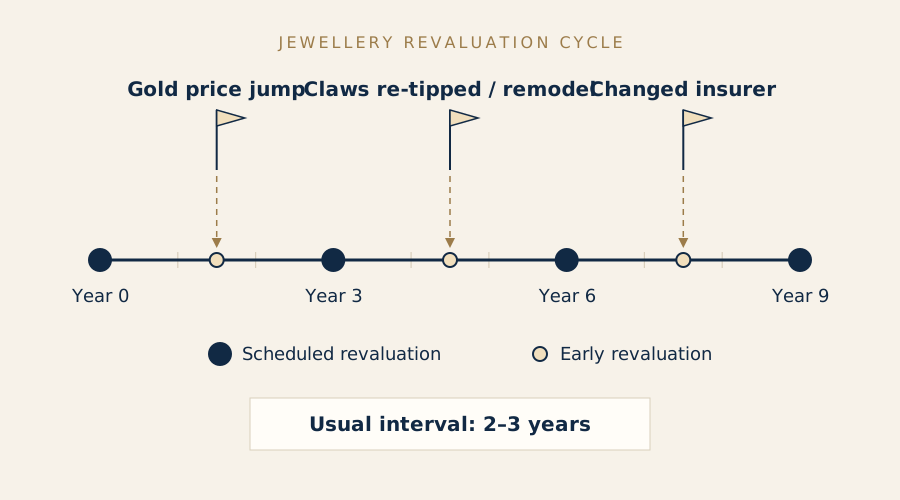
For most pieces, the answer is every two to three years. That is the interval most Australian insurers and valuers suggest for jewellery on a home contents or standalone jewellery policy. Some insurers also ask for a valuation no older than that before they will accept it for a specified item, meaning a piece listed individually on your policy with its own sum insured (the maximum the insurer will pay for it).
A revaluation is a fresh look at a piece that has already been valued. The valuer checks the item against the earlier document, confirms nothing has changed, and updates the figure to what it would cost to replace today. It is usually quicker than a first valuation because the stones, metal and measurements are already on record.
Two to three years is a starting point, not a law. Heavy gold, high-value pieces and anything whose market has moved sharply may need checking every year or two, while a modest silver bracelet may never need it. If you are new to valuations, start with how an insurance valuation is written and what each line means, and read why a valuation and a diamond certificate are different documents. Words such as fineness and sum insured are also in our plain-English jewellery glossary.
Why do jewellery values change over time?
An insurance valuation states replacement value: what it would cost, at retail in Australia, to replace the piece with one of like kind and quality, usually including 10% GST. That figure is tied to several markets that move independently of each other, so a valuation written a few years ago can be too high, too low, or both at once across a collection.
| Factor | What has been happening | Effect on replacement value |
|---|---|---|
| Gold price (in AUD) | Has risen strongly; the AUD gold price more than doubled between about 2019 and 2025 | Gold-heavy pieces valued years ago are often underinsured |
| Platinum and silver | Move up and down, less steadily than gold | Usually a smaller effect unless the piece is heavy |
| Natural diamond prices | Softened at wholesale since about 2022; fine and rare stones tend to hold better | Can drift down or stay flat |
| Lab-grown diamond prices | Fallen steeply over the past several years | Older valuations are often too high |
| Exchange rate | Diamonds and precious metals are priced in US dollars | A weaker Australian dollar pushes replacement costs up |
| Labour and making costs | Rise with wages and workshop costs | Detailed or hand-made pieces cost more to remake |
Because these forces pull in different directions, a ring with a natural diamond in a heavy 18 carat gold band (75% pure gold, stamped 750) could rise in replacement value while a lab-grown diamond tennis bracelet bought the same year falls. A 9 carat piece is only 37.5% gold (stamped 375), so the metal price affects it less. This is why the valuer weighs every piece in grams and records its fineness.
Remember that replacement value is not what you would get if you sold the piece; see why replacement value sits well above resale value. How a piece was made matters as well. Cast and hand-fabricated pieces need very different amounts of bench work to remake, and the valuer has to price that labour at today's rates, not the rates of the year you bought it.
When should you update a jewellery valuation early?
Some events make a valuation out of date overnight, whatever its age. Get a piece revalued sooner if any of these apply:
- Big metal price moves: if gold or platinum has risen or fallen by a large amount since your last valuation, gold chains, bangles and wide bands are affected first.
- Remodelling or re-setting: a new setting, a resized band, added stones or a changed metal means the old description no longer matches the piece.
- Repairs: re-tipped claws, a new shank (the band of a ring) or a replaced stone all change the item.
- Damage: a chipped diamond may now grade lower in clarity, and a cracked emerald may need replacing.
- Changing insurer or policy: a new insurer may ask for a valuation dated within the last two or three years.
- Inheritance or separation: values for estates and property settlements are prepared on a different basis to insurance.
- Before a long trip: it is worth knowing your cover is right before jewellery leaves home.
- Lab-grown pieces bought a few years ago: falling prices may mean you are paying premiums on a figure the insurer would not pay out.
If you are planning to change a piece, our guide to what can be safely reused in a remodel explains which stones and metal usually carry over; get the finished piece revalued once the work is done. For trips, see reducing risk when you travel with fine jewellery. And because an insurance figure is not the right number for a will or a settlement, read about valuations prepared for estates and family law before using one for those purposes.
How often to revalue jewellery by type of piece?
The right interval depends on how much of the value comes from metal, from stones and from workmanship, and on how fast each of those markets is moving. As a guide:
| Piece | Suggested interval | Why |
|---|---|---|
| Gold chains, bangles, heavy gold rings | Every 1–2 years when gold is moving | Metal is a large share of the value |
| Natural diamond engagement ring or studs | Every 2–3 years | Diamond prices move slowly; claws can be checked at the same visit |
| Lab-grown diamond jewellery | Every 1–2 years | Retail prices have fallen; the insured figure may be too high |
| Coloured gemstones (sapphire, ruby, emerald) | Every 2–3 years | Fine untreated stones can rise; treatment status affects value |
| Pearl strands | Every 2–3 years | Check knots and silk condition at the same time |
| Antique and estate jewellery | Every 2–3 years, and after any repair | Hand-made work is costly to replicate |
| Silver and fashion jewellery | Rarely, or not at all | Often falls under the insurer's unspecified-item limit |
Many home contents policies cover unspecified jewellery only up to a set amount per item, commonly somewhere around $1,000 to $2,500, and a total limit for all jewellery. Anything worth more usually needs to be specified with a current valuation. Check your own policy wording, because limits vary widely between insurers.
For coloured gemstones, the valuation should record whether the stone is natural, treated (for example, heated sapphire or oiled emerald) or lab-created. A lab-created sapphire has the same hardness, 9 on the Mohs scale, as a natural one, but its replacement value is a small fraction of a fine natural stone's, so the wording matters as much as the number.
Not sure which one is right?
Send us the stones you are looking at and our gemologist will tell you which to choose and why.
What happens if your jewellery valuation is out of date?
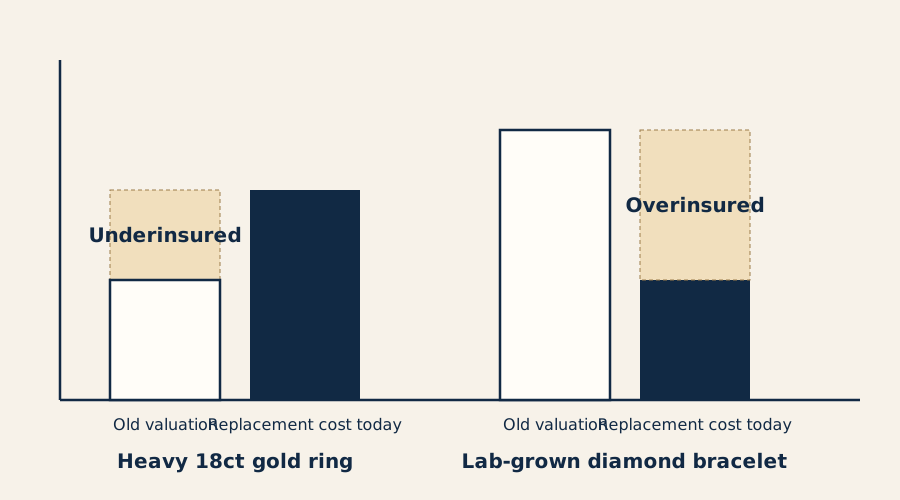
An old valuation causes problems in one of two directions. If it is too low, you are underinsured: the insurer generally will not pay more than the sum insured, so you may not be able to replace the piece. If it is too high, you are overinsured: you pay premiums on a figure you are unlikely to receive, because many policies settle by replacing the item or paying what replacement would actually cost them.
| Underinsured (value too low) | Overinsured (value too high) | |
|---|---|---|
| Common cause | Gold price rises; old valuation on heavy gold or natural stones | Lab-grown diamond prices falling; older retail-inflated figures |
| At claim time | Payout capped at the sum insured, below today's cost | Insurer replaces or pays actual replacement cost, not the higher figure |
| Cost to you | You fund the gap or accept a lesser piece | Higher premiums for cover you cannot use |
| Fix | Revalue and raise the sum insured | Revalue and lower the sum insured |
Policy types matter here. Some policies are agreed value, where you and the insurer agree the amount when the item is listed, and others are replacement policies, where the insurer can choose to replace the item through its own suppliers. Read the product disclosure statement or ask your insurer which applies, because it changes how much a precise, current figure matters.
Related guideReplacement Value vs Resale Value in JewelleryDo diamond certificates expire, and do they need redoing?
No. A diamond grading report, often called a certificate, does not expire. It records what a laboratory saw on the day it graded the stone: shape, measurements, carat weight, colour, clarity, cut (for rounds), polish, symmetry, fluorescence and whether the diamond is natural or laboratory-grown. Our guide to how diamond certificates and jewellery reports work goes through each line.
What a report does not do is state a price. It is evidence of identity and quality, which the valuer uses to work out replacement value. That is why a stone with a report is quicker and more reliable to value than one without; see certified versus uncertified diamonds for what changes when there is no report. A report only needs redoing if the stone itself changes, for example if it is chipped and recut, or if the original report is from a lab whose grading is not widely trusted.
Not all reports carry the same weight with valuers. GIA, IGI and HRD reports compared side by side shows how the major labs differ, and our overview of how the main grading labs differ in strictness covers the rest. If your ring came with a European report, reading an HRD report line by line helps. Older reports from some labs, such as certain EGL offices, were known for generous grades, so a valuer may grade the stone independently rather than rely on the paper; what to know about GSI and EGL reports explains why. Where a diamond also has an origin report tracing where it was mined, keep it with your valuation, as it can support replacement with a like stone.
What does a jewellery revaluation involve?
A good revaluation is not just a new number on old paper. The valuer should see the piece in person and work through the same checks as a first valuation, using the earlier document as a reference:
- Identify the piece: match the description, measurements and weight in grams to the previous valuation, so the document still describes the same item.
- Confirm the metal: check hallmarks such as 750 or 950 (95% platinum) and test where marks are missing or worn.
- Check the stones: measure them, match any laser inscription on the girdle (the thin outer edge) to its report, and confirm natural, lab-grown or lab-created status.
- Assess condition: look for chips, abrasions, thin claws and a worn shank, and note anything that needs repair.
- Photograph: clear, dated photos that identify the piece.
- Research current replacement cost: stones, metal at today's price, and the labour to make an equivalent piece.
- Issue a new dated document: with the updated replacement value, usually including GST.
The condition check is often as useful as the figure. A claw worn down by daily wear is one of the most common reasons a diamond is lost, and a revaluation every two to three years is a natural moment to catch it. If repairs are needed, the valuation should be updated once they are done so it describes the piece as it now is.
How much does a jewellery valuation cost in Australia?
Fees vary with the valuer and the piece, but as a broad guide a single item usually costs somewhere around AUD $80–$250, with additional items on the same visit often charged at a lower rate. Complex pieces, such as a multi-stone antique brooch, or stones that need full independent grading, cost more. A revaluation of a piece with good existing paperwork can sit at the lower end.
Reputable valuers generally charge a flat fee or an hourly rate rather than a percentage of the item's value, so the fee does not reward a higher figure. In Australia, look for a valuer with recognised gemmological qualifications, and ideally one registered with a professional valuers' body such as the National Council of Jewellery Valuers (NCJV). Our page on valuations and diamond certificates is linked above; the service page below explains how a GemTrove valuation is carried out.
To put the fee in context, compare it with your annual premium for that item. If a piece has moved a long way in value, one revaluation can correct years of paying for the wrong amount of cover.
Jewellery valuation service, natural and lab-grown diamonds
How do you look after jewellery between valuations?
Condition affects value, and a well-kept piece is easier to value and less likely to need a claim. A few habits help:
- Store pieces separately so diamonds (10 on the Mohs scale) do not scratch softer gems and gold; our guide to storing jewellery so pieces don't scratch each other covers boxes, pouches and safes.
- Clean rings regularly, because built-up grime dulls brilliance and hides loose claws; compare professional cleaning versus cleaning at home to see what is safe for each gem.
- Have claws and settings checked about once a year for rings worn daily, even in the years between revaluations.
- Keep all valuations, grading reports and receipts together, with copies stored away from home.
- Tell your insurer straight away about any change, repair or new piece rather than waiting for renewal.
How to organise a jewellery revaluation: step by step
- List your pieces. Note each item, the date of its last valuation and whether it is specified on your policy.
- Check your policy. Find the unspecified-item limit, whether cover is agreed value or replacement, and any rule on how recent a valuation must be.
- Prioritise. Revalue first anything heavy in gold, any lab-grown diamond pieces, and anything repaired, remodelled or damaged since its last valuation.
- Gather paperwork. Bring the previous valuation, grading reports and any receipts or remodelling invoices.
- Choose a qualified valuer. Look for gemmological qualifications, professional registration and a flat or hourly fee.
- Review the new document. Check the description, metal, stone details, photos and date are all correct.
- Update your insurer. Send the new valuation and adjust each sum insured, then diary the next revaluation in two to three years.
Free consultation
Talk to a gemologist
Compare stones in person or online with Raj Sood, Graduate Gemologist (GIA), AJP (GIA).
Book a consultationFAQ
Common questions
How often should jewellery be revalued for insurance in Australia?
Most insurers and valuers suggest every two to three years. Revalue sooner after a large gold price move, a repair or remodel, damage, or if your insurer asks for a more recent valuation.
Does a jewellery valuation expire?
A valuation does not have a legal expiry date, but its figure becomes less accurate as metal, diamond and labour costs change. Many insurers treat valuations older than two or three years as out of date for specified items.
Do diamond certificates expire?
No. A grading report describes the diamond as it was when graded and stays valid unless the stone is damaged or recut. It does not state a price, so you still need a current valuation for insurance.
Should I revalue lab-grown diamond jewellery?
Yes, and often sooner than natural pieces. Lab-grown diamond prices have fallen over recent years, so an older valuation may be higher than the cost of replacement, which means you could be paying premiums on cover you would not receive.
How much does it cost to revalue jewellery?
As a broad guide, around AUD $80–$250 per item, with extra pieces on the same visit often cheaper. Complex or antique pieces and stones needing full grading cost more.
Can I use an insurance valuation for a will or property settlement?
Usually not. Insurance valuations state replacement value, which is typically higher than the market value used for estates and family law, so a separate valuation prepared for that purpose is needed.
Ask a gemologist
Not sure which diamond to choose?
Raj Sood is a Graduate Gemologist (GIA) and master jeweller. Bring the stones you are considering, or send the reports, and he will tell you honestly which one is better and why.
Keep learning
Related guides
 Certificates & ValuationsInsurance Jewellery Valuation ExplainedCertificates & ValuationsReplacement Value vs Resale Value in Jewellery
 Certificates & ValuationsJewellery and Diamond ValuationCertificates & ValuationsJewellery Valuations for Estates and Family LawCertificates & ValuationsDiamond Certificates & Jewellery Reports
 Care, Repairs & RemodellingHow to Store Jewellery
 Buying Knowledge & Custom ProcessCast vs Hand-Fabricated JewelleryCertificates & ValuationsCertified vs Uncertified Diamonds
Explore more
More guides on this topic
Education