
Pearls
Akoya Pearls Guide: Origin, Size, Colour, Grading and Care
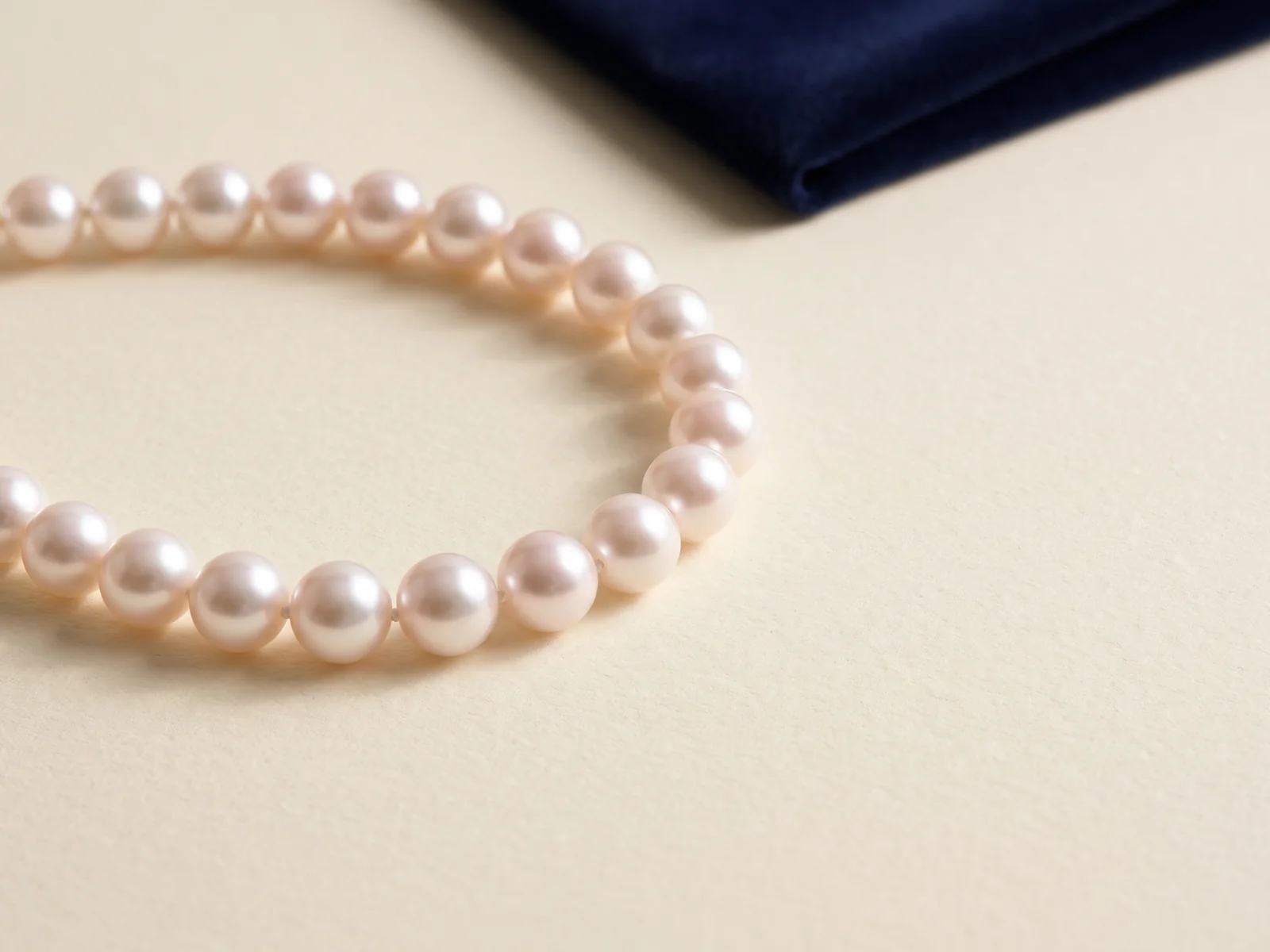
Akoya pearls are the classic round white pearls of a first strand or a pair of wedding studs. This guide explains where they come from, what separates a good strand from an average one, and how to keep them looking right for decades.
 Reviewed by Raj Sood, Graduate Gemologist (GIA), AJP (GIA)Master jeweller and Graduate Gemologist (GIA) · reviewed 4 November 2026
Quick answer
Akoya pearls are saltwater cultured pearls grown in the Pinctada fucata oyster, mainly in Japan and China. They are usually 6–8 mm, white or cream with rose, silver or cream overtones, and known for a sharp, mirror-like lustre. Judge them on lustre, nacre thickness, surface, shape, size and matching before you look at price.
What are akoya pearls?
Akoya pearls are saltwater cultured pearls grown in the small akoya pearl oyster, Pinctada fucata (often listed as Pinctada fucata martensii). "Cultured" means a person starts the pearl by placing a small bead and a piece of mantle tissue inside the oyster; the oyster then coats that bead in layers of nacre, the iridescent material that gives every pearl its glow. If you want the full background on how that differs from a pearl that forms with no human help, our guide to natural versus cultured pearls explains it.
Of all the cultured pearl types, akoya are the ones most people picture when they hear the word pearl: round, white, evenly sized and very bright. They sit in the middle of the pearl family on size and price, above most freshwater pearls and below Tahitian and South Sea pearls. Our overview of every pearl type and how to identify each one places akoya alongside the others, and our main pearl jewellery and custom pearl designs page shows how they are used in finished pieces.
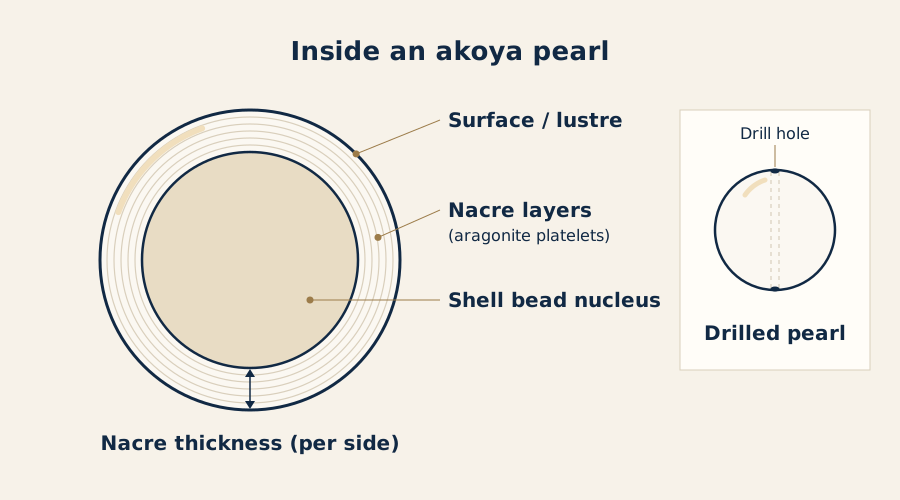
Pearls are organic gems, not minerals, so they behave differently from diamonds or sapphires. Nacre is made mostly of tiny platelets of aragonite (a form of calcium carbonate) held together by a protein called conchiolin. That structure gives pearls a hardness of only about 2.5–4.5 on the Mohs scale and a refractive index of roughly 1.52–1.66, and it is why acids, perfume and sweat can dull them. Any unfamiliar term here is also defined in our plain-English jewellery glossary.
Where do akoya pearls come from?
Akoya pearls were the first round cultured pearls produced commercially. Japanese researchers and entrepreneurs, most famously Kokichi Mikimoto, developed pearl culturing in the late 1800s and early 1900s, first producing half pearls and then fully round pearls. Within a few decades Japan had built a large akoya industry, and the name "akoya" is still closely tied to Japan.
Today the main producing areas are:
- Japan: Ehime Prefecture (around Uwajima), Mie Prefecture (Ise-Shima and Ago Bay), Nagasaki and Kumamoto. Japanese akoya are known for consistent round shapes and careful processing.
- China: mainly Guangxi and Guangdong in the south. Chinese akoya are often smaller and usually more affordable, though quality ranges widely.
- Vietnam and other areas: smaller volumes of akoya-type pearls are also produced.
Akoya pearls are bead-nucleated. A technician implants a polished round bead, traditionally cut from freshwater mussel shell, together with a small square of mantle tissue from a donor oyster. The oyster is returned to the sea for roughly 9–24 months while it lays nacre over the bead. Because the bead is round, a high share of akoya come out round, which is one reason they are so popular for classic strands. An akoya oyster usually produces one or two pearls per harvest.
Not every implant goes to plan. Sometimes the oyster rejects the bead but still forms a small pearl of solid nacre; these are akoya keshi, which our guide to keshi pearls and how they form covers. A different technique, where a half-round nucleus is fixed to the inside of the shell, produces the domed blister pearls described in our page on mabe pearls and blister pearl culturing.
What sizes and colours do akoya pearls come in?
The akoya oyster is small, roughly 7–8 cm across, so its pearls are small too. Most akoya pearls range from about 2 mm to 10 mm, and the sweet spot for necklaces and studs is 6–8 mm. Above 9 mm they become rare, and true 10 mm akoya command a strong premium. If you want a larger white pearl, that is where South Sea pearls take over; our guide to white and golden South Sea pearls covers sizes from about 9 mm up to 15 mm and beyond.
| Akoya pearl size | How it looks | Common uses |
|---|---|---|
| 2–5 mm | Delicate, almost seed-like | Accent pearls, children's jewellery, layered fine chains |
| 5.5–6.5 mm | Fine and understated | Everyday studs, first necklaces, petite wearers |
| 6.5–7.5 mm | The classic size | Most single strands and wedding studs |
| 7.5–8.5 mm | Fuller, noticeably present | Statement strands, evening studs |
| 8.5–9.5 mm | Large for akoya, harder to match | Premium strands and pendants |
| 9.5 mm+ | Rare for akoya | Special-order pieces; priced well above smaller sizes |
Pearl colour has three parts. Body colour is the main colour, usually white or cream for akoya. Overtone is a translucent colour that seems to float over the surface: rose (pinkish), silver or cream are the common akoya overtones. Orient is a subtle rainbow shimmer some fine pearls show just below the surface.
- White with rose overtone: the traditional favourite, flattering on fair and pink-toned skin.
- White with silver overtone: cooler and crisper, popular with white gold and platinum.
- Cream or ivory: warmer, suits olive and deeper skin tones and yellow gold.
- Natural blue-grey akoya: uncommon, untreated colour that sells as a niche choice.
- Dyed colours: some akoya are dyed black, gold or other colours; this should always be disclosed.
Most white akoya are bleached after harvest to even out the body colour, and many are lightly tinted pink to strengthen the rose overtone. These are standard, long-accepted treatments, but a jeweller should still tell you about them. Dark akoya dyed to look black are a common substitute for naturally dark pearls, which is a different thing entirely from the naturally coloured pearls in our Tahitian pearls guide.
How are akoya pearls graded?
There is no single worldwide grading standard for pearls the way there is for diamonds. Sellers use letter scales (A to AAA), and some Japanese pearls carry Hanadama certificates from a Japanese pearl laboratory for the top tier of akoya. Because the letter grades are set by each seller, two strands both called "AAA" can differ a lot. It is more useful to understand the underlying factors, which our pearl grading guide to lustre, nacre, surface, shape and size goes through in depth.
| Factor | What to look for in akoya | Why it matters |
|---|---|---|
| Lustre | Sharp, mirror-like reflections with clear edges | The single biggest driver of beauty in akoya |
| Nacre thickness | Thick enough that no bead shows through; often quoted as about 0.3 mm+ per side for good pearls | Thin nacre looks chalky and can wear through |
| Surface | Clean, with only small marks you have to look for | Pits, spots and wrinkles reduce value |
| Shape | Round or near-round for classic strands | Round is rarest and most expensive |
| Size | Measured in mm across; larger is rarer | Price climbs sharply above about 8 mm |
| Matching | Even size, colour, overtone and lustre along the strand | Poor matching is obvious when the strand is worn |
Lustre is the quality of light reflected from the surface and from within the nacre layers. Good akoya have the strongest lustre of the common pearl types for their size, because their thin, tightly packed nacre layers reflect light very sharply. Nacre thickness is linked: if pearls are harvested too early, the nacre is thin, the lustre is weak and, with wear, the bead underneath can start to show.
Hanadama (Japanese for "flower pearl") is a certification rather than a seller's grade. It is generally issued only to Japanese akoya strands that pass tests for nacre thickness, lustre, surface and matching, and it comes with a numbered certificate. Hanadama akoya pearls are a useful benchmark for the top of the market, though a well-chosen strand without the certificate can look very close.
Not sure which one is right?
Send us the stones you are looking at and our gemologist will tell you which to choose and why.
How do akoya pearls compare with freshwater, Tahitian and South Sea pearls?
| Akoya | Freshwater | Tahitian | South Sea | |
|---|---|---|---|---|
| Mollusc | Pinctada fucata (saltwater oyster) | Freshwater mussels | Pinctada margaritifera (black-lip oyster) | Pinctada maxima (silver- or gold-lip oyster) |
| Main sources | Japan, China | China | French Polynesia | Australia, Indonesia, Philippines |
| Typical size | 6–8 mm (2–10 mm) | 5–12 mm | 8–14 mm | 9–16 mm |
| Natural colours | White, cream; rose, silver overtones | White, pink, lavender, peach | Grey, black, green, aubergine | White, silver, cream, gold |
| Nucleus | Shell bead | Often no bead (solid nacre) | Shell bead | Shell bead |
| Lustre | Very sharp, mirror-like | Softer, satiny | Strong, metallic | Deep, satiny glow |
| Relative price | Mid-range | Lowest | High | Highest |
The question most people ask is akoya vs freshwater pearls. Modern freshwater pearls can look surprisingly close to akoya, especially the round, high-lustre ones, and they usually cost much less. The differences are in the details: akoya tend to be rounder in matched strands with a sharper lustre, while freshwater pearls are often solid nacre and can be more durable as a result. Our freshwater pearl guide compares them in more depth.
Australia is home to one of the world's most important pearl industries, but it is not akoya. The pearls farmed off Broome and the Kimberley coast grow in the much larger Pinctada maxima oyster and are typically around one and a half to two times the diameter of a standard akoya. If you want a pearl with Australian provenance, read our guide to Broome South Sea pearls from Western Australia.
Related guideBroome South Sea Pearls (Australian)How much do akoya pearls cost in Australia?
Akoya pearl prices depend mostly on size, lustre, nacre thickness, surface, shape and how well the pearls are matched. Size has the steepest effect: going from 7 mm to 8.5 mm can more than double the price of a strand of similar quality, because larger akoya are far rarer. Japanese origin and Hanadama certification also add a premium.
| Akoya pearl piece | Approximate price range (AUD) |
|---|---|
| Pair of 6.5–7 mm studs, good quality | about $200–$700 |
| Pair of 8–8.5 mm studs, high quality | about $600–$1,800 |
| 45 cm strand, 6.5–7 mm, good quality | about $1,000–$3,000 |
| 45 cm strand, 7.5–8 mm, high quality | about $2,500–$7,000 |
| 45 cm Hanadama strand, 8–8.5 mm | about $6,000–$15,000 |
These are broad ranges only and move with the harvest and exchange rates. Be cautious with very low prices for "akoya" strands: they may be thin-nacre pearls, poorly matched, or freshwater pearls described loosely. A clear description should state the pearl type, size range in mm, any treatments and the strand length.
Browse natural gemstones
Which akoya pearl jewellery suits you: necklace, earrings or bracelet?
An akoya pearl necklace is the classic piece, and length changes the look more than most people expect. Standard lengths, measured end to end including the clasp:
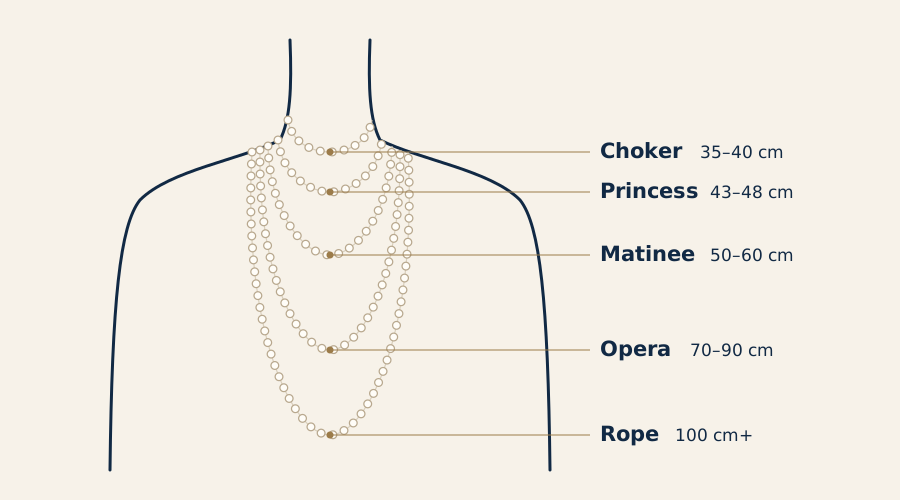
- Choker, about 35–40 cm: sits at the base of the neck; suits open necklines.
- Princess, about 43–48 cm: sits just below the collarbone; the most popular first strand.
- Matinee, about 50–60 cm: sits at the top of the bust; works over business wear.
- Opera, about 70–90 cm: can be worn long or doubled.
- Rope, 100 cm+: knotted, doubled or wrapped; needs many more pearls.
Akoya pearl earrings are usually studs of 6.5–8 mm. As a rough guide, a 7 mm pearl sits close to the visual size of a 1.25 carat round diamond stud, which our chart of diamond stud sizes by carat can help you picture. For movement, akoya work well as drops; the options are set out in our page on how drop earrings are set and hung.
Akoya bracelets are usually a single knotted row of 6–7 mm pearls, and some people pair one with a line of diamonds in the style of our tennis bracelet guide. Pearl is also a traditional June birthstone, which is why akoya feature so often in birthday and anniversary gifts; see our June birthstone guide to pearl, moonstone and alexandrite.
Pearls are drilled and glued onto a post or peg, or strung through a drill hole, so the metal work is about clasps, posts, cups and pendant fittings rather than claws:
How do you care for akoya pearls?
At 2.5–4.5 on the Mohs scale, akoya pearls are softer than almost every other gem you own, and their nacre reacts to acids and chemicals. Good habits keep the lustre for decades:
- Last on, first off: put pearls on after perfume, hairspray, sunscreen and make-up have dried, and take them off before exercise, swimming or cleaning.
- Wipe after wearing: a soft, slightly damp cloth removes skin oils and sweat, which slowly dull nacre.
- Never use ultrasonic or steam cleaners, bleach, vinegar or jewellery dips.
- Store flat and separate: in a soft pouch or lined box, away from diamonds and other hard gems that will scratch them.
- Don't hang a strand to store it: the silk stretches over time.
- Avoid long dry storage: pearls contain a little water; sealed plastic or a hot, dry safe for years can make nacre brittle. Wearing them is good for them.
Pearl strands are traditionally strung on silk thread with a knot between each pearl. The knot stops pearls rubbing against each other and means that if the thread breaks you lose one pearl, not the whole strand. Silk stretches and frays, especially if the strand is worn often or gets wet, so most strands need restringing every 1–3 years with regular wear. Signs it is due: small gaps appearing beside the knots, a grubby or frayed thread near the clasp, or a strand that drapes longer than it used to.
GemTrove restrings pearls in our own Melbourne workshop. Our guide to pearl care and when to restring covers cleaning, storage and what happens during a restring.
How do you choose akoya pearls? Step by step
- Confirm the pearl type. Make sure the description says akoya, cultured, saltwater, and lists any treatments such as bleaching, tinting or dyeing.
- Check the size range. Strands are quoted as a range, such as 7–7.5 mm; a tighter range means better matching.
- Judge the lustre first. Look for sharp, clear reflections of a light source in every pearl, not a soft glow.
- Ask about nacre. Thicker nacre lasts longer; if you see a dull, chalky look or a hint of the bead at the drill hole, walk away.
- Roll the strand on a flat surface. Round pearls roll smoothly; wobbles show off-round pearls.
- Look at matching in daylight. Colour and overtone should be even from clasp to centre.
- Check the stringing. Knotted silk, neat knots tight against each pearl and a secure clasp.
Free consultation
Talk to a gemologist
Compare stones in person or online with Raj Sood, Graduate Gemologist (GIA), AJP (GIA).
Book a consultationShop this shape
FAQ
Common questions
Are akoya pearls real pearls?
Yes. Akoya pearls are real cultured pearls grown by a living oyster; people start the process by inserting a bead, but the oyster produces all the nacre. They are not imitation or plastic pearls.
What is the most popular akoya pearl size?
About 6.5–7.5 mm is the classic size for both strands and studs. Pearls above 9 mm are rare for akoya and cost considerably more.
Are akoya pearls better than freshwater pearls?
Neither is better overall. Akoya usually have sharper lustre and rounder matched strands, while freshwater pearls cost much less and are often solid nacre, which can make them durable.
What are Hanadama akoya pearls?
Hanadama is a certification issued in Japan to top-quality akoya strands that pass tests for nacre thickness, lustre, surface and matching. Each certified strand comes with its own certificate.
How often should akoya pearls be restrung?
With regular wear, every 1–3 years. Strands worn rarely can go longer, but restring sooner if you see gaps beside the knots or a frayed thread.
Can you wear akoya pearls every day?
Yes, if you put them on last, take them off before swimming, exercise or cleaning, and wipe them after wearing. Studs tend to cope with daily wear better than strands.
Terms in this guide

Ask a gemologist
Not sure which diamond to choose?
Raj Sood is a Graduate Gemologist (GIA) and master jeweller. Bring the stones you are considering, or send the reports, and he will tell you honestly which one is better and why.
Keep learning
Related guides
 PearlsPearl Grading: Lustre, Nacre, Surface, Shape, SizePearlsFreshwater PearlsPearlsBroome South Sea Pearls (Australian)PearlsPearl Care and Restringing
 PearlsPearl Jewellery, Pearl Strands and Custom Pearl DesignsPearlsTypes of Pearls and Pearl Identification Guide
 PearlsTahitian PearlsPearlsMabe Pearls
Explore more
More guides on this topic
Education