
- Education
- Lab-Grown Diamonds
- Are Lab-Grown Diamonds Real Diamonds? The Honest Answer
Lab-Grown Diamonds
Are Lab-Grown Diamonds Real Diamonds? The Honest Answer
Are lab-grown diamonds real, or a clever imitation? The answer decides how you compare prices, read a report and judge what a seller tells you, so here it is from a Melbourne store that sells both.
 Reviewed by Raj Sood, Graduate Gemologist (GIA), AJP (GIA)Master jeweller and Graduate Gemologist (GIA) · reviewed 4 November 2026
Quick answer
Yes. A lab-grown diamond is a real diamond: crystallised carbon with the same hardness (10 on the Mohs scale), refractive index (2.42) and sparkle as a natural diamond. The difference is origin. It is grown in weeks in a laboratory, not over billions of years underground, so it must always be disclosed as lab-grown and costs much less.
Are lab-grown diamonds real diamonds?
Yes. A lab-grown diamond is diamond in every physical and chemical sense: carbon atoms locked in a cubic crystal lattice, the same tight arrangement that makes natural diamond the hardest natural material known. It is not a coating, a glass or a look-alike. GIA, IGI and the other major gem laboratories identify it as diamond, and a gemmologist usually cannot separate it from a natural stone with the eye or a 10× loupe.
What differs is origin. A natural diamond crystallised roughly 150–200 km below the surface, somewhere between about 1 and 3.5 billion years ago, and was carried up by volcanic rock. A laboratory-grown diamond is grown above ground in a few weeks, on a thin slice of diamond called a seed. Our complete guide to lab-grown diamonds covers the whole category; this page answers the narrower question of whether it is real, and how to be certain you know exactly what you are buying.
| Property | Lab-grown diamond | Natural diamond |
|---|---|---|
| Chemical composition | Carbon (C) | Carbon (C) |
| Crystal structure | Cubic | Cubic |
| Mohs hardness | 10 | 10 |
| Refractive index | 2.42 | 2.42 |
| Dispersion (fire) | 0.044 | 0.044 |
| Specific gravity | 3.52 | 3.52 |
| Usual diamond type | Mostly type IIa (almost no nitrogen) | About 98% type Ia (contains nitrogen) |
Two terms in that table are worth explaining. Refractive index measures how strongly a material bends light; the higher it is, the more brightness a well-cut stone returns. Dispersion is how much it splits white light into flashes of colour, which jewellers call fire. Because both numbers are identical, a lab-grown and a natural diamond of the same cut look the same.
So the honest short answer has two halves: yes, it is real diamond; no, it is not natural diamond. Both are true at once, and a good jeweller will tell you both.
How are lab-grown diamonds made?
There are two growing methods. Both start with a diamond seed and finish with a rough crystal that is cut and polished exactly like mined rough.
- HPHT (high pressure, high temperature): a press recreates the conditions deep in the earth, around 5–6 gigapascals and 1,300–1,600 °C. A molten metal solvent (iron, nickel or cobalt) dissolves carbon and deposits it onto the seed. Crystals grow in a blocky, many-sided shape.
- CVD (chemical vapour deposition): a sealed chamber is filled with methane and hydrogen at low pressure. Microwaves turn the gas into a glowing plasma, and carbon atoms settle onto flat seed plates layer by layer at roughly 800–1,200 °C. Crystals grow as flat, square tablets.
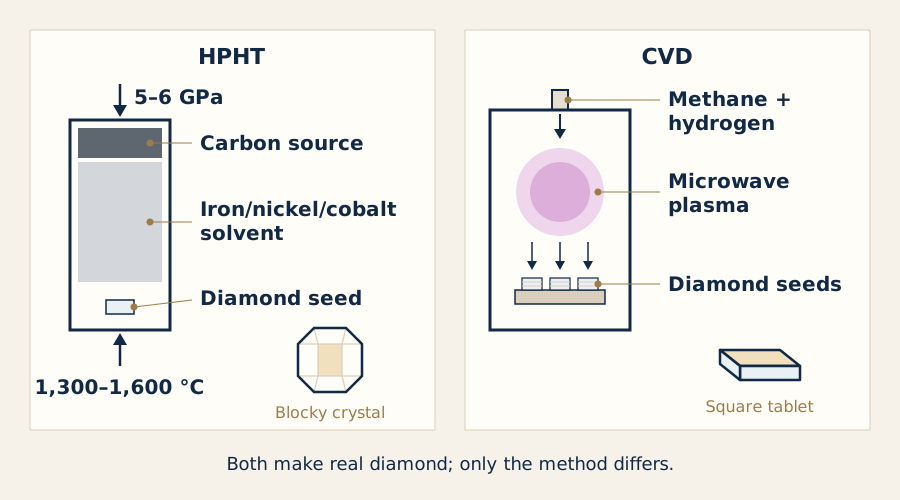
Many CVD diamonds come out of the chamber with a faint brown or grey tint and are then heated under pressure to improve their colour. That is called post-growth treatment, and it should be noted on the report; our explainer on post-growth treatment in lab-grown diamonds covers what it means for you. For the factory detail, from seed preparation to cutting, see how lab-grown diamonds are manufactured.
Growing the crystal is only half the job. Cutting decides how much light the finished stone returns, and lab-grown rough is cut on the same wheels to the same proportions. Some is cut beautifully and some is cut quickly to save weight, which is why cut quality in lab-grown stones matters as much as it does in natural ones.
Are lab-grown diamonds real, or a simulant like moissanite?
Much of the confusion comes from mixing up lab-grown diamonds with simulants: materials that imitate a diamond's look but are a different substance entirely. Moissanite and cubic zirconia are simulants. A lab-grown diamond is not; it is the real material made a different way.
| Lab-grown diamond | Moissanite | Cubic zirconia | Glass | |
|---|---|---|---|---|
| Material | Carbon | Silicon carbide | Zirconium dioxide | Silica glass |
| Is it diamond? | Yes | No | No | No |
| Mohs hardness | 10 | 9.25 | 8–8.5 | About 5.5 |
| Refractive index | 2.42 | 2.65–2.69 | 2.15–2.18 | About 1.5 |
| Double refraction | No | Yes | No | No |
| How it looks | Identical to natural diamond | More rainbow fire, doubled facet edges | Softer, glassier; scratches and clouds over time | Rounded edges, wears quickly |
Moissanite in jewellery is itself lab-created silicon carbide, which is part of why the names get tangled. Our side-by-side guide to lab-grown diamond vs moissanite shows the visual differences, and how a lab-grown diamond differs from cubic zirconia explains why CZ costs so little and wears so quickly. So if someone asks whether lab-grown diamonds are fake, the accurate answer is no: a fake diamond is a simulant sold as diamond.
How do lab-grown diamonds compare with natural diamonds?
Once you accept that both are diamond, the comparison comes down to origin, rarity, price and paperwork.
| Lab-grown diamond | Natural diamond | |
|---|---|---|
| Origin | Grown in a laboratory by HPHT or CVD | Formed deep in the earth, then mined |
| Time to form | A few weeks | About 1–3.5 billion years |
| Appearance | Identical when cut to the same quality | Identical when cut to the same quality |
| Durability | Mohs 10; the same everyday toughness | Mohs 10; the same everyday toughness |
| Rarity | Produced in large and growing quantities | Finite supply; each stone geologically unique |
| Price (1 ct, G–H, VS) | Roughly AUD 1,000–3,000 | Roughly AUD 6,000–15,000 |
| Resale | Very small second-hand market | Resale usually well below the retail price |
| Report and inscription | States laboratory-grown; girdle usually inscribed | States natural; girdle often inscribed with report number |
Neither is a lesser diamond. Lab-grown suits people who want a larger or higher-grade stone for their budget; natural suits people who value its age and rarity. Neither should be bought as an investment. Our detailed comparison of lab-grown and natural diamonds goes through each row.
Colour behaves a little differently. Most natural diamonds have a trace of yellow from nitrogen, while lab-grown stones are more often very white or carry a faint grey or blue tint. That changes what each grade looks like in practice, which our lab-grown colour grades guide explains.
Related guideLab-Grown Diamonds vs Natural DiamondsNot sure which one is right?
Send us the stones you are looking at and our gemologist will tell you which to choose and why.
Can a jeweller tell a lab-grown diamond from a natural one?
Not by looking. With a loupe, a lab-grown and a natural diamond of similar grade look the same. A standard handheld diamond tester, which measures how fast the stone carries heat away, will read both as diamond, because both are. Our article on whether lab-grown diamonds pass a diamond tester explains what those pens can and cannot do.
Separating the two needs laboratory-style equipment that reads the crystal's growth history:
- Spectroscopy: infrared and other light readings show whether nitrogen is present and how it is arranged. Most natural diamonds are type Ia; most lab-grown are type IIa.
- Fluorescence imaging: under strong short-wave ultraviolet light, instruments photograph the growth pattern. Natural diamonds grow in octahedral zones; CVD shows fine parallel layers and HPHT shows a cross-shaped pattern.
- Inclusions: HPHT stones can contain metallic flux inclusions, sometimes enough to make the stone weakly magnetic. CVD stones can show tiny dark graphite specks.
- Screening devices: desktop machines used by jewellers flag any stone that is not clearly natural and refer it for full testing.
Screening matters most with small stones, where hundreds of tiny diamonds can be mixed in one parcel. If you are choosing a halo or pavé ring, read how lab-grown melee is used in pavé and halo rings. For a broader look at separating diamond from glass, CZ and moissanite at home, see how to tell if a diamond is real.
What does a lab-grown diamond report show?
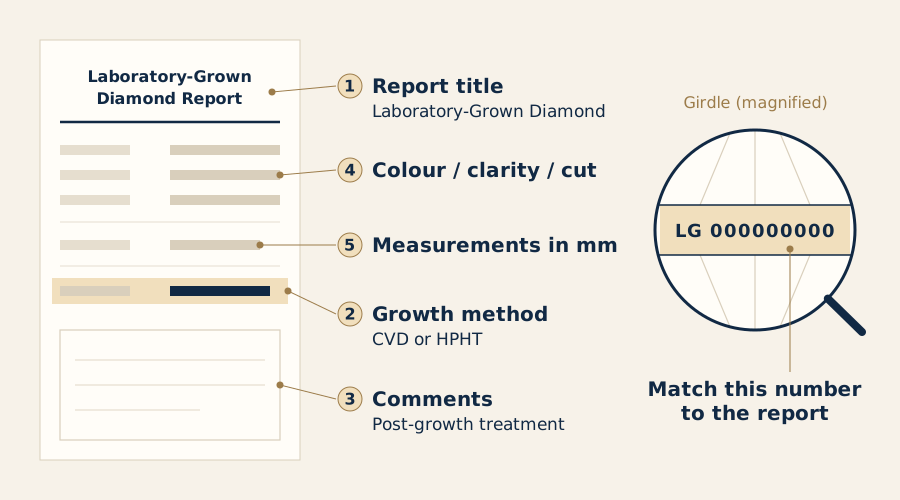
Because you cannot see the difference, the grading report is your proof of what the stone is. IGI grades most of the lab-grown diamonds sold in Australia; GIA also issues lab-grown reports. Here is what to look for:
| Report item | What to check |
|---|---|
| Report title | Says Laboratory-Grown Diamond Report (or similar); never just Diamond Report |
| Growth method | States CVD or HPHT |
| Post-growth treatment | Comment such as 'may include post-growth treatment' if colour was improved |
| Girdle inscription | GIA: LABORATORY-GROWN plus report number. IGI: LG plus report number |
| Colour and clarity | IGI uses the full D–Z colour and FL–I3 clarity scales; GIA uses a simpler assessment |
| Cut, polish, symmetry | Same scales as natural diamonds; aim for Excellent or Ideal on a round |
| Measurements | Length, width and depth in millimetres; match these to the stone |
GIA has moved away from giving lab-grown diamonds the full D–Z and FL–I3 grades, describing them instead in broader bands with a Premium or Standard designation. Our guide to GIA's Premium and Standard lab-grown assessments explains how that compares with an IGI report.
What does Australian law say about calling lab-grown diamonds real?
There is no Australian law written specifically for lab-grown diamonds. Instead the Australian Consumer Law, enforced by the ACCC, bans misleading or deceptive conduct and false claims about what goods are made of or where they come from. For a jeweller, that means the lab-grown origin must be clear wherever the stone is described: the tag, the listing, the invoice and the report.
International trade standards, including the CIBJO Diamond Book used by jewellery associations worldwide and the US Federal Trade Commission's guides for the jewellery industry, set out the wording. They require a clear qualifier next to the word diamond, and they discourage words such as real, genuine or natural for lab-grown stones, even though the stone is diamond, because shoppers read those words as meaning mined.
- Clear wording: lab-grown diamond, laboratory-grown diamond, laboratory-created diamond, synthetic diamond.
- Misleading on its own: diamond with no qualifier, real diamond, genuine diamond, or a brand name that hides the origin.
- Unclear: cultured diamond, or a qualifier in tiny print far from the word diamond.
- Claims to question: broad environmental or ethical promises without evidence.
That last point catches a lot of marketing. Read how to treat conflict-free claims about lab-grown diamonds before relying on one. GemTrove, founded in 2008 from a family jewellery trade going back to 1984, sells both natural and lab-grown diamonds, and the plain rule we work by is the one the law expects: say lab-grown every time.
How much do lab-grown diamonds cost in Australia?
Lab-grown diamond prices have fallen sharply over the past several years as production has grown, and they still move. The ranges below are approximate retail figures for a well-cut round brilliant in G–H colour and VS clarity, with an independent report.
| Carat weight | Lab-grown (approx. AUD) | Natural (approx. AUD) |
|---|---|---|
| 0.50 ct (about 5.1 mm) | 500–1,200 | 1,500–3,500 |
| 1.00 ct (about 6.4 mm) | 1,000–3,000 | 6,000–15,000 |
| 1.50 ct (about 7.4 mm) | 1,800–4,500 | 12,000–28,000 |
| 2.00 ct (about 8.1 mm) | 2,500–6,000 | 20,000–50,000 |
Within lab-grown, price depends on cut, colour, clarity, the growing method, whether there was post-growth treatment and which laboratory graded it; our breakdown of what really moves lab-grown diamond prices goes through each factor. Insurers value lab-grown stones at replacement cost, which is lower than natural, so it is worth reading whether to insure a lab-grown diamond before you choose a policy.
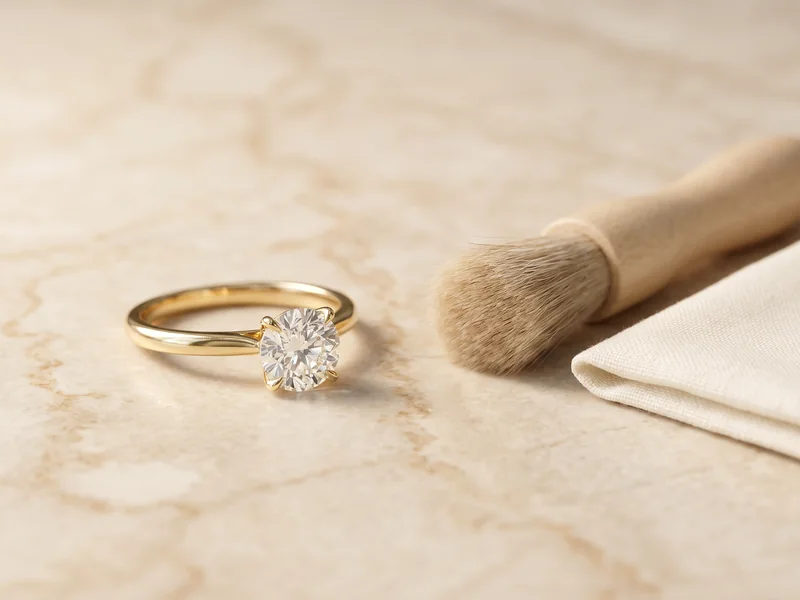
Because a lab-grown diamond is diamond, it is cleaned and cared for in exactly the same way; there is nothing extra to do, as our lab-grown care guide explains. The lower price per carat also makes lab-grown popular for pieces that use many stones, covered in lab-grown diamonds for studs and tennis bracelets.
Browse lab-grown diamonds in our stock
Is a lab-grown diamond worth it?
That depends on what you value. If you want the look, hardness and sparkle of diamond, and a larger or whiter stone for your budget, a lab-grown diamond delivers exactly that, because it is diamond. If the meaning for you lies in a stone that formed deep in the earth over billions of years, only a natural diamond will do. Neither choice is wrong, and neither should be sold to you as an investment.
For pairs, such as stud earrings, lab-grown makes it easier to find two stones that match closely in size and colour; see matching two lab-grown diamonds for earrings. Whichever you choose, the setting and metal matter as much as the stone.
Seeing the stone in person helps with cut and colour, while online listings make it easy to compare reports. Our guide to buying lab-grown online or in a showroom weighs both, and the jewellery glossary explains any term you meet along the way.
How to check a lab-grown diamond before you buy: step by step
- Confirm the wording. The listing, tag and quote should say lab-grown or laboratory-grown diamond next to the word diamond, not in fine print.
- Ask for the report. Check it is from an independent laboratory such as IGI or GIA and that the title states laboratory-grown.
- Read the growth and treatment lines. Note whether it is CVD or HPHT and whether post-growth treatment is mentioned.
- Match the inscription. Use a loupe to find the girdle inscription and check the number against the report.
- Check the cut grades and measurements. Look for Excellent or Ideal cut on a round, and compare the millimetre size with similar stones.
- Get it in writing. Make sure the invoice describes the stone as lab-grown, with the report number, carat, colour and clarity.
Free consultation
Talk to a gemologist
Compare stones in person or online with Raj Sood, Graduate Gemologist (GIA), AJP (GIA).
Book a consultationShop this shape
FAQ
Common questions
Is a lab-grown diamond a real diamond?
Yes. It is crystallised carbon with the same structure, hardness and optical properties as a natural diamond. Only its origin differs, so it must be sold as lab-grown.
Are lab-grown diamonds fake?
No. A fake diamond is a simulant such as glass or cubic zirconia sold as diamond. A lab-grown diamond is genuine diamond material grown in a laboratory rather than mined.
Will a lab-grown diamond pass a diamond tester?
Yes. Standard thermal and conductivity testers read lab-grown stones as diamond because they are. Only laboratory equipment that reads growth patterns and trace elements can separate lab-grown from natural.
Can you see the difference between lab-grown and natural diamonds?
Not with the eye or a loupe when the cut, colour and clarity are similar. The report and the girdle inscription are how you know which one you have.
Do lab-grown diamonds get cloudy or lose their sparkle?
No. A lab-grown diamond is as hard and stable as a natural one and will not cloud or fade. Like any diamond it looks dull when dirty, so regular cleaning keeps it bright.
Is it legal to call a lab-grown diamond real in Australia?
Under the Australian Consumer Law, any description must not mislead. Calling it a real diamond without saying lab-grown would be misleading, so sellers should always use lab-grown or laboratory-grown next to the word diamond.

Ask a gemologist
Not sure which diamond to choose?
Raj Sood is a Graduate Gemologist (GIA) and master jeweller. Bring the stones you are considering, or send the reports, and he will tell you honestly which one is better and why.
Keep learning
Related guides
 Lab-Grown DiamondsLab-Grown Diamonds vs Natural Diamonds
 Lab-Grown DiamondsDo Lab-Grown Diamonds Test as Diamonds
 Lab-Grown DiamondsHow Are Lab-Grown Diamonds Manufactured?
 Lab-Grown DiamondsGIA Premium vs Standard Lab-Grown Diamond AssessmentsLab-Grown DiamondsLab-Grown Diamonds GuideLab-Grown DiamondsShould a Lab-Grown Diamond Be Insured?Lab-Grown DiamondsLab-Grown Diamond Cut Quality
 Lab-Grown DiamondsDo Lab-Grown Diamonds Need Different Care?
Explore more
More guides on this topic
Education